If you want to survive a war, you don’t show up for the opening skirmish.
We arrived at the rental house forty minutes late on purpose. It wasn’t traffic. The coastal highway was a gray ribbon of open asphalt under a sky that couldn’t decide between rain and fog. We were late because if you miss the first hour, you miss the initial interrogation. You miss the forced hugs that feel like bear traps snapping shut. You miss the collective delusion where everyone pretends the blood on the floor from last Christmas is just cranberry sauce.
It is a small, quiet survival skill I have honed over a decade. My daughter, Vivien, did not possess this skill.
She sat in the passenger seat of my sedan, smoothing the front of her blouse as if she were about to walk into a federal indictment rather than a family reunion. She checked her hair in the visor mirror. She flipped it up, frowned, and checked it again.
“Do I look okay?” she asked, her voice tight.
“You look like you,” I said, keeping my eyes on the road.
“That is not what I meant, Mom.”
“I know.”
She stared out the window at the Pacific Ocean, a churning mass of steel-gray water that looked about as welcoming as I felt. She was thirteen. Hope was still her default factory setting, despite my best efforts to install a firewall.
“Are Grandpa and Grandma excited to see me?” she asked.
I tightened my grip on the steering wheel. Lie? Or the soft truth?
“They will act excited,” I said.
Vivien frowned, tracing a pattern on the foggy glass. “That is also not an answer.”
“It is an answer, Viv. It’s just not the one you want.”
“And Aunt Monica?”
There it was. The name that landed in the center of my chest like a dropped anvil. The Architect of my childhood anxiety. The Golden Child who never quite grew out of the need to be the only star in the sky.
“Monica likes attention,” I said carefully.
Vivien offered a small, tentative smile. “Anyway, everyone likes attention.”
“Not like Monica,” I murmured. “It’s a hunger with her. If she isn’t eating, she’s starving.”
Vivien didn’t argue. She just shrank a little in her seat, like her excitement had bumped into something sharp in the dark. We pulled into the driveway of the rental—one of those weathered, shingled coastal beasts that tries very hard to look charming but mostly smells of damp wood and salt.
The moment I killed the engine, the wall of sound hit us. Laughter. The clatter of cheap cutlery. Someone shouting a name across the room with the booming projection of a sports announcer.
My father saw us first. He was standing near the door, holding a drink, wearing that fixed, pleasant grimace he’d perfected over forty years of marriage.
“Lydia,” he said. He didn’t sound angry. He didn’t sound warm. He just sounded like he’d located a misplaced object. “You made it.”
He gave me a hug that consisted of two firm pats on the back—inhale, exhale, release. Transaction complete. My mother materialized from the kitchen, wiping her hands on a tea towel. She bypassed me entirely, her eyes locking onto my daughter.
“Oh my goodness,” she chirped, her voice pitched an octave too high. “Look at you!”
Vivien lit up. Because of course she did. She didn’t know that my mother played the role of ‘Grandma’ the way a method actor plays a historical figure—impeccable when the audience is watching, vacant when the curtains close. My mother held the hug a second too long, performing affection for the room.
Then the air pressure dropped.
Monica had arrived.
She didn’t storm in. She didn’t sneak in. She appeared in the archway of the living room at the precise moment the conversation lulled, ensuring maximum visibility. She was wearing a cashmere sweater that cost more than my first car and a smile that looked like it had been sharpened on a whetstone.
“Lydia,” she said, gliding forward.
“Monica.”
She bent down to Vivien. She didn’t hug her; she inspected her. Her eyes raked over Vivien’s outfit, her hair, her posture. It was a triage assessment disguised as a greeting. Then she kissed Vivien’s cheek with a loud, wet smack.
“And this must be Vivien,” she announced to the room, as if introducing a circus exhibit. “Lydia, she’s so… grown.”
Vivien beamed, desperate to be liked before she even knew the rules of the game. But I saw the look in Monica’s eyes. It was cold. Calculating. It was the look of a predator realizing there was fresh meat in the territory.
“I am being nice,” Monica whispered to me as she straightened up, her perfume cloying and sweet. “You owe me for it.”
For a moment, I thought I could manage this. Just get through dinner. Keep the peace. Don’t let the blood hit the floor.
Then the front door opened again, and the atmosphere in the room didn’t just shift—it solidified.
My grandmother, June, walked in.
She was leaning on the arm of a caretaker I didn’t recognize, moving slowly, her spine slightly curved by age. But her eyes were the same—sharp, glittering, anthracite black. Grandma June was the only person in this family who saw the ledger for what it was. She didn’t care about the performance. She cared about the bottom line.
Vivien gasped. “Grandma June!”
She abandoned all pretense of decorum and bolted across the room. This bond wasn’t complicated. It wasn’t performative. June called every Sunday. June sent books, not checks. June listened.
My grandmother steadied herself and hugged Vivien, her gnarled hands gentle on my daughter’s shoulders. “There you are,” she whispered, as if she had been holding a breath until this very moment.
She looked over Vivien’s head, her eyes finding mine across the crowded room. She gave a single, imperceptible nod.
“Lydia,” she said. “I’m glad you’re here. We have work to do.”
I felt a chill crawl up my spine. Grandma June didn’t do small talk, and she certainly didn’t do “work” on a Sunday unless she was planning a demolition.
Dinner was a masterclass in tension.
We sat around a long, scarred oak table that smelled of lemon polish and the fried fish my mother had been cooking since the dawn of time. Plates were passed. Stories were told—loud, boisterous, sanitized anecdotes that scrubbed all the ugly parts out of our history.
Vivien sat next to Grandma June, practically vibrating with happiness. Monica sat next to my mother, whispering in her ear, glancing at Vivien every few minutes with that same cold, assessing stare. My father hovered in the middle, pouring wine and agreeing with everyone, a diplomat in a war zone he refused to acknowledge.
When the plates were cleared and the coffee was poured, the chatter began to die down. People leaned back, unbuttoning jackets, assuming the danger had passed.
Grandma June placed her hands flat on the table. She didn’t ding a glass. She didn’t shout. She just stood up.
The silence was instantaneous.
“I won’t keep you long,” she said, her voice raspy but clear. “My lawyer advised me to do this privately, but I believe sunlight is the best disinfectant.”
My mother froze, her coffee cup halfway to her mouth. Monica’s smile faltered, a crack appearing in the porcelain mask.
“I have been looking at my estate,” June continued, her eyes landing gently on my daughter. “And for my amazing great-granddaughter, Vivien, I have a gift.”
Vivien went still.
“I am setting up a trust,” June announced. “Protected. Irrevocable. When she turns eighteen, she will have full control for her education, her travels, her life.”
The word trust hit the table like a grenade.
This wasn’t birthday money. This was generational wealth. I saw my mother’s posture stiffen. I saw my father look down at his hands. But Monica? Monica looked as if she had been physically struck.
“There may be small distributions before then,” June added, ignoring the tension vibrating in the air. “For programs that support her future. But the principle remains: It is hers. No one else can touch it.”
A polite, stunned ripple of applause moved through the room. A cousin murmured, “That’s wonderful, June.”
It should have been a beautiful moment.
But Monica stood up.
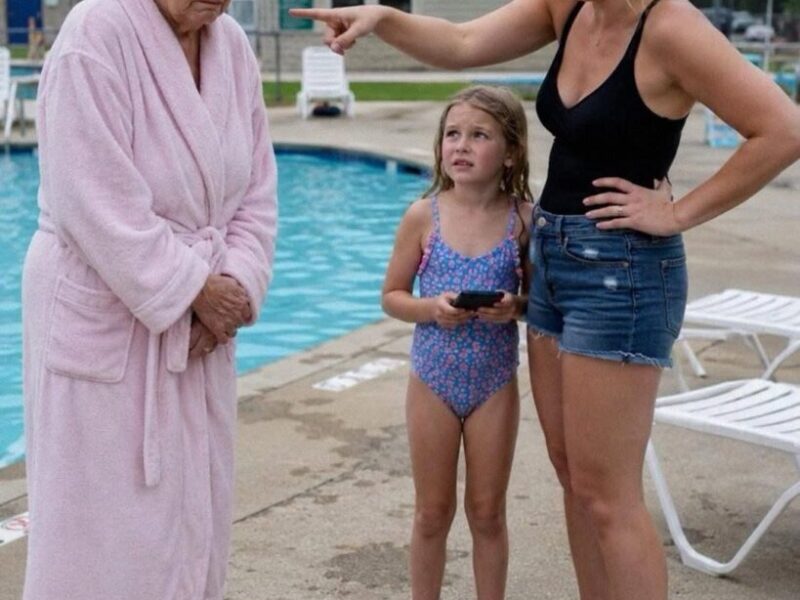
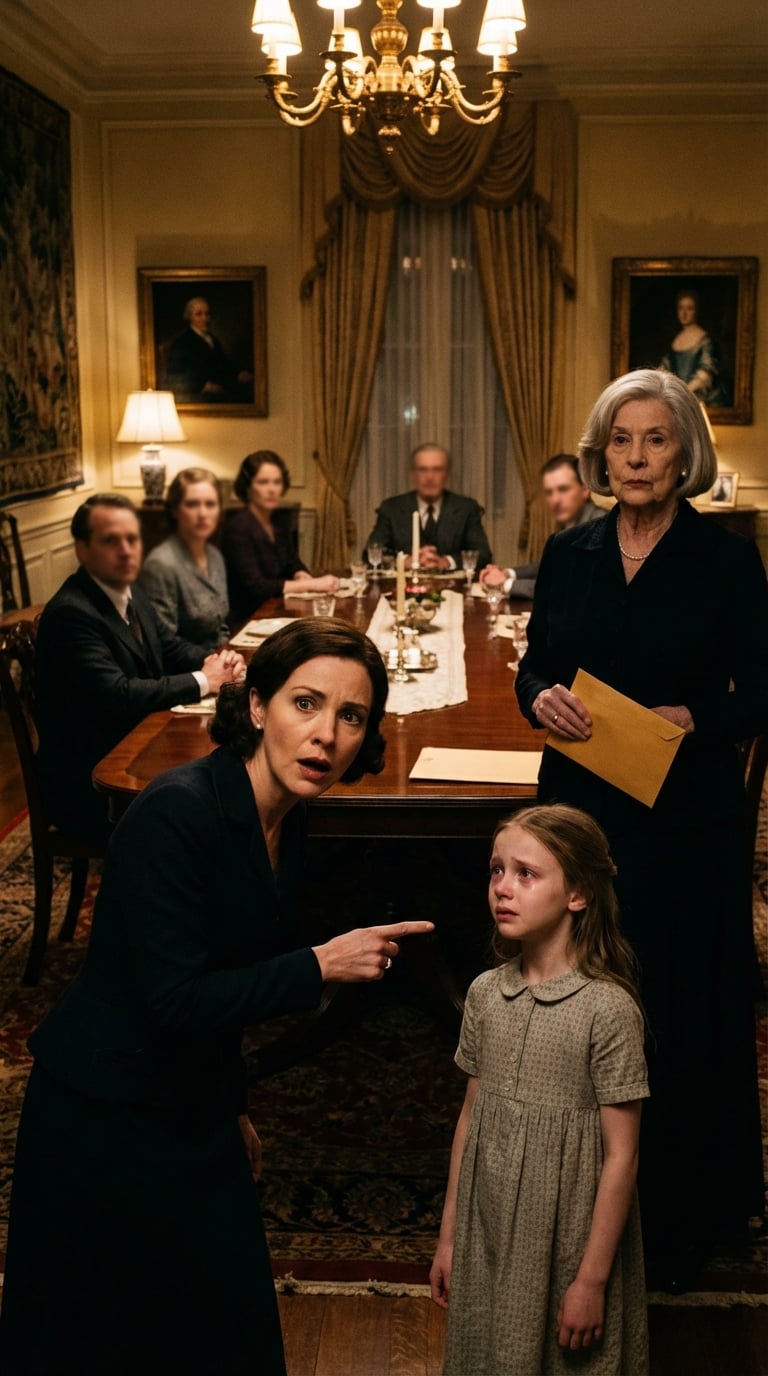
She didn’t stand up to toast. She stood up with the jerky, frantic energy of someone realizing they were being written out of the script. She looked at June, then she pointed a manicured finger directly at Vivien.
“You can’t do that,” Monica said, her voice shaking with suppressed rage.
“Excuse me?” June said, her eyebrows lifting.
“She…” Monica gestured at Vivien, who was shrinking into her chair. “She isn’t capable. She is mentally behind. You can’t give her that kind of money. It’s irresponsible.”
The silence that followed wasn’t the polite silence of before. It was a vacuum. It was the sound of twenty people collectively ceasing to breathe.
Vivien blinked. She looked at me, confusion warring with shame. She didn’t understand. She had just been diagnosed with ADHD two years ago—a struggle, yes, but one she had conquered with Herculean effort. But to hear it twisted? To hear mentally behind thrown at her like a slur?
My mother stared at the tablecloth. My father poured more wine into an already full glass, refusing to look up.
Grandma June didn’t flinch. She turned her entire body toward Monica. She looked at her with a profound, terrifying curiosity.
“You really don’t know who she is, do you?” June asked softly.
Monica blinked, caught off guard. “What? Of course I do. I’m trying to protect the family assets. Lydia hides it, but we all know—”
“Vivien,” June interrupted, her voice cutting through the air like a diamond saw. “Sweetheart, stand up for a second.”
Vivien looked at me. I nodded, my hands clenched into fists under the table. Stand tall, baby. Let them see.
Vivien stood. She was trembling, but she stood.
“Some of you know this,” June said, addressing the room, “because you actually call her. Because you are actually in her life.”
She turned back to Monica.
“Vivien has just been accepted into the Larkin Academic Fellowship.”
A gasp went through the room. Even the cousins who barely paid attention knew what Larkin was. It was the premier gifted program in the state. It was for the top 1%.
“Straight As,” June listed, ticking them off on her fingers. “Teacher recommendations that made me weep. Two rounds of interviews.” She paused, letting the weight of it settle on Monica’s shoulders. “And I know this, Monica, because I paid the deposit this morning.”
Monica went pale. It wasn’t a slow fade; the color drained from her face as if a plug had been pulled.
“So,” June said, her voice dropping to a whisper that carried to the back of the house. “When you say you ‘know’ she is behind… I have to wonder which child you are talking about. Because it certainly isn’t this one.”
Monica opened her mouth, then closed it. She looked at my mother for support, but my mother—sensing the shifting tides—remained fascinated by the floral centerpiece.
“I… I didn’t know,” Monica stammered, her voice thin. “Nobody told us.”
“You didn’t ask,” I said.
I hadn’t planned to speak. I wanted to let June handle it. But the sight of my sister trying to backpedal over my daughter’s dignity broke something inside me. I stood up.
“You didn’t know because you haven’t seen her in three years, Monica,” I said, my voice steady. “You didn’t know because when I told Mom about the diagnosis, you guys spent forty minutes on speakerphone debating which ‘special school’ to send her to so she wouldn’t be an embarrassment. You didn’t know because you don’t care.”
“I was trying to help!” Monica shrilled, the mask slipping completely now. “I was trying to protect Mom’s legacy!”
“This isn’t Mom’s legacy,” Grandma June snapped. “It’s mine. And I get to decide who is worthy of it.”
June pointed to the door.
“You need to leave, Monica.”
“What?”
“Leave. Now. Take your parents with you, since they seem unable to find their tongues to defend their own grandchild.”
My father finally looked up, shock written across his face. “June, surely—”
“Out,” June commanded. “I will not have this poison at my table. Go.”
It was a rout. Monica gathered her purse with jerky, furious movements. My parents followed her, mumbling vague apologies that no one listened to. They slunk out of the rental house into the gray afternoon, leaving a silence that felt cleaner, lighter.
When the door clicked shut, Vivien finally broke.
She buried her face in Grandma June’s shoulder and sobbed—heaving, silent sobs that shook her small frame. I wrapped my arms around both of them.
“I didn’t do anything,” Vivien choked out. “Why does she hate me?”
“She doesn’t hate you, Viv,” I whispered into her hair. “She hates that you shine brighter than she does.”
We finished the weekend in a bubble of relief. The toxicity was gone. Vivien spent the next day walking on the beach with June, collecting sand dollars, looking like a child who had been given a reprieve.
I thought we had won. I thought the worst was over.
We drove home Sunday night. Monday morning, I woke up to the sound of rain hitting the roof and a notification on my phone.
It was an email from the Larkin Academic Fellowship.
Subject: Urgent – Regarding Vivien’s Admission Status.
My stomach dropped. I opened it.
Dear Ms. Holloway,
In light of recent information brought to our attention, specifically the video media currently circulating on social platforms, we are placing Vivien’s acceptance on administrative hold pending a review of academic integrity.
A video.
I sat up, the room spinning. I went to the family group chat—the one I was barely active in. There was a link, sent from a burner account, but with a caption that made my blood run cold.
Thought you should see the real genius.
I clicked it.
The video was vertical, shot in shaky, warm lamplight. It was framed too close, claustrophobic.
It was Vivien. Or… it looked like Vivien.
She was sitting on a couch I didn’t recognize. She was laughing, but the sound was wrong—sharp, tinny.
“Say it again,” a girl’s voice off-camera urged.
On screen, Vivien rolled her eyes. “The funniest thing,” she drawled, her voice dripping with a cynicism my daughter did not possess. “Everyone is so stupid.”
“I hate studying,” the Vivien-thing said. “I really hate it.”
“But the program?” the other voice asked.
“My mom got me the answers,” Vivien said, leaning into the camera with a smirk. “All of them. In advance.”
I stopped breathing.
“So you just memorized them?”
“Obviously,” the girl on screen said, tossing her hair. “My mom said it’s for the inheritance. Like, tons of money. My great-grandma loves all the ‘hard work’ stuff, so we just had to fake it to get the bag.”
She laughed. “She totally believed it. Now she’s setting up a trust. When I’m eighteen, I get the cash and I’m done. Done with school, done with the old hag, done with all of it.”
The video cut to black.
I stared at the phone. My hands were shaking so hard I nearly dropped it. It wasn’t real. I knew, in my bones, it wasn’t real. Vivien didn’t talk like that. She didn’t call June an “old hag.” She didn’t care about money.
But it looked like her. It sounded like her.
I heard a door creak open down the hall. Vivien shuffled out of her bedroom, her hair messy from sleep, clutching her phone. Her face was the color of ash.
She looked at me, and I saw the light go out of her eyes.
“Mom?” she whispered. “Why are people sending me this? I didn’t say that. I never said that.”
I rushed to her, grabbing the phone from her hand. “Don’t look at it.”
“Everyone sees it,” she sobbed, her legs giving out. “The Larkin program… Mom, they’re going to think I’m a cheater. They’re going to think I hate Grandma June.”
“They won’t,” I said, though I had no idea if that was true. “We will fix this.”
“Who would do this?” she wailed. “Who hates me this much?”
I knew. I didn’t need an IP address. I didn’t need a detective. I knew exactly who had the motive, the spite, and the sheer lack of morality to weaponize a child’s face against her.
Monica.
She hadn’t just lashed out. She had gone nuclear. She was trying to burn the trust fund, the fellowship, and Vivien’s relationship with June in one strike.
I held my sobbing daughter on the kitchen floor, and I felt a shift inside me. The survival instinct—the one that told me to stay quiet, to show up late, to avoid conflict—died.
In its place, something cold and hard was born.
I stood up. I wiped Vivien’s face.
“Get dressed,” I said.
“Where are we going?”
“We are going to a lawyer. And then,” I said, picking up my car keys, “we are going to war.”
I didn’t call Monica. I didn’t call my parents to beg for sanity. I called Ellen, the fiercest litigation attorney I knew, a woman who ate bullies for breakfast.
We sat in her glass-walled conference room two hours later. I had the email, the screenshots, and the video file.
“It’s a deepfake,” I told her. “It has to be.”
Ellen watched the clip, her face impassive. “It’s good,” she admitted. “Better than the cheap apps. This took effort. Someone paid for this.”
“Can we prove it?”
“We don’t just need to prove it’s fake,” Ellen said, tapping her pen on the desk. “We need to prove who uploaded it. We need a forensic analysis.”
We hired a digital forensic expert that afternoon. A guy named Kevin who looked like he hadn’t slept in a week and communicated exclusively in technical jargon. He loaded the video onto a massive monitor and started scrubbing through it frame by frame.
“Here,” Kevin said, pointing to a timestamp at 0:14. “Watch the jawline.”
He slowed it down. Vivien’s face moved, but for a split second, the shadow under her chin didn’t move with it. It was a ghostly flicker, a digital seam showing where the mask hadn’t quite adhered to the actor beneath.
“Blend artifact,” Kevin muttered. “And look at the background. See the pillow?”
He zoomed in. As the ‘Vivien’ on screen laughed, the pattern on the pillow behind her warped and snapped back into place.
“The AI struggled with the depth of field,” Kevin explained. “It’s a fabrication. A synthetic media overlay.”
“Can you put that in writing?” I asked.
“I can write you an affidavit that will hold up in supreme court,” he said.
We had the proof of the lie. Now we needed the source.
We filed a police report for harassment of a minor and cyberstalking. Because the victim was a child, and the damage was to her educational prospects, the police took it seriously. They subpoenaed the platform for the upload logs.
It took three weeks. Three weeks of Vivien refusing to go to school. Three weeks of Grandma June calling every day to reassure Vivien that she didn’t believe a word of it.
“I know my girl,” June told her. “I know your heart. A computer trick cannot change that.”
Then, the call came.
“We have the IP,” Ellen said. “It traces back to a residential address in Lake Oswego.”
Monica’s house.
She hadn’t even used a VPN. She was so arrogant, so sure that I was the same passive, frightened little sister who would just roll over and take it, that she hadn’t even bothered to hide her digital fingerprints.
“What do you want to do?” Ellen asked.
I looked at Vivien, who was sitting at the kitchen table doing homework, her shoulders hunched, still waiting for the other shoe to drop.
“I want her to bleed,” I said. “Legally speaking.”
We didn’t just send a cease and desist. We filed for a restraining order. We forwarded the forensic report and the police file to the Larkin Fellowship. We sent a copy to Grandma June’s estate attorney.
And then, I drove to my parents’ house.
I knew Monica was there. It was Tuesday; they always had family dinner on Tuesdays. The dinner I was never invited to.
I walked up the driveway. I didn’t knock. I used the key I had kept on my ring for fifteen years, the key to a house that had never really felt like home.
They were in the dining room. Monica was laughing, a glass of wine in her hand. My mother was smiling.
They stopped when they saw me.
“Lydia?” my mother asked, confused. “What are you doing here?”
I tossed the manila envelope onto the table. It slid across the wood and hit Monica’s wine glass with a heavy thud.
“It’s over,” I said.
Monica stared at the envelope. She didn’t touch it. She knew.
“I don’t know what you’re talking about,” she sneered, though her voice wavered.
“The police report,” I said calmly. “The forensic analysis proving the video is a deepfake. The subpoena logs tracing the upload to your IP address. It’s all there.”
My father stood up. “Lydia, you called the police on your sister?”
“She committed a crime, Dad,” I said, looking him dead in the eye. “She tried to frame a thirteen-year-old girl to steal a trust fund. That’s not a prank. That’s malice.”
Monica stood up, her face twisting. “You turned her against me! You made Mom and Dad hate me!”
“I didn’t do anything,” I said softly. “I just let you be yourself. You did the rest.”
I looked at my mother. She was reading the police report, her hand covering her mouth. She looked old. She looked defeated.
“Grandma June knows,” I added. “She’s removing you from the will entirely, Monica. And Mom, Dad? If you side with her on this… if you try to excuse this… you lose Vivien. Forever. No visits. No calls. No photos. She will be a stranger to you.”
The room was silent. The kind of silence that marks the end of an era.
“I’m pressing charges,” I told Monica. “Get a good lawyer. You’re going to need one.”
The legal system moves slowly, but it grinds exceedingly fine.
Monica took a plea deal. Harassment and dissemination of harmful synthetic media. She got two hundred hours of community service, a year of probation, and a permanent restraining order.
The judge was particularly unimpressed by her attempt to play the victim. He assigned her community service to the county waste management detail.
I drove past a park a few months later and saw a crew in bright orange vests picking up trash in the rain. I didn’t stop to look for her face. I didn’t need to.
The Larkin Fellowship reinstated Vivien immediately upon receiving the forensic report. They even issued a formal apology. Vivien started the program in the fall. She struggled with the workload at first, but she loved it. She loved being in a room where being smart wasn’t an insult.
My parents tried to reach out. My mother sent a birthday card. My father left a voicemail.
I didn’t block them, but I didn’t answer. I put the card in a drawer. Maybe one day, when Vivien is older, she can decide if she wants them. But for now? My job isn’t to be a dutiful daughter. It’s to be a shield.
The trust fund was finalized. $150,000, locked tight, with a trustee who isn’t family.
Last Sunday, we were at Grandma June’s house. She’s frailer now, moving slower, but her mind is still sharp as a tack. We were sitting on her porch, watching the ocean.
Vivien was reading a book, her legs curled under her. June reached out and patted her knee.
“You know,” June said, her voice raspy. “People think peace means everyone getting along. It doesn’t.”
I looked at her. “What does it mean?”
“Peace,” June said, looking out at the gray water, “is knowing that the wolves are outside the gate, and you are the one holding the key.”
She squeezed my hand.
“You’re a good gatekeeper, Lydia.”
I looked at my daughter, safe, happy, and brilliant.
“I learned from the best,” I said.
The wolves were gone. And for the first time in my life, the house was quiet. Not the silence of fear, but the silence of safety.
And that was worth every bridge I had to burn.