Chapter 1: The Porcelain Trap
I used to believe that family loyalty was a debt paid in silence—a ledger where I was perpetually in the red, no matter how much of my soul I signed away. For thirty-four years, I played my part in the grand theater of the Matthews Family Christmas, a production directed with iron-fisted whimsy by my mother, Margaret.
That year, the dining room felt less like a sanctuary and more like a carefully calibrated trap. The tablecloth was a crisp, blinding white, ironed to a degree that felt hostile. The Noritake China, which saw the light of day exactly twice a year, gleamed under the chandelier with a cold, predatory brilliance. Every candle was positioned with obsessive, mathematical precision, as if a single millimeter of deviance might cause the entire facade of our “perfect” life to crumble.
Margaret had been orchestrating this day since the first week of November. She wore her exhaustion like a martyr’s crown, reminding us every hour on the hour of the Herculean effort required to host us. “I’ve been on my feet since five,” she’d sigh, her voice a practiced tremolo of fatigue. “But it’s worth it, isn’t it? To have the family together? You children have no idea how lucky you are.”
Beneath the scent of roasted turkey and expensive pine candles, there was that familiar hum—the low-frequency vibration of a faulty wire behind a beautiful wall. It was the tension of things unsaid, of grievances tucked neatly under the silverware.
Beside me, my seven-year-old son, Leo, sat perched on a chair that was far too tall for him. He looked small and fragile in the navy cashmere sweater Margaret had bought him the previous year—the same sweater she had later used as a weapon, complaining to my sister that it was “far too fine a garment for a child who doesn’t know how to say thank you properly.”
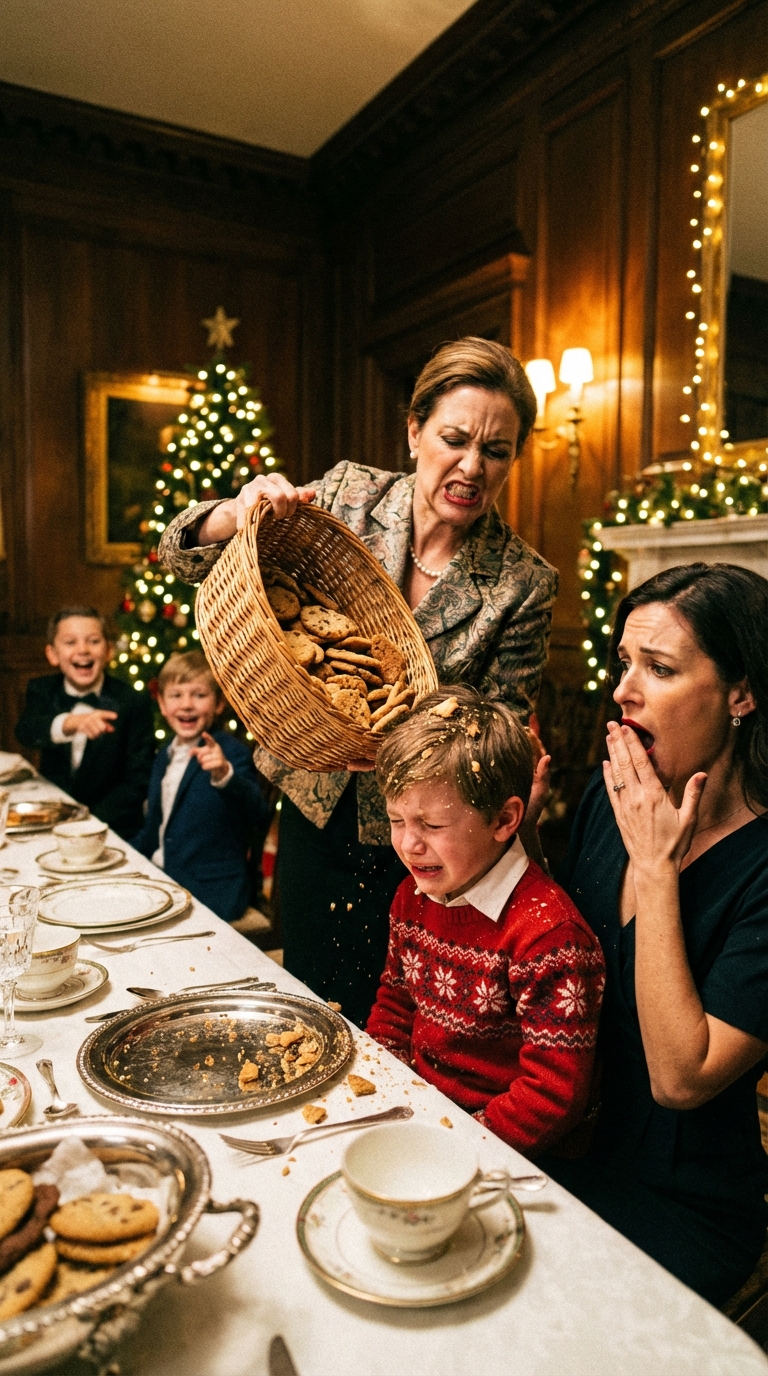
Leo hadn’t spoken more than ten words all evening. He felt the hum, too. His eyes kept drifting toward the center of the table, specifically to the Matthews Heirloom Cookies. They were massive, sugar-dusted discs, slightly cracked on top to reveal a soft, buttery heart. In our house, they weren’t food; they were sacred artifacts. No one touched them until Margaret gave the signal. To do so earlier was more than a breach of etiquette; it was an act of heresy.
Leo leaned toward me, his voice a tiny, hopeful wisp. “Mom, can I please have just one?”
I looked at his face, then at the cookies, then at my mother, who was currently holding court about the “decline of modern manners.” Something in me, a dormant spark of rebellion, flickered to life. “Go ahead, baby,” I whispered. “Take one.”
He reached out, his hand trembling slightly, moving with the agonizing slowness of someone disarming a bomb. He hadn’t even touched the sugar before the sound echoed through the room.
Smack.
It wasn’t a blow meant to bruise, but it was loud enough to shatter the room’s artificial peace. Margaret had swatted his hand away with the casual cruelty one might use on a persistent fly. Then, she let out a bright, melodic laugh that didn’t reach her eyes.
“Oh no, Leo,” she said, her voice dripping with a saccharine poison. “Those aren’t for you. Those are for the good grandkids. The ones who actually deserve a treat.”
The silence that followed was absolute. It was a vacuum that sucked the oxygen right out of my lungs. It wasn’t a joke. It wasn’t a misunderstanding. It was a declaration of rank.
My older sister, Elena, let out a sharp, jagged laugh into her wine glass. My aunt smiled at her plate, murmuring, “Oh, Margaret, you and your little jokes.” My father, the “Great Mediator” Arthur Matthews, didn’t even pause. He continued slicing the turkey, his eyes fixed on the bird as if the most important thing in the world was the thickness of a slice of white meat.
I looked at Leo. His hand was still frozen in mid-air, fingers curled in a pathetic little defensive knot. He didn’t cry. He didn’t scream. He simply pulled his hand back into his lap and shrunk. He became smaller, physically smaller, right before my eyes. He was learning the most dangerous lesson a child can learn: that his worth was conditional, and today, he had been found wanting.
In that moment, the hum behind the walls didn’t just stop. The whole house went quiet. Every holiday where I was told I was “too sensitive,” every “joke” at my expense, every time I had swallowed my own dignity to keep the peace—it all rushed forward like a tidal wave.
I stood up. I didn’t slam the table. I didn’t scream. I simply reached for Leo’s coat.
“We’re leaving,” I said.
The silence broke into a thousand jagged pieces. “Oh, don’t be so dramatic, Jana!” Margaret scoffed, waving her hand. “It was a joke! Honestly, your skin is like tissue paper.”
“It’s Christmas, Jana. Don’t ruin it for everyone,” Elena added, her voice laced with the boredom of the truly complicit.
I looked directly at my mother. “You already ruined it. Years ago.”
My father finally looked up, his face a mask of corporate disappointment. “Sit down, Jana,” he said in the flat, icy tone he used on employees he was about to fire. “Don’t make a scene.”
I didn’t answer. I took Leo’s hand—his palm was cold and damp—and walked out. We didn’t say goodbye. We didn’t take the leftovers. We walked into the biting December air, and as the door clicked shut behind us, I felt the first breath of clean air I’d had in a decade.
But as we reached the car, Leo tugged on my sleeve. His voice was so small I almost missed it. “Mom… was I bad?”
That question was the match that lit the fuse. I knelt in the gravel, ignored the cold stinging my knees, and held him. “No, Leo. You were perfect. The cookies are just sugar and flour. They don’t mean anything. You are everything.”
He nodded, but I could see the doubt lingering in his eyes. As I started the car, my phone buzzed in the cupholder. I expected a flurry of apologies or even more insults. Instead, it was a text from my father.
Don’t forget the Matthews Logistics business loan payment is due tomorrow. Get it handled.
I stared at the screen until the numbers blurred. They didn’t care that they’d crushed a seven-year-old’s spirit. They only cared about the ledger.
I typed back two words: Already handled.
I didn’t know then that those two words were about to burn their entire world to the ground.
Chapter 2: The Morning of the Great Silence
I woke up the next morning to a phone that was vibrating so violently it nearly danced off the nightstand. It was a rhythmic, persistent thrumming—missed calls from Elena, voicemails from my mother, and increasingly frantic texts from my father.
I didn’t touch it. I lay there in the grey morning light, listening to the sound of Leo playing quietly in the next room. For the first time in my adult life, I didn’t feel the crushing weight of “What will they think?” I felt a terrifying, crystalline calm. It was the eerie stillness that follows a landslide—when the dust has settled and you realize the landscape has changed forever.
I made breakfast. I cut Leo’s toast into perfect triangles. He watched me with a wary intensity, the ghost of last night still haunting the corners of his mouth.
“Are we still in trouble with Grandma?” he asked, poking at a piece of crust.
I sat down across from him, looking him straight in the eye. “No, Leo. We aren’t in trouble. We’re just not playing their game anymore. We don’t go where people are mean to us. Not for Christmas, not for anything.”
“Okay,” he said. He didn’t ask for a deeper explanation. Children accept the boundaries of safety much faster than adults do. To him, the rule was simple: Mean people don’t get our time. I wished I had learned that twenty years ago.
Once he was on the school bus, I finally picked up the phone. The first voicemail was Margaret. She wasn’t apologizing; she was performing. Her voice was a symphony of staged sobs and gasps. “How could you humiliate me like that? In front of your Aunt Martha? You’ve always been so difficult, Jana. So selfish.”
The second was my father. He sounded less like a parent and more like a panicked CFO. “Jana, what did you mean ‘already handled’? The bank says the transfer hasn’t cleared. Call me immediately. This isn’t a game.”
I felt a cold smile touch my lips. For five years, I had been the silent partner in Matthews Logistics. When my father’s “aggressive expansion” nearly tanked the company in 2018, I was the one who stepped in. I had the credit, I had the savings from my own firm, and I had the misplaced sense of duty. I had been quietly funneling a significant portion of my monthly income into a private loan to keep the family business afloat, all while being treated like the “disappointing daughter” who didn’t understand the “real world.”
I sent one reply to the family group chat: It means I am no longer subsidizing the business. The loan payments end today. Effective immediately.
The three dots appeared almost instantly. They vanished. Appeared again. The digital equivalent of a heart attack.
My phone rang ten seconds later. I let it ring. And ring. And ring. I poured a cup of coffee and watched it go cold. I wanted them to feel the silence. I wanted them to understand that the “good daughter” had finally checked out of the theater.
When I finally answered, I didn’t say hello. I just put it on speaker.
“Are you insane?” My father’s voice exploded into the kitchen. “You can’t just stop! We have contracts, Jana! We have payroll! You’re talking about people’s livelihoods!”
“I’m talking about my livelihood, Dad,” I said, my voice sounding strangely steady to my own ears. “And my son’s dignity. You used me as a bank while you used him as a punchline. The bank is closed.”
“You are being incredibly cruel after everything we’ve done for you!” Margaret’s voice shrieked in the background.
Everything we’ve done for you. The mantra of the emotional extortionist.
“Everything?” I asked. “Like ranking your grandchildren? Like laughing while Leo withered in his chair? You think money buys the right to be a monster? It doesn’t. It only bought your comfort. And now, you’ll have to find it elsewhere.”
“Jana, please,” my father’s tone shifted. The anger was replaced by a desperate, oily wheedling. “Let’s be rational. Your mother… she’s high-strung. You know how she is during the holidays. Don’t throw away the family legacy over a plate of cookies.”
“It was never about the cookies, Dad. It was about the fact that you sat there and watched. You’ve been watching her do this to me for thirty years. Now you’re watching her do it to Leo. But this time, I’m the one with the remote. And I’m turning you off.”
I hung up. My heart was pounding against my ribs like a trapped bird, but for the first time, I wasn’t afraid. I was holding every single card in the deck, and the realization was intoxicating.
An hour later, a different kind of message arrived. It was from my grandmother, Evelyn, my father’s mother—the woman who had been sidelined by Margaret years ago for being “too simple.”
I heard what happened, the text read. You did the right thing, Jana. I wish I had your courage forty years ago. Don’t look back.
I sat at my kitchen table and cried. Not for the family I was losing, but for the one I should have had.
Chapter 3: The Shield and the Sword
By that evening, the tone of the messages had shifted from outrage to a frantic, disorganized bargaining. Elena texted me privately, her usual snark replaced by a thin, vibrating anxiety.
Jana, look, Mom is a nightmare, we all know that. But if the business goes under, I lose my position too. Can’t you just help until the spring? Just until the Q1 contracts clear?
I looked at her message and felt a pang of pity that quickly curdled into realization. Elena wasn’t just a bystander; she was a parasite. She had been drawing a six-figure salary from Matthews Logistics for “consulting” work that consisted mostly of expensive lunches and social climbing.
But then, I received a call from an old contact—a bookkeeper who had been “let go” from the firm months ago.
“Jana,” she whispered over the phone. “I saw the news. If you’re pulling out, you need to know where your money actually went. It wasn’t just the expansion.”
“What are you talking about, Sarah?”
“Your brother. Leo Senior—the ‘Golden Boy.’ He didn’t just have ‘bad luck’ in Vegas. He’s been using the company accounts as a personal piggy bank for three years. Your father hasn’t been building a legacy; he’s been bailing out a sinking ship with your bucket. He didn’t tell you because he knew you’d say no.”
The blood in my veins turned to ice. I wasn’t just the silent partner. I was the shield. I was the one working fifty hours a week so my brother could throw thousands down the drain in private poker rooms, while my mother mocked my son’s “unworthiness” for a sugar cookie.
I didn’t call my father. I didn’t call Margaret. I spent the next four hours with my laptop, digging through every digital trail I had access to. The deeper I went, the uglier it got. The “business loans” I’d been paying off were funneled into a shell account that paid for my brother’s luxury apartment and a series of failed “ventures” that were nothing more than gambling debts.
I felt a rage so clean, so surgical, it felt like a superpower.
At 9:00 PM, a knock came at my door. It wasn’t the aggressive, rhythmic pounding of my father. It was a soft, hesitant tapping.
I opened the door to find Margaret standing on my porch. She wasn’t wearing her martyr’s crown tonight. She looked small in her expensive wool coat, clutching a red tin decorated with painted reindeer.
“I brought these,” she said, her voice trembling with what she clearly hoped I’d perceive as genuine remorse. “They’re the cookies. For Leo. I… I realized I was a bit sharp last night. The stress of the hosting, you know…”
She tried to step past me, but I didn’t move. I stood in the doorway, a human barricade.
“I don’t want the cookies, Margaret.”
“But they’re his favorites!” she insisted, her “perfect mother” mask slipping just a fraction. “I made a fresh batch just for him. Can’t we just put this behind us? Your father is so worried about the business… it’s affecting his heart.”
“Is it his heart, or is it Leo’s gambling debts?”
The color drained from her face so fast she looked like a ghost. She gripped the red tin until her knuckles turned white. “I… I don’t know what you’re talking about.”
“Liar,” I said, the word feeling heavy and satisfying. “You knew. You knew you were taking my money to save your favorite child, while you treated me and my son like we were lucky to even be invited to your table. You slapped his hand away to remind him he was ‘less than.’ But here’s the truth: Without me, you are nothing. The house, the China, the precious cookies—they’re all bought with my ‘unworthy’ money.”
“How can you be so cold?” she hissed, the mask finally falling away to reveal the bitterness underneath. “He’s your brother!”
“And Leo is my son. I’m choosing him. Goodbye, Margaret.”
I closed the door. She stood on the porch for a long time. I watched her through the sidelight as she finally turned and walked away, leaving the red tin of cookies on the mat.
I picked up the tin and walked it straight to the trash can. Leo didn’t need her sugar. He needed a mother who would burn the world down to keep him warm.
Chapter 4: The Neutral Ground
Two days later, the “Summit” was arranged. I refused to go to their house, and I refused to have them in mine. We met at The Blue Diner, a greasy spoon twenty miles away where the smell of old coffee and industrial cleaner acted as a deterrent to high drama.
I arrived first. I chose a booth in the back, facing the door. When my parents walked in, they looked like they had aged a decade. My father’s suit looked too big for him; my mother’s makeup was a desperate attempt to cover the dark circles under her eyes.
They sat down. No hugs. No pleasantries.
“We’ve spoken to the lawyers,” my father began, his voice raspy. “What you’re doing… the way you’ve restructured those payments… it’s going to trigger a default on the main line of credit.”
“I know,” I said, sipping my tea. “I’m the one who wrote the original terms, Dad. I knew exactly what would happen.”
“Why?” he whispered. “Why would you destroy everything I worked for?”
“Because you didn’t work for it,” I replied. “I did. For the last five years, I’ve been the one keeping the lights on. And you lied to me. You let me believe I was helping the ‘family legacy’ while you were just covering up Leo’s disasters.”
Margaret opened her mouth to speak, but I held up a hand. “If you say the word ‘loyalty,’ I am walking out of this diner and you will never see Leo again. Loyalty is a two-way street, Margaret. You used it as a leash.”
“What do you want?” my father asked, defeated.
“I want full control,” I said. “The business is insolvent. I will buy out your remaining shares for the value of the debt I’ve already covered. You and Margaret will retire. Leo Senior will be removed from the payroll immediately. I will run the company—not for your legacy, but for my son’s future.”
“You’re taking it from us?” Margaret gasped. “Our own company?”
“It ceased to be yours the moment you started using my son as a verbal punching bag,” I said. “This is the price of the cookies, Margaret. They turned out to be very expensive.”
My father looked at the table. He looked at his hands—the hands of a man who had let his pride blind him to the truth. “And if I say no?”
“Then I let it default. The bank takes the warehouse. The equipment. The name. You’ll be left with the debt and your secrets. Either way, the ‘Golden Boy’ is done.”
A long, agonizing silence stretched between us. The waitress came by and refilled my tea. Finally, my father looked up. There were tears in his eyes, but I didn’t feel the old tug of guilt. I felt… nothing.
“I’ll sign,” he said.
Margaret let out a low, guttural moan of protest, but he ignored her. He looked at me, really looked at me, for perhaps the first time in my life. “You really are better at this than I ever was, aren’t you?”
“I had to be,” I said. “I didn’t have a shield.”
Chapter 5: The Only Legacy That Matters
The transition was brutal. There were lawsuits from my brother, screaming matches on the phone, and a month where I didn’t sleep more than four hours a night. But when the dust settled, Matthews Logistics was no longer a sinking ship. It was lean, honest, and, for the first time, profitable without my personal infusions.
My brother disappeared into the shadows of his own making. My mother retreated into a world of “social illness,” telling anyone who would listen that I had “stolen” the family fortune. I didn’t care. The hum in the walls was gone.
Six months after that Christmas, my father called. He didn’t ask for money. He didn’t talk about the business.
“Can I see him?” he asked. “Leo? I… I’ve been talking to a therapist. About my silence.”
I hesitated. I looked at Leo, who was in the backyard, successfully climbing the oak tree for the first time. He looked strong. He looked happy.
“You can come over for one hour,” I said. “But if there is a single comment about his behavior, his clothes, or his ‘place,’ you will leave and never return. And you will apologize. Face to face.”
An hour later, my father stood in my living room. He looked smaller, humbler. When Leo came in, sweaty and covered in grass stains, my father didn’t flinch. He knelt down on the carpet—a man who had once refused to wrinkle his trousers for anyone.
“Leo,” he said, his voice thick with emotion. “I wanted to say I’m sorry. About Christmas. About the cookies. I was wrong. You are a very good grandson. And I should have said so then.”
Leo looked at me, then back at his grandfather. He tilted his head, processing the weight of a grown man’s apology. “It’s okay, Grandpa,” he said softly. “Do you want to see my tree?”
“I’d love to,” my father whispered.
As I watched them walk into the sunlight, I realized that I hadn’t destroyed my family. I had pruned it. I had cut away the rot of Margaret’s manipulation and my brother’s greed so that something real could finally grow.
I learned that boundaries aren’t walls; they’re gates. They keep out the people who want to hurt you, and they let in the people who are willing to change.
Leo will grow up knowing that his mother is his fiercest advocate. He will grow up knowing that his worth isn’t measured in sugar-dusted cookies or porcelain plates. He will grow up in a house where the only ledger that matters is the one that tracks the love we give and the respect we demand.
That Christmas didn’t ruin our lives. It saved them. And as I watched my son climb higher into the branches, I knew that the Matthews legacy was finally, for the first time, in very good hands.