The Storm After the Silence
Chapter 1: The Art of Discarding
Six weeks ago, the world ended. It didn’t end with fire or a nuclear flash; it ended with the click of a deadbolt sliding into place against a frame of expensive, reinforced pine.
I stood on the porch of the mountain rental, a sprawling A-frame structure that Mason had insisted we rent for his “mental clarity” before the quarter closed. The wind was already howling, a living thing tearing through the valley, stripping the trees bare. In my arms, wrapped in my own oversized wool coat because the diaper bag was only half-packed, was Noah. My son. Our son. Seven weeks old and weighing less than a sack of flour.
Snow hit my face like needles, sharp and relentless. It wasn’t just snowing; the sky was collapsing.
Through the glass panel of the door, I saw him. Mason Hale. He didn’t look guilty. He didn’t look like a man who had just shoved the mother of his child out into a blizzard. He looked annoyed. He looked like I had tracked mud onto a white carpet, or interrupted a conference call with a trivial question. He smoothed the front of his cashmere sweater, his face a mask of bored indifference.
I pounded on the glass with my free hand, the cold already biting into my knuckles. “Mason! Open the door! Noah is freezing!”
He stepped closer to the glass. I could see his lips move, forming words I had heard a thousand times before, usually whispered in the dark to shut me up. But this time, he spoke them with finality.
“You’ll be fine. You always survive.”
Then he turned his back. He walked toward the fireplace, where the logs were crackling warm and orange, and the darkness of the house swallowed him.
I stood there for a minute, paralyzed by the sheer impossibility of it. People don’t do this. Monsters in movies do this. Not the man who bought me a charm bracelet for our anniversary. Not the CEO who was featured in Forbes as a “Visionary of the Year.”
But the cold doesn’t care about disbelief. It crawled up my legs, seizing my ankles. Noah let out a whimper, a tiny, thin sound that was instantly snatched away by the wind. That sound broke my paralysis.
I stumbled down the icy stairs, clutching Noah so tight against my chest I was afraid I’d crush him. The rental was miles from the main town. The driveway was a winding ribbon of treacherous black ice. I started walking. I didn’t have a phone—it was inside, on the kitchen island. I didn’t have a wallet. I had a diaper bag with three diapers, a half-empty bottle of formula, and the coat on my back.
I walked until my feet went numb. Then I walked until they felt like blocks of burning wood. I hallucinated the warmth of the fireplace. I whispered to Noah, over and over, a mantra to keep his heart beating. “Just a little more, baby. Just a little more.”
I survived because of a flashing yellow light.
A county plow driver, a man named Gus, saw a shape stumbling along the shoulder of Route 9 just as the storm turned into a whiteout. He later told me I looked like a ghost refusing to leave the earth. He didn’t ask questions. He cranked the heat in his cab, wrapped us in a greasy flannel blanket that smelled of diesel and tobacco, and drove like a maniac to the county clinic.
I survived because the night nurse, a woman with tired eyes and gentle hands, didn’t ask for an insurance card before placing Noah under the heat lamps. She rubbed his tiny, blue-tinged toes until they turned pink again.
And I survived because the next morning, a woman named Diane Carter walked into the waiting room. She was a volunteer legal advocate for the county, sixty years old, wearing a suit that looked like armor and carrying a briefcase that looked like a weapon.
She sat down next to me. I was drinking lukewarm coffee, staring at the wall, still shaking. Diane took one look at the bruises on my wrists—the imprint of Mason’s “guiding hands” when he had shoved me out the door.
She didn’t say, “Oh, you poor thing.” She didn’t offer me a tissue.
She opened a notepad and clicked a pen. “Honey,” she said, her voice like gravel and honey. “You’re not just leaving him. You are documenting him. And then, we are going to burn his kingdom down.”
I looked at her, tears finally spilling over. “He’s powerful, Diane. He’s… he’s Mason Hale.”
Diane smiled, and it was the terrifying smile of a predator who had just found prey. “Good,” she said. “I like big targets. They fall harder.”
Cliffhanger:
I spent six weeks in a motel room funded by a domestic violence grant, plotting with Diane. We built a case. We waited. And then, we found the date. Mason wasn’t just moving on; he was cementing his image. He was getting married. Tonight. To a woman named Sloane. And Diane decided we weren’t just going to send a letter. We were going to hand-deliver it.
Chapter 2: The Magazine Spread
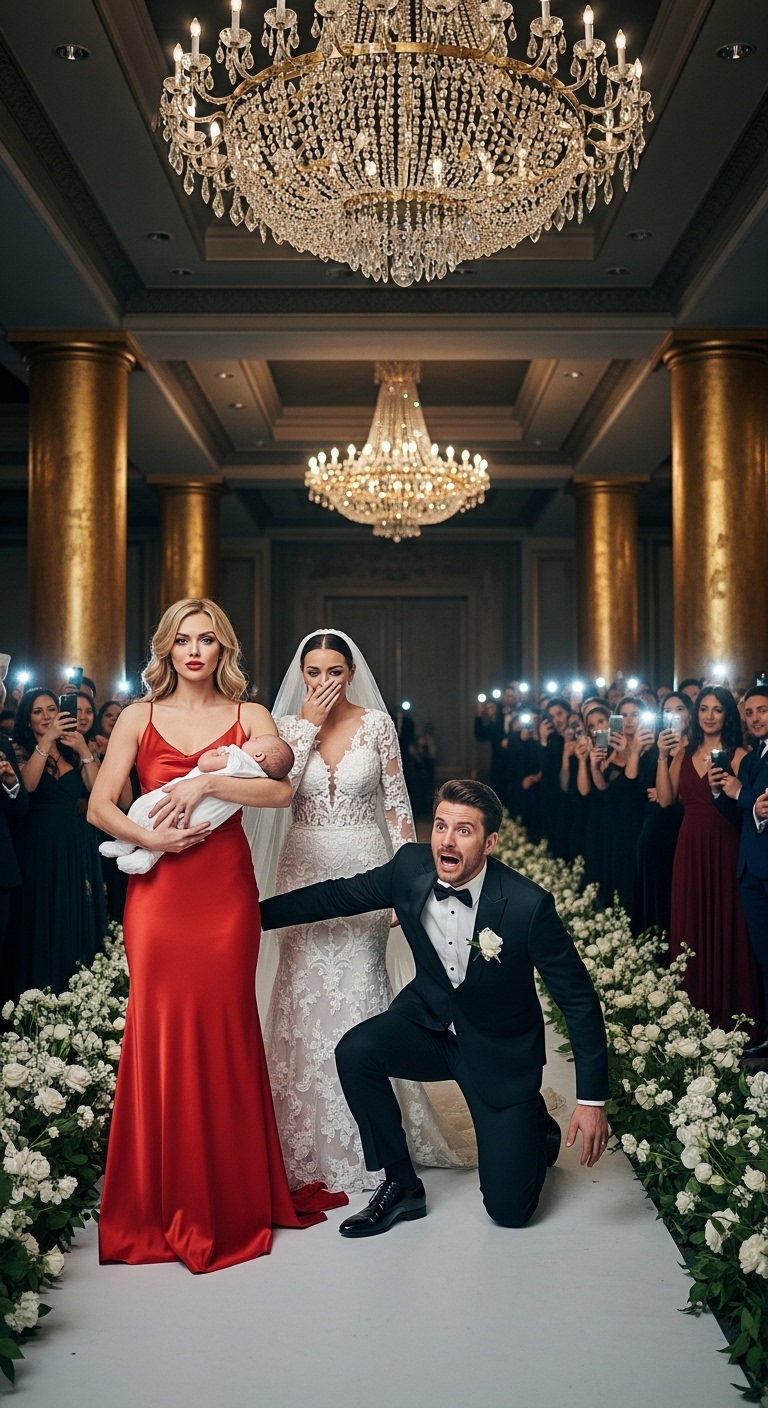
The Grandview Hotel ballroom was a study in excess. It was the kind of wealth that whispered rather than shouted, though the message was the same: You don’t belong here.
Crystal chandeliers the size of small cars dripped light onto the guests. A string quartet played Debussy in the corner, the music floating over the hum of polite conversation and the clinking of champagne flutes. The air smelled of expensive lilies and even more expensive perfume.
I stood at the back of the room, in the shadow of a massive floral archway. I was wearing my cheap black coat—the same one I’d worn in the blizzard, though now dry-cleaned. It was lint-rolled and pressed, but against the sea of satin, silk, and tailored tuxedos, I looked like a jagged scar on a beautiful painting.
And that was the point.
Noah was strapped to my chest in a carrier, sound asleep. His warm breath fogged the air near my collarbone, a steady rhythm that grounded me. My hand was in my pocket, clutching a thick, manila envelope.
Beside me, Diane Carter stood in her navy pantsuit, checking her phone. “Showtime in two minutes,” she murmured. “Remember, keep your chin up. You are not the victim here. You are the reckoning.”
People began to turn. It started as a ripple—a glance, a double-take, a nudge to a partner. Then the whispers started.
“Who is that?”
“Is that… isn’t that his old assistant?”
“Why does she have a baby?”
“Look at her coat. Good god.”
Someone near the front lifted a phone. A flash went off. Then another.
I didn’t shrink. I locked my knees and stared straight ahead.
At the altar, beneath a canopy of white roses, stood Mason. He looked perfect. The tailored tuxedo fit his broad shoulders as if he’d been born in it. His hair was swept back, his smile practiced and dazzling—the smile that charmed investors, seduced women, and hid a soul made of rot.
Beside him was Sloane. She was glowing. Her dress was a cascade of ivory satin, fitting her like a second skin. She looked at Mason with a mixture of adoration and triumph. She thought she had won the prize. She didn’t know the prize was a grenade with the pin pulled out.
The officiant was speaking about love, about partnership, about “weathering the storms of life together.” The irony was so sharp it almost made me laugh out loud.
Mason spotted me mid-vow.
I watched the exact moment it happened. He was scanning the crowd, soaking in the admiration, when his gaze landed on the back of the room. He froze. His smile didn’t just fade; it shattered. It cracked like ice under a heavy boot. The color drained from his face, leaving him pale and waxen.
He leaned toward the officiant, murmuring something rapid and urgent. Then, he stepped off the altar.
The crowd murmured, confused. Sloane reached for his arm, but he was already moving. He started down the aisle, putting on that “CEO handling a crisis” face—furrowed brow, serious but controlled. He walked fast, his eyes locked on mine.
When he reached me, he didn’t shout. He moved into my personal space, blocking me from the view of the cameras, his voice dropping into a hiss that only I could hear.
“What are you doing here?”
The scent of his cologne—sandalwood and arrogance—hit me, and for a split second, my stomach clenched in old fear. But then Noah stirred against my chest, and the fear vanished, replaced by a cold, hard rage.
I kept my eyes steady, looking right into his pupils. “Giving you what you forgot,” I whispered. “And taking what you stole.”
His eyes darted to the envelope in my hand. He recognized the legal seal. “You’re insane,” he said, his teeth clenched. “You show up at my wedding? Like some psycho ex?”
“I’m not an ex, Mason,” I said calmly. “We never broke up. You just threw me away.”
Behind him, the music faltered. The string quartet had stopped playing. The silence in the room was heavy, thick with tension. Sloane was staring, her bouquet lowering slowly.
Mason snatched at the envelope. “Give me that. Get out. I’ll call security.”
As he grabbed the paper, his hand brushed Noah’s leg. Noah, startled by the sudden movement and the aggression in Mason’s voice, let out a sharp, piercing cry.
The sound cut through the ballroom like a knife.
Mason’s face tightened into a snarl. “Not now,” he muttered at the baby. He didn’t look at his son. He looked at the noise as a problem to be silenced.
That was the moment.
Diane Carter stepped out from behind a decorative pillar, holding her phone up like a police badge.
“Actually,” she said, her voice projecting to the back of the room, “now is perfect.”
Cliffhanger:
Mason spun around to face Diane. He opened his mouth to bark an order, but before he could speak, Diane turned to the crowd. “Ladies and gentlemen, I apologize for the interruption. But since Mr. Hale forgot to invite his son to the wedding, we thought we’d bring the family reunion to him.”
Chapter 3: The Paper Trail
Silence spread through the ballroom like a stain. Waiters froze mid-pour. Guests froze mid-sip. Every eye was glued to the trio at the back of the room: the CEO, the woman in the cheap coat, and the lawyer who looked like she ate CEOs for breakfast.
Mason’s fingers dug into the envelope in his hand as if crushing it could erase the ink inside. He flashed that politician smile toward the guests, a desperate attempt to regain control.
“Folks, I’m so sorry—my ex-employee is… emotional,” he boomed, his voice regaining some of its boardroom authority. “She’s been struggling with mental health issues. Security will handle this immediately.”
Two men in dark suits, earpieces coiled like snakes behind their ears, started toward me from the side exits.
I didn’t step back. I didn’t flinch.
Diane moved first. She stepped directly into the path of the lead security guard, raising a hand.
“Before anyone touches her,” Diane said, her voice even but sharp as a whip, “I’d like to introduce myself. Diane Carter, Family Law. And those ‘suits’ might want to think twice. There is a temporary restraining order signed by Judge Harmon this morning that specifically names Mason Hale and prohibits him—or his agents—from approaching my client.”
The security guards stopped dead. They looked at Mason, then at Diane, then at each other. They knew Judge Harmon. Everyone in the county knew Judge Harmon, and they knew you didn’t mess with his orders.
Mason’s jaw tightened until a muscle feathering in his cheek started to spasm. “This is my wedding,” he snapped, his voice dropping the pleasant facade. “You can’t do this here.”
“You already did,” Diane cut in. “Six weeks ago. In a blizzard. With a newborn.”
A ripple of shock moved through the crowd. It was physical—a collective gasp. Sloane, who had been standing frozen at the altar, stepped down, her satin train rustling loudly in the quiet. She walked toward us, her eyes narrowing.
“Mason…” Sloane’s voice was trembling. “What is she talking about?”
Mason turned his back to Sloane, treating her like an accessory he could deal with later. “It was a misunderstanding,” he said to the room, then turned his glare on me. “You’re trying to embarrass me. That’s all you ever wanted. You want money? Is that it? You want a payout?”
I laughed once, a short, bitter sound. “No, Mason. I wanted you to stop hurting me.”
Diane nodded toward the envelope in Mason’s hand. “Open it,” she commanded. “Go ahead. Read the part you didn’t think applied to you.”
Mason hesitated. But the cameras were up now. Everyone was filming. If he refused, he looked guilty. If he opened it, he was doomed. His pride made the choice for him.
He tore the top of the envelope. I watched his eyes scan the first page. The color drained from his face so fast it looked like someone had pulled a plug in his heels. His hands started to shake, rattling the paper.
Sloane grabbed his arm. “What is it?”
He tried to fold the papers, to hide them against his chest. Diane spoke louder, her voice projecting like an actor on a stage.
“That,” Diane announced, “is a court-ordered paternity test confirming that the infant in my client’s arms is Mason Hale’s biological son. It is followed by a petition for emergency child support and sole custody based on abandonment and endangerment.”
Sloane’s mouth fell open. Gasps hit the room like popping glass.
“He has a son?” someone whispered.
“He left her in a storm?” another voice asked, louder this time.
Mason recovered enough to sneer. He looked at me with pure hatred. “You set me up,” he spat, his eyes wild. “You think this makes you some hero? You were a fling. A mistake.”
“It makes me a mother,” I said, rocking Noah as he fussed. “And it makes you accountable.”
Sloane’s face hardened into something cold. She looked at Mason, really looked at him, perhaps for the first time. “You told me she was ‘unstable,’” she said quietly. “You told me the baby wasn’t yours. You swore on your mother’s grave.”
Mason’s eyes flicked around the room, searching for an exit that wouldn’t ruin him. “Sloane, baby, listen—she’s twisting things. It’s complicated.”
“It’s not complicated,” Diane said. She pulled a second document from her own briefcase. “And this,” she said, holding it up, “is the signed severance agreement Mason forced on her during her pregnancy. It contains a clause that triggers massive financial penalties if he committed misconduct toward an employee.”
Mason flinched. “Employee?”
I lifted my chin. “I worked for his company. In his office. I ran his schedule. I organized his life. And he made sure I lost everything—my job, my insurance, my home—the moment I got pregnant.”
The guests looked at Mason like they were seeing a stranger. The illusion of the benevolent CEO was dissolving, revealing the petty tyrant underneath.
Sloane took a step back from him, as if his touch burned.
Cliffhanger:
Mason looked at the crowd, seeing his reputation evaporating. He decided to play his last card: anger. He puffed up his chest, pointed a finger at me, and shouted, “She’s lying! She’s here to extort me! This is a shakedown! She’s obsessed with me!”
I stared at him. I didn’t scream back. I simply reached into my coat pocket and pulled out my phone.
Chapter 4: The Recording
The room was so quiet you could hear the ice melting in the champagne buckets.
“I recorded the night you locked me out,” I said, my voice steady.
Mason’s eyes widened for half a second—pure, unadulterated fear—before he tried to mask it. “That’s illegal,” he blurted out. “You can’t record me without consent!”
Diane didn’t even blink. “It’s a one-party consent state, Mason,” she said, calm as a surgeon holding a scalpel. “It is perfectly legal. It is admissible. And we’ve already submitted it with the petition to the court.”
I pressed play.
I didn’t need a microphone. The acoustics of the ballroom amplified the tinny sound from the speaker.
First, the sound of wind. A roaring, tearing wind.
Then, my voice, panicked and crying. “Mason! Open the door! Noah is freezing!”
Then, Mason’s voice. Clear. Cold. Distinct.
“You’ll be fine. You always survive.”
Then, the sound of a deadbolt clicking shut.
I stopped the recording.
Sloane’s voice shook. She looked at Mason, her eyes brimming with tears, but not of sadness—of horror. “Mason… did you really do that? Did you leave a baby in a blizzard?”
Mason’s mouth opened, then closed. No charming line arrived in time. He was stripped bare. He was too used to me being alone, voiceless. He hadn’t counted on me finding a voice.
A man near the front—Mr. Henderson, one of Mason’s primary angel investors—slowly lowered his champagne glass. He set it on a waiter’s tray with a deliberate clink.
“Is this why you pushed the merger deadline, Mason?” Henderson asked, his voice booming. “Because you knew this was coming? Because you were busy cleaning up your personal messes?”
Mason snapped, turning on his investor. “This isn’t business, Jim! This is a private matter!”
“Character is business,” Henderson said coldly. He turned to his wife. “We’re leaving.”
That was the dam breaking.
The room murmured again, but this time the whispers turned into decisions. People began stepping away, creating a physical distance from Mason. They were protecting their own reputations. No one wanted to be in the photo with the man who abandoned his child in the snow.
Sloane’s hands curled into fists at her sides. She looked down at her dress, then at the altar, then at me.
“You let me plan this wedding,” she said, her voice rising, cracking with fury. “You let me pick out flowers and taste cakes… while your son was sleeping in a clinic because you threw him into a storm?”
Mason grabbed her wrist. “Sloane, stop. We can fix this. Don’t make a scene.”
She yanked free so hard his fingers slipped. “Don’t touch me.”
That one sentence hit harder than any scream. The crowd heard it. So did the security men, who suddenly took a step back, deciding they weren’t sure who they were supposed to be protecting anymore.
Sloane ripped the veil from her hair. It caught on her diamond earring, tearing it loose, but she didn’t care. She threw the veil onto the floor at Mason’s feet.
“I’m done,” she said. “I’m not marrying a monster.”
She turned and walked down the aisle, past me. She paused for a second, looking at Noah. Her expression softened, just for a moment, into profound sadness. “I’m sorry,” she whispered to me. Then she ran out the double doors.
Mason stood alone in the center of the aisle. The envelope was crumpled in his hand. The guests were filing out, some checking their phones, others avoiding his gaze. The quartet was packing up their instruments in hurried silence.
Diane stepped forward and placed a hand on my shoulder. “We’re leaving now,” she said gently. “You’ve made the record. Let them watch him unravel.”
I adjusted Noah on my shoulder. He blinked up at the chandelier, innocent and heavy with sleep. I looked at Mason one last time. He looked smaller now. The tuxedo didn’t fit as well. The posture was gone.
“You were right,” I told him.
He looked up, his eyes bloodshot and wild. “What?”
“You said I’d survive,” I said. “I did.”
His eyes flashed with impotent rage. “You think you won?” he snarled. “You think this is over? I’ll bury you in legal fees.”
I nodded toward the empty altar, the fleeing guests, the veil on the floor. “No, Mason. I think you finally lost.”
Epilogue: The Thaw
As I walked down the aisle, people moved aside without being asked. It wasn’t out of disgust anymore; it was out of respect. Or fear. I didn’t care which.
Someone whispered, “She’s brave.”
Another murmured, “That baby…”
Diane held the door open for me. Outside, the night air bit—but it wasn’t a blizzard. It was just winter. It was crisp, clean, and manageable. The world had stopped helping Mason pretend.
We walked to Diane’s car, a sensible sedan that had seen better days. I buckled Noah into his car seat. He was still sleeping, blissfully unaware that he had just toppled a king.
Diane got into the driver’s seat and sighed, a long, releasing breath. She glanced at me in the rearview mirror.
“You okay?” she asked.
I looked at my hands. They weren’t shaking anymore. “I feel… light.”
“Good,” Diane said, starting the engine. “You ready for the next part? Court. The press. The custody battle. He’s going to fight dirty.”
I looked down at Noah. I thought about the cold night, the fear, the helplessness. And then I thought about the look on Mason’s face when the recording played. I thought about Sloane walking away. I thought about the investor putting down his glass.
“I’m ready,” I said, and I meant it. “Because I’m not alone anymore.”
As we drove away from the Grandview Hotel, I didn’t look back at the lights or the luxury. I looked forward, into the dark, where the road was clear and the heater was running warm.