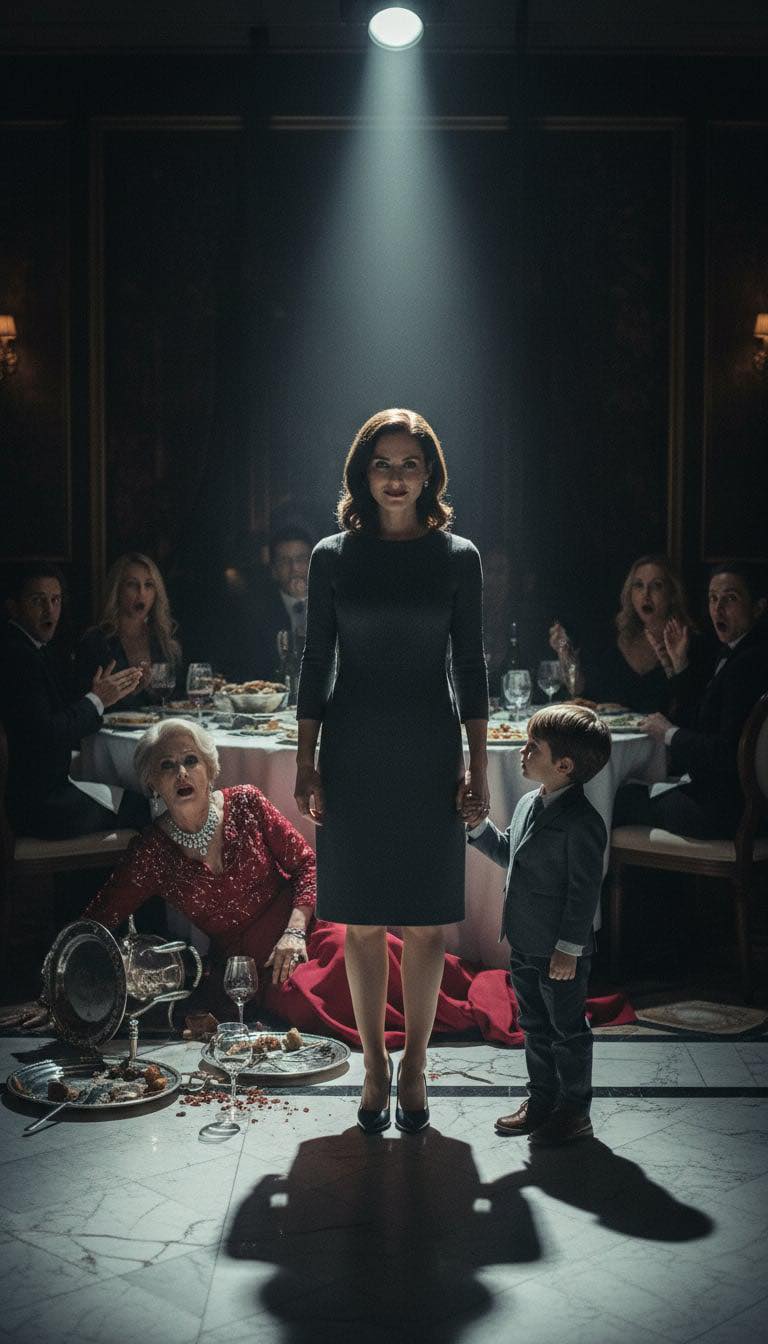
They say blood is thicker than water, but in my family, blood was just another currency to be traded for social standing. I had spent my entire life as the depreciation asset in my mother’s carefully curated portfolio. I was the mistake, the struggling artist, the single mother who “didn’t apply herself.”
Tonight, however, the ledger was going to be balanced.
My name is Sarah Sterling. To the world—or at least, the world my mother, Margaret, inhabits—I am a cautionary tale. A woman who squandered her potential to raise a son, Leo, on a shoestring budget. But the truth is a funny thing; it hides in plain sight, obscured only by the arrogance of those who refuse to look closely.
I am not struggling. I am the silent majority shareholder of the Aurora Hospitality Group. And tonight, I walked into the Grand Obsidian Hotel not as its owner, but as a ghost from the wrong side of the tracks, giving my mother one final, desperate chance to prove she had a heart.
————
The ballroom of the Grand Obsidian shimmered with an aggressive opulence. Crystal chandeliers the size of small cars dripped from the ceiling, casting fractured light over the cream of New York society. The air smelled of expensive lilies, floor wax, and the metallic tang of old money.
I stood at the entrance, clutching Leo’s small, warm hand. He was six years old, wearing a faded denim jacket and sneakers that had seen better days—props in a play he didn’t know he was starring in. I wore a dress I’d bought at a thrift store three years ago, the hem slightly frayed, my hair pulled back in a messy, utilitarian bun.
“Mommy,” Leo whispered, pressing his face against my leg. “Are we in the right place? It looks like a castle.”
“We’re in the right place, bug,” I said, squeezing his hand. “Just stay close to me.”
My eyes scanned the room, bypassing the jewels and the Botox, landing on the infrastructure. I noticed a smudge on the brass railing of the grand staircase. I saw a waiter holding a tray at a dangerous forty-five-degree angle. A frown tugged at my lips—a micro-expression of a boss, not a guest. I’ll have to speak to Henderson about the polishing schedule, I thought, before catching myself. Tonight, I had to be Sarah the disappointment, not Sarah the CEO.
Margaret stood in the center of the room, holding court. She was draped in a deep emerald velvet gown that cost more than my first car. She was directing the flow of waiters with the precision of a drill sergeant, her laugh tinkling artificially as she charmed a Senator’s wife.
Then, she saw us.
Her smile didn’t just fade; it evaporated. She excused herself from the Senator’s wife and rushed over, her heels clicking aggressively on the marble.
“You actually came,” she hissed, stopping inches from my face. Her voice was low, designed to avoid a scene, but sharp enough to draw blood. She looked Leo up and down with open disgust. “And you brought him? In those… rags?”
“Hello, Mother,” I said, keeping my voice level. “It’s your sixtieth birthday. We wanted to celebrate you.”
“Celebrate me?” She laughed, a harsh, dry sound. “You’re here to embarrass me. Look at you, Sarah. You look like you just crawled out of a shelter. Do you have any idea who is in this room? The Van Der Bilts are here. The Astors.”
“Leo made you a card,” I said, ignoring the name-dropping. I nudged Leo forward. He held out a piece of construction paper with a wobbly drawing of a cake.
Margaret didn’t take it. She didn’t even look at it. She grabbed my arm, her perfectly manicured nails digging into my skin with surprising strength.
“Put that away,” she snapped. “Listen to me clearly. You will go to that corner table—the one behind the pillar—and you will stay there. You will not speak to anyone. You will not eat the hors d’oeuvres. If you cause one mistake, one embarrassment, I will make sure you never see a dime of your father’s inheritance. Do you understand?”
I looked at her hand on my arm. Then I looked into her eyes. There was no love there. Only calculation. She saw me as a stain on her perfect evening.
“Don’t worry, Mother,” I replied, my voice chillingly calm. “Tonight will be unforgettable.”
—————
We sat in the shadowy corner, hidden behind a massive fern and a marble pillar. It was the penalty box of the party. Leo swung his legs, bored, watching the waiters glide by with trays of lobster puffs and truffle arancini.
“I’m hungry, Mom,” he whispered.
My heart broke a little. “I know, baby. Just a little longer.”
The party was in full swing. A jazz band was playing a soft, soulless rendition of Sinatra. Margaret was in her element, floating from group to group, accepting compliments, pretending her life was as perfect as her diamonds. She was performing. It was a masterclass in narcissism.
A waiter passed by our corner, momentarily distracted. Leo, driven by the impulse of a hungry six-year-old, slid off his chair. Before I could grab him, he reached out and took a small, bacon-wrapped scallop from the edge of the tray.
“Hey!” Margaret’s voice cut through the jazz like a whip.
She had been watching us. Of course she had. She was a hawk circling prey. She marched over, the crowd parting for her.
“What did I tell you?” she shrieked. She slapped the scallop out of Leo’s hand. It landed on the pristine white carpet with a wet splat.
Leo recoiled, his eyes wide, tears instantly welling up.
The room went silent. The music stopped. Every eye turned to us.
“Mother, he’s a child,” I said, standing up. My blood was starting to boil, a low hum in my ears.
“He’s a thief!” Margaret announced, turning to her guests, deciding to turn her cruelty into a performance. “This food is for the elite, Sarah! For people who contribute to society! Not for a broke single mom and her undisciplined brat.”
A titter of nervous laughter rippled through the room. Margaret’s friends—women dripping in stones bought by their husbands—covered their mouths, giggling. They pointed at Leo’s scuffed sneakers.
“If you want to eat,” Margaret sneered, her voice projecting to the back of the ballroom, “go wash dishes in the kitchen. I’m sure the staff can find a use for you. Maybe they’ll give you scraps if you work hard enough.”
The humiliation was absolute. She wasn’t just scolding me; she was stripping me bare for the amusement of her social circle. She was offering me up as a sacrifice to the god of Status.
I looked at Leo. He was trembling.
That was it. The test was over. She had failed.
I knelt down, ignoring the burning stares of three hundred people. I wiped a tear from Leo’s cheek.
“Go to the lobby, baby,” I whispered. “Find the man in the grey suit by the elevator. That’s Uncle Mike. He has your iPad and he’s going to take you to get ice cream. The big sundae.”
“But Mom…”
“Go. Now.”
Leo ran, his sneakers squeaking on the polished floor. I watched him go until the heavy oak doors closed behind him.
Then, I stood up.
The slouch was gone. The tiredness was gone. The “struggling daughter” posture evaporated. I rolled my shoulders back, standing to my full height. I looked at Margaret, not with fear, but with the cold, dead eyes of an executioner.
“So hard to get good help, isn’t it?” Margaret laughed to her friends, thinking she had won.
She didn’t see me reach into my pocket. She didn’t see me pull out the sleek, matte-black phone—a prototype that wouldn’t be on the market for another six months.
I pressed a single speed-dial number. I stared directly at Margaret as I spoke four words that cut through the laughter like a blade.
“Execute Protocol Omega. Now.”
—————
The effect was instantaneous.
It started with the lights. The warm, golden glow of the chandeliers flickered once, then shifted to a harsh, clinical white—the “cleaning mode” setting usually reserved for 3:00 AM. The jazz music cut out with a dying whine of feedback.
Then, the service stopped.
Every waiter in the room froze. In perfect unison, they set their trays down on the nearest tables. The bartenders put down the shakers. The coat check girl stepped away from the counter.
“What is going on?” Margaret demanded, looking around wildly. “Why is the music off? Waiter! Bring me another champagne!”
The waiter, a young man named David who I knew was putting himself through law school, looked right through her. He turned his back and walked toward the kitchen.
“Excuse me!” Margaret screamed, her face patching with red rage. “I am talking to you! I will have you fired! I will have you all fired!”
“I smiled and called the manager,” I narrated internally, watching the chaos unfold.
Within thirty seconds, the double doors of the kitchen burst open. Mr. Henderson, the General Manager of the Grand Obsidian, appeared. He was a man of impeccable composure, usually unflappable. But right now, he wasn’t walking; he was running. He was sweating.
Margaret saw him and smirked, relief washing over her face. “Finally! Henderson! Get control of your staff. And escort this trash”—she pointed a shaking finger at me—”out of my party immediately.”
Henderson didn’t look at Margaret. He walked past her, ignoring the wealthy socialite entirely, almost knocking into the Senator’s wife in his haste. He stopped in front of me.
The room watched in confused silence. Why was the manager running to the broke daughter?
Henderson bowed his head—a gesture of profound, terrified submission. He clasped his hands in front of him.
“Ms. Sterling,” he said, his voice trembling slightly. “We received the code from the central server. The system has locked out all external commands. Are you… are you sure?”
I looked at my mother. She was frowning, her head cocked to the side like a dog hearing a high-pitched whistle. She couldn’t process what she was seeing.
“I’m sure, Mr. Henderson,” I said softly.
“But Ms. Sterling,” Henderson whispered, glancing nervously at the stunned guests. “This is a full shutdown. The cancellation fees… the PR fallout…”
“I don’t care about the PR,” I said, stepping into the harsh white light of the chandelier. “Shut it down.”
Margaret stomped over, grabbing Henderson by the lapel of his expensive suit.
“Why are you talking to her?” she shrieked. “She is a nobody! I paid a fifty-thousand-dollar deposit! Do you know who I am?”
I stepped forward, my voice dropping an octave, echoing with an authority that bounced off the marble walls.
“You paid a deposit to rent a room, Mother. You didn’t pay for the right to abuse the owner.”
Margaret froze. Her eyes went wide. “The owner? Don’t be stupid. The owner lives in Switzerland. Mr. Al-Fayed.”
“Mr. Al-Fayed retired six months ago,” I said, smoothing the front of my thrift-store dress. “He sold the controlling stake to the Aurora Group.”
Margaret scoffed. “So? Some corporation owns it.”
“Mother,” I said, tilting my head. “Who do you think founded Aurora?”
———–
The realization hit her like a physical blow. Her mouth opened, but no sound came out. She looked from me to Henderson, who was nodding solemnly.
“CANCEL THE PARTY,” I said clearly.
“You can’t do this!” Margaret shrieked, finding her voice. “These are my friends! This is my night!”
“Everyone out. Now,” I commanded, projecting my voice to the entire room.
“Security!” Henderson barked.
The side doors opened, and twelve large men in dark suits entered. They weren’t the regular hotel security; they were my personal detail, the ones who usually guarded the boardroom. They moved with military precision, forming a perimeter around the guests.
“Ladies and gentlemen,” I announced. “The Grand Obsidian is closing for a private maintenance issue. You have five minutes to vacate the premises. Anyone remaining after that time will be considered a trespasser and handed over to the NYPD.”
“You… you ungrateful little witch!” Margaret lunged for me.
My security chief, Marcus, stepped in front of me, blocking her path with a wall of muscle.
“Do you know who these people are?” Margaret screamed, gesturing to the shocked crowd. “They are the elite! They will ruin you!”
“I know exactly who they are,” I replied, stepping around Marcus until I was inches from her face. “They are people who laugh at a six-year-old child because he’s hungry. They are people who judge a book by its cover because they’re too shallow to read the pages.”
I turned to look at the “friends.” The women who had covered their mouths to giggle were now clutching their Hermes bags, looking for the exit. They were terrified. They realized that their status meant nothing inside these walls because I built these walls.
“And you?” I looked back at Margaret. “You’re the ringleader.”
I turned to Henderson. “Revoke Mrs. Sterling’s membership. Permanently. Blacklist her from every property in the Aurora portfolio. That includes the spa in Aspen, the resort in St. Barts, and the club in London.”
A gasp went through the crowd. I was effectively exiling her from her own life.
“And Henderson?” I added. “Bill her for the cancellation fees. Full price. Breach of contract for conduct violations.”
The guests began to scatter. It was a stampede of silk and tuxedos. No one stopped to say goodbye to Margaret. No one wished her a happy birthday. They scurried like cockroaches when the lights turn on, desperate to disassociate themselves from the woman who had just angered the most powerful hotelier in the city.
“Sarah, wait!” Margaret stammered, realizing the social suicide unfolding before her eyes. She reached out, her face crumbling from rage to pathetic desperation. “It was a joke! We were just… playing! You know how I am! I’m your mother!”
I stared at her. I remembered the years of criticism. The way she ignored Leo’s birthdays. The “wash dishes” comment.
I turned my back on her.
“You wanted me to wash dishes?” I asked over my shoulder. “I’m doing something better. I’m taking out the trash.”
I snapped my fingers.
Two security guards stepped toward Margaret, each taking an arm. She began to kick and scream, her dignity dissolving into a puddle of mascara and hysteria.
“You can’t do this to me! I am Margaret Sterling!”
As they dragged her toward the exit, her scream wasn’t of anger anymore; it was the terrifying, high-pitched wail of a woman watching her entire identity shatter on the floor like a dropped champagne glass.
————-
Outside, the New York sky had opened up. A torrential rain was hammering the pavement.
Through the security monitors in the penthouse suite, I watched the scene on the sidewalk. Margaret stood on the curb, her velvet dress soaked and clinging to her frame, her hair plastered to her skull. She was frantically waving at taxis, but they were all full. Her “friends” hurried into their limousines, ignoring her screams for a ride. She was alone. Truly, utterly alone.
Inside the penthouse, the fireplace was crackling.
I sat on the plush rug with Leo. We were eating grilled cheese sandwiches made with gruyère and sourdough, prepared personally by the head chef.
“Was Grandma mad?” Leo asked innocently, wiping a crumb from his lip.
“Grandma is just learning a lesson, buddy,” I said, kissing his forehead. “Sometimes, adults have to go in time-out too.”
“Is she coming back?”
“No,” I said, the word tasting like fresh water. “She isn’t.”
My phone buzzed on the coffee table. It was a text from “Mom.”
You ungrateful brat. Everyone is laughing at me. The Van Der Bilts blocked my number. You have ruined my life. Fix this immediately or you are dead to me. I mean it, Sarah.
I looked at the words. Years ago, they would have made me cry. They would have sent me into a spiral of guilt and begging. But tonight? I felt nothing. It was a liberating, hollow emptiness.
I typed a reply I had waited ten years to send.
You can’t disown me, Mother. I own you. The inheritance you threatened to cut? Keep it. You’re going to need it for the legal fees if you ever try to contact me or my son again.
I pressed send.
Then, I pressed “Block Contact.”
The silence that followed wasn’t lonely; it was the first time in my life I heard the sound of freedom. The ghost of her expectations was gone.
But then, a notification popped up from my personal lawyer, David (the waiter who was actually a junior partner at my firm).
Subject: Urgent.
Ms. Sterling, your mother just called her attorney. She is screaming about ‘grandparent rights’ and claiming you are an unfit mother because of your ‘financial instability.’ She doesn’t know the truth yet about your assets. She’s going to sue for custody of Leo.
————-
Six months later.
The Grand Obsidian ballroom was full again.
But this time, there were no diamonds. There were no tuxedos. The air didn’t smell of judgment; it smelled of roasted chicken and optimism.
Banners hung from the ceiling: The Sterling Foundation: Night for New Beginnings.
I stood on the balcony, looking down. The room was filled with women in business suits, women in jeans, women holding children. They were single mothers, survivors of domestic abuse, and scholarship recipients. Tonight, the hotel wasn’t hosting a gala for the elite; it was hosting a job fair and fundraiser for women starting over.
I wore a tailored red suit—no more disguises.
My lawyer had crushed Margaret’s lawsuit in less than three weeks. The moment we submitted my financial statements to the judge—showing a net worth that eclipsed Margaret’s by a factor of fifty—the case was dismissed with prejudice. Margaret was now a pariah in the social circles she worshipped, known as the “delusional woman who tried to sue the Aurora owner.” She had moved to Florida, living in a small condo, telling anyone who would listen that her daughter was a witch.
I didn’t care. She was a story from a closed book.
“Mom!”
Leo ran up to me, wearing a little tuxedo t-shirt. He looked happy. Confident.
“Mom, Mr. Henderson let me press the button for the lights! Can we go help serve the cake?”
I looked at him. The boy who was told to wash dishes was now the prince of the castle. But we weren’t ruling from a throne; we were serving.
“We sure can,” I said, taking his hand.
As we walked down the grand staircase, I saw Henderson smiling at me. I saw the staff working with genuine pride.
We reached the bottom of the stairs, and I glanced at the front revolving doors one last time. For a split second, I imagined the ghost of the scared, slouching daughter I used to be standing there, clutching a child’s hand, terrified of the world.
I winked at her. You made it, I thought.
I walked through the crowd, greeting people by name, shaking hands, listening to their stories. The doors of the hotel closed, sealing the past shut against the rain. But in the distance, through the spotless glass windows, the city lights of New York seemed to rearrange themselves into a question I was finally ready to answer:
Now that you have everything, and you owe nothing to anyone… who will you become?
The answer was easy. I would become the mother I never had.