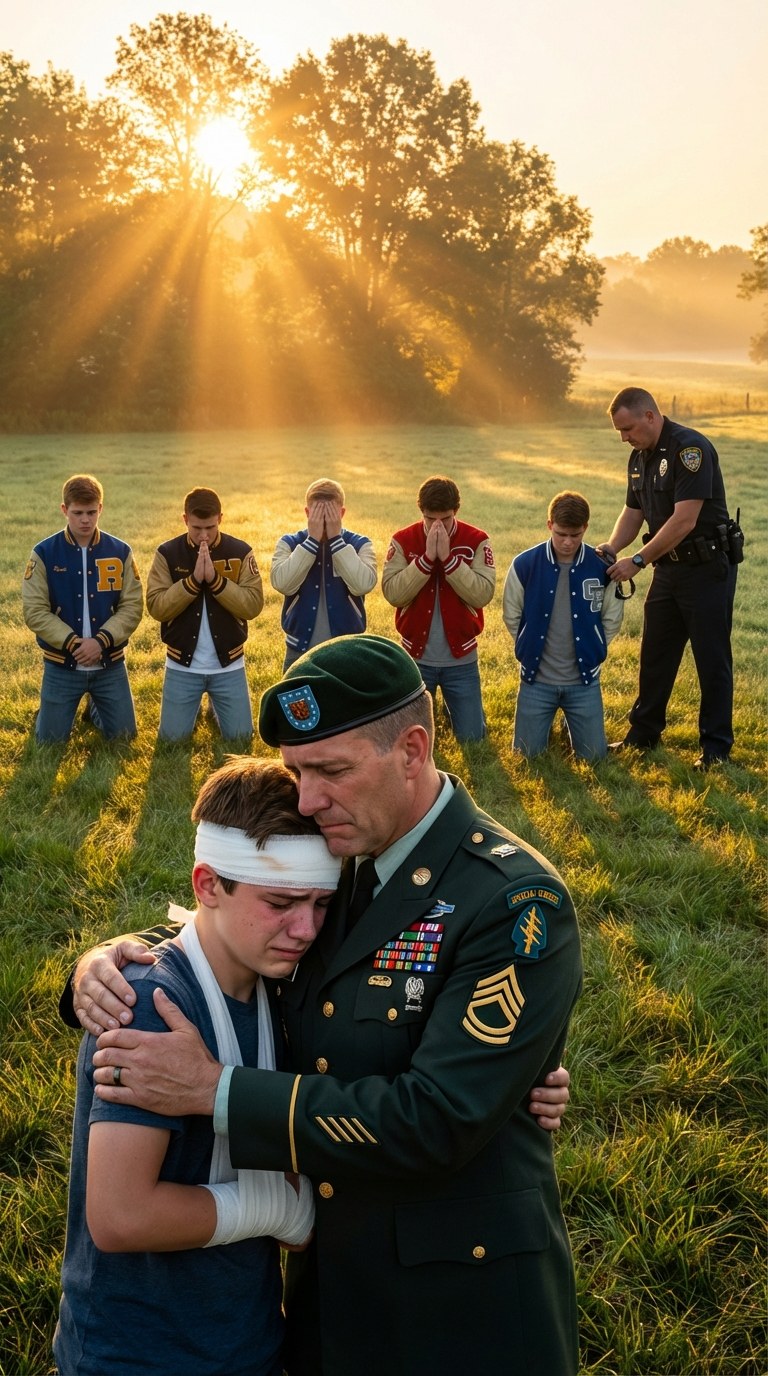
The steam from my coffee smelled like woodsmoke and routine, a fragile peace shattered by the sharp vibration of my phone. Twenty years as a Green Beret had rewired my nervous system; I didn’t just hear a notification, I felt a threat assessment execute in my marrow. The number was unknown. My gut, that ancient radar that had kept me alive from Kandahar to the Euphrates, knotted into a cold, hard lump. Across the table, Lynn saw the shift. After seventeen years of marriage, she could read the micro-expressions of a man trained to have none.
The voice on the other end belonged to Abigail Sawyer, the principal of Riverside High. It was tight with the specific frequency of controlled bureaucratic panic. She told me there had been an “incident” involving my son, Carl, and that I needed to get to Mercy General immediately. The line went dead before I could ask if he was breathing. The drive took twelve minutes, but it felt like a decade in a decompression chamber. I spent every second bargaining with a God I hadn’t spoken to in years, offering my own scarred soul in exchange for my boy’s safety.
Nothing prepared me for the sterile reality of the ICU. Dr. Veronica Wilkins met us with the hollow eyes of a woman who spent her life delivering wreckage to parents. She explained that six students had cornered Carl in the locker room. They hadn’t just fought him; they had used a padlock inside a sock—a makeshift morning star. The trauma was severe, the brain swelling critical. They had induced a coma. Lynn collapsed, melting into my chest, but I remained a pillar of stone. My mind was already cataloging the data: six-on-one, premeditated, lethal intent. The father in me was shattered, but the soldier—the man I thought I had retired—was wide awake.
An hour later, Principal Sawyer appeared in the waiting room. She spoke of “suspensions” and “investigations,” her words sliding off me like rain on a windshield. When I demanded names, she hid behind privacy laws and district protocols. I leaned in, the air in the room dropping ten degrees, and told her she wanted me to hear the names from her rather than finding them myself. Her resolve crumbled. Bobby Estrada, Carl Merritt, Pete Barnes, Alberto Stone, Steven Coons, and Samuel Randolph. The “Kings of Riverside.” The untouchables.
As the days bled into a gray twilight of monitors and hushed whispers, the pattern emerged. A sympathetic nurse confirmed what I already suspected: these boys were the town’s royalty. Their fathers owned the real estate, ran the law firms, and funded the athletic programs. They had a history of “accidents” that were always swept under the rug to protect scholarship opportunities and state titles. When I met with the superintendent, Muhammad Emory, he confirmed the rot. He spoke of “ruined young lives” and “acceptance,” suggesting that a lawsuit would only bankrupt me. He saw a grieving father. He didn’t see the man who had spent a career dismantling insurgent networks.
I contacted Abraham Samson, a former JAG officer I’d served with. He confirmed the system was rigged to protect the school’s insurance and the boys’ futures. He told me they would walk away clean. I thanked him and hung up. That night, in the blue light of my home office, I opened six files. I wasn’t looking for a legal loophole; I was looking for pressure points. These boys lived their lives out loud on social media, documenting their sins with the arrogance of those who believe consequences are for the poor. I began to build a dossier.
The dismantling began with Bobby Estrada, the ringleader. I didn’t lay a finger on him. Instead, I captured high-definition footage of him drinking and driving his Corvette, then sent it to his insurance provider and the NCAA compliance office. When I uncovered the paper mill he used for his term papers, USC pulled his scholarship within forty-eight hours. Carl Merritt was next. I tracked his steroid buys to a defunct auto-body shop and placed an anonymous tip for an “armed dealer.” The police found him with enough controlled substances to end his Alabama dreams before they started.
Pete Barnes, the adrenaline junkie, lost his season when I removed the warning markers on a washed-out trail he bragged about dominating; he rolled his truck at fifty miles per hour, surviving with a shattered collarbone and a permanent record of reckless driving. Alberto Stone met a widened pothole during his 5:00 AM run that snapped his ACL, ending his Oregon prospects. For Steven Coons, I “dropped” a USB drive in a coffee shop for his girlfriend to find—a drive containing his own bragging videos about how he manipulated her. The resulting social media firestorm was a total tactical collapse. Finally, Samuel Randolph, the lawyer’s son, collapsed during practice after I ensured his dealer’s supply was laced with a potent emetic.
In two weeks, the “Kings” were gone—arrested, hospitalized, or disgraced. Their fathers, men accustomed to buying their way out of trouble, were frantic. They knew it wasn’t a coincidence, but there was no proof. Only a string of “bad luck” born from their own vices. When I stood before the school board one last time, I didn’t plead for justice. I told them they had a choice to do the right thing or live with the consequences of doing nothing. They chose to be offended.
The final act occurred at my home. I knew they would come. At 9:00 PM, six fathers, led by Michael Estrada, marched onto my porch with bats and tire irons. They were fueled by a toxic mix of entitlement and rage. I watched them on the security monitor, ensuring the 4K cameras were recording every threat. When they broke through the security screen, I stepped back and invited them into the kill box.
It wasn’t a fight. It was a surgical dismantling. I controlled the space, using their own momentum and weight against them. Within minutes, the “pillars of the community” were a heap of groaning limbs on my entryway rug. I didn’t call an ambulance; I called the police to report an armed home invasion. The footage was undeniable. They had walked into their own destruction, providing the evidence needed to bury their businesses and their reputations for good.
Three weeks later, the rhythmic beeping in the ICU changed. Carl’s eyes fluttered open. The word “Dad” was weak and slurred, but it was the most beautiful sound I had ever heard. The recovery was brutal. There were memory gaps and physical therapy that made him weep with frustration, but he was alive.
Months later, as we sat on the porch, Carl asked if the rumors were true—if I was the reason the “Kings” had fallen. I looked at my son, who was now sketching in a notebook because his hands were no longer steady enough for the sports those boys had played. I told him that I had defended our home, and as for the rest, the world has a way of balancing the scales if you give it a little push. I explained that revenge is emotional, but consequences are necessary. For the first time in twenty years, the soldier in my chest went to sleep. The war was over, the enemy was neutralized, and my son was finally home.