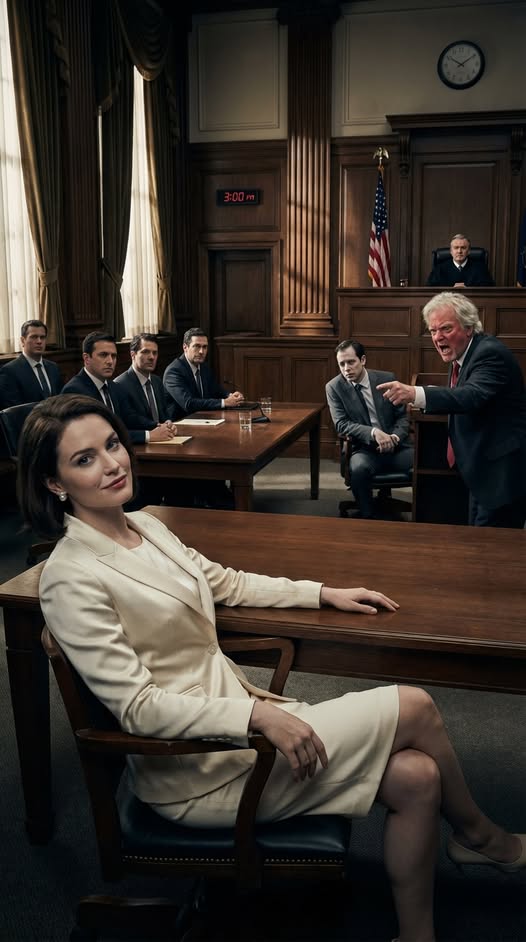
“She is unstable. She is mentally incompetent. She is a drifter with no husband, no career, and she lives in a shoebox apartment!”
The voice boomed off the mahogany walls of the courtroom, distorted by a mixture of arrogance and desperation. My father, Thomas Hail, was screaming so loudly that the veins in his neck were bulging against his starched collar, his face turning a terrifying, mottled shade of crimson. He gripped the wooden podium as if he were trying to crush it into sawdust, pointing a shaking finger at me across the aisle.
“Look at her, Your Honor! She can’t even speak. She sits there like a statue. She needs a conservator to manage her trust fund before she wastes it on whatever unstable people waste money on—drugs, cults, imaginary businesses!”
I sat perfectly still, my hands folded demurely in my lap. I focused on the sensation of the cool, recycled air against my skin and the rhythmic ticking of the watch hidden beneath my blazer sleeve. I didn’t blink. I didn’t frown. I didn’t offer a single micro-expression that he could latch onto and use as ammunition.
10:14 a.m. Right on schedule.
The courtroom was stuffy, smelling of floor wax and old paper. Dust particles danced in the singular beam of sunlight cutting across the defense table, oblivious to the family war being waged beneath them. I watched those specks of dust rather than looking at the man who had engaged in a thirty-year campaign to erode my existence.
Judge Alvarez stared at him over the rim of her reading glasses. She was a woman of sharp angles and even sharper patience, her expression entirely unreadable. She let the echo of Thomas’s outburst hang in the air, allowing the silence to curdle.
At the table beside my father, his attorney, Mark Ellison, had stopped taking notes. He was frozen mid-scroll on his tablet, his eyes widening as he stared at a physical document the bailiff had just placed in front of him. I watched the blood drain from Ellison’s face, a slow-motion physiological reaction that fascinated me. It was the look of a man realizing he had brought a knife to a nuclear test site.
Thomas, oblivious to his lawyer’s sudden paralysis, continued his tirade. “She is catatonic! Look at her! She hasn’t said a word in twenty minutes. She is clearly medicated or having some kind of episode. I demand immediate conservatorship. Immediately!”
I adjusted my cuff, feeling the heavy, comforting weight of the Patek Philippe watch against my wrist. Let him scream. Let him paint the picture of the fragile, broken daughter who couldn’t keep a man or a fixed address. That was the strategy. If I spoke now, I would look defensive, emotional—exactly the hysteric he claimed I was. Silence allowed him to look unhinged. Silence gave him the rope to hang himself.
Judge Alvarez finally moved. She leaned forward, the leather of her chair creaking in the pressurized quiet of the room. She ignored Thomas and looked directly at his attorney, then back at my father. She asked one quiet question that sliced the room in half.
“Mr. Hail, you really don’t know who she is, do you?”
The silence in that wood-paneled courtroom wasn’t empty; it was dense, heavy, the kind of atmospheric pressure that precedes a tornado. As Thomas sputtered, trying to comprehend the Judge’s bizarre question, my mind drifted away from the courtroom, back four months to Christmas Eve.
We were seated at the long, mahogany dining table in his house in Austin, Texas—the sprawling colonial estate I was quietly paying the mortgage on. The air smelled of expensive roast beef and Douglas fir, a scent that usually made me nauseous.
Thomas had laughed when I handed him my new business card. He didn’t just chuckle; he threw his head back and barked a harsh, mocking sound. He tossed the card onto the white linen tablecloth as if it were a used napkin.
“A Consultant?” he sneered, swirling a glass of amber bourbon that cost more than my first car. “Is that what we’re calling ‘unemployed’ now, Marin? It’s a cute little hobby, sweetheart. But let’s be honest, you’re playing pretend. You’re thirty-two years old.”
I remembered the heat rising in my face that night, the familiar, stinging burn of being the disappointment, the failure, the invisible daughter. His new wife had giggled nervously, picking at her salad.
“You need to be realistic,” Thomas continued, sawing into his steak. “You don’t have the head for business. You never did. You’re too… soft. Too emotional.”
But sitting in the courtroom, four months later, the memory didn’t hurt. It fueled me. Because while he was mocking my “pretend job” between bites of medium-rare beef, he had no idea that my firm had just secured a $14 million federal contract auditing a corrupt medical supply chain. He saw a drifter. I saw the Managing Partner of Atlas Advisory Group, a forensic accounting firm built to follow money that doesn’t want to be found.
And right now, the money I was following was his.
“She lives in some rundown rental downtown!” Thomas shouted, snapping me back to the present. He was pivoting to my living situation, desperate to regain momentum. “Won’t let family visit because she’s ashamed. Probably filthy. I bet there are rats in the walls!”
I almost smiled. He was talking about The Calderon.
He was right about one thing: I didn’t let him visit. But everything else was wrong. I didn’t rent at The Calderon. I owned the building—the entire historic structure, including the renovated luxury penthouse I lived in and the commercial office space on the third floor that his firm was leasing.
I had evicted two commercial tenants last quarter for non-payment. My father, a man who prided himself on being “sharp as a tack,” never realized that the landlord’s signature on those eviction notices—scrawled in an illegible, corporate loop—was mine.
Ellison was sweating now. He was frantically scrolling through the documents, tapping his screen with a trembling finger. I knew exactly what he was reading. It wasn’t my grandmother’s asset summary. It was mine.
I wasn’t here for an inheritance. I didn’t need one. I earned more in a single fiscal quarter than my father had generated in his entire mediocre career. I was here because he had tried to take my freedom. He had tried to weaponize the legal system to erase me.
And now, the “unstable drifter” he’d belittled for thirty years was the one holding the leverage.
I met Judge Alvarez’s eyes. She gave the smallest, almost imperceptible nod. The trap was set. Now, all we had to do was let him keep talking.
“She is clearly unwell!” Thomas barked, feeding off his own echo, mistaking the room’s shock for agreement. “Look at her posture. That blank stare. This is what untreated instability looks like!” He pounded the podium for emphasis. “I demand immediate conservatorship!”
I didn’t move. I didn’t blink. Let him perform. Let him unravel.
Thomas shifted gears, sensing he needed more damage. “She lives alone. No husband, no children, no stability, no proof she can manage anything of value.”
I folded my hands tighter in my lap. Alone wasn’t the insult he thought it was. Alone meant uninterrupted. Alone meant focused. Alone meant dangerous.
My gaze drifted again, not to him, but backward in time to a Tuesday afternoon two years earlier. I remembered the date because it was the same day I closed my first seven-figure audit for a defense subcontractor.
Two police officers had knocked on my door with a 5150 involuntary psychiatric hold.
The paperwork, clutched in the hand of a confused young officer, claimed I was delusional, reckless, and burning through my trust fund on imaginary businesses. The signature on the medical declaration belonged to a physician I’d never met—a golfing buddy of my father’s named Dr. Evans.
The plan was simple, brutal, and archaic: lock me up for 72 hours, file emergency motions while I was incapacitated, and seize control of my trust fund before I could object. He didn’t want to protect me. He wanted liquidity. He had bad debts, and I was his piggy bank.
The officers took one look at my apartment—pristine, minimalist, organized—and then at me. I was calm, dressed in a silk blouse, with federal agents visible on my laptop screen mid-conference call.
“Ma’am, are you… Marin Hail?” the officer asked, looking at the “delusional” checkbox on the form and then back at my clearly lucid demeanor.
“I am,” I said softly. “And I believe my father is attempting to file a false report to cover a gambling debt. Would you like to speak to the FBI agents on my screen?”
They left within minutes. The report was flagged as malicious. I didn’t press charges; that would have ended things too quickly, and he would have just tried again. Instead, I decided to become the solution to his problem—and the author of his consequences.
The next morning, I formed Atlas Advisory Group, a shell company with a neutral name and a Delaware registration. Through Atlas, I approached his bank quietly, professionally. I offered to purchase his distressed debt.
The bank officers were thrilled to unload a sinking ship. I bought his loans, his credit lines, every obligation tying him to solvency. Then, through an intermediary, I injected $650,000 into his firm as a “senior secured loan” under the guise of private capital.
Thomas didn’t question it. He didn’t investigate the source. He saw the deposit and assumed the universe finally recognized his brilliance.
And what did he do with the money? He didn’t stabilize payroll. He didn’t modernize his failing computer systems. He bought a vintage slate-gray Porsche 911 and drove it to Thanksgiving dinner like a trophy.
He carved the turkey that year, raised his glass, and looked straight at me. “Maybe if you applied yourself, Marin, you wouldn’t be such a financial embarrassment. At your age, still needing help.”
I smiled and ate my potatoes. He didn’t know the car was already mine. Every mile he drove depreciated an asset he didn’t own.
Back in the courtroom, Thomas leaned into the podium again, his confidence rebuilding in the face of my silence. “We’re wasting time. My daughter has no income, no assets, and no grasp on reality. This silence is fear. She knows she’s nothing without me.”
I looked at him then, really looked. He wasn’t a villain. He was just a bad investment. And today, I was closing the account.
His attorney, Mark Ellison, finally found his voice. He leaned close to my father, whispering urgently, his face pale and slick with sweat.
Thomas brushed him off with a violent shrug. “Not now, Mark! I’m making my point.”
“You should listen to your counsel, Mr. Hail,” Judge Alvarez said, her tone suddenly dropping ten degrees. She lifted a single document from the stack Ellison had been staring at. “According to this, the petitioner isn’t just your daughter. She’s your creditor.”
Thomas laughed, a wet, dismissive sound that bounced off the high ceiling. “My creditor? Your Honor, this is exactly what I mean. Delusions of grandeur! Marin can’t run a company. She can barely run her own life.”
Ellison made a strangled sound, gripping Thomas’s sleeve. “Thomas, stop. Look at the seal. This is federal. You need to sit down.”
Thomas yanked his arm free. “I will not sit while my daughter makes a mockery of this court!” He turned back to the Judge, pointing a finger at me. “Look at her clothes! Discount suit, scuffed shoes. Does that look like success to you?”
I glanced down at my heels. The scuffs came from climbing through a warehouse window three days ago to verify inventory for a client. I didn’t replace them because I didn’t care. Unlike him, I didn’t wear my worth. I kept it in the bank.
“She lives at The Calderon!” he snapped, delivering what he thought was the final blow. “That crumbling brick building downtown. A studio. Probably rats in the walls. And you want me to believe she owns Atlas?”
I kept my face neutral. He was right about the rats—when I bought the building two years ago. I had exterminated them, renovated the structure, and took the entire top floor for myself. Unit 3C, which he thought was my apartment, was just a mail drop.
“This is a waste of taxpayer money!” Thomas shouted. “She is unstable, alone, no legacy, just a sad girl telling stories. Sign the order!”
He stood there, chest heaving, convinced he’d won.
Judge Alvarez slowly removed her glasses. Boredom replaced patience on her face. “Mr. Hail,” she said quietly, “you have ten seconds to sit down and stop speaking, or I will hold you in contempt so fast you won’t understand what happened.”
His mouth opened, then closed. Ellison practically forced him into his chair.
“Good,” the Judge said, smoothing the paper in front of her. “Now that we’ve heard your opinion, let’s review the facts. Because according to this deed…” She slid a single page across the polished wood toward the defense table.
The paper stopped inches from my father’s trembling hand.
“The Calderon, Unit 3C, is indeed a mail drop. You were correct about that,” Judge Alvarez said. “But Miss Hail doesn’t rent it. She owns the entire property. Including the commercial suites on the third floor. The suites your firm currently occupies.”
Thomas stared at the page, then at me, then back at the Judge. His mind stalled, the gears grinding against the grit of reality. “That’s… that’s impossible. My landlord is a corporate entity. I pay rent to Atlas Real Estate. I’ve never written her a check.”
“Atlas,” the Judge repeated, opening another folder. “Atlas Real Estate. Atlas Capital. Atlas Advisory Group. According to your financial disclosures, Atlas Advisory is your firm’s primary lender. In fact, they are the only reason your firm is solvent. They injected $650,000 two years ago. Is that accurate?”
Thomas straightened, finding familiar ground. “Yes. Atlas is a private capital backer. They believed in my firm. They recognized my talent and saved us.” He sneered at me again. “Unlike my daughter, who wouldn’t recognize an investment if it tripped her.”
I watched him brag about the rope he had tied around his own neck.
“Fascinating,” the Judge said, turning the folder so he could see the incorporation papers. “Because the sole incorporator, CEO, and signatory of Atlas Advisory Group is Marin Hail.”
The room emptied of air.
Thomas stared at the signature. My signature. The same one I’d used on birthday cards he never opened. The same one on the lease renewal he signed without reading.
“No,” he whispered. Then louder, “No! This is fraud.” He turned to Ellison, grabbing his lapels. “Tell her this is illegal! She’s not a lawyer. Non-lawyers can’t own firms. ABA Rule 5.4!”
He turned back to me, triumphant, desperate. “You broke the rules! You’re finished. Dismiss this! She’s not my creditor. She’s a fraud!”
I leaned forward and spoke for the first time. My voice was low, steady, and clear.
“You’re right, Thomas. I can’t own a law firm.”
I stood up. The chair scraped softly against the floor.
“But you didn’t read the contract.”
I walked toward him, my heels clicking steadily on the hardwood floor. Ellison shrank back, practically trying to merge with his chair.
“I didn’t buy equity,” I said calmly. “I bought your debt.”
I tossed the loan file onto the defense table. It landed with a heavy thud.
“Two years ago, you were insolvent. Three banks rejected you. You were co-mingling client funds to pay personal expenses.”
“That was temporary!” he snapped. “Cash flow issues!”
“It wasn’t cash flow. It was insolvency. Atlas purchased your loans, your credit lines, and the lien on your equipment. Then we extended $650,000 as a senior secured loan.”
Ellison flinched. He knew what “senior secured” meant.
“I don’t own your firm, Thomas. I own the collateral.”
I leaned over the table, looking him dead in the eye. “Every desk. Every laptop. Every file. And the Porsche out front.”
I pointed to Clause 14.B on the document.
“Default on Character. Public disparagement of the guarantor accelerates the loan. You called me incompetent on the record. You called me unstable in a court of law.”
I checked my watch. 10:28 a.m.
“You defaulted.”
His face drained of all color, leaving him looking grey and old. “I… I don’t have that money.”
“I know,” I said. “You have $11,000 in the operating account and a maxed-out Amex.”
I turned to the Judge. “Your Honor, I am calling the loan. I request immediate enforcement.”
Ellison stood up, his voice cracking. “Objection! If you seize assets, the firm collapses!”
“I accept your resignation, Mr. Ellison,” I said without looking at him.
Thomas erupted. He grabbed his phone, his fingers fumbling. “Chapter 7! Automatic stay! You get nothing! Bankruptcy protects companies, not guarantors!”
“I said, look at the contract,” I said, sliding the final page forward. “You signed personally. Cross-collateralized.“
The silence that followed was absolute.
“When the firm fails,” I whispered, “the debt transfers to you. Personally.”
Thomas froze.
“You didn’t bankrupt the firm, Thomas. You bankrupted yourself. I now have claims on your house, the lake cabin, the Porsche, your pension, and even your country club membership.”
Judge Alvarez raised the gavel. It looked heavy.
“Hearing dismissed with prejudice,” she ruled. “Petition for conservatorship denied. Counter-motion for asset seizure granted. You have 24 hours to vacate the premises, Mr. Hail.”
She looked at me. “Commercial eviction effective immediately.”
The gavel fell. Bang.
Mark Ellison packed up his briefcase in record time and left the courtroom without a word to his client. He knew a sinking ship when he saw one.
Thomas sat small and hollow in his chair, staring at the empty space where his life used to be. The rage was gone, replaced by a terrified confusion. He looked at me, searching for the daughter who used to beg for his approval, the girl who would apologize just to make the shouting stop.
She wasn’t there.
I walked out of the courtroom without looking back.
That night, I stood in the hallway of the third floor of The Calderon. The air smelled of industrial cleaner and stale coffee. I watched a locksmith drill into the mahogany door of the main office. The sound was shrill, piercing.
Within twenty minutes, the lock was changed.
I picked up the brass nameplate from the door: Thomas Hail & Associates. It felt heavy, substantial, implying a legacy that didn’t exist. I dropped it into a cardboard box.
I didn’t profit from this. The liquidation would barely cover the initial outlay. But I didn’t need the money. The money was just the price of admission. The profit was my freedom.
I took the elevator up to the penthouse. It was quiet. Peaceful. I poured a glass of water and sat by the window, looking out over the city lights of Austin.
My phone buzzed. A text from Thomas.
Marin, please. We’re family. You can’t do this.
I looked at the message. For a moment, I felt the old pull, the conditioned response to fix, to help, to endure. But then I looked at my reflection in the dark glass of the window. I saw a CEO. I saw a survivor.
I deleted the contact. Not blocked. Deleted.
Just silence.
Sometimes, you don’t have to destroy a toxic family. You just have to stop funding them.
Most people scroll past stories like this. They want the fantasy where everyone hugs at the end. But the ones who are still reading—the ones who understand why I didn’t look back—are the ones trying to change something inside themselves.
If this story made you stop scrolling, it’s because you know that sometimes, the only way to win the war is to buy the battlefield.