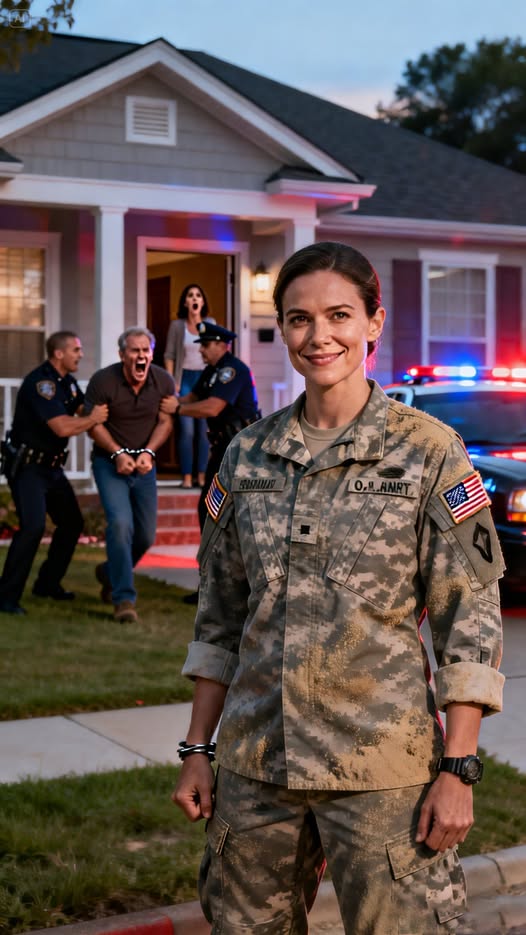
I had barely stepped out of the taxi when the humidity of the Pacific was replaced by the sharp, biting chill of a Washington autumn. My seabag was still slung over my shoulder, a heavy, familiar weight that felt like an extension of my own spine. My boots were still coated in the fine, pale dust of Okinawa, a souvenir from a six-month rotation that had felt like a decade. I hadn’t even managed to take three purposeful steps toward my own front door before the air was sucked out of the neighborhood.
There they were. Standing on my porch like two vultures waiting for a carcass to stop twitching. My father, his arms crossed with a rigid, defensive posture, and my older brother, Chad, leaning against the railing with a smirk that suggested he had just won a lottery he didn’t deserve.
“You’re homeless now,” my father said.
No “hello.” No “welcome home, Staff Sergeant.” Just a sentence that hit with more kinetic energy than any blast wave I had ever felt downrange. I froze in the driveway, the gravel crunching under my heels like breaking bone.
“What are you talking about?” I asked, my voice dropping into the low, dangerous register of a Marine preparing for a breach.
Chad snorted into his beer, the condensation dripping onto the porch I had stained with my own hands two summers ago. “We sold your house, sis. Try to keep up.”
They actually laughed. A father and a son, chuckling at a daughter and a sister who had just spent months serving her country, only to find the roof over her head had been auctioned off like common livestock. My father pointed lazily at the front door, his expression devoid of anything resembling remorse.
“Your brother needed help, Maria,” he said, as if the word family were a blank check I had unknowingly signed. “Family sacrifices for family. You weren’t here. You didn’t need the place. You Marines bounce around anyway. What difference does a single house make?”
I should have exploded. I should have dropped that seabag and leveled the porch. But instead, a slow, icy calm settled over me. It was the same clarity that hits when the first shot rings out and the training takes over. I let a steady smile spread across my face—a smile that made both of them shift their weight uncomfortably.
“What’s so funny?” my father snapped.
“The house you sold,” I said, my voice as smooth as polished steel. “It wasn’t exactly what you thought it was.”
I stood there, watching the confusion cloud their eyes, knowing that they had just stepped into a tactical minefield they weren’t equipped to survive.
To understand the depth of this betrayal, I have to take you back three months. I was stationed at Camp Foster in Okinawa, halfway through a shore duty rotation. Shore duty is supposed to be the “predictable” part of a Marine’s life, a time to breathe and recalibrate. I used my off-hours to call home, ostensibly to check on the house I had owned for eight years.
I had bought that property after my second deployment. I had renovated it room by room, pouring my bonuses and my leave time into the rafters. It was my anchor. My future. But lately, the phone calls home felt like an interrogation where the suspect was hiding everything.
My father would answer, sounding irritated, as if my voice were an unwanted intrusion. Chad, the eternal “finding himself” project, had crawled back into my father’s house after losing yet another job. Whenever I asked how Chad was getting back on his feet, my father’s voice would turn sharp.
“He just needs time, Maria. Don’t be so judgmental. You’ve always had the Corps to take care of you. Chad has to do it on his own.”
One night, I heard dishes clattering in the background of a call—voices I didn’t recognize. Someone in the distance yelled, “Did she send the money yet?” and the line went dead two seconds later.
Two weeks before I was scheduled to return, I received a text from my father. Call us before you come home. No punctuation. No context. Every instinct I had honed in thirteen years of service told me a storm was coming. I tried calling back, but it went straight to voicemail. Twice.
I told myself I was being paranoid. I told myself that family didn’t devour their own. I was wrong. I was standing in my driveway, staring at the shamelesness in their posture, and realized they had sold my sanctuary to pay off Chad’s latest gambling debt.
“Don’t look so shocked,” Chad said, crushing his beer can. “Dad had Power of Attorney. It was an easy process. You’ll get over it. You’ve got plenty of savings.”
“Is that what he told you?” I asked softly.
My father’s eyebrows knitted together. “What’s that supposed to mean?”
The silence that followed was a weapon. I let it hang there, heavy and suffocating, because they had no idea that the paperwork they had signed was a ticking clock.
I set my seabag down on the driveway with a dull thud. I didn’t go inside. I just stood there on the porch, watching them. They expected tears. They expected me to crumble so they could feel justified in “taking care of things.” But the Marine in me was already ten steps ahead.
“When did you sell it?” I asked, my voice devoid of emotion.
“Three weeks ago,” my father said, leaning against the doorframe of my house. “It was the right thing to do. Your brother had people looking for him, Maria. Serious people.”
“Debt,” I whispered. The word sat in my stomach like lead. Chad didn’t pay debts; he cultivated them like a hobby. And my father had enabled him until there was nothing left to give but my blood.
“And you didn’t think to call me?”
“You were busy!” he shot back. “Always busy with the Marine Corps. You think you’re better than us because you wear that uniform. You think you don’t need this family.”
“I’ve been serving this country for thirteen years,” I replied, stepping up onto the first stair. “And every single time I was in the dirt, I thought about this house. My house.”
“You’ll buy another one,” he waved a hand dismissively. “You make good money.”
At that moment, the front door opened. A woman stepped out—blonde hair, wearing sweatpants, holding a mug that said Mama Needs Coffee. She wasn’t a neighbor. She wasn’t a friend.
“Who are you?” I asked.
She smiled tentatively. “I’m Emily. The new owner.”
The world tilted. It wasn’t just a “for sale” sign; the deal was closed. The locks were changed. The betrayal was complete.
“Congratulations,” I said to Emily. Then I looked back at my father and Chad. Their faces paled just a shade—just enough for me to know I had found the pressure point.
“Did they tell you everything, Emily?” I asked.
The woman blinked, her coffee mug trembling slightly. “Everything?”
“Did they tell you,” I paused, letting the tension coil like a spring, “that the house you just ‘bought’ isn’t actually in their name?”
Emily looked confused. My father’s voice cracked. “Maria, don’t.”
I looked at my brother, who was suddenly gripping the railing as if it were a life raft, and I realized that I wasn’t the only one standing in dangerous territory.
Emily looked like the kind of woman who had spent her life avoiding conflict. She clutched her mug as if it were the only solid object left in a dissolving world. “What do you mean it’s not in their name? The paperwork… the man at the agency said it was a standard family transfer.”
“A man named Benson?” I asked.
She nodded slowly. “Yes. He said he was a friend of the family. He handled the quick-close.”
Benson. An old acquaintance of my father’s. A gray-market shark who lived for “flipping” properties without ever lifting a hammer. The kind of man who knew how to turn desperation into a commission.
“Emily,” I said, my voice gentle but firm. “I’m sorry you were dragged into this. But paperwork only tells the side of the story the liars want you to see.”
I turned to my father. “Upsetting her? You sold her a house you had no legal right to sell. You stole from me, and you put a stranger in the crosshairs of a federal investigation.”
“We had Power of Attorney!” Chad yelled, his bravado finally fracturing.
“Power of Attorney is a responsibility, not a golden ticket,” I replied. “And here is what you didn’t account for: This house was purchased using a VA Home Loan. Do you know what that means, Dad?”
His jaw tightened, but he remained silent.
“It means certain federal protections apply,” I continued. “It means that selling a property backed by the Department of Veterans Affairs without the primary owner’s consent, without specific authorizations filed through the VA and the Lender, is a violation of federal law. You didn’t just sell a house; you committed a felony against the United States government while I was on active duty.”
Emily’s eyes widened. My father’s face went from red to a sickly, ashen gray. Chad looked like a child who had been caught stealing from a store shelf and suddenly realized the store had cameras.
“Is the sale… invalid?” Emily whispered.
“I’m saying,” I replied, “that this isn’t a family dispute anymore. This is a criminal matter. You need a lawyer, Emily. And you need to stop talking to my father immediately, because everything he says from this point forward is evidence.”
My father stepped forward, his voice shaking. “Maria, we’re family. Don’t do this. We did it for your brother!”
“Family didn’t matter when you needed quick cash,” I said, lifting my seabag again. “Why should it matter now that you’re facing the consequences?”
I walked back toward the street, the sound of my boots on the gravel feeling like a rhythmic countdown, leaving them to drown in the mess they had so carefully orchestrated.
I didn’t sleep that night. I checked into a roadside motel that smelled of lemon-scented cleaning spray and old carpets. The neon sign outside buzzed with a low-frequency hum that matched the vibration in my skull. I set my gear on the floor and sat on the edge of the bed, staring at my phone.
My father’s number flashed across the screen four times. I let it ring. I wasn’t ready to hear the excuses. I wasn’t ready to listen to the “I thought you’d understand” speech.
I pulled a folder from my seabag. I had been carrying it since Okinawa. Screenshots, emails, transaction logs I had requested the moment I saw a “Property Ownership Update” notification on my military bank account. I hadn’t known the full extent of it then, but I had gathered enough to know the dam was breaking.
I remembered the night the notification popped up. I was standing on a balcony at Camp Foster, looking out over the Pacific. The air was so thick with humidity it felt like breathing through a wet towel. The notification was a digital confirmation of a processed ownership change.
I had called the JAG (Judge Advocate General) officer on base the next morning. He had seen this before. Soldiers getting burned by family members who treated a deployment like an opportunity to loot.
“Trust is good, Staff Sergeant,” the JAG officer had told me, his eyes full of a weary recognition. “But oversight is better. Request the transaction logs from the county recorder’s office. Don’t tell them you’re looking. Just watch.”
And I had watched. I watched as my father signed the first authorization two days after telling me he loved me on the phone. I watched as Chad’s bank account was listed as the destination for a “wire transfer” that represented my blood, sweat, and thirteen years of service.
People assume the “strong one” doesn’t feel the knife when you twist it. They think that because you can survive a deployment, you can survive betrayal. They forget that the strongest foundations are the hardest to rebuild once you’ve dynamited them.
I laid out the documents on the motel bed, cross-referencing dates and signatures, preparing the ledger that would eventually bankrupted my brother’s luck and my father’s pride.
The next morning, I drove to the Sheriff’s Department. I wasn’t Maria, the daughter. I was Staff Sergeant Lawson, a victim of property fraud.
The deputy at the front desk was a man nearing retirement with silver hair and glasses perched low on his nose. He recognized me from when I had registered my address after my last deployment.
“Back in town already, Lawson?”
“I came home to a problem, Deputy,” I said, laying the folder on the counter.
Within ten minutes, I was sitting in the office of Lieutenant Donaghhue. He was a man who looked like he had spent twenty years putting out other people’s fires. He scanned the documents I had meticulously organized.
“VA-backed property,” he muttered, his brow furrowing. “Unauthorized POA use. No court approval. This isn’t just a civil dispute, Maria. This is a mess.”
“I know.”
“You’re sure you want to move forward?” he asked, looking over the rims of his glasses. “Once we file this with the county prosecutor, there’s no pulling it back. It will be public. It will destroy your father’s reputation. And your brother… well, with his history, he’s looking at significant time.”
“He destroyed my trust,” I said, my voice steady. “He used my deployment as a window to steal my life. If I let this go, I’m telling every other service member that their families can do the same without consequence.”
Donaghhue nodded slowly. “Alright. Let’s get the statements started.”
I spent the rest of the morning with a young female deputy who transcribed the entire saga. The emails from Okinawa. The unreturned calls. The confrontation on the porch. The involvement of Benson. By the time I walked out of that building, the afternoon sun was high, and I felt a strange mixture of exhaustion and lightness.
I wasn’t seeking revenge. I was seeking accountability. And accountability, I was learning, was a far more effective weapon.
I returned to the house around 5:00 PM. My father’s truck was still in the driveway. Emily was on the porch, talking to a man in a suit—likely her own attorney. When she saw me, she signaled for me to come over.
“This is Mr. Vance,” she said. “He’s reviewed the documents you gave me.”
The attorney looked at me with a professional curiosity. “Staff Sergeant, you were right. The VA Home Loan status makes this a nightmare for the title company. The sale shouldn’t have been allowed to proceed without a clear waiver of rights from you, regardless of the Power of Attorney.”
At that moment, the front door opened, and Chad stepped out, rubbing sleep from his eyes as if he were waking up from a nap instead of a catastrophe.
“Is this still about the house?” he mumbled, yawning.
I looked at him—really looked at him. I saw a man who had never been told no. A man who had grown comfortable consuming everyone around him because taking was easier than earning.
“Yes,” I said. “It’s still about the house.”
“Jesus, Maria. Get over it. You’ve got your military pension. You’re fine. I was in trouble.”
“You were in trouble because you chose to be,” I said, stepping onto the porch. “I was in a combat zone. There’s a difference.”
My father stepped out behind him. He looked smaller today. Older. The bravado had been replaced by a quiet, desperate worry. “Maria, we can work this out. We’ll pay you back. Every cent.”
“With what money, Dad? You already gave it to the bookies.”
“We’ll find a way!”
“The Sheriff’s office has the file,” I said, and the silence that followed was absolute. “The prosecutor is reviewing the fraud charges. And Emily is filing a civil suit against you and Benson for the return of her funds.”
Chad’s face twisted. “You called the cops on your own family?”
“No,” I said. “I called the law on two criminals who happened to share my DNA.”
I watched my father sink into a porch chair, his head in his hands, and for the first time, I didn’t feel the urge to rescue him.
“We did it for him!” my father shouted suddenly, his voice cracking. “Your mother asked me to look after him before she passed. She knew he was weak, Maria! She knew he needed a safety net!”
“A safety net is one thing, Dad,” I replied. “A sacrifice is another. You didn’t give him a net. You gave him me.”
“You were always the strong one,” he whispered, looking up with watery eyes. “We thought… we thought you wouldn’t feel it. We thought you’d just bounce back.”
“That’s the thing about being the strong one,” I said, my voice low and dangerous. “People assume you don’t feel the knife when they twist it. They assume your strength is an invitation for their abuse.”
Chad tried to sneak past me toward his car. I didn’t even turn around. “Don’t bother, Chad. The Sheriff has an APB out for Benson. They’ll be looking for you next to find out where the money went.”
He froze, his hand on the door of his beat-up sedan. “I didn’t do anything illegal! Dad signed the papers!”
“And you accepted the wire transfer,” I countered. “That’s money laundering through fraud, little brother. Try to keep up.”
The attorney, Mr. Vance, cleared his throat. “Mr. Lawson, it would be in your best interest to remain here until the deputies arrive. Attempting to flee will only worsen the charges.”
My father looked at me, a look of profound betrayal on his face. The irony wasn’t lost on me. He felt betrayed because I was holding him accountable for his betrayal.
“I’m proud of you, Maria,” he said, the words sounding hollow and late. “I know I never said it. But you’ve always been a damn good Marine.”
“I would have preferred it if you had just been a damn good father,” I said.
The sirens began to wail in the distance, a low, mourning sound that signaled the end of the life they had tried to build on the ruins of mine.
The next few weeks were a blur of legal wrangling. The sale to Emily was officially voided by the court due to the fraudulent nature of the Power of Attorney and the violation of VA lending regulations. Emily and her husband were eventually reimbursed through the county’s emergency fraud fund, and they were able to secure another home nearby.
Benson was picked up in a trailer park three counties over. He flipped on my father and Chad within an hour of being in the interrogation room.
My father received a suspended sentence and heavy fines, mostly because of his age and my own testimony that he had been manipulated by Chad. But Chad… Chad wasn’t so lucky. Between the property fraud and the underlying gambling debts that turned out to involve some very unsavory characters, he was sentenced to five years.
The day I finally moved back into my house, the neighborhood was quiet. The fog was rolling in off the sound, wrapping the trees in a soft, gray blanket. I walked through the empty rooms, the echo of my boots a reminder of the silence I had fought so hard to reclaim.
I found a small scratch on the doorframe of my bedroom—a mark I had made when I moved in eight years ago. I ran my thumb over it.
The house felt different. It wasn’t just a building anymore. It was a testament to the fact that you can’t steal a person’s foundation if they’re willing to fight for it.
I stood in the kitchen, the light of the setting sun spilling across the floorboards. My father had come by earlier that day to drop off the last of his things. He hadn’t asked to come in. He had just stood on the driveway, looking at the house he had tried to sell.
“Can we ever be… okay?” he had asked.
“I don’t know, Dad,” I had told him. “Accountability is a slow process. Forgiveness is even slower.”
I sat down on the porch steps, the same place where I had been told I was homeless just weeks ago. The seabag was gone. The boots were clean. And for the first time since I had landed at SeaTac, I finally felt like I was home.
I looked at the initials I had carved into the windowsill years ago, nearly hidden under a layer of paint, and realized that while family can fail you, the person you’ve built yourself to be never will.
People often ask me if I regret calling the police on my own father. They ask if a house was worth the destruction of my family.
But they’re asking the wrong question.
The question isn’t whether the house was worth it. The question is whether my service, my sacrifice, and my dignity were worth defending.
Betrayal is a quiet thing. It starts with small cracks and uneasy silences. But the reclamation of oneself is loud. It requires the truth, no matter how much it burns.
I still have a long way to go. The rafters are back in my name, but the foundation of my family is still in pieces. And that’s okay. Some things aren’t meant to be fixed. Some things are meant to be built anew.
If you’re out there, and you’re the “strong one,” remember this: You do not owe your life to those who would see you as an opportunity rather than a person. Your strength is your own.
Keep your boots dusty. Keep your eyes open. And never let anyone sell the roof over your head while you’re busy protecting theirs.
Home isn’t just a place you live. It’s the place you’re willing to fight for.