Chapter 1: The Sound of a Closing Vault
The sound of a heavy oak door slamming in one’s face is distinct. It doesn’t just vibrate through the wood; it echoes in the bones. That slam, originating from the entrance of 424 Crestview Lane—my daughter Jessica’s house—reverberated through the entire residential street, or at least, it felt that way to me.
I stood there, staring at the polished mahogany grain, the brass knocker shaped like a lion’s head that I had paid for, and felt the first crack in my heart.
Twenty minutes later, I stood on the doorstep of a glass-and-steel fortress belonging to Michael, my middle son. He didn’t slam the door. That would have been too passionate, too messy for a man of science. Instead, he opened it a crack, his eyes scanning the street for witnesses, and thrust a crumpled fifty-dollar bill at me. He muttered something about his professional reputation, about the neighbors, about how my presence was a “variable he couldn’t control right now.” Then, the latch clicked shut.
Two children. Two rejections. Two direct stabs to the chest of a woman who had spent thirty-five years ensuring they would never know the cold bite of want.
But when I knocked on the third door, the one with peeling cream paint located miles away from the wealthy district, the air shifted. Daniel opened it. My youngest, the teacher with the salary his siblings mocked at every Thanksgiving dinner. Beside him stood Sarah, the daughter-in-law I had privately criticized for lacking pedigree.
They didn’t scan the street. They didn’t ask for explanations. They saw a shivering, dirty old woman—their mother—and pulled me out of the wind as if it were the only logical instinct in the universe.
That night, huddled under a scratchy wool blanket on their worn-out beige sofa, I feigned sleep. Through the thin drywall, I heard the hushed, frantic whispers coming from the kitchen.
“We can sell the rings, Daniel,” Sarah whispered, her voice steady. “The pawnshop on 5th opens at nine. They’re just metal. She needs food. She needs a doctor.”
They didn’t know I could hear them. They didn’t know that the “homeless woman” weeping on their couch was currently sitting on a net worth of fifty-eight million dollars.
And when the sun rose the next morning, bringing with it my attorney, Robert, and a convoy of black SUVs, the look on Jessica and Michael’s faces when they were summoned wasn’t just regret. It was the terrified realization that they had just gambled their inheritance on their own arrogance, and lost.
But to understand the end, you have to witness the beginning. You have to understand the precise moment I realized I hadn’t raised children; I had raised parasites.
Chapter 2: The View from the 23rd Floor
My name is Linda Miller. For three and a half decades, I have been the iron spine of Miller Textiles, an empire that supplies fabric to the largest clothing chains across the continent. When my husband died twelve years ago, the vultures began to circle. The board members bet on my collapse; competitors sharpened their knives, waiting to carve up the carcass of our legacy.
They didn’t know me.
I didn’t crumble. I worked eighteen-hour days until my eyes burned and my hands cramped. I learned the chemical composition of dyes, the logistics of trans-oceanic shipping, and the brutal art of negotiation with men who thought a woman’s place was in the showroom, not the boardroom. I swallowed humiliations that would have choked a lesser person. I didn’t just keep the ship afloat; I turned it into a armada.
And why? For them. For Jessica, Michael, and Daniel.
I wanted them to float above the world, untouched by the hunger that had defined my own childhood. I paved their roads with gold.
Jessica studied in Switzerland. I wrote a check for an MBA that cost more than my first house. Michael attended an elite private medical school; I invested a quarter of a million dollars in his brain. Daniel… Daniel was the anomaly. He chose a state university to become a teacher. The family disappointment was palpable, a silent fog that hung over him, fueled by his siblings’ sneers and my own passive silence.
I became a walking ATM. A sentient checkbook. Every problem they had was solved with a signature.
But the breaking point came three weeks ago, on a Tuesday in January. I was sitting in my office, staring at the gray skyline, when the phone rang three times in succession.
First, Jessica. “Mom, the kitchen remodel is going over budget. I need another hundred thousand. The marble I want has to be imported.” Not a hello. Not a ‘how are you.’ Just a demand.
Second, Michael. “Mother, an investment opportunity has come up. A clinic. I need seventy thousand by Friday. It’s a sure thing.”
Then, Daniel called.
“Hi, Mom,” he said, his voice warm and crackling with static. “I just… I had a weird feeling. Wanted to hear your voice. How’s your blood pressure? Are you sleeping?”
That difference hit me like a sledgehammer to the temple. Two children saw a bank vault; one saw a mother.
I looked at the ledger on my desk. The millions I had poured into them. I realized, with a nausea that had nothing to do with illness, that I didn’t know who they truly were. If the money vanished, would the love remain?
I called Robert, my lawyer and only confidant. “I need to disappear,” I told him. “I need to become nothing.”
He tried to talk me out of it. “Linda, you’re sixty-one. The streets are dangerous. This is theatrical.”
“It’s an audit, Robert,” I snapped. “An audit of the heart. I need to know.”
The transformation was methodical. I locked my diamonds in the safe. I went to a thrift store three towns over and bought a coat that smelled of mothballs and stale tobacco. I bought shoes with peeling soles. I stopped washing my hair. I rubbed garden soil into my fingernails and let the exhaustion I usually hid with makeup settle into the deep lines of my face.
When I looked in the mirror, Linda Miller the CEO was gone. Staring back was a ghost. A bag lady. An inconvenience.
I was ready.
Chapter 3: The Golden Gate
The plan was brutal in its simplicity. I would walk. I would knock. I would beg.
The first night on the street was a slap of reality. I left the penthouse, the heated floors, the silk sheets, and walked out into the biting February wind. I walked until blisters formed on my heels, bursting and bleeding into the cheap socks.
People didn’t just ignore me; they actively un-saw me. I was urban camouflage. I spent the first night at a bus station, the air thick with the scent of urine and diesel. An older woman, who had likely been homeless for years, broke a piece of stale baguette in half and shared it with me.
“Kids forget,” she mumbled, chewing with difficulty. “They get busy. Then they forget.”
Will that be me? I wondered.
By the third day, the hunger was real. The dirt on my skin wasn’t cosmetic anymore; it was a layer of grime that made my skin itch. I was ready for the test.
I arrived at Jessica’s estate first. It shone like an obscene jewel in the late afternoon sun. The landscaping was manicured to within an inch of its life. I recognized the stone fountain at the entrance; I had signed the check for it.
My legs trembled as I pressed the intercom.
“Yes?” Jessica’s voice was tinny, bored.
“Jessica… it’s Mom.”
Silence. Then, a hesitation. The electronic gate buzzed and clicked open a mere foot. I squeezed through and walked up the long, stone path.
The front door opened before I reached it. Jessica stood in the frame, blocking the entrance with her body. She was wearing a salmon-colored yoga outfit that probably cost more than Daniel’s car. Her hair was perfect. Her nails were fresh.
She looked me up and down, and her lip curled. It wasn’t shock. It was disgust.
“Mom,” she dragged the word out, poisoning it. “What… what are you doing here? Look at you.”
“I lost everything,” I rasped, the lie tasting like ash. “The company folded. The creditors took the house. I’ve been on the street for three days, Jessica. I have nowhere to go.”
She didn’t move. She didn’t reach out. She looked over my shoulder, scanning the neighboring mansions, terrified that Mrs. Vanderwal next door might see the stain on her porch.
“This is not a good time,” she hissed, lowering her voice. “Robert is hosting partners tonight. Important people. I can’t… I can’t deal with this situation right now.”
“Situation?” I asked, my voice cracking. “I am your mother. I paid for this house, Jessica. I just need a corner. The garage. The maid’s room. Just for tonight.”
She shook her head, the diamond earrings I gave her for her thirtieth birthday catching the light. Five thousand dollars of compressed carbon swinging from the ears of a woman who wouldn’t give me a blanket.
“You can’t stay here,” she said firmly. “Think of the reputation. If people see you like this… it reflects on us. It’s for your own good, really. There are shelters downtown. Charities. Go there.”
“Jessica, please.”
“I can’t, Mom. When you fix this… mess, call me. But not like this.”
The door slammed. The deadbolt slid home with a sound finality that felt like a guillotine blade dropping.
I stood there for a full minute, looking at the wood, realizing that the checkbook had finally run dry, and with it, her affection.
Chapter 4: The Clinical Rejection
I walked two miles to Michael’s neighborhood. My feet were bleeding now. The physical pain was grounding, a distraction from the hollowness opening up in my chest.
Michael’s house was a monolith of modern architecture. Cold, sharp angles. I rang the bell.
He opened it quickly, expecting a courier. When he saw me—filthy, hair matted, clutching a torn plastic bag—he recoiled.
“Mom?” He stepped out onto the porch and pulled the door shut behind him, sealing his family away from the contagion of my poverty. “What the hell happened?”
I gave him the same script. Bankruptcy. Ruin. Desperation.
Michael crossed his arms. He didn’t look at me; he looked at me, diagnosing the problem. He was calculating the risk-benefit analysis of helping me.
“I have surgeries in the morning,” he said, his voice clinical. “Neuro-navigation procedures. I need absolute focus. If you stay here… the drama, the mess… it’s a distraction I can’t afford. My patients rely on me.”
“A distraction,” I repeated. “I slept under a bridge last night, Michael.”
“And that is terrible,” he said, reaching for his wallet. The Italian leather wallet I had bought him in Milan. “Truly. But you’re an adult. You should have diversified your assets better. This is… irresponsible.”
He pulled out a fifty-dollar bill. He held it out by the corner, as if my failure might transmit through touch.
“Take this. Go to a motel on the highway. Shower. Get yourself together. We can talk next week when you’re… presentable.”
I looked at the fifty dollars. It was an insult. It was a severance package for a mother.
“I paid for your textbooks,” I whispered. “I sold my jewelry when you were in med school so you wouldn’t have to take loans. And you give me fifty dollars?”
“It’s not personal, Mom. It’s boundaries.”
He shoved the money into my hand and stepped back inside. “Go. Before the neighbors call security.”
The door clicked shut.
I was zero for two. I had raised wolves. I stood under the streetlamp, the fifty dollars crumpled in my fist, and felt a laugh bubbling up in my throat—a hysterical, broken sound. I kept the money. I wanted it as evidence.
I had one stop left.
Chapter 5: The Warmth of Poverty
The sun was setting by the time I reached the working-class district on the edge of the city. The houses here were small, cramped together. Daniel’s house had a crooked fence and a garden that needed weeding, but the windows glowed with a warm, yellow light.
I didn’t have high hopes. I had been hardest on Daniel. I had let his siblings mock him. I had made Sarah feel small for her lack of ambition. Why would they help the woman who had made them feel like the family failures?
I knocked. A simple, rhythmic rap on the wood.
Sarah opened the door. She was wearing a faded olive sweater, her hair in a messy ponytail. No makeup. Just a raw, open face.
Her eyes went wide. “Linda?”
She didn’t scan the street. She didn’t check for neighbors.
“Oh my god, Linda!” She threw the screen door open and grabbed my arm, pulling me across the threshold. “Daniel! Daniel, come quick! It’s your mom!”
The house smelled of onions and garlic and baking bread. It smelled like safety.
Daniel ran in from the kitchen, wearing a stained apron. When he saw me, his face crumpled.
“Mom? What happened? Are you hurt?”
He didn’t ask about the money. He didn’t ask why I was dirty. He just wrapped his arms around me, hugging the filth and the smell of the street tight against his chest. I felt his tears wet my shoulder before I even realized I was crying too.
I told them the lie. The bankruptcy. The loss.
“You’re staying here,” Daniel said instantly. “Period.”
“We don’t have much room,” Sarah added, already moving to the linen closet. “But you’ll take our bed. We can take the sofa. It pulls out. It’s not great, but the bed is decent.”
“No,” I protested, my voice weak. “I can’t take your bed.”
“Family doesn’t sleep on the floor,” Sarah said, handing me a fluffy towel. “I’ll run you a hot bath. Daniel, heat up the soup.”
That night, after I had scrubbed the grime of the city off my skin and eaten two bowls of vegetable soup that tasted better than any Michelin-star meal I’d ever had, they tucked me into their bed. The sheets were old, washed so many times they were threadbare, but they smelled of lavender.
I feigned exhaustion and closed my eyes. They turned off the light and left the door ajar.
That’s when I heard it. The conversation in the kitchen.
“The electric bill is due on Tuesday,” Daniel whispered. “With Mom here… extra food, hot water… we’re going to be short.”
“I know,” Sarah replied. “I’m going to the pawnshop tomorrow. I’ll sell the rings.”
“Sarah, no. Your wedding ring…”
“It’s just gold, Dan. It’s a symbol. We have the real thing. Your mom has nothing. She gave you everything growing up. It’s our turn.”
I stuffed the corner of the pillow into my mouth to stifle the sob that tried to escape. They were willing to liquidate the only assets they had—the symbols of their love—to feed the woman who had judged them for being poor.
I fell asleep with a heart that was breaking and healing all at once.
Chapter 6: The Unmasking
The next morning, the sun filtered through the thin curtains. I heard the coffee maker gurgling.
I reached into the pocket of my coat and pulled out the burner phone. It was 6:00 AM.
“Robert,” I whispered into the receiver. “It’s time. Bring the team. Bring the paperwork. Meet me at Daniel’s address at 9:00 AM.”
“Are you sure, Linda?” Robert asked. “Once you do this…”
“I have never been more sure of anything.”
I walked into the kitchen. Daniel and Sarah were already up. They looked tired, likely from sleeping on the lumpy sofa, but they smiled when they saw me.
“Good morning,” Sarah said, pouring me a mug of cheap, strong coffee. “We were thinking… Daniel can take an extra shift tutoring, and I can pick up a few more cleaning jobs. We’re going to make this work, Linda. You don’t have to worry.”
I looked at them. Really looked at them. The fraying cuffs of Daniel’s shirt. The calluses on Sarah’s hands.
“I need you to do something for me,” I said, my voice steady for the first time in days. “I need you to call Jessica and Michael. Tell them I’m here. Tell them… tell them my lawyer is coming with news about the bankruptcy. Tell them they need to be here at 9:00 AM.”
Daniel looked worried. “Mom, they were horrible to you. Do you really want to see them?”
“I need to close the circle, Daniel.”
They arrived at 8:55. Jessica’s white Mercedes and Michael’s grey BMW looked ridiculous parked in front of the peeling fence.
They stormed in without knocking.
“This is insane,” Jessica announced, not even looking at me. She glared at Daniel. “Why is she here? And why is Robert coming? Is there money left? Did he salvage something?”
Michael spotted me sitting at the small kitchen table. “You look terrible, Mother. Did you at least shower?”
“I did,” I said calmly. “Sarah drew the bath for me.”
“How quaint,” Jessica sneered, looking around the small kitchen with disdain. “Well, let’s get this over with. I have a brunch at eleven.”
At that moment, the rumble of engines shook the house. We all looked out the window. Two black SUVs pulled up. Robert stepped out, flanked by three security guards in dark suits.
Jessica frowned. “Why does Robert have security?”
Robert entered the house. He didn’t look at Jessica or Michael. He walked straight to me, bowed his head slightly, and placed a leather briefcase on the table.
“Mrs. Miller,” he said. “The assets are secured. The board is awaiting your return. The stock actually jumped two points while you were… away.”
The room went silent. A vacuum of sound.
“Return?” Michael asked, his voice trembling. “What stock?”
I stood up. I wasn’t the hunched, broken woman anymore. I straightened my spine, letting the authority of thirty-five years of empire-building flood back into my posture.
“There is no bankruptcy,” I said, my voice ice cold. “There is no ruin. My net worth is fifty-eight million dollars. And yesterday, it was all available to you.”
Jessica’s face went white. She grabbed the back of a chair to steady herself. “A… test? You tested us?”
“I did,” I said. “And you failed. spectacularly.”
I turned to Jessica. “You slammed the door because of your neighbors. You valued your social standing over my life.”
I turned to Michael. “You gave me fifty dollars. You called your mother a ‘distraction.’ You valued your convenience over my safety.”
Then I pointed to Daniel and Sarah, who were standing in the corner, holding hands, looking utterly confused.
“And then there are these two. They took me in. They fed me. And last night, I heard them planning to sell their wedding rings to buy me food.”
Sarah gasped. “You heard that?”
“I hear everything,” I said softly.
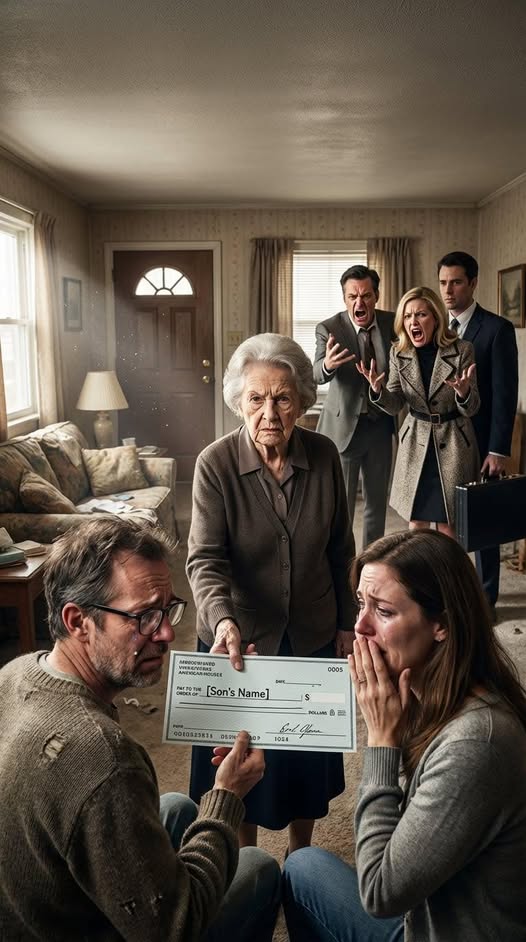
I reached into Robert’s briefcase and pulled out a thick envelope. I walked over to Daniel and pressed it into his chest.
“Open it.”
Daniel’s hands shook as he tore the seal. He pulled out a document.
“It’s… it’s a deed,” he stammered.
“It’s the deed to the Victorian on Elm Street,” I said. “The one with the wrap-around porch you always admired. It’s fully paid for. And there is a check in there for five million dollars. For you. And for Sarah.”
Jessica let out a choked sound. “Five million? Mom, you can’t be serious. That’s… that’s our inheritance!”
“It was your inheritance,” I corrected. “I am rewriting my will this afternoon.”
“You can’t do that!” Michael shouted, the clinical veneer cracking. “We are your children! We made a mistake! We didn’t know it was you… I mean, we didn’t know you were testing us!”
“That is exactly the point, Michael!” I roared, the anger finally breaking free. “You treated a homeless woman like garbage because you thought she had no power! If you had known I was rich, you would have opened the door wide. That isn’t love. That is transaction. And I am done being a transaction.”
I turned to Daniel. “The money is yours. The house is yours. You are the only one who carries my legacy because you are the only one who carries my values.”
Daniel looked at the check, then at his siblings, who were now crying—tears of greed and panic, not remorse.
He looked at me. “Mom… I can’t take this.”
“What?” Jessica shrieked. “Take it, you idiot!”
“I can’t take it if it means destroying the family,” Daniel said quietly. He looked at Jessica and Michael. “They’re lost, Mom. But they’re still my brother and sister. If you cut them off completely… hatred is the only thing that will grow.”
Sarah squeezed his hand. She looked at me. “Linda… punishment doesn’t teach love. It just teaches fear.”
I looked at this woman, this cleaner who possessed more nobility in her little finger than my other children had in their entire bodies. She was pleading for the people who had mocked her for years.
I took a deep breath.
“Fine,” I said. I turned to Jessica and Michael. “Daniel has saved you. Again. I will not cut you out completely. But the ATM is closed. No more allowances. No more bailouts. No more kitchen renovations.”
I leaned in close to them. “If you want to be in the will, you will earn it. You will attend family therapy every week. You will do community service—real service, in the shelters you told me to go to. And you will treat your brother and his wife with the respect they deserve.”
“And if we don’t?” Jessica whispered.
“Then I leave it all to a cat shelter,” I promised. “Try me.”
Chapter 7: The Real Wealth
The black SUVs took Jessica and Michael away. They left quietly, humbled, terrified, and hopefully, on the first step of a very long road to redemption.
I stayed behind in the peeling house.
“The offer for the Victorian house still stands,” I told Daniel. “Please. Let me do this. I want to see Sarah plant flowers in a real garden.”
Daniel smiled, tears streaming down his face. “Okay, Mom. We accept.”
“But,” Sarah added, pouring me another cup of coffee. “You’re staying for lunch. I’m making grilled cheese. And it’s not going to cost $50.”
I laughed. It was a genuine laugh, bubbling up from a place I hadn’t visited in years.
I sat there in that crooked kitchen, wearing borrowed clothes, drinking cheap coffee, surrounded by the only people who had loved me when I was nothing. I thought about my empire, my millions, my skyscrapers.
And I realized that for the first time in my life, I was truly wealthy.
Because money buys houses. But it takes a test by fire to find a home.