The windshield wipers of the Light Medium Tactical Vehicle (LMTV) didn’t just clear the rain; they shrieked against the glass in a rhythmic, agonizing cadence that grated on my nerves. It was two o’clock in the morning, the deadest hour of a Virginia night, and the transport route back to Fort Belvoir should have been a ghost-run—sterile, predictable, and according to the Standard Operating Procedure (SOP).
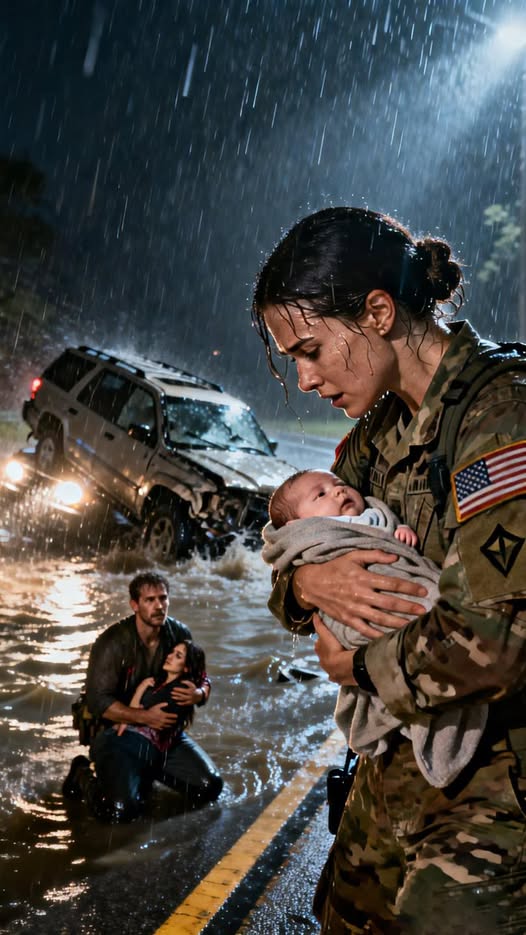
Suddenly, the high beams of my five-ton mechanical beast swept across the muddy shoulder. A civilian SUV lay mangled on its side, half-submerged in a swirling eddy of ink-black floodwater. A man stood in the deluge, his arms flailing with a frantic, primitive desperation. Through the cracked window of the sinking vehicle, I caught a glimpse of a woman. She was huddling over a child whose lips had turned a terrifying shade of cobalt blue.
My stomach didn’t just tighten; it solidified into a cold, jagged knot of granite. The chill racing down my vertebrae wasn’t a product of the cabin’s air conditioning. It was the weight of the operations notebook resting on the passenger seat. Rule Number Four was written in unyielding black ink: Under no circumstances is the transport vehicle to stop for unauthorized incidents.
I gripped the steering wheel until my knuckles resembled bleached bone. My breathing grew shallow, my chest constricting under the Kevlar of my uniform. In the rearview mirror, I saw the father’s eyes—pleading, drilling through the metal plating of the LMTV and deep into my soul. If I maintained my velocity, they would be casualties of the storm. If I depressed the brake, twelve years of a pristine military trajectory would be incinerated by a brutal disciplinary record.
The radio crackled with useless white noise. I ground my teeth together, the taste of salt filling my mouth, and slammed my boot onto the brake. The LMTV skidded across the rain-slicked asphalt, its tires howling in protest. I wasn’t an emotionless cog in a machine. I was Lieutenant Millie Evans, and tonight, I was willing to trade my rank for the breath of three strangers.
I slapped the hazard lights. The amber glow pulsed weakly against the suffocating Virginia dark, a heartbeat in the void. As I kicked the heavy steel door open, the wind nearly tore it from its hinges, threatening to smash my face. The rain didn’t feel like water; it felt like gravel pellets hitting my skin.
I jumped down, the freezing sludge of the backwoods ditch swallowing my boots, and I realized with a jolt of terror that the water was rising faster than the SUV was sinking.
The mud squelched with a sickening, wet sound as it rose past my ankles. The man was hysterical, bashing his bloody elbow against the rear safety glass of the SUV. The storm swallowed his screams, but the raw agony on his face needed no translation.
“My baby! My baby is stuck!”
The SOP manual in my head dissolved. There was no military doctrine for this—only the silent order I’d learned in a small Sunday school back in the Appalachian foothills, years before I’d ever touched a tactical weapon: Do not walk on by.
“Stand back!” I roared over the gale, my voice raw. I ripped the heavy crowbar from the LMTV’s utility mount. With a desperate, sweeping arc, I swung. Crack. The glass shattered into a thousand diamonds of light, and the high-pitched wail of an infant pierced the roar of the thunder.
The woman inside was a portrait of shock, her skin the color of damp parchment. She had curled herself around the child like a human shield, a primal attempt to transfer her last embers of body heat into her baby. I waded into the rushing current, the water tugging at my thighs like invisible, malicious hands. My fingers were numb—clumsy, frozen blocks of ice—as I struggled to hook the heavy steel tow chains onto the SUV’s undercarriage.
Click. Lock. This wasn’t a motorpool drill. This was the razor’s edge of existence. I scrambled back into the high cab of the LMTV, my uniform heavy with swamp mud, and threw the gear into low.
“Come on, big girl,” I whispered, patting the dashboard as if the truck had a soul.
I eased off the clutch. The massive tires spun, spewing a fountain of sludge into the night before they finally bit into the asphalt. The truck groaned, the chains pulled taut with a metallic scream, and slowly, agonizingly, the SUV was dragged from its iron grave and onto the safety of the shoulder.
We didn’t speak during the ride. I couldn’t risk taking them to the base; the MPs at the gate would have arrested me for unauthorized civilians before I could even explain. Instead, I found a Motel 6 fifteen miles off-route, its neon sign flickering like a dying beacon.
I helped them into a room that smelled of bleach and stale cigarettes. It was dry. That was all that mattered. As I turned to leave, the father, shivering under a thin towel, grabbed my wrist. His eyes dropped to the name tag on my sodden jacket.
“Evans,” he rasped, his voice breaking. “You saved my whole world.”
I forced a crooked smile. “Keep that baby warm. That’s your only mission now.”
The drive back to the base was the longest mile of my life. The cabin was a cavern of silence, smelling of wet canvas and the fading tang of adrenaline. I checked the dashboard clock: 0430. I was two hours behind schedule. The military GPS, the Blue Force Tracker, had logged every second of my unauthorized detour in digital red ink.
I started the engine, the bitter taste of bile in my throat, knowing I had just played the Good Samaritan—but in the eyes of the Army, I had just become a deserter.
At 0600, the fist pounding on my door wasn’t a wake-up call; it was a summons. Two military police officers stood in the hallway, their faces as expressionless as statues.
“Colonel Briggs wants to see you, Lieutenant. Now.”
They marched me across Fort Belvoir like a criminal. I was a walking exhibition of my crime. My tactical pants were caked with dried Virginia clay, and my boots squelched with every step. We entered Administration Building A—a glass and steel fortress of bureaucratic efficiency.
Inside the Colonel’s office, the air was set to a crisp 68 degrees, humming with a climate-controlled perfection that felt like a slap. It smelled of expensive coffee and polished wood. A steaming Starbucks cup sat on the corner of his mahogany desk, the green mermaid logo mocking my exhaustion.
Colonel Briggs didn’t look up for fifteen minutes. He left me standing at the position of attention, my knees locked, my body shivering as the AC cut through my damp uniform. A drop of muddy water fell from my hem, landing on his pristine beige carpet with a soft, incriminating plip.
Finally, Briggs removed his reading glasses and looked at the puddle around my boots. His eyes were devoid of humanity; he looked at me the way one looks at a cockroach in a clean kitchen.
“Lieutenant Evans,” he said, his voice quiet but sharp enough to draw blood. “Do you labor under the delusion that the United States Army provides you with a half-million-dollar tactical vehicle so you can operate it as your personal Uber?”
“Sir, there was an overturned vehicle. An infant was dying—”
BAM! Briggs slammed his palm onto the desk. The sound cracked through the room like a pistol shot. I flinched.
“I don’t care if it was the President!” Briggs roared, standing up and circling me like a shark. “Procedure is the spine of this Army. You deviated fifteen miles. You put sensitive cargo at risk because of some bleeding-heart impulse.”
He stopped next to my ear. I could smell his cologne—clean, synthetic, overpowering the scent of the swamp on my skin. “You know, Evans,” he whispered with dripping venom, “I’ve always said females have no place in tactical transport. You’re a liability. You see a few tears and you forget your discipline. It’s biology.”
The insult hit harder than the cold. He was reducing twelve years of service to a gendered stereotype.
“You want to play Mother Teresa?” He sneered, tossing a silver pen at my chest. It hit my jacket and clattered into the muddy puddle at my feet. “Fine. Sign this GOMOR (General Officer Memorandum of Reprimand). As of this morning, your command is stripped. Your driving privileges are revoked.”
He took a slow sip of his coffee. “Tomorrow, you report to Warehouse B. I have a backlog of toilet paper and wool socks that need counting. Stay out of my sight until I decide whether to kick you out of my Army entirely.”
I looked down at the pen lying in the mud. I had saved three lives, and my reward was a burial in a basement.
Warehouse B was located three stories underground—a concrete bunker where the sun was a myth and the air tasted of stale cardboard. It was a necropolis of ambition.
“Beep. 200 pairs of wool socks, size large,” I muttered to the empty aisle.
Every beep of the plastic barcode scanner was a reminder of my fall. Briggs didn’t just want to punish me; he wanted to bore me into a voluntary discharge. By 1200 hours, the silence was deafening. I clocked out and headed to the mess hall, desperate for the sight of a human face.
The moment I stepped into the serving line, the cacophony of the cafeteria dropped into a sudden, sickening hush. Whispers rippled through the room like a contagion. I kept my eyes on my tray, loading it with a dry hamburger patty.
THUD. A shoulder slammed into mine. My water cup tilted, splashing over my hand. I looked up into the grinning face of Lieutenant Miller—a “yes-man” who polished his boots more than he trained his men.
“Whoa there, Evans,” he boomed, playing to the audience. “Watch your step. I heard you’re trying to win a Nobel Peace Prize on the taxpayer’s dime. Next time you want to play superhero, maybe ask permission first.”
A cruel ripple of laughter broke out from the surrounding tables. “Stick to the toilet paper, Evans. It suits you,” Miller sneered.
I sat in the corner, the hamburger tasting like sawdust, swallowing the bitter salt of tears I refused to shed in public. I retreated to the old payphone bank behind the kitchen—a relic of a bygone era that offered a shred of privacy. I dialed my mother’s number in rural Virginia.
“Hello, Millie? Is that you, baby?” Her voice was warm, thick with the accent of the foothills.
“Hi, Mama,” I said, my voice cracking.
“Are you safe? I saw those storms on the news.”
I looked at my dull, scuffed boots. I wanted to tell her I was drowning, that my career was a corpse. “I’m fine, Mama,” I lied, the words feeling like ash. “I got a new assignment. Administrative work. It’s… much safer.”
“Oh, thank you, Jesus. I’m so proud of you, Millie.”
I hung up and slid down the wall, curling into a ball on the cold concrete. A rough, calloused hand appeared in my field of vision, holding a steaming styrofoam cup. I looked up. It was Sergeant First Class Morales, a thirty-year veteran with skin like weathered leather.
“Drink,” he grunted. “Black. It’ll put the steel back in your spine.”
He leaned against the wall next to me. “Don’t listen to those idiots, Lieutenant.” He rolled up his sleeve, revealing a jagged white scar. “Fall of 2004. I got demoted for carrying a wounded Marine onto a chopper instead of securing an ammo crate. Command said I prioritized sentiment over assets.”
He looked at me with intense, unyielding eyes. “Ammo crates can be replaced. Human souls cannot. The Colonel can strip your rank, Evans, but he cannot touch your honor. God is your witness, and that is the only promotion board that matters.”
For the first time in three days, the crushing weight on my chest lifted an inch. In the dark basement of my life, a lighthouse had just flickered on.
The scuttlebutt moved through the barracks faster than a wildfire. By 0400 hours, the base was in a state of controlled panic. General Warren was coming.
General Warren wasn’t a Pentagon bureaucrat. He was the Vice Chief of Staff of the Army, a four-star legend known for eating incompetent commanders for breakfast. His visits were audits of the soul.
Fort Belvoir transformed into what we cynically call a “dog and pony show.” Soldiers were on their hands and knees scrubbing sidewalks with toothbrushes. I even saw a squad spray-painting dying patches of grass green. It was a theater of the absurd, a desperate attempt to hide the rot.
I was counting socks in Warehouse B when the phone rang. It was Briggs. Again.
When I walked into his office, the explosive rage was gone, replaced by a cold, malignant calculation. He was smiling. It was the smile of a shark that had found a bypass around the cage.
“Lieutenant Evans,” he said smoothly. “Redemption is on the table. Tomorrow morning, General Warren will be holding a command briefing. He wants a report on logistical anomalies.”
He stepped closer, his voice dropping to a conspiratorial whisper. “I want you to present the incident from Route 17. But we’re going to frame it correctly. You will tell the General that you had a lapse in judgment—that you panicked due to inexperience. And then you will say that thanks to my swift intervention and disciplinary guidance, protocol was restored. You are the mistake. I am the correction. Do you understand?”
I stared at him, horrified. “Sir, I won’t lie. It wasn’t a mistake.”
Briggs’s smile vanished. “Millie, you have eighteen years of service. You’re two years away from a full pension, guaranteed healthcare, and a secure retirement.” He leaned in until I could smell the coffee on his breath. “If you embarrass me, I will ensure your discharge papers cite gross misconduct. You will leave this Army with nothing but the shirt on your back. You have a choice: be my puppet for ten minutes, or be homeless by Christmas.”
I felt the blood drain from my face. It was a bureaucratic noose. I went back to my quarters and ironed my Class A uniform, the steam rising like a fog that clouded the mirror. I didn’t recognize the woman looking back. I was a coward, terrified of losing a paycheck.
I hung the uniform on the door—stiff, hollow, and perfect. I was no longer a soldier; I was just a prop in Briggs’s theater.
The War Room was colder than a meat locker. It was a windowless sanctuary of mahogany and silver stars. At the head of the table sat General Warren. He didn’t look like a movie general; he was unassuming, with cropped gray hair and eyes that seemed to perceive the molecular structure of the room.
Briggs strode to the front, clicking a laser pointer with the confidence of a man who believed his own lies. “General, as you can see, Fort Belvoir is operating at 110% efficiency,” he boomed.
He clicked through slides of massaged data. “However, we do not tolerate deviation. This brings me to Lieutenant Evans. A case study in failure.”
He beckoned me forward. I walked to the end of the table, my legs feeling like wooden stilts. I snapped to attention, staring at the wall.
“On the night of October 14th,” Briggs continued, “Lieutenant Evans allowed female emotion to override her training. She panicked, abandoned her route, and put the mission at risk. It was a stupid mistake—a lapse in fortitude. However, I intervened immediately, and the Lieutenant has accepted full responsibility.”
Briggs turned to me, his eyes screaming the threat: Say it. Save your pension.
“Lieutenant,” Briggs barked. “Confirm for the General that your actions were a result of poor judgment.”
The script was ready. Yes, sir. I was scared, sir. But my throat had closed up. The silence stretched until it was a physical weight.
“Wait.”
The word didn’t come from Briggs. General Warren slowly closed his folder and removed his glasses. He didn’t look at Briggs. He looked past him, straight at me.
“Lieutenant Evans,” the General said, his voice a low rumble. “Ignore the Colonel’s flowery language. I want to hear it from you. What exactly did you do at 0200 hours on Route 17?”
Briggs turned pale. “General, she is confused—”
“I am asking your soldier, Colonel,” Warren silenced him with a raised hand. “Not you.”
I swallowed hard. The charade was cracking, and I was the only one holding the hammer.
“General,” I said, my voice shaking but the words crystalline. “I did stop my vehicle. But it wasn’t a mistake. I saw an overturned SUV. The water was rising. There was a baby inside, blue from hypothermia. I used my LMTV to tow them because if I hadn’t, they would be dead.”
I braced for the explosion. Briggs was inhaling to bury me, but Warren simply stood up and walked around the table. He stopped inches from me.
“Three questions, Lieutenant. One: was the cargo compromised?”
“No, sir. Seals intact.”
“Two: was the mission completed?”
“Yes, sir. Forty-five minutes late, but delivered.”
“Three: were there any injuries during your operation?”
“No, sir. Everyone walked away.”
Warren turned to Briggs, his eyes blazing with a cold, terrifying fire. “So, Colonel, you tell me that saving three American lives without compromising a single piece of Army property is what you call… stupid?”
Briggs stammered. “General, rules are rules—”
BAM! Warren slammed his hand onto the table. “Reckless? You call that reckless?”
He pulled a grainy black-and-white photo from his pocket and slapped it onto the mahogany. It was a security shot from the Motel 6. It showed my LMTV parked sideways, shielding the battered SUV from the driving rain.
“I received a phone call at 0300 that night,” Warren’s voice trembled. “From a man who thought he was going to die in a ditch. He told me a soldier stopped when no one else would.”
Warren pointed a shaking finger at the photo. “That man in the car, Colonel, is my son-in-law. The woman holding the baby is my daughter, Sarah.”
A collective gasp sucked the air out of the room.
“And that blue-lipped infant?” Warren took a step closer to the shrinking Colonel. “That is my only grandson.”
The silence was absolute. Briggs looked like he’d been punched in the gut. His silver pen slipped from his sweaty fingers and clattered onto the floor, rolling away into the shadows.
“You saved my whole world, Evans,” Warren whispered, his hand resting on my shoulder in a gesture of desperate gratitude.
He turned back to Briggs. “You measures leadership by spreadsheets and creased uniforms. But you almost crushed the only officer in this room who still has a moral compass.”
Warren picked up the GOMOR—the career death sentence Briggs had forced me to sign. With a slow, deliberate motion, he tore it in half. RIP.
“Colonel Briggs, you are relieved of command. Effective immediately. I am transferring you to the records archive at the Pentagon. Basement Level 4. No windows, Colonel. Just miles of files and dust. You can count paper clips until your heart is content. At least there, you can’t hurt anyone else.”
As Briggs shuffled out of the room like a ghost, General Warren turned to me, and the steel in his eyes melted away.
One week later, the sun was blazing over the parade field at Fort Belvoir. The entire transport battalion was assembled in a sea of camouflage.
I marched to the center of the field. General Warren stood there, flanked by the American flag. He reached out and removed the silver bar from my chest—the rank of First Lieutenant. In its place, he pinned a gold oak leaf.
I had skipped an entire rank. I was now Major Millie Evans, the new battalion commander.
“I don’t want another Briggs running this unit,” Warren said as he adjusted my collar. “I want someone whose conscience leads the way.”
But the promotion wasn’t the biggest victory. Before dismissing the troops, the General announced a new standing order: Regulation 19-C, officially known as the Samaritan Rule. It authorized any military personnel to utilize government assets to provide emergency assistance to civilians in life-threatening distress without fear of reprisal.
Kindness had been codified into law.
As the formation broke, Lieutenant Miller approached me. The arrogant sneer was gone. He twisted his cap in his hands, looking at his boots. “Major… I was a jerk. I’m sorry.”
I looked at him, remembering the humiliation in the mess hall. I could have sent him to the basement. But I thought of Morales.
“It’s forgotten, Lieutenant,” I said, extending my hand. “Just remember: never laugh at someone trying to do the right thing. You never know when you’ll be the one in the ditch.”
Miller saluted—a genuine, sharp salute. I watched him walk away and realized I was exactly where I belonged.
One year later, the dogwood trees were shedding russet leaves outside my office. The door was open, and the smell of cheap, honest drip coffee filled the room. Warehouse B was no longer a threat; it was just a place where we kept the extra socks.
My unit was now known as the Samaritan Squad. In twelve months, my drivers had assisted in over fifty roadside emergencies. We proved that you could deliver cargo on time and still carry hope.
I picked up a letter that had arrived in the morning mail. It was from Ohio—from a former Colonel named Briggs. He was volunteering at a Red Cross distribution center. He wrote that for the first time in twenty years, he was sleeping through the night. He thanked me for the hardest lesson of his life: that honor isn’t worn on the shoulder; it’s carried in the chest.
I looked at the only decoration on my desk—a cheap black plastic frame holding that grainy Motel 6 photo. On the back, General Warren had written: For the days when the storms return. So you never forget what real courage looks like.
I keyed the radio handset, my voice steady and calm.
“Attention all Samaritan stations. This is Samaritan 6. Heavy weather incoming. Visibility near zero. Your mission is to get the payload to the destination.”
I paused, looking at the photo. “But remember your standing orders. Keep your eyes open. If you see someone in trouble, you stop. We don’t leave anyone behind in the dark. Samaritan 6 out.”
The truest test of character isn’t what you do when the General is watching. It’s what you do in the dark.
What would you have done? Would you have kept driving to save your career, or would you have hit the brakes for a stranger?
The ledger of honor is always open. Drive safe.
The story of Millie Evans reminds us that rules are the scaffolding of society, but humanity is the foundation. When the two conflict, the choice defines the soul. Real leadership isn’t about the absence of emotion; it’s about the presence of courage.
If this story resonated with you, share your thoughts. Have you ever had to choose between a rule and your heart?
Because in the end, we are all just drivers in the storm, looking for a light in the dark.