I waited a long time to become a mother. Not in a cinematic way—no dramatic montages, no public declarations. Just quiet years of hoping, then swallowing disappointment, then smiling through other people’s announcements while telling myself, someday.
Raymond and I talked about it late at night, in that soft, careful tone couples use when they’re afraid a dream might vanish if they name it too loudly. We planned. We budgeted. We promised each other we’d do it right if it ever happened.
When it finally did, I felt two things at once: joy so sharp it almost hurt, and fear that I would somehow lose it.
Pregnancy wasn’t gentle with me. I was tired in a way sleep couldn’t fix. My back felt like it was made of glass by the third trimester. My ankles ballooned by afternoon. Some days I moved like my body belonged to someone else and I was borrowing it under strict terms.
Ray tried to be steady for both of us. He read every article, downloaded every app, set reminders for appointments, and spoke to my belly when he thought I wasn’t paying attention.
“This kid is already tougher than both of us,” he’d say, pressing his palm to my stomach like he could pass courage through skin.
We prepped the house slowly—crib catalogs, paint swatches, lists taped to the fridge. Ray promised he’d take time off work for the first week. He said it so many times it became a mantra.
“I’ve got you,” he told me. “You won’t be alone in this.”
So when labor came and took everything out of me—hours of pain, a body splitting itself open to create a new life—I held onto that promise like it was a rope. I believed him. I believed the life we’d built was stable enough to hold this new weight.
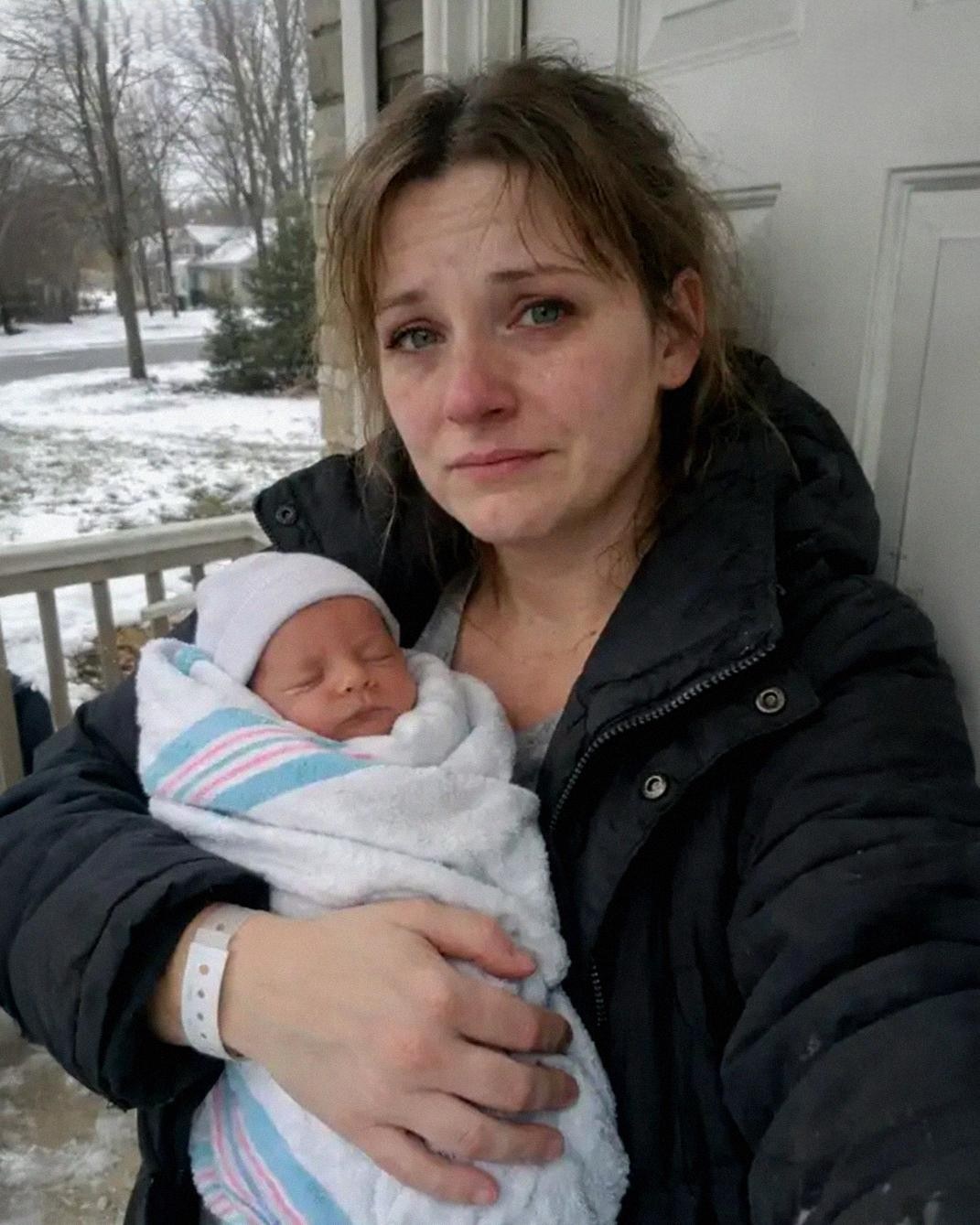
Two days later, I walked out of the hospital with our daughter bundled against my chest, exhausted and sore and overflowing with that stunned, primal love that makes you feel like your heart has been replaced by something bigger and more fragile. I expected the world to look different. I expected my home to feel like a landing pad.
Instead, I stood on our front porch at three in the afternoon and couldn’t get in.
The key wouldn’t turn.
At first I blamed myself. Sleep deprivation makes you clumsy. I tried again, slower. Then again, harder. Nothing.
Ray’s car sat in the driveway. The house was quiet. The curtains were drawn the way we always kept them. Everything looked normal except for the fact that I was locked out of my own home with my newborn.
I knocked gently. Then louder.
Footsteps sounded inside.
“Raymond?” I called, shifting the baby carefully. “The key isn’t working. Can you open the door?”
Silence stretched long enough to make my stomach drop.
Then his voice came through, muffled, like it was being filtered through something heavy.
“Penelope… please just go.”
I stared at the door. “What?”
“I need space,” he said. “Please don’t make this harder.”
For a second I actually laughed, because it was so absurd my brain tried to protect me by treating it like a joke.
“Space?” I whispered. “Ray, I just gave birth to our child. This is our house. Open the door.”
More silence. I heard movement, scraping—like something being dragged. The baby started to fuss against my chest, that tiny restless squirm that comes before a full cry.
“Ray!” I knocked again, sharper now. “Open the door. What’s going on in there?”
“I can’t,” he said. His voice cracked, just slightly. “Please. Go to Vanessa’s. Just for now.”
My hands began to shake. Not from cold. From a sudden, nauseating fear that I’d walked straight into a life I didn’t recognize.
“Fine,” I said, forcing the word out through my teeth. “I’ll go to Vanessa’s. And when I come back, you’d better be ready to explain why you just locked your wife and newborn out like strangers.”
He didn’t answer.
I turned away before I did something humiliating like beg. I walked down the steps, each one feeling like an exit from everything I thought was solid.
The Uber ride to my sister’s apartment blurred into a fog of shock. I remember my daughter asleep against me, her tiny mouth pursed like she was dreaming of warmth. I remember staring at her and wondering how a man could kiss her forehead one day and shut a door in her face the next.
Vanessa opened her door and her expression went from confusion to fury in a heartbeat.
“What happened?” she demanded.
“He changed the locks,” I said, and hearing it out loud made it sound even more impossible. “He told me to leave.”
Vanessa’s face hardened like stone. “He did what?”
I told her everything—Ray’s voice, the words space and please go, the way he wouldn’t open the door. She grabbed her phone immediately.
“I’m calling a lawyer,” she said.
“Wait,” I whispered, because part of me still believed there had to be a reason. “Something’s wrong. This doesn’t add up.”
Vanessa looked at me like I was bleeding and didn’t know it. “Penny… he locked you out with a newborn. There’s no explanation that makes that okay.”
But my mind kept replaying the hospital. Ray crying when the baby arrived. Ray kissing my forehead. Ray whispering, “We did it.” That was the same man, wasn’t it?
I didn’t sleep. The baby woke every two hours to nurse, and each time I stared at the ceiling, trying to find the moment where my life had quietly cracked in half. I called Ray three times. Straight to voicemail. I texted twice. No answer.
By morning, shock had hardened into a plan. I’d go back with Vanessa, pack what I needed, and figure out how to be a single mother. I wouldn’t beg someone to want me.
Just before noon, someone started pounding on Vanessa’s door like they were trying to break through the frame.
Vanessa stormed toward it. “Get out of here, Ray! You should be ashamed of yourself!”
“I’m not leaving until I talk to Penelope!” Ray shouted back, his voice raw and ragged. “Please—this is life or death!”
Life or death.
I stood up with my daughter in my arms and walked to the hallway. Vanessa opened the door just enough to block him with her body.
Ray looked wrecked. Hair messy. Eyes red. Clothes streaked with paint. His hands were trembling like he’d been running on adrenaline for a day straight.
When he saw me, relief hit his face so hard it made him look younger and more broken.
“Penny,” he said, almost choking on my name. “Please. Come with me. Ten minutes. That’s all I’m asking.”
Vanessa’s voice cut through him. “You locked her out with a newborn. Ten minutes for what—another lie?”
“I know how it looks,” Ray said. “I know. But please. Just trust me. Ten minutes.”
He wasn’t yelling now. He wasn’t angry. He looked scared in a way I’d never seen before, like the ground under him wasn’t real.
“Ten minutes,” I said, my voice flat. “After that, I’m done.”
The drive back to our house was silent. Ray gripped the wheel like he didn’t trust himself not to shake it apart. There was drywall dust on his jeans. Paint under his fingernails. In the back seat, a brand-new car seat was installed—properly, tightly, like he’d checked it ten times.
“Ray?” I tried.
“Please,” he said softly. “Just… two more minutes.”
We pulled into the driveway. He got out fast, came around, and helped me carefully with the baby as if one wrong move might shatter the world.
“I couldn’t explain it over the phone,” he said, swallowing hard. “Just… look.”
He unlocked the front door. The new locks gleamed.
The door opened.
And I stopped breathing.
The air inside smelled like fresh paint and something floral—lavender, maybe. The lighting in the entryway was softer. Warmer. A plush rug I’d never seen stretched across the floor. The walls that used to be a tired beige were now a clean cream, brightened but not sterile.
“Ray, what—”
“Keep going,” he whispered.
I walked down the hallway as if I’d stepped into a version of my life someone had rebuilt overnight. There was a handrail by the tub in the bathroom, and a cushioned mat on the floor, like someone had thought about my sore body and how unsteady I felt lately. In our bedroom, blackout curtains had been installed, and beside the bed sat a bassinet ready to hold our daughter close.
Then I reached the nursery.
And my throat closed.
The room wasn’t magazine-perfect. It wasn’t staged for a photo. It was perfect for us. Soft gray and blush tones. White furniture. A rocking chair in the corner with a lamp and a little table. Shelves lined with books and stuffed animals arranged with careful hands, not stylish hands. Loving hands.
Above the crib, in hand-painted letters, it read: Welcome, Little One.
I started crying so hard my knees went weak.
Ray stood in the doorway watching me with wet eyes, his face tight with something like shame and pride braided together.
“You did this?” I whispered.
“I tried,” he said. “I wanted you to come home to rest. Not chaos. Not half-finished boxes. Not you having to manage anything except her.”
We sat at the kitchen table while the baby slept in the bassinet he’d set up. The house felt like a cocoon—quiet, softened, made for recovery.
Ray’s hands shook as he explained.
“When the doctors said you’d need to stay two extra days, I saw a window,” he said. “I panicked, but in a different way. The crib was still in boxes. The nursery paint needed fixing. Tools were everywhere. I thought if you came home and saw it unfinished, you’d know what I was trying to do and it would ruin the surprise.”
He rubbed his face with both hands, leaving a faint smear of paint on his cheek.
“I called in favors,” he said. “My brother helped paint. A coworker’s wife helped pick out what we still needed. I worked nonstop. I didn’t sleep. And then you showed up early and I… I froze. I didn’t know how to tell you, ‘Please don’t come in, I’m trying to build you a soft place to land,’ without sounding insane.”
My voice came out thin. “So you locked me out.”
He flinched. “I thought you’d go to Vanessa’s for one night. I told her the plan. She agreed. I told myself it would be okay if I just finished. I didn’t stop to think what it would feel like for you. Standing outside with our baby. Not being able to get in.” His voice broke. “I should’ve answered your calls. I should’ve told you the truth. But I was covered in paint and fear and stupidity.”
“You scared me,” I said, barely above a whisper. “I thought you didn’t want us.”
His face crumpled. “God, Penny. No. I watched you carry her for nine months. I watched you suffer. I watched you go through labor. And I felt useless. Like you gave everything and I had nothing to offer back. This was the only way I knew how to say, ‘I see you. I’m grateful. I’m here.’ And I did it in the worst possible way.”
A knock came at the door.
Vanessa stood there looking almost guilty, which was rare for her.
“You knew?” I demanded.
She shrugged. “He told me two weeks ago. When you called me yesterday, I was ready to drag him into court. Then he texted me panicking and told me to stall you. So I did.” She smiled faintly. “The screaming this morning? Had to sell it.”
I looked at Ray, who was holding our daughter now, swaying gently like he’d been doing it forever.
“Life or death,” I said, remembering his words at Vanessa’s door. “Why did you say that?”
Ray met my eyes, and his were still wet. “Because it felt like it,” he said quietly. “I didn’t know how to be the husband and father you both deserve. I thought if I couldn’t get it right… I’d fail you from day one. It wasn’t logical. It was just fear.”
I let out a sound that was half laugh, half sob. “You’re both insane.”
Vanessa lifted her hands. “Yeah. But he loves you. Deeply.”
I stared at the nursery doorway, at the small careful changes around the house, at the evidence of a man trying to be good and tripping over his own plan.
I looked at my daughter’s sleeping face.
Then I looked back at Ray.
“I’m still angry,” I said. “And you still owe me a serious apology.”
He nodded immediately. “I know.”
“But,” I added, voice cracking, “I also see what you were trying to do.”
Ray’s shoulders sagged with relief.
For the first time since leaving the hospital, I felt something settle in my chest: not just love, but steadiness. The kind of steadiness you need to raise a child. The kind you build, mistake by mistake, apology by apology, together.