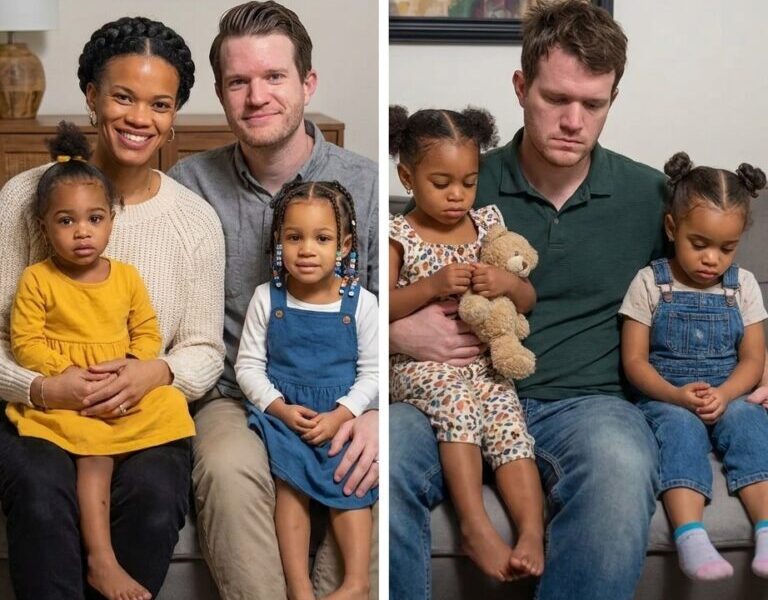
I never thought a single night could hold that much terror, that much clarity. It began with pain—sharp, rolling contractions—and ended with a truth that changed the way my husband and I understood love forever. Between those two points was fear so thick I could taste it, and a silence that almost cost us everything.
Earlier that day, my husband and I had argued. Nothing dramatic, nothing explosive—just the kind of disagreement that leaves tension hanging in the air, unresolved and heavy. We went about our evening separately, both convinced we had time to cool off, time to talk later. We always thought there would be a “later.”
Then the contractions started.
At first, I tried to stay calm. I timed them, breathed through them, told myself it was probably still early. But as the pain sharpened and the rhythm tightened, instinct kicked in. I reached for my phone and called him.
No answer.
I called again. Still nothing.
Each unanswered call made the room feel smaller, the fear louder. I texted. I called. I watched the screen light up and go dark over and over, my hands shaking, my heart racing ahead of my body. By the tenth call, I was crying. By the twentieth, panic had settled into my bones. By the thirtieth, I knew I couldn’t do this alone.
My brother arrived within minutes of my call to him. He didn’t ask questions. He didn’t hesitate. He just helped me into the car and drove. His presence was steady, grounding, a quiet anchor in a moment that felt like it was spinning out of control. Every contraction tore through me, but the physical pain wasn’t what hurt the most. What hurt was the absence. The empty passenger seat where my husband should have been. The realization that at the moment I needed him most, I couldn’t reach him.
At the hospital, the lights were too bright, the hallways too long. Nurses moved quickly, voices calm and efficient, while I focused on breathing and not falling apart completely. Between contractions, I stared at my phone, willing it to ring. It stayed silent.
Hours passed like that—pain, fear, waiting. Somewhere in that blur, my husband finally called back.
My brother answered.
His voice broke when he spoke. He didn’t yell. He didn’t explain. He simply said four words that were meant to shock, meant to wake something up that had gone dangerously numb.
“She didn’t make it.”
Those words landed exactly as intended.
My husband later told me he dropped the phone. That his legs gave out beneath him. That every missed call replayed in his head at once, each one a reminder of how careless he’d been with time, with attention, with love. He drove to the hospital in a daze, barely aware of the road, convinced that he had lost me—that his silence had become irreversible.
When he arrived, he sat in the waiting room, hollow and shaking, waiting to be told what he already believed was true. Minutes stretched. Guilt pressed down on him until it was hard to breathe.
Then the doctor appeared.
The words that followed shattered the nightmare and replaced it with something just as overwhelming. I was alive. Exhausted, shaken, but alive. And in my arms was our daughter.
My husband broke down completely.
Relief and guilt collided in him all at once. He sobbed without restraint, holding both of us as if letting go might make us disappear. The words he tried to say—apologies, regret, love—tangled together, raw and unfiltered. My brother’s lie had been brutal, but it had served a purpose. It forced my husband to face how close he had come to losing everything that mattered.
In the weeks that followed, something shifted.
There were no grand speeches, no dramatic promises. Instead, there was presence. Real presence. He was there for the early-morning feedings, even when he was exhausted. He changed diapers without being asked. He learned the rhythms of our daughter’s cries. He held me longer, touched my hand more often, looked at us like he was memorizing every detail.
Love stopped being theoretical.
It became action.
Our relationship didn’t magically become perfect. We still disagreed. We still got tired, still snapped at each other sometimes. But the way we fought changed. The way we listened changed. Silence no longer felt safe. We talked things through because we understood what silence could cost.
Sometimes, late at night, I watch him rock our daughter to sleep. His voice always softens when he talks to her, and there’s a tremor there he doesn’t bother hiding. He whispers the same sentence every time, like a confession and a promise rolled into one.
“I almost lost both of you.”
That night stripped something away from us—pride, distraction, the illusion that time is guaranteed. What it left behind was something sturdier. A love that isn’t loud, but steady. A love that doesn’t assume tomorrow will fix what we avoid today.
I learned something too. I learned that strength isn’t just surviving pain; it’s letting it change you. It’s allowing fear to teach you what matters instead of hardening you. I learned that love isn’t proven in calm moments, but in how deeply it shows up when everything is on the line.
We came frighteningly close to a different ending. One where regret would have been permanent. One where apologies would have arrived too late. That knowledge stays with us—not as a threat, but as a reminder.
Life doesn’t always warn you when a moment will matter forever. Sometimes it just arrives, unannounced, and demands that you pay attention. Almost losing someone can break you. But it can also burn away what’s false and leave behind something honest.
Our love didn’t become flawless that night.
It became real.
And real love—the kind built on presence, humility, and the courage to be vulnerable—is the kind that lasts.