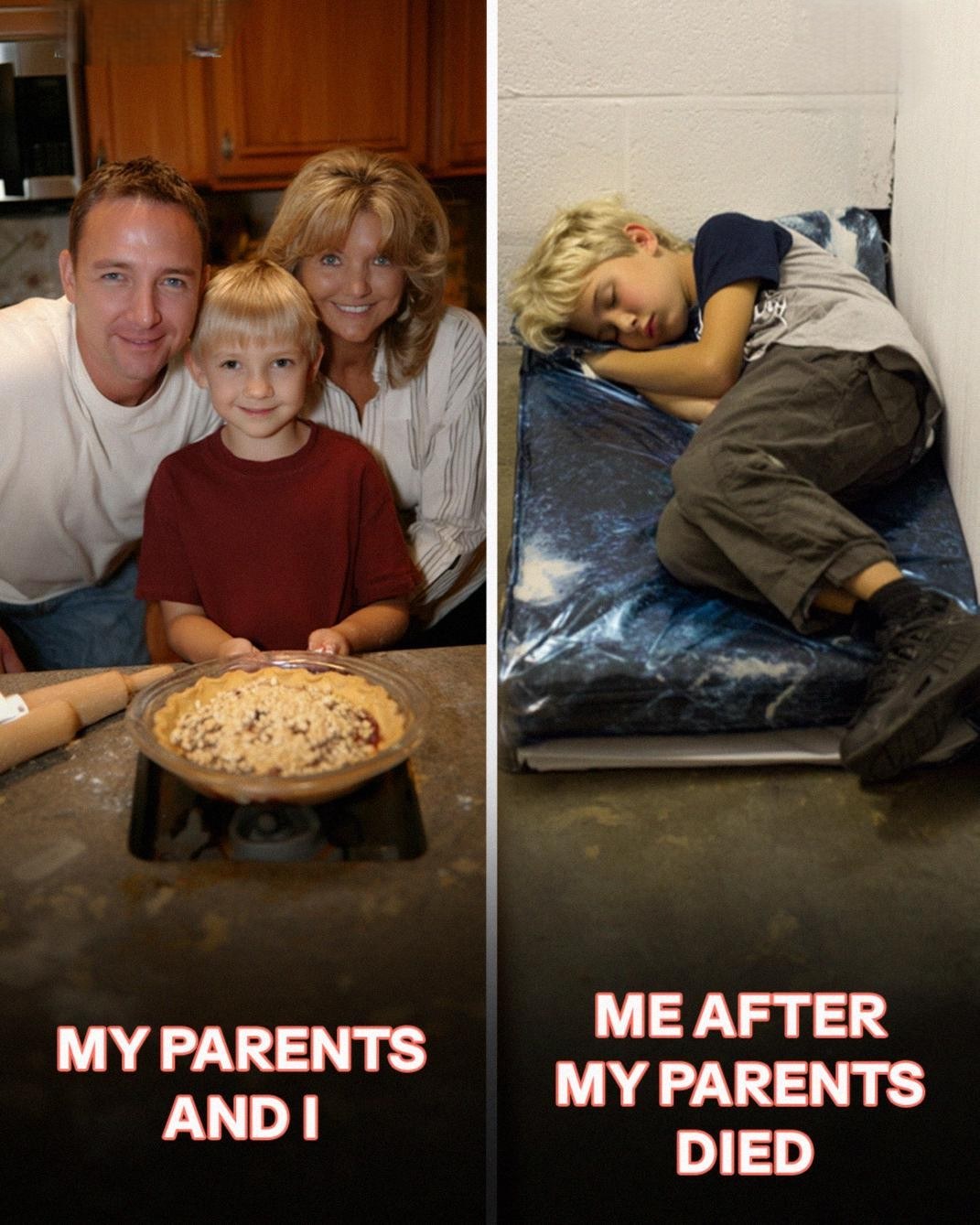
When my parents died, I was ten years old and convinced the world had simply stopped.
It was winter, the kind that makes everything feel muted and far away. Snow piled up along the roads, and later people would talk about black ice and bad visibility, as if naming the conditions could soften what happened. My parents, Claire and Michael, left the house that night and never came back. By morning, our life was already being spoken about in the past tense.
At the funeral, I stood beside a closed casket in a borrowed coat, too small for grief and too big for my body. That’s when my aunt Linda appeared. My father’s sister. She cried loudly, hugged me tightly, and made sure everyone saw her do it.
“I’ll take Ethan,” she announced. “Of course I will.”
She said it like she was rescuing a stray. Like I should be grateful she’d chosen me.
At her house, the performance ended. I was given a small room at the back—no bed, just a thin mattress on the floor and a blanket that smelled like dust and forgotten things. Her children slept in bunk beds with real sheets and shelves lined with toys. I slept in a corner and learned how to stay quiet.
The first night, I asked about my things. Clothes. Photos. My parents’ books.
“Later,” Linda said, already walking away. “You don’t need much.”
Later never came.
I didn’t know then that my parents had left money for me. Not a fortune, but enough to protect me. College savings. Insurance. A plan. Linda knew. Linda handled it.
I was ten, so I didn’t understand what “handling it” really meant. I just noticed that soon after, the kitchen got remodeled. Then a new car appeared in the driveway. My cousins started piano lessons. Tennis. Tutors.
One day, staring at a polished piano case, I asked if it came from my parents’ money.
Linda didn’t even look at me. “Be grateful you’re not in foster care.”
That sentence shut a door inside me. I stopped asking questions. I learned that survival meant silence.
A year later, she sent me to boarding school. Said it was for my own good. At first, she called once a week. Then once a month. Then not at all. By the time I graduated, I went back to my parents’ house out of instinct more than hope.
A stranger answered the door.
“We bought this place years ago,” he said gently.
Linda had sold it. And vanished.
After that, my life became very small. I slept on couches. Friends’ couches. Coworkers’ couches. Once, the couch of a man I barely knew who found me asleep in the break room and pretended not to notice.
I worked jobs that didn’t ask questions. Dishwashing. Stocking shelves overnight. Cleaning offices after hours. I saved every dollar, not out of discipline, but fear. Fear that if I stopped moving, everything would disappear again.
I wasn’t gifted. I wasn’t brilliant.
I was stubborn.
I got into culinary school and worked nights. Studied mornings. Slept whenever my body gave out. While others talked about vacations and family dinners, I talked to mixers and ovens. Food didn’t ask where I came from. It only asked for patience and care.
Years passed. Slowly, painfully, things grew. I became a pastry chef. Then a good one. I opened a small place of my own—nothing fancy, but warm. People came for dessert and stayed because it felt safe there.
Eventually, I bought a house. Not big. But mine.
That’s when Linda knocked on my door.
Three sharp knocks. Not polite. Not hesitant.
I checked the peephole and felt my chest tighten. She looked smaller now. Older. Her coat was too thin. Her purse clutched like a life raft.
“It’s cold,” she said. “You have to let me in.”
I didn’t. Not right away.
“I’m sick,” she added quickly. “My heart. The doctor says I shouldn’t be alone.”
“Call your kids,” I said.
“They don’t talk to me.”
I should have closed the door. Instead, I remembered being ten years old, standing in someone else’s house, afraid to take up space.
I let her in.
She recovered fast. Too fast.
Within days, she stopped clutching her chest. The trembling hands vanished. The pills only appeared when she thought I was watching. She started rearranging my kitchen, opening my mail, criticizing how I lived.
“This place needs guidance,” she said once, smiling. “You live like a man who never had anyone to show him how.”
That should have been my warning.
One night, I found her in my closet, holding a box I’d told her never to touch. Inside were the few things I’d saved from my parents. Photos. My mother’s scarf. Her recipe notebook.
Linda flipped through it, unimpressed.
“She really thought she was special,” she said.
Then she found the envelope taped inside the cover. A tiny brass key fell into her palm. Her expression changed instantly—sharp, focused.
“Well,” she said slowly. “That explains a lot.”
That night, I didn’t argue. I didn’t shout. I went to the bank the next morning. The one my parents had trusted.
The manager listened, nodded, and brought out a folder.
“The box was opened once,” he said. “Your aunt tried. She wasn’t authorized.”
Inside was the truth. A trust. Modest, but real. Money meant for me. And a letter from my mother.
She wrote that some people confuse love with control. That she’d hidden the key where only I would keep it.
I went home calm.
Linda was at my table, sorting my mail.
“I know why you’re here,” I said. “You have a week.”
She scoffed. Then she packed.
When the door closed behind her, the house felt lighter.
That night, I baked. Not for customers. Not for profit. Just for me.
The kitchen filled with warmth and familiar smells. For the first time, I wasn’t guarding my past.
I was finally living in it.