The winter afternoon was biting, the kind of cold that seems to seep through layers of wool and settle deep in your bones. I had ducked into a small, local café, desperate for nothing more than a steaming cup of coffee and a few moments of thaw. The air inside smelled of roasted beans and cinnamon, a sharp contrast to the grey slush of the streets outside.
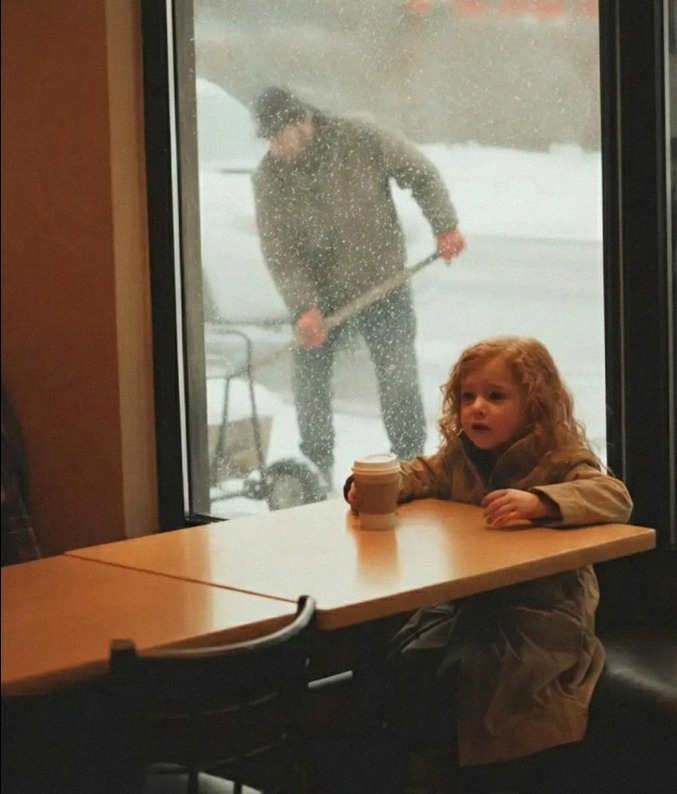
As I waited for my order, my attention was drawn to a table by the window. A young girl, perhaps ten years old, sat perfectly still. In front of her was a cup of tea, the steam long gone, untouched. What haunted me wasn’t her stillness, but the quiet, rhythmic way tears were rolling down her cheeks, dripping steadily into her cup. It wasn’t the loud, attention-seeking wail of a child who had scraped a knee; it was the heavy, private grief of a soul carrying a weight far beyond its years.
I felt like an intruder, but I couldn’t bring myself to look away. Something about her solitary sorrow pulled at me until I found myself standing by her table.
“Hi there. Are you okay, sweetheart?” I asked softly.
She looked up, her eyes red-rimmed and hollow, and shook her head. “Today is my mom’s birthday,” she whispered, her voice trembling. “She died four years ago.”
I pulled out a chair, my heart sinking. “I am so incredibly sorry.”
“She loved cupcakes,” the girl continued, wiping her eyes with a frayed sleeve. “Since I was little, I always made her one or bought her one. Even when she was in the hospital. But today… Dad and I didn’t have enough money. He told me to wait here where it’s warm while he finished his shift.”
She pointed through the glass. Outside, a man in a thin, worn jacket was rhythmically shoveling heavy snow from the sidewalk. His hands were raw and crimson from the cold, his breath hitching in white clouds. He was a city cleaner, working extra hours on the hardest day of his year just to keep their heads above water.
In that moment, the world felt unnecessarily cruel. I walked to the counter and, in addition to my coffee, ordered two vanilla cupcakes topped with high swirls of pink frosting and silver sprinkles. When I brought them back to the table, the girl’s eyes widened until they were like saucers.
“One is for you, and one is for your dad,” I told her. “So you can keep your tradition alive.”
The smile she gave me was radiant, a sudden burst of light that seemed to warm the entire room. “Thank you,” she whispered. “He says Mom wouldn’t want us to give up.”
I watched her for a moment, moved by the resilience of this small family. Before I left, I reached into my purse. I had just cashed a bonus check, and while five hundred dollars was a lot of money, it felt like paper compared to the struggle I was witnessing. I quietly tucked the bills under her empty teapot.
“Give this to your dad when he comes in,” I said. She didn’t look at the money; she just jumped up and hugged me with a strength that nearly took my breath away.
I walked out into the cold feeling a rare sense of peace. I believed that kindness was a closed loop—you do something good, the world gets a little better, and you move on. I never could have imagined that, three days later, that loop would tighten into a noose.
The knock on my door was loud and official. When I opened it, two police officers were standing on my porch, their expressions unreadable and stern.
“Ma’am, were you at the café on Tuesday? Did you interact with a minor and provide her with cupcakes and a large sum of cash?” one officer asked.
“Yes,” I stammered, my pulse beginning to hammer against my ribs. “Is something wrong? Is the girl okay?”
“We need you to come down to the station to clear a few things up,” he replied, his tone chillingly neutral.
The ride to the station was a blur of mounting anxiety. I ran through every possible scenario. Had I violated some obscure local ordinance? Was it illegal to give cash to a child? At the station, I was led into a grey, windowless interview room. A camera in the corner blinked with a steady, judgmental red light.
The interrogation was polite but relentless. They asked if I knew the girl, if I had ever sought her out before, and why I would give such a specific amount of money to a stranger. As I explained the story—the anniversary, the cupcakes, the father shoveling snow—the officers exchanged glances that made my stomach churn. In the sterile light of a police station, my act of empathy was being dismantled and reassembled into something that looked like “grooming” or “suspicious behavior.” I felt the walls closing in, the horrifying realization that in a cynical world, no good deed goes unpunished.
“You have to understand,” the lead officer said, leaning forward. “When an adult targets a child with expensive gifts and cash without the parent’s knowledge, it triggers a welfare report. We have to investigate the intentions.”
“Targeted?” I choked out the word. “I was helping a crying child!”
The door to the room suddenly swung open. An older sergeant entered, followed by a woman in a flour-dusted apron—the café owner—and the man from the sidewalk. He looked even smaller without his shovel, his eyes wide with a mixture of panic and deep-seated shame.
“That’s her,” the father said, pointing a trembling finger at me. “That’s the lady.”
I braced myself for an accusation, for the final blow that would ruin my life. But the man didn’t look angry. He looked broken.
“Sir, tell the officers why you contacted us,” the sergeant commanded.
“I didn’t mean for this to happen!” the father cried out, his voice cracking. “I went back to the café to find out who she was. I wanted to thank her, but I was also scared. I thought… I thought maybe I should report the money so no one thought I stole it. I didn’t know how to find her legally.”
The café owner stepped forward, holding her phone. “I told him to talk to the police to be safe, but I also brought the security footage. Look at this.”
She played a clip on the screen. It showed the entire interaction: me standing tentatively by the table, the girl’s hesitant nod, the cupcakes, and the hug. It showed me leaving the money and walking away without looking back. It was the undeniable anatomy of a selfless act.
The atmosphere in the room shifted instantly. The tension evaporated, replaced by a heavy, awkward embarrassment. The sergeant sighed, looking at his junior officers. “This was logged as a predatory welfare concern. It’s clearly a misunderstanding of the highest order.”
He turned to me. “You’re free to go, ma’am. I’m sorry for the inconvenience.”
“Inconvenience?” I whispered, my legs shaking as I stood up. I had been treated like a criminal for an hour.
The father followed me out into the hallway. “I am so sorry,” he said, his eyes moist. “My daughter… she thinks you’re an angel. That money… it paid our rent for two months. It changed everything for us. I just wanted to do the right thing by reporting it, I didn’t know they’d bring you in like this.”
I looked at him—a man who had been so beaten down by life that he was terrified of a miracle. I realized then that the suspicion of the police and the fear of the father were both symptoms of a world that has forgotten how to handle pure, unvetted kindness.
“It’s okay,” I said, and I realized I meant it. “I’m just glad you’re okay.”
As I walked back out into the winter air, I felt the sting of the cold again, but it didn’t feel as bitter. I had learned a frightening lesson about how easily light can be mistaken for shadow. But as I thought of the girl’s smile and the cupcakes with the pink frosting, I knew the answer to the question I had asked myself in that grey room.
I would do it again. Every single time. Because if we let the fear of being misunderstood stop us from helping one another, then the cold truly wins.