Thanksgiving was supposed to be the one day where the chaos of the world stayed firmly outside our front door. My vision for the holiday was simple, perhaps even modest: I wanted a home-cooked meal, the children in their pajamas, and an absolute lack of the usual familial dramas. I spent the morning in a kitchen that smelled of rendered butter, sage, and the sweet, sharp scent of cooling pumpkin pies. The house felt like a sanctuary, alive with the sounds of Emma, our six-year-old, and Noah, our four-year-old, as they transformed the living room into a kingdom of blankets and pillows.
I had been married to Lochlan for nine years, and I thought I knew the rhythm of his soul. He was usually the stabilizer, the man who managed the kids while I navigated the stress of holiday cooking. But as we finally sat down to the table—the turkey golden and the mashed potatoes piled into ivory peaks—Lochlan was elsewhere. He wasn’t the man I knew. He sat at the end of the table, his plate untouched, his eyes glued to the glowing screen of his phone. I watched the tight, rhythmic twitch in his jaw, a telltale sign that he was trapped in a mental spiral.
“Everything okay?” I asked, trying to keep my tone light as I passed the gravy. He mumbled something about work, never once making eye contact. By the third time I checked on him, he didn’t even bother to respond. Then, without warning, the screech of his chair against the hardwood floor cut through the children’s laughter.
“I need to step out. I’ll be right back,” he said, grabbing his jacket with a frantic energy that bordered on panic. Before I could even process the words, the front door clicked shut. I stood there, a serving spoon trembling in my hand, watching the steam rise from a dinner that was suddenly cold.
The silence that followed his departure was deafening. I told myself it was a work emergency—a server down, a crisis only he could solve. But as the hours bled into the night, the excuses began to crumble. My messages remained on “Delivered,” and eventually, his phone went straight to voicemail. For the first time in our marriage, he had disabled his location. I spent the night paced between the window and the front door, jumping at the sound of every passing car, my heart a heavy, cold stone in my chest.
Friday was a blur of terror and fury. I called his coworkers, who knew nothing. I called the police, who told me that a grown man missing for less than twenty-four hours wasn’t a priority unless there was blood on the floor. I had to face my children—explain why Daddy wasn’t there to eat the leftovers, why he hadn’t tucked them in, and why his side of the bed remained perfectly flat.
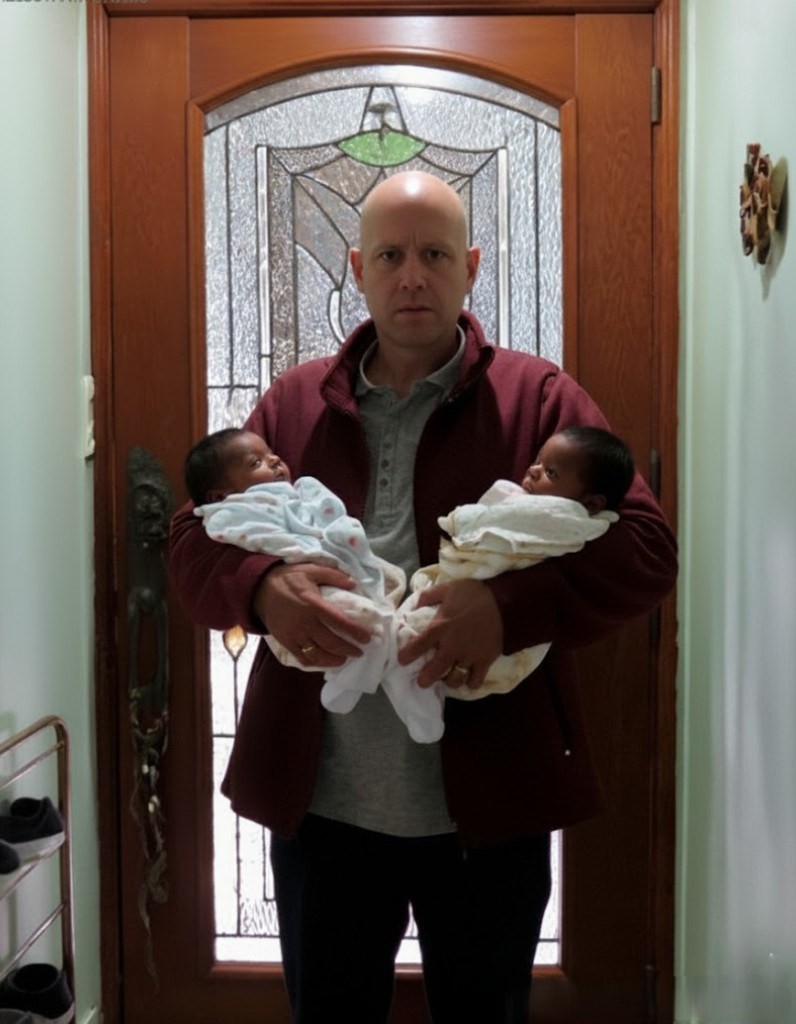
Just after sunrise on Saturday, the sound of the front door finally echoed through the house. I rushed to the hallway, a hurricane of questions and accusations ready to pour out. But the sight that met me froze the breath in my lungs. Lochlan looked like a man who had walked through a war zone. His eyes were bloodshot, his hair was a matted mess, and his clothes were hopelessly rumpled. But it was what he was carrying that stopped my heart. In each arm, he cradled a tiny bundle swaddled in striped hospital blankets. Two infants, their faces wrinkled and pink, were twitching in their sleep.
“Lochlan… whose babies are those?” I whispered, my voice barely audible.
He didn’t answer immediately. He walked past me with a ghostly gait and laid the twins gently on the sofa, handling them as if they were made of spun glass. Only then did he sink onto the cushions, bury his face in his shaking hands, and utter a broken apology.
“Start talking,” I demanded, my voice gaining a sharp, defensive edge. “From the very beginning.”
Lochlan took a ragged breath and explained that the moment we had sat down for dinner, he received a desperate text from Astrid, his twenty-three-year-old office assistant. She was a girl we both knew—shy, soft-spoken, and isolated in the city. She had claimed it was a matter of life and death. When he arrived at her apartment, expecting a panic attack or a medical emergency, she had thrust the two infants into his arms and bolted out the door without a word of explanation.
He had waited for an hour in a state of sheer paralysis. When Astrid finally returned, she was hysterical. She revealed that the babies belonged to her sister, Greer, who was currently in hiding from a violent, high-risk ex-partner. The man had threatened to kidnap the twins and flee the country, and Greer was too terrified of his reach to go to the authorities. Astrid had begged Lochlan to take them somewhere safe—somewhere the boyfriend would never think to look.
“I panicked, Lydia,” he whispered, looking up at me with eyes full of tears. “I was in a freezing car with two screaming newborns. I didn’t know how to call you and explain this without it sounding like I’d lost my mind. I got a motel room. I bought formula at a gas station. I just… I couldn’t bring them here until I knew it was safe.”
I stared at him, the anger in my heart melting into a profound, aching realization. My husband hadn’t been unfaithful or indifferent; he had been a man trying to be a hero in a situation he was utterly unprepared for. I made him put Astrid on speakerphone. She confirmed every detail—the threats, the history of violence, and her desperate decision to involve the only person she trusted: Lochlan.
“We can’t keep them here,” I said softly, looking at the tiny, innocent lives on our sofa. “We have to go to the police.”
That evening, we met Astrid at the precinct. Under the flickering fluorescent lights, the full scope of the danger became clear. The police acted with a decisive speed that finally allowed us to breathe. Greer and her babies were moved to a secure domestic violence shelter, and an investigation into the boyfriend began immediately.
Two days later, the final piece of the puzzle fell into place. The man had been apprehended while trying to break into Astrid’s apartment, walking straight into a police stakeout. The threat was gone.
That night, after our own children were tucked safely into their beds, Lochlan and I sat in the quiet of our kitchen. He looked hollowed out, a man who had reached his limit. He apologized again—for the silence, for the fear he caused me, and for breaking the sanctity of our holiday.
I walked over to him and cupped his face. I had imagined every terrible scenario over those forty-eight hours, but the reality was simply that I had married a man whose heart was sometimes too big for his own good.
“You scared me half to death,” I told him, my thumbs tracing the dark circles under his eyes. “But I know exactly who you are. Next time you decide to play the hero, Lochlan, don’t go alone. Take me with you.”
Our Thanksgiving didn’t have the “butter and cinnamon” perfection I had meticulously planned. It was messy, terrifying, and entirely unpredictable. But as I leaned into my husband, I realized that we had protected a family that wasn’t our own, and in doing so, we had strengthened our own. We were whole, we were safe, and we were together. That was the only thing that truly mattered.