The hospital corridor smelled of lemon antiseptic and stale coffee, a scent that tries to mask the underlying odor of fear, but never quite succeeds. I stood there, staring at the polished linoleum tiles, watching the way the fluorescent lights reflected off the wax. They blurred, just for a moment, before I blinked the moisture away.
Margaret Sandoval stood before me, clutching her designer purse like a shield. Her face was a mask of practiced sorrow, the kind you see in bad movies. Not a hair was out of place. Her mascara wasn’t running.
“She’s gone, Arthur,” she said. Her voice was flat, devoid of the jagged edges that real grief leaves in a person’s throat. “There were… complications. The baby is fine, but Lucy…” She trailed off, offering a helpless shrug that enraged me more than a scream would have.
Something inside me hardened. It felt like concrete setting in my chest, heavy and cold. I have worked in construction for forty years. I know when a foundation is solid, and I know when the ground is shifting beneath my feet. This ground was shifting.
“No,” I said quietly. The word hung in the air, heavy as a stone. “These things don’t just happen. Not to Lucy. She was healthy. She ran marathons. She didn’t have a single risk factor.”
Margaret sighed, a sharp exhalation through her nose that signaled annoyance rather than sympathy. “You’re in shock. That’s normal. The doctors did everything they could. The hospital will give you time to say goodbye later.”
Later.
That word burned through me like a soldering iron. In a hospital, when someone dies, they don’t tell the father “later.” They usher you into a room. They bring a chaplain. They let you hold the hand that is slowly losing its warmth. They don’t block the hallway like a bouncer at a nightclub.
“I want to see her now,” I said, my voice dropping an octave.
“Arthur, please. Don’t make a scene. Martin is devastated. We need to handle the paperwork.”
I looked over her shoulder. Martin, my son-in-law, was standing near the vending machines, typing furiously on his phone. He didn’t look devastated. He looked busy.
I turned and walked away without asking permission. My heart pounded against my ribs, a frantic drumbeat of panic and rage. I followed the signs toward the primary nurses’ station. If Lucy was truly gone, then someone—a professional, not her mother-in-law—would look me in the eyes and tell me so.
A young nurse, her eyes rimmed with red fatigue, stepped forward to intercept me. “Sir, you can’t be back here—”
I stopped and looked at her. I didn’t yell. I didn’t threaten. I just let her see the absolute ruin in my face. She faltered, stepping aside as if pushed by an invisible hand.
Behind the high central desk stood a man in scrubs that looked like they had been worn for three days straight. He was reviewing a tablet, rubbing his temples. His name badge read Dr. Evan Carter.
“Excuse me,” I said.
He didn’t look up. “I’ll be with you in a moment.”
“I am Lucy Moore’s father.”
The reaction was microscopic, but I saw it. His hand froze over the tablet. His eyes widened—just for a fraction of a second—before he composed himself and glanced down the hallway, checking for witnesses.
“Mr. Moore,” he said, his voice tight. “I… I thought the family had already left.”
“The Sandovals are still here,” I corrected him. “But I am her father. And I want to know why I haven’t been taken to my daughter’s body.”
He swallowed hard. His Adam’s apple bobbed. “Sir, it’s complicated.”
“Death is rarely complicated, Doctor. It is final. Is my daughter dead?”
He hesitated. He looked at the tablet, then at me, then at the security camera blinking in the corner of the ceiling. He leaned closer over the desk, lowering his voice to a whisper that was barely audible over the hum of the air conditioning.
“Your daughter had complications,” he said slowly, choosing his words as if walking through a minefield. “Hemorrhaging. Severe distress. But… she did not die in this delivery room.”
The floor seemed to tilt beneath me. I gripped the edge of the desk so hard my knuckles turned white.
“What did you just say?”
Dr. Carter looked terrified. “She lost consciousness. Her heart stopped briefly. We resuscitated her. We got a rhythm back.”
My ears began to ring, a high-pitched whine that drowned out the hospital page system. “Then why is her mother-in-law telling me she’s dead? Where is she?”
“She was transferred,” he whispered, his eyes darting to the hallway where Martin was still on his phone. “Moved out of this hospital twenty minutes ago.”
“By whom?”
His jaw tightened. “I shouldn’t even be telling you this. I could lose my license.”
“Doctor,” I growled, leaning in until we were nose to nose. “My daughter is all I have. If she is alive and you let them take her, you won’t just lose your license. You will lose your freedom. Tell me the truth.”
He glanced around one last time, then spoke in a rush. “Someone from her husband’s family signed emergency medical authorization. They claimed the facility here wasn’t equipped for her specific post-trauma needs. They had a private ambulance waiting at the loading dock before she was even stable. They said it was their decision. Private facility. Private doctors.”
“Where?” I demanded.
He shook his head, a look of genuine helplessness on his face. “I don’t know. The paperwork was rushed. Too rushed. They overrode my recommendation. But Mr. Moore…”
He looked me dead in the eye.
“She was critical. But she was alive.”
That was the moment I knew. The grief evaporated, replaced by a cold, sharp clarity.
Lucy was alive.
And someone wanted her gone.
I didn’t go back to the waiting area. I didn’t confront Margaret or punch Martin, though the urge to do so made my hands shake. If they knew I knew, they would bury her deeper.
I walked straight outside into the biting night air. I sat in my beat-up Ford F-150, gripping the steering wheel, breathing through the pain that felt like a knife twisting in my gut.
Think, Arthur. Think.
Why? Why fake a death? Why move a woman who is barely clinging to life?
Money. It always comes back to money.
I started the truck and drove. Not home, but to the Sandoval estate. It was a sprawling Georgian manor on the north side of town, the kind of place that screams “old money” to people who don’t know any better. But I’m a contractor. I know that fresh paint can hide dry rot.
I knew the gate code—Lucy had given it to me months ago for emergencies. The gate swung open with a rusty groan. As I drove up the long driveway, I noticed things I had ignored before. The landscaping was overgrown at the edges. The fountain was dry. The roof had missing slate tiles.
The house was dark. They were all still at the hospital, putting on their performance.
I used the spare key hidden under the planter on the back porch. I let myself into the silent, cavernous kitchen. It smelled of dust and neglect.
I went straight to Martin’s study.
I’m not a hacker, and I’m not a spy. But people who are arrogant rarely hide their sins well because they never expect to be caught. Martin’s desk was a chaotic mess of papers.
I turned on the desk lamp and started digging.
The first thing I found was a stack of final notices. The electric bill was three months overdue. Then came the credit card statements—Amex, Visa, Mastercard—all maxed out. Tens of thousands of dollars in luxury watches, trips, and online gambling debts.
Then, buried under a pile of racing forms, I found the mortgage papers. The house had been refinanced. Twice. They were underwater. The Sandovals weren’t just broke; they were drowning.
And then I saw the binder.
It was blue, labeled “Estate Planning – L. Moore.”
My hands trembled as I opened it. Lucy had inherited $750,000 from her mother’s estate last year. It wasn’t a fortune to billionaires, but to the Sandovals right now, it was a life raft.
I read the terms of the trust.
In the event of Lucy Moore’s death, if the child is a minor, control of the trust assets reverts to the legal guardian.
Martin.
But there was a clause. If Lucy Moore is incapacitated, power of attorney is granted to the spouse.
If she was dead, they got the money.
If she was alive but “vegetative” or hidden away where she couldn’t speak, they controlled the money.
But why the rush? Why tonight?
I flipped to the back of the binder and found a foreclosure notice. The bank was seizing the Sandoval estate in seven days. They needed access to her liquidity immediately. They couldn’t wait for probate. They needed to show she was either dead or incompetent now.
I took photos of everything with my phone. My heart was hammering against my ribs like a trapped bird.
I was about to leave when I saw a crumpled piece of carbon paper in the wastebasket. I smoothed it out. It was a transport invoice from a private medical transport company called “Shadowline Medical.”
The destination was scribbled in ballpoint pen in the corner: Sanctuary Hills Recovery. Willow Creek.
Willow Creek was two states away. A six-hour drive.
I checked my watch. 2:00 AM.
They had a head start, but they were arrogant. They thought I was an old man, a grieving father who would go home and cry into his pillow. They thought I would wait for the funeral arrangements.
I pocketed the paper.
“I’m coming, Luce,” I whispered to the empty room.
I didn’t drive alone.
I made a call to Frank “Sully” Sullivan. Sully was a retired detective who owed me a favor from when I framed his deck for free after his divorce. He picked up on the third ring.
“Artie? It’s three in the morning.”
“I need you, Sully. And I need your piece.”
He didn’t ask questions. He heard the tone in my voice. He met me at the interstate on-ramp twenty minutes later.
We drove through the darkness, the miles eating up the road. I told him everything. The fake death. The debts. The clinic.
“Sanctuary Hills,” Sully muttered, looking up the place on his phone as I sped 90 miles per hour down the highway. “It’s off the grid, Artie. Not a normal hospital. It’s a ‘long-term care facility’ for the wealthy and discreet. Places like that… they don’t ask questions as long as the check clears.”
“Can we get in?”
“Legally? No. Physically?” Sully patted the glove compartment. “We’ll see.”
Dawn was breaking when we hit the state line. The sky was bleeding a bruised purple and orange. By the time we reached the turnoff for Willow Creek, the sun was up, blinding and cold.
The facility was tucked away in a valley, surrounded by high fences and dense pine trees. It looked more like a prison than a hospital. A sleek, modern, white prison.
I pulled the truck up to the security gate. A guard in a tactical uniform stepped out.
“Private property,” he said, holding up a hand. “Turn around.”
Sully rolled down the passenger window. He flashed his retired badge—it still looked real enough to the untrained eye.
“Detective Sullivan,” he barked. “We’re following up on a transfer from City General. Patient name Lucy Moore. We have reports of irregular paperwork regarding narcotics transport. Open the gate, or I call the staties and we tear this place apart.”
It was a bluff. A massive one. But Sully had that cop voice, the one that makes you feel guilty even if you haven’t done anything.
The guard hesitated. He looked at the badge, then at my face. I looked like a man who was ready to drive his truck through the gate if it didn’t open.
“I have to call the director,” the guard said.
“Call him,” Sully said. “Tell him he’s got five minutes before I call the DEA.”
The guard retreated to the booth. The gate buzzed and began to slide open.
“We’re in,” I said, hitting the gas.
We parked right in front of the main entrance. I didn’t wait for Sully. I slammed the truck door and marched into the lobby. It was silent, sterile, smelling of lavender and money.
A receptionist looked up, startled. “Sir, you can’t—”
“Lucy Moore,” I said. “Where is she?”
“We don’t have a patient by that—”
I slammed my hand on the desk. “Don’t lie to me! I have the transport invoice! She arrived three hours ago!”
A door opened behind the desk. A tall man in a white coat appeared. He looked smooth, expensive, and slimy.
“Is there a problem?” he asked.
“Dr. Vance, I presume?” Sully said, stepping up beside me. He had read the website on the way over. “I’m Detective Sullivan. This is Mr. Moore. We have reason to believe you are holding a patient against her will and facilitating insurance fraud.”
The doctor’s eyes flickered to the door, checking for security. “That is a serious accusation. I assure you, all our patients are here voluntarily or under legal guardianship.”
“She’s unconscious!” I yelled. “She can’t volunteer for anything! Take me to her. Now.”
“I cannot do that without—”
I didn’t wait. I pushed past him.
“Security!” he shouted.
I saw a hallway labeled High Dependency Unit. I ran.
Two orderlies, big men, appeared from a side room. Sully stepped in front of them. “I wouldn’t do that, boys,” I heard him say, followed by the sound of a scuffle.
I didn’t look back. I threw open the first door. Empty. The second door. An old man sleeping.
I reached the third door.
There she was.
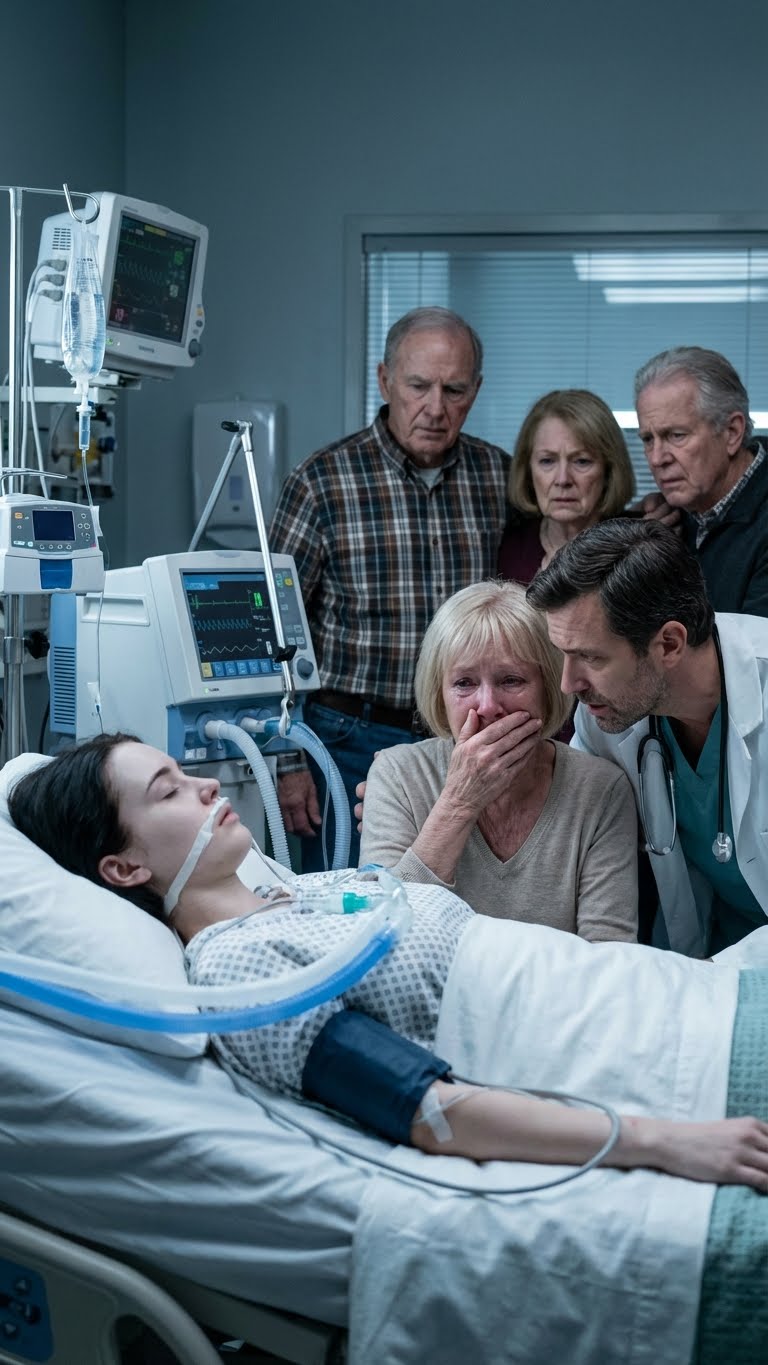
The room was dim, lit only by the blinking lights of the monitors. She looked so small in the bed, pale as the sheets, a tube in her nose, an IV in her arm.
“Lucy,” I choked out.
I rushed to the bedside. Her skin was cold, but when I touched her hand, I felt a pulse. Faint, threading, but there.
Thump-thump. Thump-thump.
The most beautiful sound in the world.
“Dad?”
It was barely a whisper. A breath of air shaped into a word.
Her eyelids fluttered. She looked at me, her eyes unfocused, swimming with drugs and exhaustion.
“Dad…” she whispered again. “They took… they took the baby…”
“The baby is safe,” I promised, squeezing her hand until I was afraid I’d break it. “And you’re safe. I’m here. I’ve got you.”
The door burst open behind me. Dr. Vance stood there, flanked by the guard from the gate.
“Step away from the patient,” Vance ordered. “You are trespassing.”
I turned slowly. I didn’t let go of Lucy’s hand.
“Trespassing?” I said, my voice low and dangerous. “I’m not trespassing. I’m a witness.”
I pulled out my phone. I had already dialed 911 on the drive in, leaving the line open.
“Operator,” I said to the phone in my hand. “Did you hear that? I’ve located the missing person, Lucy Moore. I am at Sanctuary Hills. send the State Police. Now.”
Vance’s face went white. He knew it was over.
The authorities arrived twenty minutes later.
It turns out, when you accuse a private clinic of kidnapping and insurance fraud, and you have a retired detective and a furious father on the scene, the police take it seriously.
Dr. Vance tried to claim it was a misunderstanding, that the paperwork was in order. But when the police saw the “death certificate” signed by a doctor on Vance’s payroll—a certificate that hadn’t even been filed yet—the handcuffs came out.
I didn’t leave Lucy’s side. Not for a second.
I called Margaret from the hospital room as the EMTs were preparing to transfer Lucy to a legitimate trauma center.
“Hello?” Margaret answered. She sounded annoyed. “Arthur, I told you, we are handling arrangements—”
“She’s alive, Margaret.”
Silence. Dead silence on the other end.
“I’m with her,” I said. “The police are here. They have the financial records from Martin’s desk. They have the transport logs. They know about the inheritance.”
I heard a gasp, then a thud. I think she might have actually dropped the phone.
“Tell Martin to run,” I said coldly. “It will make it more fun for the cops when they catch him.”
I hung up.
The fallout was swift and brutal.
Martin was arrested at the hospital back home, trying to leave with the baby. He was charged with kidnapping, fraud, and conspiracy. He cried like a child when they put the cuffs on him.
Margaret didn’t faint, contrary to what I might have wished. Instead, she lawyered up, blaming everything on her son, claiming she was a victim of his deception. But the texts on her phone—coordinating the “private doctors”—told a different story. She was indicted as a co-conspirator.
Dr. Carter, the young doctor at the first hospital, turned state’s witness. He admitted he had been bribed to look the other way during the transfer, though he hadn’t known they planned to fake her death entirely. He lost his license, but he stayed out of prison.
As for the Sandovals, they turned on each other within hours. It was a shark feeding frenzy. Martin blamed his mother’s pressure; Margaret blamed Martin’s gambling debts. They tore their family apart to save their own skins.
But I didn’t care about them.
I only cared about the woman in the bed next to me.
——————-
Lucy survived.
It wasn’t like the movies. She didn’t just wake up and run a marathon. Her recovery was slow. Painful. There were infections, physical therapy, and weeks of nightmares where she would wake up screaming that they were taking her away.
But she survived.
Three months later, the snow was melting in North Dakota. I parked my truck in the driveway of my small house—the one I built with my own hands thirty years ago.
I walked around to the passenger side and opened the door.
Lucy stepped out. She was thinner than before, and she walked with a cane, but she was standing. She was breathing.
I handed her the bundle from the back seat.
Ethan.
He was tiny, with a tuft of black hair and lungs that could shatter glass.
“We’re home, bug,” Lucy whispered to him, kissing his forehead.
We walked inside. The house smelled of wood smoke and pot roast—real food, not hospital slop.
I watched them settle onto the sofa. Lucy looked at me, her eyes clear and bright.
“Thank you,” she said. She didn’t need to say what for.
“I didn’t do anything any father wouldn’t do,” I said, gruffly, turning away to stoke the fire so she wouldn’t see me tearing up.
“You’re wrong,” she said softy. “Martin is a father. Look what he did.”
I paused, poker in hand.
“Martin isn’t a father,” I said. “He’s a donor. There’s a difference.”
Every morning now, I wake up to the sound of Ethan laughing. It’s the best sound in the world. Better than a circular saw cutting straight timber. Better than a finalized contract.
I sit on the porch with my coffee, watching Lucy teach him how to walk in the grass.
I think back to that hospital corridor. The cold tiles. The lies. The way Margaret Sandoval smiled at me while she tried to erase my daughter from existence.
They thought family was about bloodlines and inheritances. They thought it was about protecting the “name” at all costs.
They were wrong.
Family isn’t who smiles at you in the waiting room when things are going well. It isn’t the people who share your last name or your tax bracket.
Family is the person who stands in the rain for you. It’s the person who tears down a gate for you.
Family is who fights for you when you can’t fight for yourself.
And looking at my daughter and grandson, safe in the sun, I know I’d fight the whole world all over again if I had to.