For the better part of twenty-three years, I operated under the delusion that silence was the currency I had to pay for safety. I believed that being hidden, being a shadow in the corner of a room, was simply what wives like me did to survive. I had no idea that one night, in one glittering ballroom, one man walking toward me was about to set a match to the paper-thin walls of the life I had built.
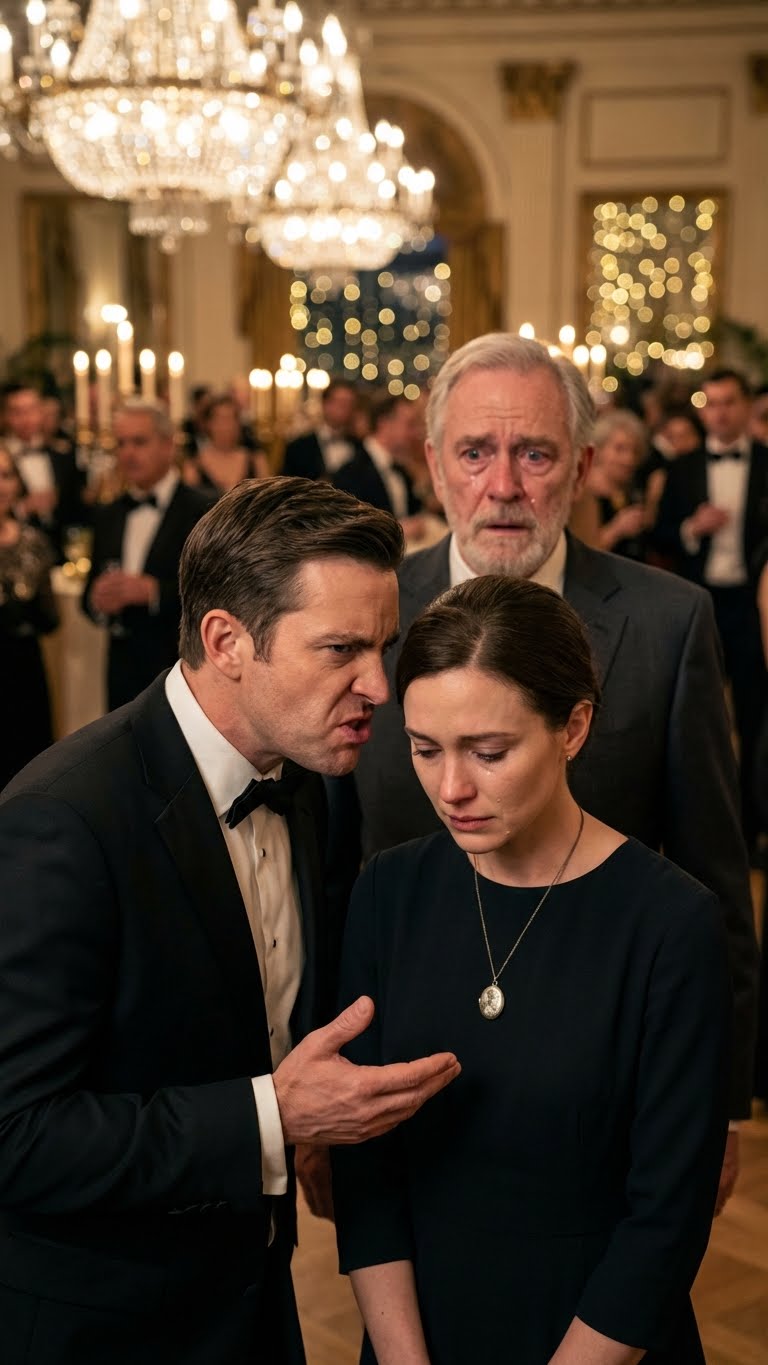
The Grand Ballroom of The Drake Hotel shimmered with calculated opulence. It was the kind of wealth that whispered rather than shouted—old money, deep connections, and the quiet, terrifying power of exclusion. Crystal chandeliers, heavy with history, refracted light across the imported marble floors, casting geometric webs that shifted with the movement of the crowd.
I stood near the coat check, a precise, calculated distance from the main floor. From this vantage point, I watched Black women in designer silk gowns drift past like expensive sailboats, navigating waters I was no longer permitted to enter. My own dress, a deep navy satin, was beautiful—I had made absolutely certain of that—but Kenneth had barely glanced at it when I emerged from our bedroom three hours earlier.
He had simply checked his Rolex, a quick, dismissive flick of the wrist, and muttered something about the traffic on Lakeshore Drive.
Now, he was somewhere in that sea of networking conversations. I knew exactly what he was doing. His hand was likely resting on someone’s shoulder with practiced familiarity. His laugh would be pitched at that specific frequency he reserved for people he considered useful to his crumbling advertising empire.
Over two decades of marriage, I had learned to read those calibrations like a seismologist reads tremors. The microscopic variations in tone that indicated whether he was speaking to a subordinate or a savior. The subtle shift in his spine that telegraphed respect or disdain. Kenneth navigated social hierarchies the way surgeons navigate anatomy: with precision, cold purpose, and absolutely no room for error.
“You can wait by the coat check,” he had instructed when we arrived, not bothering to turn his head. With Kenneth, there were never suggestions, only directives delivered with the certainty of a man who had never been meaningfully challenged. “I need to make connections tonight. Important people will be here. The kind of people who can save what I’ve built. You understand?”
I understood. I always understood. Understanding had become my primary function somewhere around year seven, the year I stopped trying to stand beside him and started accepting my assigned positions in the margins, the corners, and the shadowed alcoves.
I was the invisible wife. The woman who existed in tax documents and on impeccably staged holiday cards, but rarely in the moments that actually mattered. The woman whose intelligence was only acknowledged when Kenneth could strip-mine it for insights to present as his own.
But I hadn’t always been this ghost.
There was a time, thirty years ago, when I filled rooms with my presence. When professors at Howard University sought my perspective on urban policy. When my senior thesis on generational wealth accumulation in Black communities was recommended for publication. There was a time when a different man had looked at me and seen not an accessory to be positioned, but a partner whose mind matched his own in ambition and fire.
I touched the silver locket at my throat without thinking. My fingers found the small, familiar clasp I had opened ten thousand times. Inside was a photograph, so worn the features were fading into white noise. But I didn’t need the photo to see his face.
So you remember, he had said, fastening it around my neck the summer after graduation, his hands trembling with the weight of our impending separation. So you never forget that someone saw you exactly as you are, and loved every bit of it.
I had never taken it off. Not when Kenneth gave me a diamond choker to replace it. Not when he sneered that silver was “cheap.” It was the only piece of territory I still held.
Across the room, the energy shifted. Conversations dropped to a murmur. Heads turned toward the main entrance like iron filings to a magnet. I craned my neck, careful not to draw attention, curiosity warring with my training.
A man had entered the ballroom.
Even from fifty feet away, the gravitational pull was undeniable. He was tall, wearing a tuxedo tailored to the millimeter, moving with the quiet confidence that comes from authentic power, not the desperate imitation of it. His hair was cut close, threaded with distinguished silver at the temples. But it wasn’t his appearance that made my breath hitch painfully in my throat.
It was the way he moved. The slight tilt of his head when he listened. The economical grace. The way he looked at people—actually looked at them—making them feel seen.
I knew those movements. I had memorized them three decades ago in a dorm room in D.C.
“That’s Julian Hartwell,” a woman whispered near the bar, her voice carrying over the clinking of glass. ” The new CEO of Morrison Industries. They say he’s worth two billion. Single, too.”
Julian.
The name hit me like a physical blow, spinning me backward through time. Julian Hartwell. He had been Julian Blackwood when I knew him, before he dropped his father’s toxic name and built his own legacy from ash and will.
Julian, who had held me while I wept over the child we lost. Julian, whose father had systematically dismantled our relationship with threats that terrified a twenty-two-year-old girl from Detroit into running away.
I watched Kenneth spot him. I saw the predator’s gleam in my husband’s eyes. Kenneth adjusted his tie, put on his most charming smile, and moved to intercept the billionaire who could save his failing business.
And then, Julian’s eyes swept the room.
He wasn’t looking at the influential politicians. He wasn’t looking at the beautiful debutantes. He was scanning the perimeter. And then, his gaze locked onto mine.
For one infinite, suspended second, the world stopped turning. I saw the shock register on his face—the breakdown of his composure. His lips parted. His hand, which Kenneth was reaching out to shake, went slack.
He ignored my husband completely.
Julian started walking. He moved through the crowd with a single-minded intensity, cutting a path straight toward the coat check. Straight toward the invisible woman in the shadows.
Kenneth’s voice rose behind him, a confused and irritated squawk as his golden ticket walked away mid-sentence. But Julian did not pause. He didn’t even blink.
I couldn’t move. My feet were nailed to the marble floor. My heart hammered against my ribs so hard the silver locket jumped against my skin.
When he reached me, Julian stopped an arm’s length away. Close enough for me to see the fine lines of wisdom around his eyes, close enough to see that his hands—the hands of a titan of industry—were shaking.
We stared at each other in a silence that screamed.
“Naomi,” he said finally. My name sounded like a prayer he had been whispering in secret for thirty years. “Oh my God. Naomi.”
I tried to speak, but my throat had closed up. Yes, I wanted to scream. It’s me. I’m here. I never stopped wearing your locket.
Instead, I just nodded, feeling the ceramic mask of my composure begin to crack.
“I’ve been searching for you,” he whispered, his voice thick with emotion. “For thirty years. I hired investigators. I checked every registry. I looked for you at every reunion. I never stopped looking. I never stopped hoping that someday, I would walk into a room and you would be there.”
Behind us, I heard Kenneth’s sharp intake of breath. He had followed. He was standing ten feet away, witnessing the impossible.
“I thought you hated me,” I managed to whisper, the words scraping my throat. “When I left… when I wouldn’t answer your calls… I thought you would hate me.”
Julian shook his head, tears gathering in his dark eyes. “Never. Not for one single day. I found the letter, Naomi. The one my father wrote. I know what he threatened you with. I know he made you believe that loving me would destroy my future.”
The truth settled over me, heavy and validating. “I lost the baby,” I blurted out. It was the one thing I had never said aloud to anyone but my mother. “Three weeks after I left. I was alone.”
Julian’s face crumpled. He reached out then, taking my hands in his. His grip was warm, solid, anchoring me to the earth. “I am so sorry. I should have fought harder. I should have told him to go to hell.”
“You were twenty-three,” I said gently. “And he was Charles Blackwood. He would have buried us.”
“Maybe,” Julian said fiercely. “But maybe we would have survived. Maybe we would have built something real.” He looked down at our joined hands, his thumb stroking my knuckles. “I married someone else. Five years later. She was… appropriate. And I tried. I really did. But she always knew she was the compromise. We divorced seven years ago.”
I glanced over Julian’s shoulder. Kenneth’s face was a rictus of shock and mounting rage. He stepped forward, unable to contain himself.
“Who is this?” Kenneth demanded, his voice loud enough to turn heads. “Naomi, what the hell is going on?”
Julian turned slowly. The vulnerability vanished, replaced by the cold, assessing gaze of a CEO. He looked Kenneth up and down, cataloging the frayed edges of my husband’s desperation.
“I’m Julian Hartwell,” he said, his tone perfectly polite and utterly dismissive. “And you must be Naomi’s husband.”
“You went to Howard with her,” Kenneth said, connecting the dots, his tone sneering. “That was thirty years ago. Ancient history.”
“Some things don’t become ancient history just because time passes,” Julian replied quietly.
He turned his back on Kenneth, cutting him out of the universe. He looked at me, and the tenderness returned.
“Will you have dinner with me tomorrow night?” Julian asked. “I have three decades of catching up to do.”
The old Naomi—the quiet, safe, terrified Naomi—would have politely declined. She would have cited a scheduling conflict. She would have protected Kenneth’s ego.
But I was so tired. I looked at this man who had loved me across time and distance.
“Yes,” I said, my voice clear. “I would love to.”
Kenneth made a sound of pure fury. Julian ignored him. He lifted my hand to his lips, pressing a kiss to my knuckles that I felt in the marrow of my bones.
“I’ll send a car. Seven o’clock. Until tomorrow, Naomi.”
He released me and walked away, leaving the gala early because he couldn’t bear to stay in the room without me.
Kenneth grabbed my arm, his fingers digging into my bicep.
“What the hell was that?” he hissed, pulling me toward a shadowed alcove. “Do you have any idea what you just did? That is the most important connection I could make, and you—what? You had a college fling with him? Why didn’t you tell me?”
I looked at him. I saw the entitlement. I saw the complete lack of curiosity about who I was.
“You never asked,” I said calmly, pulling my arm free. “In twenty-three years, you never asked who I was before you. You wanted an accessory. You got one.”
“You are actually going to have dinner with him?” Kenneth asked, incredulous. “Do you know how that looks?”
I smiled, and it felt like the first real smile in years. “I don’t care what people say, Kenneth. For the first time, I genuinely do not care.”
I walked away. I left him standing there, shouting my name in a whisper. I went to the coat check, got my wrap, and took a taxi straight to the South Side.
My mother, Mama, was awake when I arrived. She didn’t ask questions. She just held me while I cried the tears of twenty years on her living room couch.
When I finally told her—about Julian, about the gala, about the dinner—she took my hands.
“I never liked Kenneth,” she said bluntly. “But I stayed quiet because you wanted safety. But baby, if Julian Hartwell has come back… that’s not coincidence. That’s providence. You choose joy, Naomi. You choose joy.”
I stayed at her house that night. My phone rang seventeen times. I didn’t answer.
In the morning, I went back to the Hyde Park mansion. Kenneth was waiting in his study, vibrating with anxiety and anger.
“Where have you been?” he demanded.
“Thinking,” I said.
“About what? About running off with your ex-boyfriend?” He sneered. “You think a billionaire wants a fifty-eight-year-old woman with no prospects? You’re delusional.”
The cruelty was meant to crush me. Instead, it clarified everything.
“I’m having dinner with him,” I said. “Accept it or don’t.”
“If you go,” Kenneth said, playing his final card, “I will consider it grounds for divorce.”
I looked at him, and I felt lighter than air. “Then you should call your lawyer.”
I spent the day packing. Not everything—just what was mine. My degree. My grandmother’s jewelry. The letters from Julian I had hidden in a shoebox.
At seven o’clock, I put on a burgundy dress Kenneth hated because it was “too bold.” I clasped the silver locket around my neck. When the town car arrived, I got in without looking back.
We met at a small, discreet restaurant in Bronzeville. Julian was waiting. He stood when I entered, his eyes devouring me.
“You came,” he said.
“I told you I would.”
We talked for five hours. We talked about the life we missed. We talked about his failed marriage, and my suffocating one. I told him about Kenneth’s financial control—the allowance, the lack of access to accounts.
Julian’s face darkened. “That is financial abuse, Naomi. You know that, right?”
“I… I just thought it was practical.”
“No,” he said firmly. “It’s control.” He reached across the table. “Leave him. Tonight. I have an apartment in the South Loop. It’s empty. It’s yours. No strings. Just a safe place to land.”
“I can’t take your money,” I said. “I won’t trade one keeper for another.”
“Then work for me,” he countered. “The foundation. I need someone to run the urban development initiative. I still have your senior thesis, Naomi. I read it every year. Your mind is what I need.”
I stared at him. He had kept my thesis. Kenneth hadn’t even read my resume.
“I need time,” I said.
“Take all the time you need,” he promised. “But don’t go back to him.”
When I got home, Kenneth was waiting. He was sitting on the edge of the bed, looking small and mean.
“You stayed out until midnight,” he said.
“We were talking.”
“Talking,” he scoffed. “You expect me to believe that?”
“I don’t expect you to believe anything,” I said. “I’m sleeping in the guest room.”
I locked the door.
The next morning, Kenneth was gone, but a note remained: We need to talk. 6 PM.
I laughed. He still thought he was the director of this play.
I called a locksmith. I called a lawyer my mother recommended. I spent the afternoon documenting twenty-three years of financial coercion.
When Kenneth walked in at 6:00 PM, expecting a contrite wife, he found me sitting with a folder of documents and a packed suitcase.
“I want a divorce,” I said. “I’m entitled to half of everything. The house, the business assets, the retirement funds. And I’m taking it.”
Kenneth turned a mottled purple. “You’re throwing away your life for a fantasy! You think he’s going to marry you?”
“I don’t need him to marry me,” I said, realizing it was true. “I just need to be free of you.”
I walked out that night. Julian’s driver took me to the apartment in the South Loop. It was quiet. It was empty. It was mine.
The divorce was ugly. Kenneth fought dirty. He tried to hide assets. He badmouthed me to everyone in Chicago. He blamed me for his business failure, which happened six months later when he finally ran out of credit.
But I had a shark of a lawyer, and I had Julian—not as a savior, but as a rock.
I took the job at the foundation. I worked with Julian, not for him. We kept things professional for months, courting each other with ideas and debates before we ever kissed. We needed to know who we were as adults.
Six months after the separation, we went back to Howard for our reunion. We walked the quad, holding hands.
“Did you ever stop loving her?” an old classmate asked him.
“Not for one second,” Julian said.
A year later, in his office, amidst piles of proposals for affordable housing, Julian looked at me.
“Marry me,” he said. “Not for security. But because we are better together.”
——————–
We married in my mother’s small church. Kenneth showed up at the reception, drunk and bitter, screaming that I was a gold digger. Julian’s security removed him gently but firmly.
Later that night, I asked Julian, “Did I trade up?”
“You left an abuser,” Julian said. “You would have left him eventually, even if I hadn’t walked into that ballroom. You are too strong to stay invisible forever.”
I chose to believe him.
My mother died two years later, peaceful and proud. I buried her wearing the silver locket.
Now, five years after that night at the Drake Hotel, I am sixty-three. I wake up next to a man who values my mind. I run programs that change lives. I have my own money, my own friends, and my own voice.
Sometimes I wonder what would have happened if I had been brave enough at twenty-two. If I had told Charles Blackwood to go to hell. Would we have made it? Or did we need the scars to appreciate the healing?
I don’t know. But I know this:
If you are standing in a corner, making yourself small so someone else can feel big, remember that it is never too late. You are worth being seen. You are worth being found.
I chose joy. And I would make that choice a thousand times over.