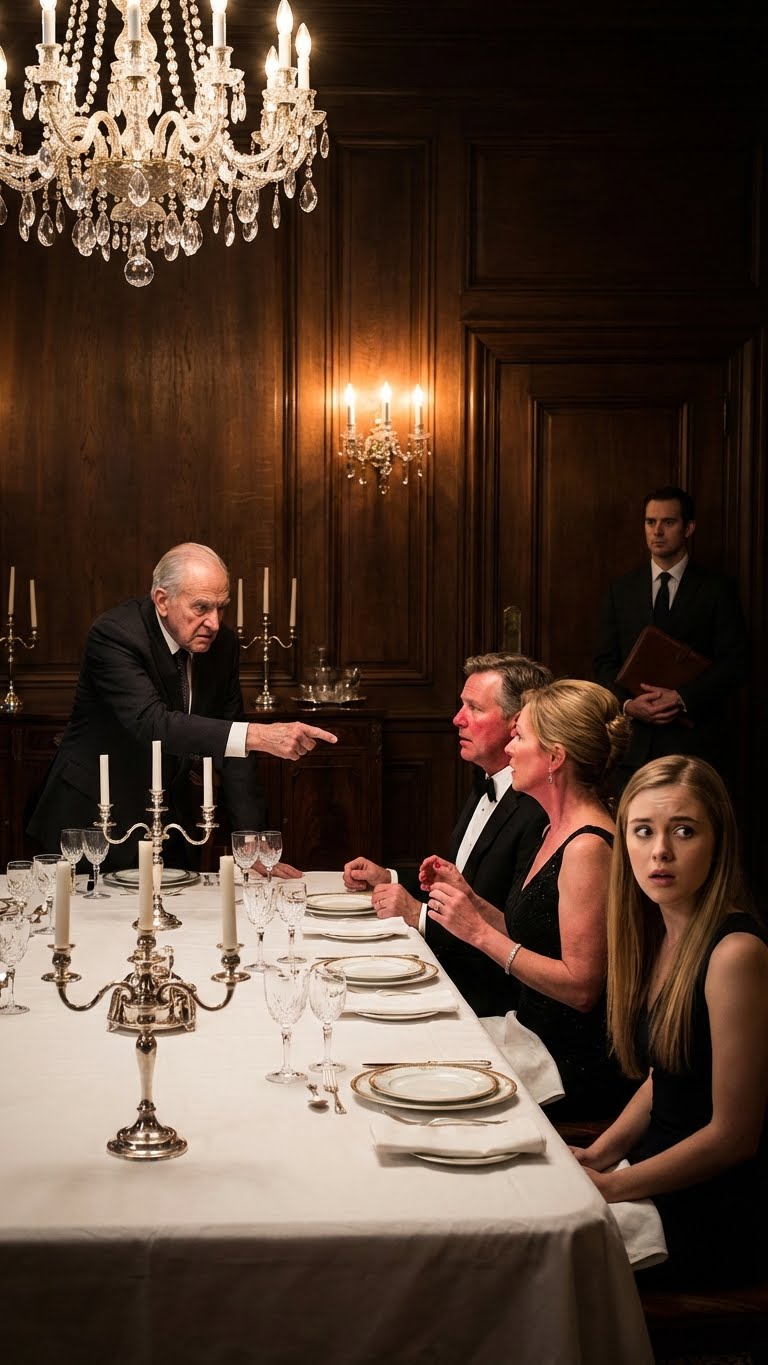
“Amanda, I hope the fifteen hundred dollars I send you monthly has made your life somewhat easier.”
The owner of that low, resonant voice was Arthur Brooks, my grandfather. He sat at the head of the mahogany table, a silver-backed lion presiding over a feast of vultures.
It was christmas Day. The air in the dining room was thick, heavy with the savory aroma of roasting turkey, sage stuffing, and the cloying, perfumed scent of expensive candles. Usually, Grandfather was a ghost in our family—a titan of industry who sent cards signed by his secretary and whose presence was felt only through the checks he occasionally wrote. But this year, for reasons unknown, he had descended from his ivory tower to join us.
Because of this unprecedented visit, my father, Jonathan, and my mother, Karen, were vibrating with a desperate, manic energy. They were performing a play titled “The Perfect Family,” and the reviews were not looking good.
“More wine, Dad?” my father asked, his voice pitching a octave higher than normal. He reached for the bottle—a vintage Cabernet from the year Grandfather was born—with a hand that trembled ever so slightly. “It breathes beautifully, doesn’t it?”
“It’s adequate,” Grandfather grunted, barely looking up from his plate.
My younger sister, Madison, sat across from me, picking at her mashed potatoes which were lavishly filled with shaved truffles. She shot me a warning glare, her eyes narrowing into slits. The message was clear: Don’t ruin this.
To be honest, I shouldn’t have been there. I hadn’t stepped foot across this threshold in five years. Not since the night the locks were changed. Not since I was told I was a burden that could no longer be carried. I had built a life out of the ashes of that rejection—a small, quiet life that belonged entirely to me.
I originally had no intention of coming. But Grandfather had called me personally. His voice had been frail, lacking its usual command. “I’m coming this year, Amanda. I want you there with me. Please.”
I couldn’t refuse him. He was the only one in this bloodline who hadn’t looked at me with disdain. So, I sat there, feeling the familiar claustrophobia of my childhood home wrapping around my throat like a noose.
The dinner was a masterclass in superficiality. My mother laughed too loud at Grandfather’s dry comments. My father dropped names of business associates he barely knew, trying to impress the man who had built an empire from scratch. And I sat in the corner, the prodigal daughter, the black sheep, trying to make myself as small as possible.
Eventually, the main course was cleared. The heavy scent of pumpkin pie and cinnamon drifted from the kitchen as coffee was poured into delicate china cups. The caffeine seemed to relax the room slightly; shoulders dropped, and the frantic energy dissipated into a lull.
Grandfather quietly placed his cup back on its saucer. The clink of porcelain against porcelain rang out like a gavel. He turned his head slowly, fixing his steel-gray gaze directly on me. In his eyes, usually so hard and calculating, I saw a flicker of genuine concern.
“Amanda,” he said softly. “Haven’t you lost a little weight? You look pale.”
The unexpected kindness made the armor I was wearing crack just a fraction. “I’m okay, Grandpa. Just working a lot. But I’m healthy.”
“You shouldn’t push yourself too hard,” he chided gently. “Health is the one asset you can’t buy back.”
“I know. Thank you.” I gave him the best smile I could muster, desperate to keep the peace. “I’m doing well, really. You should come visit my place sometime. It’s small, but it’s mine.”
Grandfather’s eyes crinkled at the corners. “Ah, I would love to.” He paused, tapping his fingers on the table. “Becoming independent is no easy task. It requires grit.”
He leaned back, looking satisfied. “But, as long as you have a solid financial foundation, you can live with some peace of mind. That’s why I set it up.”
I tilted my head, confused. “Set what up?”
He looked at me, puzzled. “The stipend. With my monthly support, you shouldn’t have to worry about rent. Your life should be much easier, right?”
The sound of cutlery scraping against plates stopped instantly. The silence that followed was sudden and violent. It sucked the air out of the room. Every gaze in the room—my father’s panicked stare, my mother’s wide eyes, Madison’s frozen smirk—pierced into me.
I couldn’t process the words. My brain stuttered.
“What… what are you talking about, Grandpa?”
My question echoed emptily through the tense room.
“Ah, Dad! If it’s about that money, you don’t need to worry!” My father cut in, his voice loud and jarring. He didn’t even bother wiping the bead of sweat rolling down his temple as he forced a rictus grin toward the head of the table. “Amanda can be… well, you know how she is. A little naive about the world.”
My mother jumped in, her voice shrill. “Exactly! Since she’s not good at managing complex finances, we simply took responsibility. We handled it for her. To ensure it was safe.”
Those words were like gasoline poured onto a smoldering ember.
Grandfather’s expression didn’t change, but the temperature in the room seemed to drop ten degrees. He turned his head slowly to look at his son.
“Manage it, you say?”
His voice was low, a rumble of thunder before the storm.
“Then answer me, Jonathan. If Amanda is supposed to be the one benefiting from this, why does she look as though she has never heard of it? Why is she wearing a coat that looks three years old? Why does she have shadows under her eyes that speak of exhaustion, not comfort?”
He leaned forward, the lion ready to strike.
“Can you show me proof? Right here. Right now. Proof that my money is truly being used for this child, just as you claim?”
My father opened his mouth, but no sound came out. He looked like a fish pulled from the water, gasping, desperate.
My mother, sensing the ship was sinking, decided to play the only card she had left: the victim.
“Dad!” Her voice trembled, a performance worthy of daytime television. “How can you say something so cruel? You know how much we worry about Amanda! She’s always been a difficult child. Her mental state… it’s fragile. We’ve been doing everything we can to protect her from herself!”
I felt a hot flush of shame and anger rise up my neck. Difficult. Fragile. The labels they had used to dismiss me my entire life.
Grandfather wasn’t looking at her. He was looking at me. And he wasn’t fooled.
“Be quiet, Karen,” he snapped. The command was sharp as a whip crack. “It was you who begged me for financial help five years ago. Do you remember?”
The room went deathly still.
“Was it five winters ago?” Grandfather continued, his memory unyielding. “You called me, weeping. You said, ‘Amanda left home. She wouldn’t listen to our advice. She’s sick, and we’re terrified she won’t be able to survive alone. We can’t sleep at night.’“
He slammed his hand on the table, making the silverware jump. “I believed those words! I believed in your concern for your daughter! That is why I started the transfer! And now look… all I hear from this child is confusion.”
My mother’s face turned the color of ash. She looked around the room, begging for an ally.
Madison, who had been silently picking at her manicure, suddenly stood up, her chair screeching against the floor.
“Grandpa, stop it! You’re going too far!” She pointed a perfectly manicured finger at me, her face twisting into a sneer. “You have no idea how much Mom and Dad have struggled! Amanda is always like this—always playing the victim, talking about her own ‘pain,’ never thinking about how much everyone else supports her!”
She turned on me, her voice dripping with venom. “Even if you got the money, you’d just blow it on useless meds or whatever nonsense you waste your life on. That’s why Mom and Dad managed it! What is wrong with that?”
The final piece of the puzzle clicked into place. Madison knew. My little sister, whom I used to read bedtime stories to, knew exactly what was happening. She had watched me struggle, watched me wear threadbare clothes, while she benefited from the theft.
“That’s a lie,” I whispered.
“Liar!” Madison screamed back.
I stood up. My legs were shaking, but my voice was steady. I looked at my parents, stripping away the veneer of respect I had held onto for too long.
“I never said I wanted to leave this house,” I said, my voice rising. “It was you. Both of you. Mom, Dad… you told me to get out. You said you were tired of dealing with my illness. You said I was a drain on the family resources.”
“What a terrible thing to say!” My mother shrieked, clutching her chest. “We would never! Your illness is confusing your memories again, Amanda!”
“That’s right,” my father barked, gaining confidence from her lie. “We refuse to indulge your delusions any longer!”
Their gaslighting was a physical blow. It burned away the last trace of affection I held for them.
“My memories aren’t confused,” I said coldly. “I remember it perfectly. It was February 12th. It was snowing. You put my bags on the porch and locked the door. I remember the sound of the deadbolt sliding home.”
I glared at them, letting the hate flow freely.
“I remember exactly who saved me. I ran to Paige’s house. She took care of me for two weeks until I found a studio apartment the size of a closet. Her parents remember me showing up at 11:00 PM, sobbing, with nothing but a duffel bag. They were furious. They wanted to call Child Services, even though I was eighteen.”
I pulled my phone from my pocket. “If you want, I can call Paige right now. Put her on speaker. She can testify very clearly whether I ‘ran away for fun’ or whether I was thrown out like garbage.”
My mother’s face stiffened. She knew Paige. She knew Paige’s mother had a sharp tongue and a long memory.
“Most of my paycheck disappeared instantly,” I continued, relentless. “Rent. Living expenses. The medication for my condition that isn’t covered by insurance. I didn’t have a single cent left over. Whenever I was desperate, I worked the overnight shift at that 24-hour diner on 4th Street. Sacrificing sleep just to survive.”
The memories flooded back—the smell of stale fryer grease that I couldn’t scrub out of my skin, the aching in my legs at 4:00 AM, the humiliation of counting quarters for laundry.
“And while I was working myself to the bone… what were you doing?”
I gestured around the room. “I was shocked to see this house today. The kitchen is remodeled. Imported marble. Sub-Zero fridge. And outside? A brand new SUV in the driveway. When I begged you for a loan two years ago—just five hundred dollars for a security deposit—you said you were broke. So, tell me… where exactly did the money for all this luxury come from?”
“That’s…” My father stammered. “Investments. Business has been…”
“And you, Madison,” I turned to my sister. “Last summer. Hawaii. Three weeks at the Four Seasons. I saw it on Instagram. You looked like you were having the time of your life.”
Madison flushed bright red. “That… that was a graduation gift! Because I actually finished school, unlike some people!”
“Enough.”
The word was spoken softly, but it carried the weight of a judge’s gavel. Grandfather stood up. He didn’t look angry. He looked disappointed, which was infinitely worse.
He pulled his smartphone from his breast pocket.
“Wait, Dad, what are you doing?” Jonathan asked, panic edging into his voice.
“I am finding the truth.”
Grandfather dialed a number. He put the phone to his ear, his eyes never leaving my father’s face.
“It’s me. Sorry to bother you on christmas. I need a favor. Access my personal banking records. I need the full transaction history of the transfers made to Karen Brooks from five years ago to present day. Send it as a PDF to my email. Immediately.”
He hung up. The silence that followed was agonizing. The only sound was the ticking of the grandfather clock in the hall—tick, tock, tick, tock—counting down the seconds of my parents’ demise.
A minute later, a soft ping echoed from Grandfather’s phone.
He put on his reading glasses, opened the email, and scrolled. The light from the screen illuminated his face, casting long shadows over his eyes. He read for a long time. Then, he placed the phone in the center of the table, facing them.
“Transfer date: the 3rd of every month,” Grandfather read, his voice devoid of warmth. “Recipient: Karen Brooks, personal account. Amount: $1,500. Memo line: Amanda’s Support.”
He looked up. “Sixty times. Five years. Not a single month missed.”
He did the math aloud, letting the number hang in the air.
“Ninety thousand dollars.”
My father flinched as if struck physically.
“My goodwill reached you faithfully,” Grandfather said, his voice trembling with suppressed rage. “But Amanda knew nothing. She never received a dime. She was scrubbing floors and serving coffee while you were remodeling your kitchen.”
He stood up, towering over them. “Explain it to me, Jonathan. Karen. Where did my ninety thousand dollars disappear to?”
My mother finally broke. She didn’t offer a defense; she just put her face in her hands and began to sob—ugly, gasping sounds of a cornered animal. My father looked at the table, his face a mask of defeat.
“I’m sorry,” he whispered. It was weak. Pathetic.
“Sorry?” Grandfather shook his head. “Sorry doesn’t fix five years of theft. Sorry doesn’t give this girl back the nights she spent freezing and hungry.”
He walked over to me and placed a heavy hand on my shoulder. The warmth of it made me want to cry, but I held it back.
“Let’s go, Amanda. There is no reason to breathe this air any longer.”
I nodded. I didn’t look back at my parents. I didn’t look at Madison, who was now crying silently, realizing the gravy train had just derailed. I walked out of the house, out into the cold November air, and for the first time in years, I felt light.
We drove in silence to Grandfather’s estate. When we arrived, he took me into his study—a room filled with the scent of old books and leather. He sat me down and poured two glasses of scotch.
“I failed you,” he said, staring into his glass. “I should have verified. I assumed… because they are family…”
“You couldn’t have known,” I said. “They are professional liars.”
“My nephew, Tyler—your uncle—visited them a month ago,” Grandfather said suddenly. “He told me about the renovation. He said, ‘It looks like a movie star’s mansion. Where is Jonathan getting the money?’ That was the first time I suspected.”
He looked at me, his eyes hard. “I thought I was helping you. Instead, I funded their greed.”
“It’s over now,” I said.
“No,” Grandfather replied, his jaw setting. “It is not over. Theft is theft. Embezzlement is a crime. And doing it to your own vulnerable child? That is unforgivable.”
He looked at me. “I intend to take legal action. I want to sue them for the return of the funds. I want a full audit. But this will drag you into the mud. It will be public. It will be ugly. I cannot do it without your consent.”
I thought about the nights at the diner. I thought about the medication I rationed, cutting pills in half to make them last. I thought about the phone call two years ago when I begged my mother for help and she told me to grow up.
“Do it,” I said. “They need to face what they’ve done.”
Grandfather nodded. He pulled out his phone again. It was Sunday, but he didn’t care.
“Cooper? It’s Arthur. I need you to file a lawsuit. Defendants: Jonathan and Karen Brooks. Charges: Embezzlement, fraud, misappropriation of funds. Victim: Amanda Brooks. Amount: Ninety thousand dollars plus damages.”
He listened for a moment, then added, his voice chillingly calm.
“Yes. Scorched earth, Cooper. I want forensic accounting. Find out where every penny went. The cars, the trips, the kitchen. Leave them with nothing.”
The lawsuit hit my parents like a meteor.
Grandfather’s lawyer, Cooper, was a shark in a three-piece suit. He moved fast. Within a week, their assets were frozen pending investigation. The foreclosure notices on their heavily mortgaged life began to pile up.
My phone became a war zone.
Mom (34 Missed Calls).
Dad (12 Missed Calls).
Madison (Text): You’re a monster. How can you do this to us?
Finally, one evening, I picked up.
“Amanda!” My mother’s voice was hysterical. “Please! Talk to Grandpa! Make him stop! We’ll lose the house! We’ll lose everything!”
I sat in my small, clean apartment, drinking tea. “You should have thought about that before you stole ninety thousand dollars.”
“We were going to pay it back!” she lied. “We were investing it! For you!”
“Stop,” I said. My voice was ice. “Do you remember two years ago? When I called you crying because I couldn’t pay my lease renewal? I begged you. I swallowed my pride. And you told me to ‘handle my own problems.’”
There was silence on the line.
“So now,” I whispered, “I am returning those words to you. Handle your problems yourselves.”
I hung up and blocked the number.
The trial was a spectacle, though short-lived. The evidence was overwhelming. Cooper presented the bank statements like a royal flush. He showed the timeline: Deposit from Arthur Brooks: $1,500. Three days later: Payment to Mercedes-Benz Finance. Payment to Four Seasons Hawaii. Payment to luxe-kitchen-remodels.com.
Not a single cent transferred to me.
My father sat in the defendant’s chair, shrunk inside a suit that suddenly looked too big. My mother looked aged, her makeup unable to hide the gray in her skin. Madison wasn’t even there; she was too ashamed to show her face.
The defense attorney tried to argue it was a “misunderstanding of the gift’s intent.” Cooper destroyed him.
“There is no misunderstanding,” Cooper boomed. “They hid the fact that they evicted their daughter. They used her illness as a pretext to solicit funds. They lived in luxury while their daughter worked minimum wage to survive. This is not a misunderstanding. This is predation.”
The judge, a stern woman with zero patience for nonsense, didn’t deliberate long.
“The defendants, Jonathan and Karen Brooks, are found liable for unlawful misappropriation of funds. They are ordered to pay restitution in the amount of $90,000 to the plaintiff, plus 5% annual interest for delayed damages, and all legal fees.”
The gavel banged. It sounded like the final nail in a coffin.
My parents wept. Not for me. Not for the relationship they destroyed. They wept for their SUV. They wept for their social standing. They wept for the money.
I walked out of the courtroom, holding Grandfather’s arm, and I didn’t look back once.
Months passed. The seasons changed.
A deposit hit my bank account. $108,500. The stolen principal plus interest. It was a staggering amount of money for someone who had learned to live on ramen and hope.
I didn’t buy a car. I didn’t go to Hawaii.
I took a portion of it and bought Grandfather a vintage watch he had admired for years—a small token, though he scolded me for spending the money.
The rest, I invested. I poured it into my consulting firm. I hired an assistant. I moved into a slightly larger office with a window that let in the sun. It wasn’t just money; it was freedom. It was the “solid financial foundation” Grandfather had wanted for me all along.
One bright Sunday afternoon, I sat on Grandfather’s terrace. We were drinking Earl Grey tea, watching the wind rustle through the oak trees.
“Have you heard?” Grandfather asked quietly.
“No,” I said. “I don’t ask.”
“Jonathan and Karen sold the house,” he said, staring out at the garden. “They had to, to pay the judgment and the legal fees. The equity was almost gone anyway because of the mortgages they took out to fund their lifestyle.”
I took a sip of tea. “Where are they?”
“A small two-bedroom apartment on the east side. Jonathan lost his VP title; the scandal was too much for his firm. He’s doing contract work now. Karen… she doesn’t leave the house much.”
“And Madison?”
Grandfather smirked, a dark, satisfied expression. “Reality hit her the hardest. No more allowance. She’s working as a cashier at a grocery store. I hear she screams at her parents every night, blaming them for ruining her life.”
I listened to the fate of the people who had once been my world. The people who were supposed to love me.
I waited for the satisfaction to hit. I waited for the glee of revenge. But it didn’t come. Instead, I felt a deep, abiding quiet. It was the silence of a war that had finally ended. The emptiness of a room after the monsters have been chased away.
“It’s tragic,” I said finally. “They had everything. A family. A home. Your support. And they threw it all away for marble floors and a car lease.”
I set my cup down and looked up at the blue sky. It was vast and open.
“It’s fine now,” I said, and I meant it. “Whatever happens to them… it’s not my story anymore. My story is just beginning.”
Grandfather reached across the table and squeezed my hand. His grip was strong.
“Yes,” he said, smiling. “Yes, it is.”