The moment I stepped across the threshold of the ballroom, the air thick with the scent of lilies and expensive desperation, I heard it. It was a whisper, technically, but it carried the acoustic precision of a gunshot in a canyon.
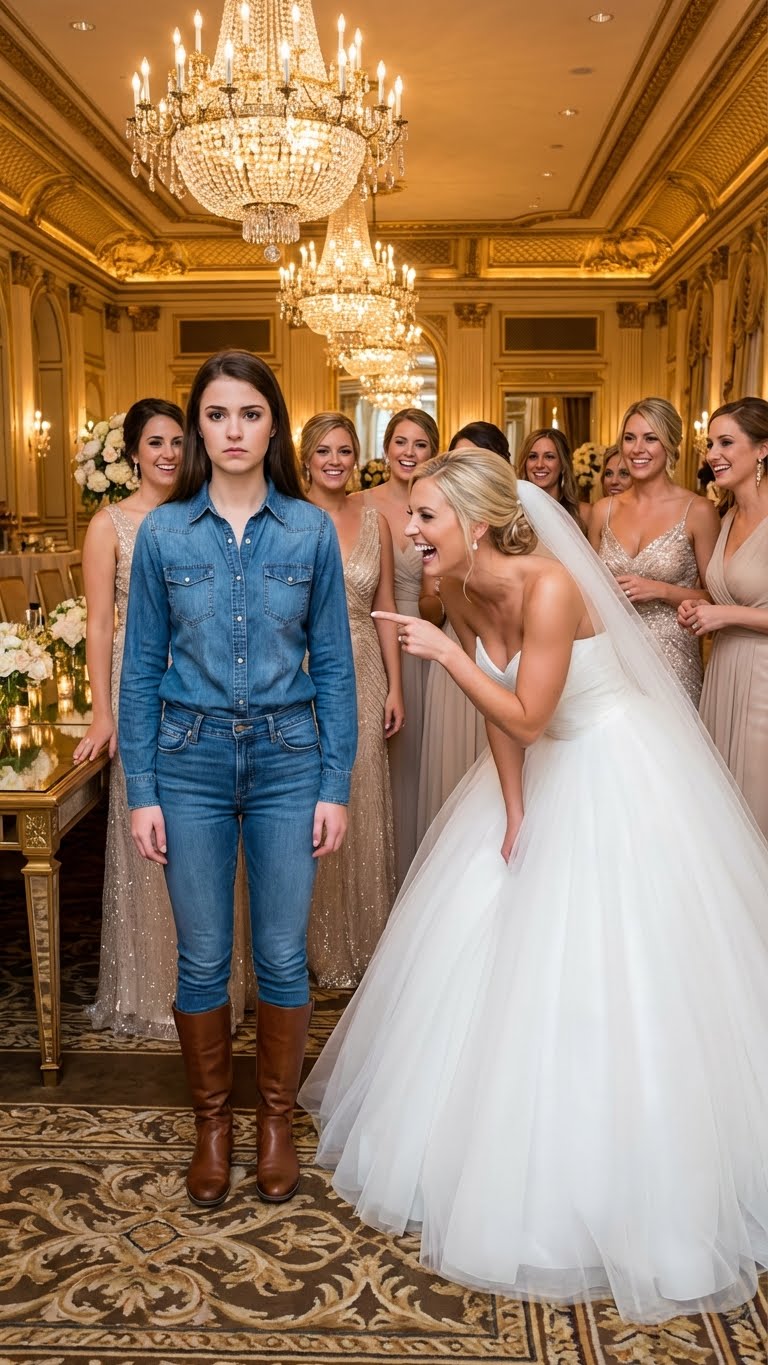
“Oh, great. The stinky country girl is here.”
Sloan Whitmore, my brother’s flawlessly manicured fiancée, was leaning toward her phalanx of bridesmaids, a crystal flute of champagne dangling precariously from her fingers. Her friends—a clone army of pastel chiffon and blowout hairstyles—erupted into giggles that sounded like hyenas fighting over a carcass. Sloan didn’t even deign to look at me. To her, I was less than significant; I was an atmospheric disturbance, a smudge of dirt on the lens of her perfect engagement party.
I was merely the embarrassment that had crawled out of the backwoods to ruin the aesthetic.
What Sloan Whitmore didn’t know—what not a single soul in this room knew—was that the very ground beneath her overpriced Italian heels belonged to me. I had signed the deed to the Monarch Hotel three years ago. Every crystal in the chandeliers vibrating above her head, every thread in the velvet drapes, every ounce of silver in the fork she was using to spear a canapé—it was all mine.
By the time the clock struck midnight, that whisper was going to cost her everything.
My name is Bethany Burns. I am thirty-one years old, and I was raised in Millbrook, Pennsylvania, a hamlet so insignificant that our only traffic jam in history occurred when Old Man Henderson’s prize heifer wandered onto Main Street and decided to nap. I fled that town at eighteen with a single suitcase, two hundred dollars stuffed in my sock, and a stubborn refusal to suffocate.
I didn’t leave because I hated the countryside. I left because my family made it explicitly clear that the inn was full.
I have an older brother, Garrett. He was the Golden Child, the sun around which my parents’ universe orbited. Growing up, I was the shadow cast by his brilliance. If I scraped a B on a math test, Garrett had brought home an A+. If I made the varsity softball team, Garrett was being crowned homecoming king. My mother, Patricia, had a specific way of looking at me—a mixture of fatigue and disappointment—as if I were a rough draft she had crumpled up and tossed aside, while Garrett was the framed masterpiece.
So, I ran. I took a Greyhound bus to the city and started over.
Back home, the narrative was that I was struggling. They imagined me in a rat-infested studio apartment, boiling instant noodles on a hot plate. For the first two years, they weren’t wrong. But they didn’t know about the job I took as a night cleaner at a boutique hotel. That job was my university. I scrubbed toilets, but I also watched. I studied the flow of logistics, the psychology of hospitality, the margins of luxury. I worked my way from housekeeping to the front desk, from the desk to management. I saved every dime that didn’t go to rent. I invested with the aggression of someone who had nothing to lose.
By twenty-eight, I bought my first dilapidated motel. By thirty, I had three properties. Now, at thirty-one, I am the CEO of Birch Hospitality, a portfolio of six high-end boutique hotels across the East Coast. The Monarch is my flagship, my crown jewel.
But when you build an empire from dust, you learn the value of silence. You learn that being underestimated is the most lethal weapon in your arsenal. So, I never told my family. To them, I was still the failure, the little sister who couldn’t measure up to Garrett’s mediocre middle-management career at a regional insurance firm.
The irony was thick enough to spread on toast.
Tonight, I had received a pity invite to Garrett’s engagement party. It was a last-minute gesture, likely my mother’s doing, just so she could tell her country club friends the “whole family” was in attendance. I stood in the entrance of my own hotel, wearing vintage denim and my favorite leather boots, my hair smelling faintly of the Millbrook wind because I’d driven the long way just to remember where I came from.
My outfit cost more than Sloan’s entire ensemble, but you’d never know it. That’s the thing about real wealth: it whispers. It doesn’t need to scream.
I spotted my mother holding court near the buffet, preening like a peacock. She was undoubtedly extolling the virtues of Garrett and his wealthy new fiancée. Garrett stood next to Sloan, looking like a man who had won the lottery, oblivious to the fact that he was holding a voided ticket.
Sloan finally glanced my way, her smile as sharp as a fresh paper cut. She didn’t recognize me as a threat. She saw an inconvenience. A stain.
Good, I thought, walking toward the bar. Let them think I’m nobody. Let them dig the grave. I’ll just provide the shovel.
My General Manager, Wesley Crane, caught my eye from across the room. He gave a microscopic nod. The trap was set. My staff knew not to acknowledge me as the owner tonight. Everything was perfect. Because in exactly three hours, Sloan Whitmore was going to learn a very expensive lesson: Never insult the country girl, especially when she owns the roof over your head.
The party was an exercise in narcissism. There were ice sculptures of swans that looked vaguely depressed, a champagne fountain that defied the laws of physics and good taste, and enough floral arrangements to deforest a small jungle. It was beautiful, technically, thanks to my incredible staff, but the soul of the event was rot.
I retreated to a quiet corner, nursing a bourbon, observing the ecosystem of the room.
That was when my mother found me. Patricia Burns approached with the grim determination of a woman locating a bad smell. She scanned me from head to toe, her gaze stalling on my boots with visceral disapproval.
“It’s… nice that you could make it, Bethany,” she said, her tone suggesting it was actually a tragedy. “Though I do wish you could have worn something appropriate. The Whitmores are a very refined family.”
She emphasized the word refined as if it were a foreign concept I couldn’t possibly grasp.
“I came straight from work, Mom,” I said calmly. “Didn’t have time to change.”
“Work.” She sighed, the sound heavy with martyrdom. “Well, try to make a good impression. For your brother’s sake. Don’t embarrass us.”
She vanished back into the crowd before I could respond. Twenty seconds. That’s all it took to make me feel twelve years old again, standing in the kitchen while she praised Garrett’s report card and ignored my art project.
I looked across the room at the Whitmores. Franklin and Delilah, Sloan’s parents, were working the room with the frantic energy of sharks that stop swimming and die. Franklin was a large man with a flushed face and a suit that cost more than my first car. Delilah was dripping in diamonds, but she kept touching her necklace, a nervous tic that betrayed her poise. They looked rich. They acted rich. But something was off. It was like looking at a high-resolution photo that had been slightly Photoshopped—the shadows didn’t match the light sources.
Garrett finally wandered over. My big brother.
“Beth! You made it,” he said, giving me a side-hug that felt obligatory. “Have you met Sloan yet? She’s incredible, right?”
“I’ve seen her,” I said neutrally.
“She’s amazing,” Garrett gushed, his eyes scanning the room for more important guests. “Mom gave her Grandma’s necklace as an engagement gift. Can you believe it? Sloan loves it.”
The air left my lungs in a painful rush. “Grandma’s necklace?”
“Yeah. The antique pendant.”
I felt a cold rage crystallize in my chest. That necklace wasn’t just jewelry. On her deathbed, our grandmother had held my hand—my hand, not Garrett’s—and told me that pendant was for me. She called me her “dreamer.” My mother knew this. She had been in the room. And yet, she had handed my inheritance to a woman who called me a stinky country girl.
I looked across the room. There it was. Resting on Sloan’s collarbone, catching the light of my chandeliers.
I excused myself, needing air. I headed toward the corridor leading to the executive offices. That’s where I passed Franklin Whitmore. He was pacing, his phone pressed to his ear, his “refined” mask completely gone.
“We need this wedding to happen, dammit,” he hissed into the phone. “The Burns family is liquid. They have the capital to cover the situation.” A pause. “Yes, just get us through the ceremony. After that, we restructure.”
He hung up, wiped sweat from his forehead, and smoothed his jacket before returning to the party.
I stood frozen in the hallway. The Burns family is liquid?
My parents had a second mortgage. Garrett made a decent salary, but he wasn’t wealthy. There was no family fortune. Why did Franklin think there was?
And then, the realization hit me like a physical blow.
For the last four years, I had been anonymously paying off my parents’ debts. When my father needed knee surgery? I paid the hospital directly. When the mortgage was overdue? I had Birch Hospitality cut a check. I did it because I loved them, despite everything. I did it anonymously because I didn’t want their gratitude or their questions.
But my mother… in her delusion, she must have assumed the money was coming from Garrett. She must have bragged to her friends, and eventually to the Whitmores, about her successful son who quietly took care of everything.
The Whitmores had done their due diligence. They saw a debt-free house, expensive medical care, and a lifestyle that didn’t match the tax returns. They assumed Garrett was sitting on a secret pile of cash.
They were grifters. They were hunting a fortune that didn’t exist—at least, not where they thought it did. And when they realized the well was dry, they would leave my brother broken and my parents destitute.
I found Wesley near the service entrance.
“I need a background check,” I said, my voice dropping to a dangerous register. “The Whitmore family. Franklin, Delilah, Sloan. Deep dive. Financials, court records, aliases. Call Naomi.”
Wesley didn’t blink. “Consider it done, boss.”
I returned to the party, my blood running cold. Sloan intercepted me near the restrooms. She linked her arm through mine, her grip surprisingly strong.
“Let’s chat,” she purred, pulling me into a secluded alcove. Her smile vanished instantly. “Listen, Bethany. Garrett tells me you send money home. Playing the dutiful daughter?”
I stared at her. “Excuse me?”
“It’s pathetic, really,” she sneered, leaning in close. “Trying to buy their love? Garrett told me everything. How you were always jealous. How you’re the black sheep. Just so you know… once we’re married, I think it’s best if you keep your distance. Nobody wants you here. You’re dead weight.”
She patted my cheek—a condescending, possessive tap—and walked away.
She thought the money came from Garrett. She thought I was the charity case sending scraps.
My phone buzzed. It was Wesley. He had sent a PDF file.
I opened it. Naomi, my forensic accountant, was a wizard.
Subject: Whitmore Investigation / URGENT
Summary: Ponzi Scheme. Active Federal Investigation.
I scrolled through the documents. Franklin and Delilah weren’t real estate tycoons; they were running a collapsing investment fraud. They were millions in debt. And Sloan?
Her real name was Sandra Williams. She had a record in Arizona. Fraud, identity theft, larceny. The “parents” were partners in the con. They moved from state to state, finding a “mark”—a respectable family with perceived wealth—marrying in, draining the accounts, and vanishing.
They were parasites. And they had attached themselves to my brother.
I looked at the time. 8:55 PM. The speeches were scheduled for 9:00 PM.
I had five minutes to destroy them.
I walked to the Audio-Visual booth. The technician, a young guy named Mike, looked up, startled.
“Ms. Burns! I didn’t know you were here.”
“I need you to load this drive,” I said, handing him a USB stick Wesley had prepared. “When Franklin starts his toast, cut the feed. Put this on the main projector.”
“But… the schedule says—”
“I sign your paychecks, Mike. Do it.”
I walked back onto the floor. The atmosphere was jovial, oblivious. Garrett was laughing at something Franklin said. My mother was beaming.
At 9:00 PM sharp, the music faded. Franklin Whitmore stepped onto the small stage, tapping the microphone.
“Good evening, everyone,” he boomed, his salesman persona in full effect. “Thank you for joining us to celebrate this beautiful union. When my daughter first brought Garrett home, I knew immediately… here was a man of integrity. A man of substance.”
A man with money you want to steal, I corrected silently.
“To family,” Franklin raised his glass. “To legacy. To forever.”
“NOW,” I texted Wesley.
The massive screens behind the stage flickered. The slideshow of Garrett and Sloan’s engagement photos vanished.
In their place, a mugshot appeared.
It was Sloan, looking younger, harder, and holding a placard that read ARIZONA DEPT OF CORRECTIONS: WILLIAMS, SANDRA.
A gasp ripped through the room. It started as a ripple and turned into a wave.
Franklin froze. He turned around, saw the screen, and his face drained of color so fast it looked like the blood had evaporated.
The image changed. A bank statement. Whitmore Holdings: OVERDRAWN -$4.2 MILLION.
Then another. An FBI Wanted poster featuring all three of them under different aliases: The Miller Family. The Davises. The Whitmores.
“Technical difficulties!” Franklin shouted, his voice cracking. “Cut the feed! Turn it off!”
“It’s not a glitch, Franklin,” I said.
I hadn’t shouted, but the room was so silent my voice carried. I walked out of the shadows, my boots clicking rhythmically on the marble floor I paid for. I walked straight to the stage.
“Bethany?” Garrett whispered, looking from the screen to me. “What is this?”
“This,” I said, taking the microphone from Franklin’s limp hand, “is the truth.”
I turned to the crowd. “I apologize for the interruption. But I thought you all deserved to know who you’re actually toasting. These people are not the Whitmores. They are the Williams ring. They are con artists currently under federal investigation for a multi-state Ponzi scheme.”
“She’s lying!” Sloan—Sandra—shrieked. She lunged forward, her face twisted into a mask of pure, ugly hate. “She’s just jealous! She’s a pathetic, poor little nobody!”
I smiled. It was the smile of a wolf watching a rabbit try to explain why it shouldn’t be eaten.
“Am I?” I gestured to the back doors. “Then I suppose the Federal Agents waiting in the lobby are just figments of my jealousy?”
On cue, the double doors burst open. Four agents in windbreakers emblazoned with FBI strode in. Agent Reeves, whom my lawyer had contacted an hour ago, pointed directly at Franklin.
“Franklin Williams, you are under arrest.”
Pandemonium.
Franklin tried to run, knocking over a waiter, but he was tackled before he made it ten feet. Delilah began to sob, mascara running in black rivulets down her face. Sloan stood frozen, looking at Garrett.
“Garrett, baby, listen to me,” she pleaded, grabbing his lapels. “They’re lying. I love you. Tell them!”
Garrett looked at the mugshot on the screen. He looked at his grandmother’s necklace around her neck. He gently reached up, unclasped the necklace, and removed it.
“I don’t even know who you are,” he whispered, stepping back.
Sloan’s face hardened. She spun toward me. “You ruined everything! You bitch! You think you’re special? You’re nothing! You’re just the help!”
Security guards—my security guards—flanked her.
I leaned in close, so only she could hear.
“Actually, Sandra,” I whispered. “I’m the owner. I own this hotel. I own the company. And I own the ground you’re standing on. Now, get off my property.”
As they dragged her away, screaming profanities, the room stood in stunned silence.
I tapped the microphone. “Well,” I said to the shocked guests. “The bar is still open, and the food is paid for. No sense in wasting a good party.”
The fallout was spectacular.
The “Whitmores” were arraigned the next morning. It was all over the news. Hotel Mogul Exposes Grifters at Brother’s Engagement. They called me a “mystery heiress.”
Three days later, I sat in my office at the Monarch, overlooking the city skyline. My assistant buzzed me.
“Your brother is here, Ms. Burns.”
“Send him in.”
Garrett walked in. He looked tired. He had aged five years in three days. He stopped in the doorway, taking in the mahogany desk, the floor-to-ceiling windows, the quiet power of the room.
“You own this?” he asked softly. “All of it?”
“Birch Hospitality owns it,” I corrected. “I own Birch.”
He sank into one of the leather chairs. “How? How did you… we thought you were struggling.”
“I let you think that,” I said. “It was easier.”
He pulled something out of his pocket. It was Grandma’s necklace. He placed it gently on my desk.
“This belongs to you,” he said. “Mom… Mom told me about the bills. The mortgage. The surgery. She saw the bank transfers on your phone that night.” He looked up, his eyes wet. “We thought it was me. But it was you. It was always you.”
“I didn’t do it for credit, Garrett.”
“I know. That makes it worse. We treated you like you were invisible, and you were holding the roof up over our heads.” He took a shaky breath. “I’m sorry, Beth. I am so, so sorry.”
For the first time in my life, I believed him. The Golden Child was tarnished, but he was real.
“It’s a start,” I said.
Later that afternoon, I went down to the lobby restaurant. My mother was there, waiting. She looked smaller than I remembered. The arrogance was gone, replaced by a tentative, fragile shame.
We didn’t hug. We weren’t there yet. But we sat. We ordered coffee.
“I started therapy,” she said abruptly, staring at her cup. “I need to understand… why I couldn’t see you. Why I didn’t want to.”
“That’s good, Mom,” I said.
“I was proud of the wrong child,” she whispered.
I reached across the table and covered her hand with mine. “You don’t have to be proud of me because I have money, Mom. You just have to be my mother.”
She squeezed my hand, tears spilling over.
As we left the restaurant, a commotion at the front desk caught my eye. A young girl, maybe nineteen, was arguing with the concierge. She wore cheap shoes and a determined expression.
“I just need to speak to the manager,” she was saying. “I’m looking for a job. I’ll clean, I’ll wash dishes, anything.”
The concierge looked dismissive. “We aren’t hiring.”
I walked over. “Actually, we are.”
The girl turned to me, eyes wide.
“My name is Bethany,” I said, extending my hand. “I started in housekeeping. What’s your name?”
“Nicole,” she stammered. “Nicole Patterson. I… I’m from a small town in Ohio. People said I wouldn’t make it here.”
I smiled. It was the first genuine smile I’d felt in weeks.
“Well, Nicole from Ohio,” I said. “People say a lot of stupid things. Come with me. Let’s get you a uniform.”
As I led her toward the offices, I caught my reflection in the glass doors of the Monarch. I didn’t see the stinky country girl. I didn’t see the invisible sister. I saw a woman who had built a castle out of the stones thrown at her.
And the view from the top was magnificent.