The wind cut across the expansive asphalt of the long-term parking lot at Toronto Pearson International Airport, carrying with it the biting, damp chill of a Canadian March. I adjusted my scarf, gripping the handle of my carry-on bag tighter. I had flown in from Vancouver on a red-eye, fueled by stale airline coffee and the warm anticipation of a surprise. It was my son Michael’s thirty-second birthday. I imagined the look on his face when I showed up at his doorstep—the shock, the laughter, the chaotic embrace of my twin grandsons, Nathan and Oliver.
It was supposed to be a good day.
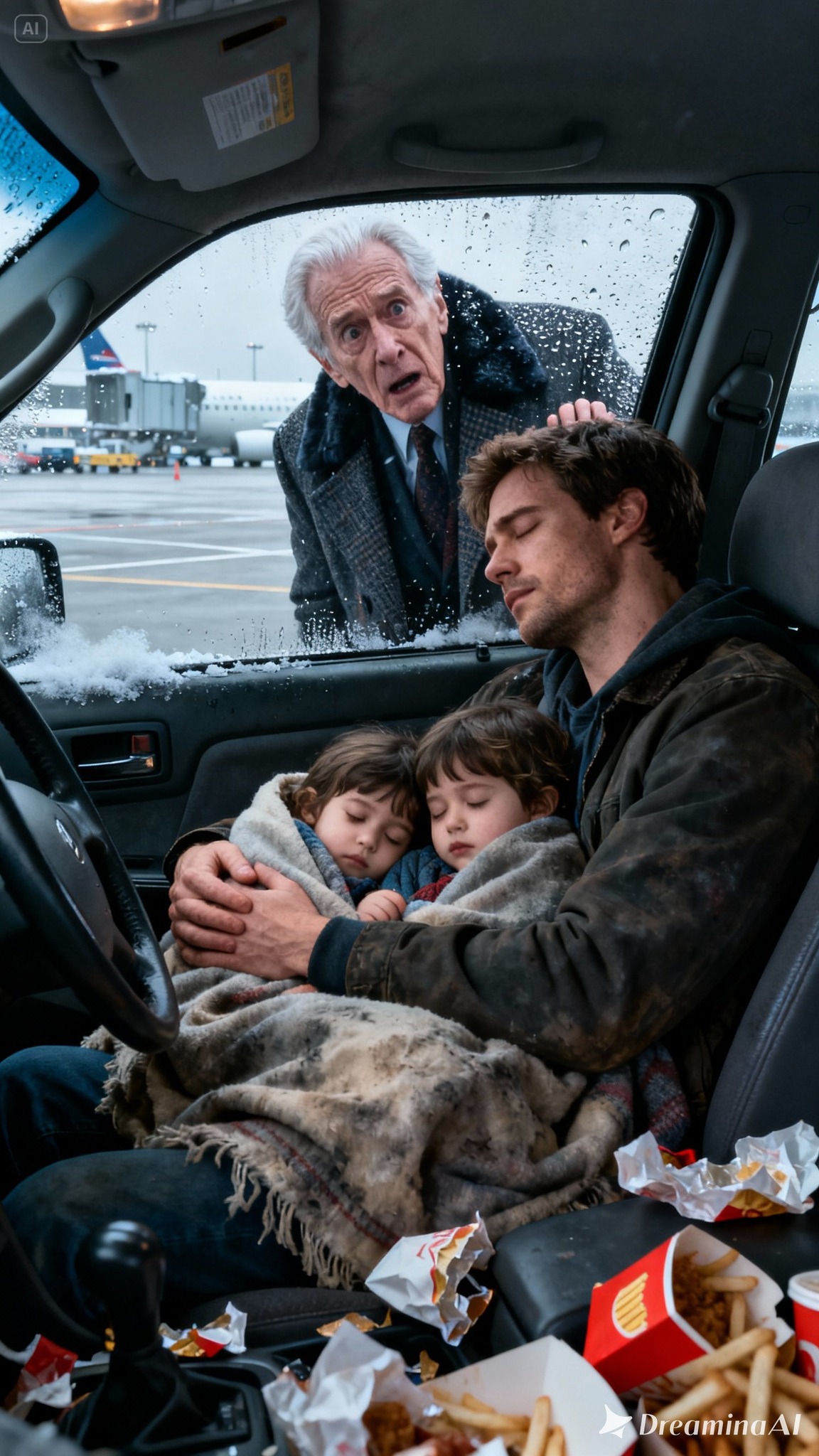
But as I navigated the labyrinth of rows, searching for the rental car section, a flash of silver caught my peripheral vision. It was a Honda Civic, parked in the far reaches of the lot where the long-term rates were cheapest. It wasn’t the car itself that stopped me; it was the condensation. The windows were fogged heavily from the inside, the kind of moisture that builds up when bodies occupy a small space for too long in the cold.
I slowed my pace. Something in the pit of my stomach, an instinct honed by decades of fatherhood, twisted violently. I recognized the license plate.
I walked closer, my breath hitching in my throat. Through the haze on the glass, I saw movement. I leaned in, shielding my eyes from the grey glare of the sky. My heart didn’t just stop; it plummeted.
It was Michael.
He was in the driver’s seat, slumped awkwardly against the door. But it was the back seat that shattered me. There, curled up under a single, heavy wool blanket, were Nathan and Oliver. My five-year-old grandsons were sleeping amidst a nest of clothes, fast-food wrappers, and stuffed animals.
I stood frozen for a moment, the cold wind forgotten, replaced by a searing heat of confusion and horror. I knocked on the window.
Michael’s eyes shot open. There was no recognition at first, only the feral panic of a hunted animal. He scrambled upright, rubbing his face, before his eyes locked onto mine. The panic dissolved, replaced by something far worse, something I had never seen on my son’s face in all his thirty-two years.
Shame. deep, crushing, debilitating shame.
He opened the door slowly. The air that escaped the car was stale—the smell of unwashed bodies and despair.
“Dad?” His voice was a hoarse rasp, barely a whisper. “What… what are you doing here?”
“What am I doing here?” My voice trembled, cracking under the weight of the sight before me. “Michael, what the hell is going on? Where is the house? Where is Jennifer? Why are you living in a Honda Civic with my grandsons in the middle of March?”
He couldn’t look at me. He stared at his boots, the leather scuffed and worn. “It’s complicated.”
“Complicated?” I stepped closer, my voice rising despite my best efforts to keep it calm. “You are sleeping in a parking lot. That is not ‘complicated,’ Michael. That is a catastrophe.”
In the back seat, the movement stirred the boys. Nathan sat up, rubbing his eyes with a fist. He blinked, focusing on me through the open door.
“Grandpa?”
His small, sleepy voice broke something profound inside my chest. It wasn’t just heartbreak; it was a call to arms.
“Hey, buddy,” I said, forcing a smile that felt like it might crack my face. I reached in and squeezed his foot through the blanket. “Why don’t you and Oliver come with Grandpa to get some breakfast? Your dad and I need to talk.”
Michael looked up then, tears brimming in his red-rimmed eyes. He looked thin—gaunt, even. The vibrancy I associated with my son was gone, extinguished.
“Okay,” Michael whispered. “Okay.”
As we walked toward the terminal, the boys holding my hands, I looked back at the car. It wasn’t just a vehicle anymore. It was a tomb where my son’s life had been buried. I swore to myself, right then and there, that I would dig him out, no matter whose hands I had to dirty to do it.
An hour later, we were seated in a corner booth at the airport Tim Hortons. The boys were demolishing plates of pancakes, their resilience a stark contrast to their father. Michael sat opposite me, nursing a black coffee, his shoulders hunched as if expecting a blow.
“Tell me,” I said. “Everything. Don’t leave out a single detail.”
He took a shaky breath, wrapping his hands around the warm mug. “Jennifer left me three months ago. But… it wasn’t just that she left, Dad. She took everything. The house, the bank accounts, the business capital. All of it.”
I frowned. “The house was in both your names. The business was a partnership.”
“She had me sign papers,” he said, his voice dropping. “About six months ago. She said it was for tax purposes, to protect the assets if the startup hit a rough patch. She wanted to put the house in her name only. I trusted her. She’s my wife. I signed.”
He paused, swallowing hard. “Then, one day I came home from work, and the locks were changed. There was a process server waiting on the lawn with a restraining order. Her lawyer claimed I was mentally unstable. Dangerous. He said I had been threatening her and the boys.”
“That is insane,” I snapped, keeping my voice low so the boys wouldn’t hear. “You have never been violent a day in your life. You’re the man who captures spiders to put them outside.”
“I know,” Michael said, sounding defeated. “But she had evidence. Or at least, her lawyer said she did. Text messages I supposedly sent—crazy, ranting threats. Witnesses who claimed they’d seen me acting erratic in public. Her parents backed up every word. They painted a picture of me as this unstable, controlling monster. The judge believed them.”
“And the money?” I asked, a cold dread coiling in my gut. “The hundred and fifty thousand I invested in your startup?”
Michael’s face crumbled. He looked away, staring out the window at the tarmac. “She was managing the business accounts. The day before she filed for the order, she transferred everything to an investment account belonging to her father, Douglas. She claimed it was a legitimate business loan we had discussed. I have no proof otherwise because she handled all the paperwork.”
“And the custody?”
“Hearing was two weeks ago. I lost.” The words fell like stones. “I only get supervised visitation twice a week. The rest of the time, they are with her and her parents. The court said I needed to prove stable housing and employment before they’d reconsider. But I can’t get housing without money. And Jennifer made sure I have nothing. She contacted my clients, told them I was having a breakdown. I lost my contracts.”
He gestured vaguely toward the parking lot. “I’ve been working day labor, but it’s barely enough for food and gas. I shower at the gym. The boys… they think we’re on a ‘camping adventure.’ I pick them up for my supervised visits, but I have nowhere to take them, so we sit in the car or go to the park.”
“Where are these supervised visits supposed to happen?”
“Her parents’ house,” Michael said, his jaw tightening. “With her mother, Patricia, supervising. It is humiliating, Dad. She sits in the corner and writes notes. Every time I hug them, every time I correct them, she writes it down. I feel like I’m being dissected.”
I felt a rage building in my chest, a cold, calculated fury I hadn’t felt since my wife passed away and the hospital tried to mishandle her records. This wasn’t a divorce. This was an execution.
“This ends now,” I said, my voice steel. “Pack up your car. You and the boys are coming to stay at my hotel. We are going to get you a suit, a hot meal, and a lawyer.”
“Dad, you don’t understand,” Michael pleaded, fear flickering in his eyes. “Her family has money. Her father, Douglas Whitmore, is a major real estate developer. They have lawyers—sharks. I can’t fight them.”
I reached across the table and gripped his wrist. “Maybe you can’t right now. But we can.”
That night, after the boys were asleep in the hotel suite, safe in real beds for the first time in weeks, I sat at the desk and opened my laptop. I wasn’t just a retired grandfather; I was a man with thirty years of business connections and a distinct lack of tolerance for bullies.
I made two calls. The first was to Paul Chen, my corporate attorney in Vancouver. The second was to Detective Sarah Morrison of the Toronto Police, an old friend who owed me a favor for helping her son get into rehab years ago.
“Paul,” I said when he answered. “I need the name of the most aggressive, ruthless family law attorney in Ontario. Money is not an issue. I don’t want a mediator. I want a wartime consigliere.”
Paul listened to the summary of events. There was a long silence on the line. “James,” he said finally. “The business transfers, the forged documents, the coordinated testimony… this isn’t just a custody dispute. This smells like organized fraud. You need Rebecca Hart.”
“Get her,” I said. “Whatever her retainer is, double it.”
I hung up and looked at Michael, who was sleeping fitfully on the pull-out couch. They thought they had broken him. They thought he was isolated, weak, and destitute.
They had forgotten one thing: he wasn’t an orphan.
Rebecca Hart was not what I expected. She operated out of a glass-walled office in downtown Toronto that smelled of espresso and expensive leather. She was in her forties, with sharp, intelligent eyes and a demeanor that suggested she didn’t suffer fools, or losses.
“Tell me everything,” she said, leaning back in her chair, a stylus poised over her tablet. “And I mean everything. Don’t leave out details you think are insignificant. The devil is in the details.”
I let Michael speak. It took an hour. He recounted the gaslighting, the sudden financial shifts, the text messages he never sent, and the humiliating supervision by his mother-in-law.
When he finished, Rebecca remained silent for a long moment. She tapped the stylus against the glass of her desk.
“Here is what we are dealing with,” she said, her voice clinical. “Your son’s ex-wife and her family have executed a textbook case of financial coercive control coupled with parental alienation. They have systematically stripped him of resources, credibility, and access to his children to force a surrender.”
She stood up and walked to the window. “The mental health accusations are the linchpin. If they can paint you as unstable, everything else—the theft of the business, the house—becomes ‘protective measures’ in the eyes of the court. It’s a playbook I’ve seen before. It’s evil, but effective.”
“Can we prove it?” Michael asked, his voice trembling slightly.
“That depends,” Rebecca turned back to us. “Do you have any documentation from the business? Bank statements, emails?”
“I have the wire transfer confirmations from when I invested the money,” I interjected. “And emails from Michael about the business plan. But Jennifer handled the day-to-day accounts.”
“That is a start,” Rebecca nodded. “What about Michael’s mental health? They claim he is unstable. Does he have any medical records proving otherwise?”
“I was seeing a therapist last year,” Michael admitted. “Dr. Lisa Patel. Not because I was crazy, but because the startup was stressful. I was trying to manage the pressure.”
Rebecca’s eyes lit up. “That is excellent. Therapy records showing you were proactively managing stress prove the exact opposite of their claims. We need those records immediately. We also need to do a forensic accounting analysis of the business. If money was transferred out improperly, we will find it.”
She looked at me. “Mr. Reeves, this will be expensive. And it will be ugly. They will drag your son’s name through the mud.”
“I don’t care about the mud,” I said. “I care about the truth. Do whatever you have to do.”
Over the next two weeks, I became a man possessed. I rented a three-bedroom apartment in Mississauga, furnished it, and enrolled Nathan and Oliver in a school nearby. Michael got a job with a tech company run by a former colleague who knew his character and didn’t believe the lies.
While Michael rebuilt his life, I built his defense.
I met with my friend, Detective Sarah Morrison, in a diner off the highway. She slid a manila envelope across the table.
“You were right to be suspicious of Douglas Whitmore,” Sarah said, keeping her voice low. “James, the guy is slippery. He’s been investigated twice by FINTRAC—the Financial Transactions and Reports Analysis Centre. Both times for suspicious large cash deposits. No charges were laid, but the red flags are there. And three years ago, a business partner sued him for fraud. Settled out of court, records sealed.”
“Can we use this?” I asked, flipping through the papers.
“Not directly as evidence of what he did to Michael,” Sarah warned. “But it establishes a pattern. If your forensic accountant can link the money from Michael’s business to Douglas’s accounts… then you have a roadmap.”
Rebecca hired Martin Woo, a forensic accountant who looked more like a librarian than a detective. It took him three weeks to dissect the wreckage of Michael’s company.
The report he presented to us was damning.
“The $150,000 you invested,” Martin said, pointing to a complex flow chart, “was transferred to an account belonging to Douglas Whitmore, labeled as a ‘Vendor Payment.’ But there are no invoices. No contracts. No services rendered. It was a straight theft.”
He flipped the page. “And it gets worse. Over fourteen months, Jennifer systematically moved money from the business to personal accounts, then to her father’s shell companies. Small amounts at first—$500 here, $1,000 there. Then, right before the separation, she drained the remaining operating capital. In total, she embezzled nearly $280,000.”
Michael stared at the paper, pale. “She was stealing from us the whole time. While I was working eighteen-hour days… she was robbing me.”
“This isn’t a marital dispute anymore,” Rebecca said, a shark-like grin spreading across her face. “This is grand larceny. And we are going to make them pay.”
But the real trap was yet to be sprung. The supervised visits.
“We need to prove the grandmother is lying,” Rebecca had told us. “Michael, does the visitation center allow recording?”
“It’s at her house,” Michael reminded her. “But the court order specifies it must be in the ‘common area.’ In Ontario, you can record a conversation if you are a participant in it. It’s ‘one-party consent’.”
“Start recording,” Rebecca ordered. “Every visit. Every word.”
Michael did. And what he captured was about to blow the case wide open.
The custody hearing was scheduled for July, six months after I had found my son in that parking lot. The courtroom was a sterile box of blonde wood and fluorescent light, devoid of the warmth of justice.
Jennifer sat with her parents and her lawyer, Trevor Harding—a man with too much hair gel and a smug smile. She looked confident, dressed in a modest beige suit, playing the part of the concerned, victimized mother to perfection. Douglas Whitmore sat behind her, radiating the arrogance of a man who believed his money made him untouchable.
Michael sat beside me and Rebecca. He was shaking.
“Steady,” I whispered, gripping his shoulder. “We have the ammunition.”
Justice Margaret Holloway, a woman in her sixties with a reputation for being thorough and severe, presided.
Rebecca began our case methodically. She presented the evidence of Michael’s new job, his apartment, the boys’ enrollment in school. She submitted Dr. Patel’s therapy notes, which described a conscientious, stressed, but entirely stable man.
Trevor Harding tried to discredit it all. “Your Honor,” he drawled, standing up. “Mr. Reeves’ newfound stability is entirely bankrolled by his father. It is artificial. It is not sustainable. And it does not erase the violent tendencies my client witnessed.”
“Violent tendencies?” Rebecca stood, her voice cutting through the air like a whip. “Let us discuss those. Mrs. Whitmore’s mother, Patricia, has submitted detailed notes from the supervised visits claiming Michael was aggressive, that the children were fearful and withdrawn. Is that correct?”
“Yes,” Harding said. “The notes are contemporaneous and detailed.”
“We would like to submit Exhibit D,” Rebecca said, handing a USB drive to the clerk. “These are audio recordings of those same visits.”
Jennifer’s head snapped up. Patricia Whitmore turned a shade of grey I hadn’t thought possible.
Rebecca played the first clip. The courtroom filled with the sound of children laughing.
“Daddy! Daddy! Look at the tower I built!” That was Oliver.
“That’s amazing, buddy. Be careful, don’t let it fall. Good job!” Michael’s voice was warm, patient, loving.
“I love you, Dad. When can we go to your house?” Nathan asked.
There was zero fear. Zero hesitation. They were normal, happy children with a father they adored.
Then, Rebecca played another clip.
“Michael, stop hovering over him, you’re making him nervous,” Patricia’s voice cut in, sharp and harpy-like.
“Patricia, I’m just helping him tie his shoe,” Michael replied calmly.
“I’m writing that down as aggression,” Patricia snapped.
The courtroom was silent. Justice Holloway stared at the speaker, then shifted her gaze to Patricia Whitmore, who was now trembling.
“The audio recordings,” Rebecca continued, “directly contradict the sworn affidavits submitted by the grandmother. The supervision is not a protective measure, Your Honor. It is a weapon being used to fabricate evidence.”
Then, Rebecca dropped the hammer.
“Now, let us address the finances.” She called Jennifer to the stand.
Jennifer walked up, looking less confident now. Her eyes darted to her father.
“Mrs. Reeves,” Rebecca began, holding the forensic report. “You testified that you transferred $150,000 to your father as a ‘business loan repayment.’ Is that correct?”
“Yes,” Jennifer said, her voice tight. “My father helped us start the business.”
“Where is the loan agreement?”
“It… it was a verbal agreement.”
“A verbal agreement for $150,000?” Rebecca raised an eyebrow. “Between a corporation and an individual? That is highly irregular. And the other $130,000 you transferred over the following year? Was that also a loan repayment?”
“I… I don’t recall the exact amounts.”
“I do,” Rebecca said, slamming the report on the podium. “This forensic accounting traces every single dollar from the joint business account into your personal account, and then directly into accounts controlled by Douglas Whitmore. And here is the interesting part.”
Rebecca turned to the judge. “We have also subpoenaed the metadata from the text messages Mrs. Reeves claims Michael sent. The threatening ones.”
Jennifer froze.
“The timestamps on the screenshots do not align with the carrier logs,” Rebecca said, her voice deadly quiet. “In fact, the digital forensics show these images were created on a desktop computer using photo-editing software. They were never sent. They are forgeries.”
“Objection!” Harding shouted, sweat beading on his forehead.
“Overruled,” Justice Holloway said, her eyes locked on Jennifer. “Answer the accusation, Mrs. Reeves. Did you fabricate those messages?”
Jennifer looked at her lawyer. She looked at her father. Douglas Whitmore was staring straight ahead, his face a mask of fury—not at the lawyer, but at his daughter for getting caught.
“I… I…” Jennifer stammered. “I was afraid. I needed to protect my children.”
“By framing their father?” Rebecca asked. “By stealing his livelihood? By committing perjury?”
Jennifer burst into tears. But they weren’t tears of remorse. They were the tears of a cornered predator.
The silence that followed was heavy, suffocating. Justice Holloway took off her glasses and rubbed the bridge of her nose. When she put them back on, her expression was terrifyingly calm.
“Mrs. Whitmore,” the judge began, looking directly at Jennifer. “I have sat on this bench for twenty years. I have seen families tear each other apart. But rarely have I seen such a calculated, malicious, and coordinated effort to destroy a parent.”
She shuffled her papers. “I find the evidence of financial fraud to be overwhelming. I find the evidence of fabricated text messages to be distinct and proven. And the manipulation of the supervised visitation notes is an affront to this court.”
She turned to Michael. “Mr. Reeves, you have been the victim of a grave injustice. I am rectifying that today.”
The gavel was raised.
“I am ordering an immediate modification of custody. Sole legal and physical custody is awarded to the father, Michael Reeves, effective immediately.”
Jennifer gasped. “You can’t! They’re my babies!”
“You forfeited that right when you abused the legal system to alienate them from their father,” Justice Holloway snapped. “Mrs. Reeves, you will have supervised visitation every other weekend. And it will not be supervised by your mother.”
The judge wasn’t finished. “Regarding the finances… I am ordering Jennifer Whitmore and Douglas Whitmore to repay the sum of $280,000 to Michael Reeves within ninety days. Failure to do so will result in the seizure of assets. Furthermore, given the evidence of forgery and embezzlement, I am referring this file to the Crown Attorney’s Office for criminal investigation.”
She struck the gavel. The sound was like a gunshot. “Adjourned.”
Michael’s knees buckled. I caught him just before he hit the floor. He wasn’t crying; he was gasping, like a man breaking the surface after drowning.
“It’s over,” I whispered, holding him up. “It’s over, son.”
Outside the courtroom, the doors to the waiting area opened. Nathan and Oliver, who had been waiting with a social worker, saw us.
“Daddy!”
They ran to him. Michael dropped to his knees, ignoring the suit we had bought him, and gathered them into his arms. He buried his face in their necks, sobbing openly now. The relief was a physical wave, washing over all of us.
Douglas Whitmore stormed past us, his face purple, shouting into his cellphone. Jennifer followed, weeping, but she didn’t look at the boys. She was looking at her own reflection in the glass doors, mourning her lost control.
“Grandpa!” Oliver reached out and grabbed my hand, pulling me into the huddle.
“I’ve got you,” I said, my voice thick with emotion. “I’ve got you all.”
Three months later, the wheels of justice, usually so slow, ground Douglas Whitmore into dust. The referral to the Crown Attorney, combined with the FINTRAC flags Sarah had found, triggered a massive audit. He was charged with fraud, tax evasion, and money laundering.
Jennifer faced charges of embezzlement and perjury. Her lawyer negotiated a plea deal: she would repay every cent and avoid jail time in exchange for a guilty plea and probation. She moved to a small condo in Oakville, her reputation in tatters. She sees the boys on weekends, but she is a ghost in their lives—physically present, but emotionally checked out, consumed by her own bitterness.
Michael got the money back. Most of it, anyway. Legal fees had taken a chunk, but there was enough to restart. He launched a new business, this time with ironclad contracts and Paul Chen reviewing every document.
I stayed in Toronto. I rented a condo near Michael’s place in Mississauga. I wasn’t going back to Vancouver. My life was here now.
One evening, about a year after that day in the parking lot, Michael and I were sitting on my balcony. The sun was setting over the city, painting the sky in hues of purple and gold. Inside, the boys were laughing, the sound drifting out through the screen door.
Michael took a sip of his beer and looked at me. “I never thanked you properly,” he said quietly.
“You don’t need to thank me.”
“Yes, I do,” he insisted. “Dad, if you hadn’t shown up that day… if you hadn’t knocked on that window… I don’t know where I’d be. I’d still be living in that car. Or worse. I’d have lost them forever.”
He paused, watching a plane descend toward Pearson in the distance. “I thought I was the problem. That maybe I really was unstable. They made me doubt my own sanity. Everyone believed them except you.”
“I know my son,” I said, looking at him. The gauntness was gone. He looked healthy, strong, like the man he was meant to be. “I’ve known you since the day you were born. I know who you are. And you are not what they tried to make you.”
He nodded, swallowing a lump in his throat. “Dad?”
“Yeah?”
“Thank you.”
I reached over and squeezed his shoulder. “You would have done the same for your boys.”
He smiled, a genuine, easy smile. “I would. Because I learned it from you.”
Inside, Nathan called out. “Grandpa! Come play Jenga with us! Oliver is cheating!”
I stood up, draining my glass. “Duty calls.”
Michael laughed. “Go. I’ll order pizza.”
I walked inside to where my grandsons were building a precarious tower of wooden blocks on the coffee table. It wobbled slightly as Oliver pulled a piece from the bottom.
Oliver looked up at me and grinned, his eyes bright and full of trust. “Grandpa, don’t let it fall.”
I sat down carefully on the floor beside them. “I won’t, buddy,” I promised, looking from the boys to my son standing in the doorway. “I won’t let anything fall.”
And I meant it. Not just the tower. Not just this moment. I meant all of it. This family. These boys. My son. I had pulled them from the wreckage, and I would stand guard until my last breath.
Because that is what fathers do. We don’t just build the tower. We hold it steady when the wind blows.