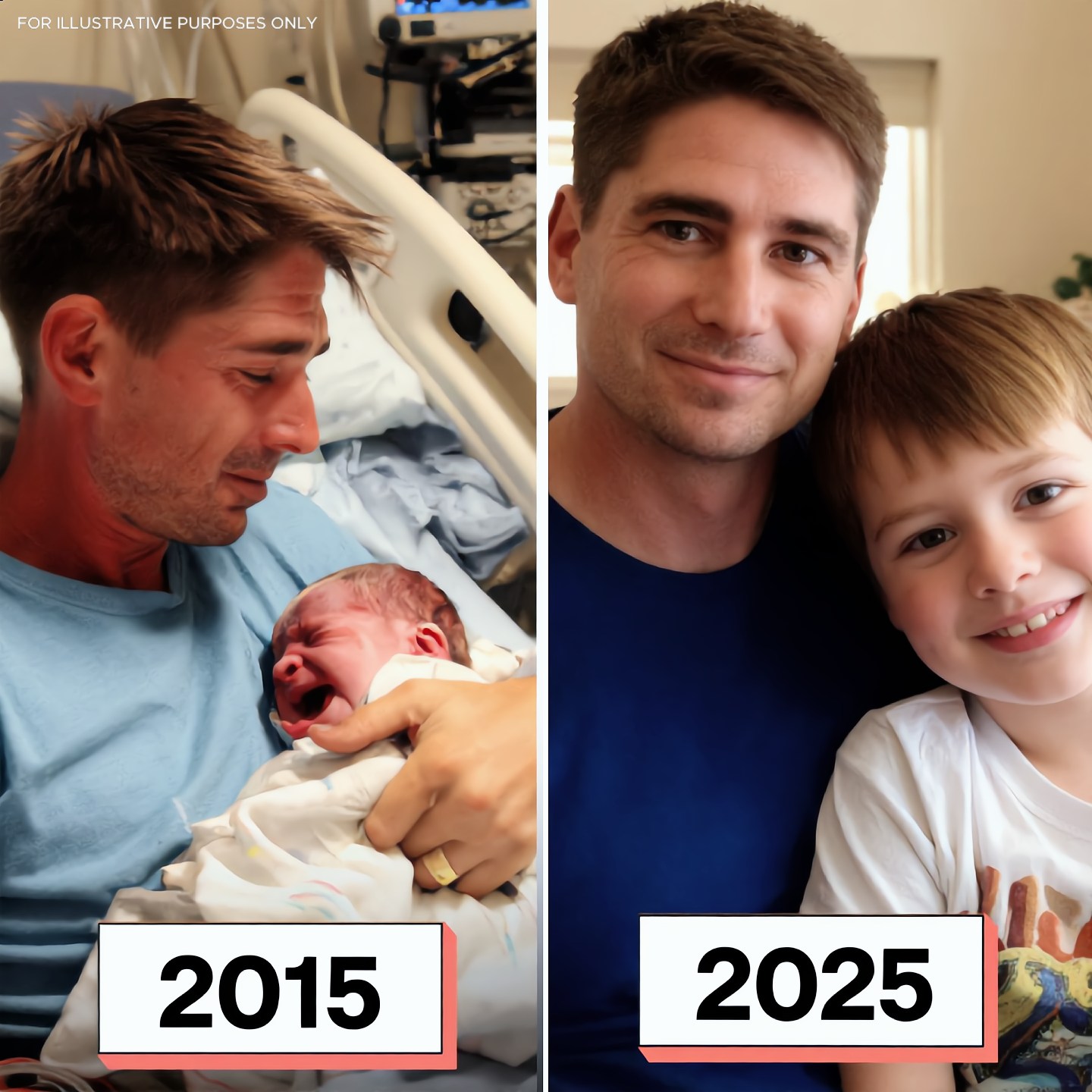
Ten years ago, on Christmas morning, my wife and I walked into the hospital hand in hand, laughing in that soft, foolish way people do when they believe the world is about to give them everything.

It was our son’s due date.
We called him our Christmas miracle. My wife had even packed a tiny red stocking into her hospital bag, stitched with a name we’d whispered for months like a secret prayer.
Liam.
She was calm at first—smiling at the nurses, teasing me through contractions. When they wheeled her into the delivery room, she squeezed my fingers and joked, “If he looks like you, I’m sending him back.”
I laughed. I kissed her forehead. Her skin was warm. Alive.
Later, she said she felt tired.
“Just for a second,” she murmured, leaning back. “I’ll close my eyes.”
She never opened them again.
Her heart stopped without warning.
The room erupted—alarms screaming, doctors shouting, feet running. Someone yelled, “Code blue!” and suddenly I was shoved against a wall, useless and shaking, watching doors slam shut between me and my entire world.
This wasn’t real.
Not on Christmas.
Not to us.
They rushed her into emergency surgery to save the baby.
When a doctor finally came out, she wasn’t smiling. She placed something impossibly small into my arms.
“This is your son,” she whispered.
Liam wasn’t breathing.
He was blue and silent, his tiny chest still. I pressed him to my chest, instinct overtaking reason, tears soaking his blanket.
“Please,” I begged. “Please don’t leave me too.”
Then—a sound.
A thin, fragile cry that cut through the silence like a blade of light.
Liam screamed his way into the world.
My wife never woke up.
Liam survived.

From that day on, Christmas became two things at once: grief and gratitude, twisted together so tightly I could never feel one without the other.
I raised Liam alone.
I never dated again—not out of loyalty or tragedy, but because my heart simply stayed where it was. Married to a woman frozen in time, young and smiling in a hospital bed, joking about sending our son back if he looked like me.
I gave Liam everything I had—not money, not excess, but presence.
We built Lego cities that swallowed the living room. We baked cookies that burned at the edges. I packed his lunches, read him stories, and talked about his mother often—how brave she was, how deeply she loved, how she would have adored him.
Liam grew into a gentle boy. The kind who shared without being asked. Who apologized even when he wasn’t at fault. Who cried at sad movies and asked big questions at bedtime.
I was proud of him in a quiet, aching way.
Then this December came.
One afternoon, after dropping Liam off at school, I returned home and saw a man standing near my porch. He paced back and forth, hands shoved into his coat pockets, visibly nervous.
I assumed he was homeless. Maybe looking for help.
I stepped out of my car. “Can I help you?”
He turned around.
My legs nearly gave out.
He looked exactly like my son.
Same eyes. Same jawline. Same expression Liam wore when he was trying not to show fear.
It was like seeing the future staring back at me.
“Who are you?” I demanded.
“My name is Daniel,” he said quietly. “I’ve come because of Liam.”
My heart slammed against my ribs. “You need to leave.”
“I will,” he said. “After I tell you the truth.”

We stayed on the porch as cold air seeped into my bones and he spoke.
Ten years ago, Daniel had been a cardiology resident at the hospital. My wife had a rare heart condition—one she knew about, but never told me.
“She was warned pregnancy could kill her,” Daniel said, his voice tight. “She didn’t want you living in fear.”
To protect the baby, she secretly chose assisted reproduction, selecting an anonymous donor with no genetic risk for heart disease. A donor with a perfect cardiac profile.
Daniel.
“I never met her,” he said quickly. “I didn’t know who received the donation. It was anonymous. Clinical.”
On the night Liam was born, he’d been on call. When Liam needed an emergency blood transfusion, Daniel was a match. Routine genetic testing followed.
That’s when he learned the truth.
“I didn’t come for him,” Daniel said. “I left the hospital the next morning. I didn’t think I deserved to exist in his life.”
I wanted to scream. To deny everything. But memories shifted into place—my wife’s quiet doctor visits, her insistence on certain tests, the way she once said, ‘Some choices parents make alone.’
“What do you want?” I asked.
“That you tell him the truth,” Daniel said. “Not for me. For him.”
That night, after Liam finished his homework, I sat him down at the kitchen table.
I told him about Christmas morning. About his mom. About how brave she was.
Then I told him the rest.
He listened without interrupting.
When I finished, he asked one question.
“You’re still my dad, right?”
My voice broke. “Always.”
He nodded. “Then I’m okay.”

A week later, while cleaning the closet, I found something I’d never seen before—a sealed envelope tucked inside a shoebox, addressed in my wife’s handwriting.
To you. When the time comes.
My hands shook as I opened it.
My love,
If you’re reading this, it means I didn’t make it—and I’m so sorry I left you this way.
There’s something I never told you, not because I didn’t trust you, but because I loved you too much to burden you with fear.
I knew my heart might fail me. I knew pregnancy could take my life.
But I wanted our child to live.
I chose science. I chose anonymity. I chose the safest path for our baby, even if it meant carrying this secret alone.
Please know this:
I never stopped loving you.
You are Liam’s father in every way that matters.
If the truth ever finds you, don’t let it break you. Let it remind you how fiercely we loved him—how fiercely you loved him.
Be kind to yourself. Be honest with our son.
And when you hang his stocking each Christmas, remember—I’m still there.
Always.
—Her
I cried until my chest hurt.

The next day, Liam asked to meet Daniel.
They sat across from each other in the living room, mirrors of posture and eyes.
“I’m not here to replace anyone,” Daniel said. “I just wanted to say thank you—for staying.”
Liam studied him, then said quietly, “My mom wouldn’t want you punishing yourself forever.”
Daniel broke down.
That Christmas, we hung one more stocking on the mantel.
Not for a miracle.
But for truth.
And for the quiet understanding that a father isn’t the one who shares your blood—he’s the one who never leaves.