When Mark’s wife vanishes without a word, he’s left to raise their newborn daughter alone. Five years later, a chance glimpse of a TV segment shatters everything he thought he understood. As the past walks back through his front door, Mark has to ask whether absence can be undone…

The first thing I noticed was the silence.
My daughter, Maisie, was only three months old then. She woke every few hours to eat, so waking to quiet—true, uninterrupted quiet—felt wrong. Almost unsettling.
I glanced at the baby monitor beside the bed. The screen showed only white noise.
I sat up. Erin wasn’t next to me.
“Probably feeding Maisie,” I muttered as I stretched, kicked off the blanket, and crossed the hallway, the floor cold beneath my bare feet.
Maisie was asleep in her crib, tucked beneath a fleece blanket, her cheeks still round with sleep. She looked untouched by the morning—warm, safe. Her breathing was slow and shallow.
She was clutching the sleeve of Erin’s favorite gray hoodie.
Erin had worn that hoodie through two winters and her entire pregnancy. I leaned closer and noticed the drawstring was missing, torn out from one side. A frayed edge dangled loose. I noticed it—but didn’t think much of it. Maybe it had come loose in the wash.
Maisie stirred slightly and tightened her grip on the sleeve.
I exhaled.
Relief came first. Then confusion.
The clock read 6:14 a.m. Erin was always awake before me. She usually had coffee brewing by now, sometimes even laundry started. I waited for the familiar clink of cups from the kitchen.
Nothing.
The kitchen was empty. The coffee pot was cold. Erin’s phone sat on the counter, still plugged in, battery at 76%. Her wedding ring rested in the small ceramic dish by the sink—the one she always used when washing dishes.
Only this time, she hadn’t put it back on.
There was no note. No message. No sound of running water in the bathroom.
There was simply no sign of Erin anywhere.
My wife had vanished.

That first week, I was frantic. I called hospitals. I texted anyone who might know something. I went to her mother’s house twice, even though they hadn’t spoken in months.
I left voicemails.
At night, I sat awake watching the driveway, convinced she’d come walking back in, exhausted, apologetic, still wearing socks.
She never did.
People said the things people always say—well-meaning words that land like careless blows.
“Maybe she has postpartum depression, Mark,” a neighbor said, handing me a basket of apples. “These things happen.”
“Maybe she panicked. Maybe she just needed space.”
Even my mother said once, “Maybe you missed the signs. That’s awful, Mark.”
Eventually, I stopped inviting people over. Some looked at Maisie like she was a burden Erin had walked away from. No one said it out loud, but I could feel it—in the pauses, the looks, the careful tones.
I left the house untouched. Erin’s sweater stayed on the hook by the door. Her mug with the letter E stayed in the cabinet. I didn’t remove her photos. And I didn’t lie to my daughter.
When Maisie was old enough to ask, I told her the only truth I had.
“Did Mommy go to heaven?” she asked one morning when she was four.
I shook my head and pulled her onto my lap.
“No, baby. Mommy didn’t go to heaven. Mommy… left. I don’t know why. But it wasn’t because she didn’t love you.”
She frowned.
“Did she not like me then?”
That question always hurt the most.
“She loved you,” I said quietly. “But something happened inside her. Something that made her leave. Maybe it was because of me. But it was never your fault.”
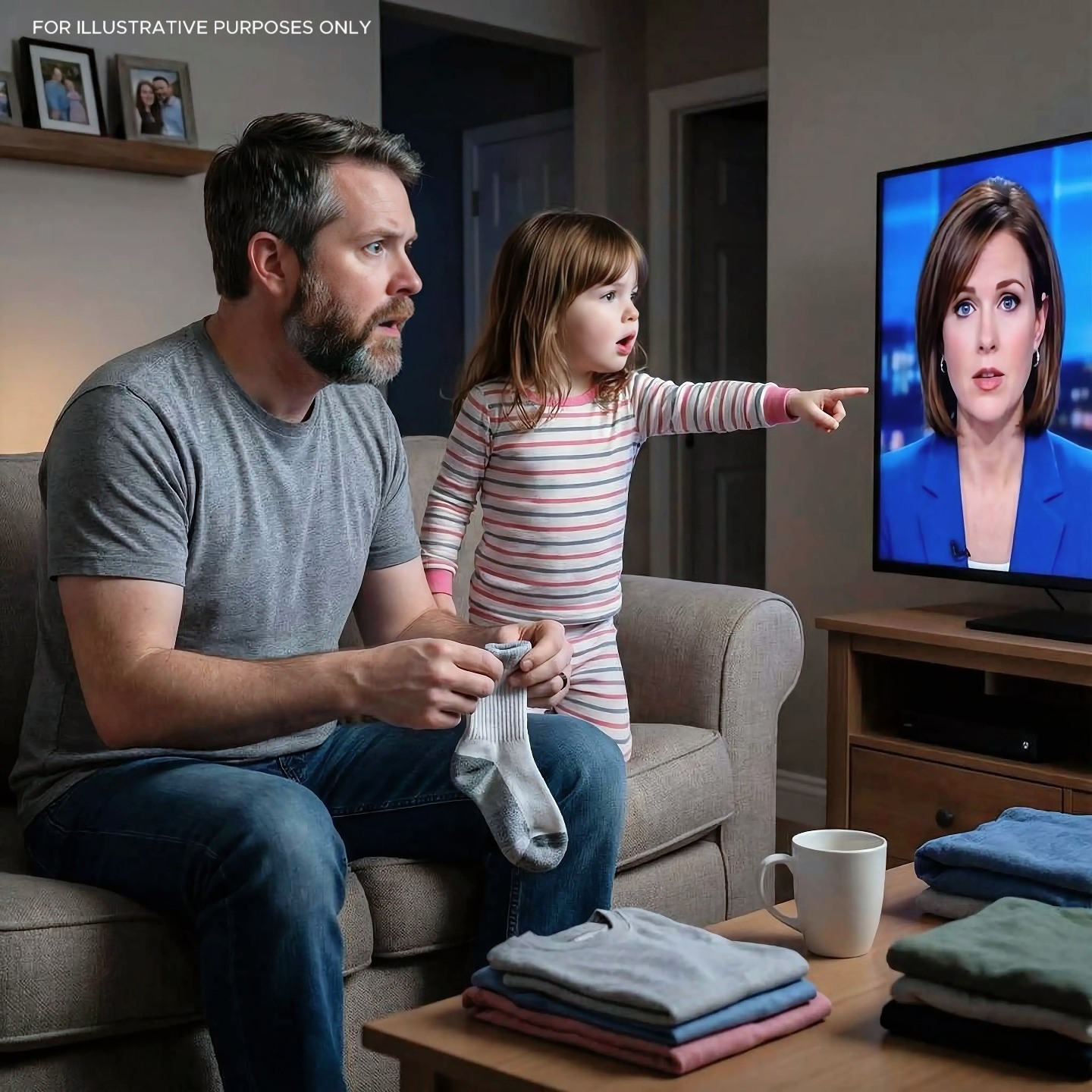
Maisie had just turned five a few weeks earlier. That night, we were in the living room, surrounded by half-folded laundry. She sat cross-legged on the rug, eating apple slices and playing with her dolls while the TV murmured in the background.
I was sorting shirts when she suddenly froze.
“Daddy,” she said softly. “Look.”

A woman stood beneath studio lights, wearing a navy dress. Her hair was pulled back neatly. A microphone rested against her cheek.
She turned slightly—and my body went completely still.
“That’s…” Maisie whispered. “That’s Mommy?”
It was Erin.
Older. Thinner. Her eyes heavier. But unmistakably her.
The host introduced her by a name I didn’t recognize. She was an up-and-coming singer. She had written a song about motherhood and reinvention.
Then Erin looked straight into the camera.
“If Mark and Maisie are watching,” she said, her voice measured, “I’m sorry. And I’m finally ready to tell you the truth.”
“She said our names!” Maisie gasped, clutching my hand. “She remembers us!”
“I didn’t leave because I didn’t love you,” Erin said. “I left because I was drowning. I thought if I stayed, I’d become someone my daughter wouldn’t recognize.”
She paused.
“I spent five years trying to find my way back to myself. And now I want to find my way back to you.”
She pulled a frayed gray drawstring from her pocket.
“When Maisie was a baby, she fell asleep holding this. I carried it everywhere. It reminded me of what I almost gave up.”
The segment ended.
Thirty minutes later, my phone buzzed.
Unknown Number: I’m outside, Mark. Please don’t slam the door in my face.
I opened the door to find Erin standing on the porch, coat zipped to her chin, a rental car idling behind her.
Maisie padded up beside me, barefoot, clutching her stuffed giraffe.
Erin crouched to her level.
“Hi,” she whispered. “You’re beautiful.”
“You’re real,” Maisie said.
“I am, sweetheart. And I’ve missed you so much.”
I stepped forward instinctively.
“You vanished,” I said. “Why are you here?”
“I’m here to be honest,” she said quietly.

Later, after Maisie slept, Erin sat at the kitchen table, steam curling from an untouched mug.
“They diagnosed me with postpartum depression,” she said. “I got help. I rebuilt myself.”
“You could have reached out,” I said.
“I did,” she replied. “Through your mother. Anonymous checks. I didn’t want to disappear completely.”
Everything clicked—the ballet lessons, the groceries, the quiet help.
“I’ll allow visits,” I said finally. “On my terms.”
She nodded, eyes full.
When she left, the house didn’t feel quite as silent anymore.
And somewhere down the hall, Maisie stirred in her sleep.