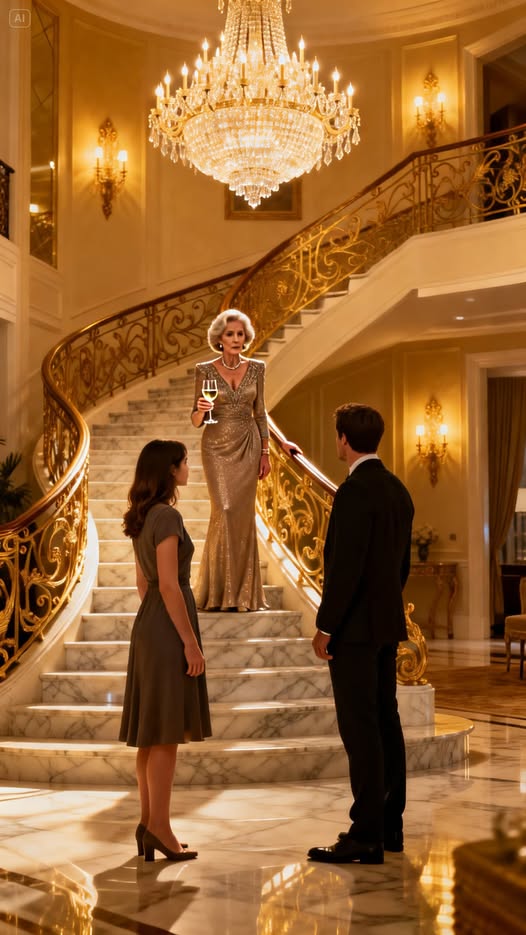
The moment I crossed the threshold of the Whitmore Estate, passing through a mahogany door that likely cost more than my first car, I felt the atmosphere shift. It wasn’t just the temperature controlled air; it was the immediate, crushing weight of judgment.
Patricia Whitmore stood in the foyer like a sentinel guarding the gates of a very exclusive, very hollow heaven. Her face, a mask of surgical preservation and societal disdain, twisted into something resembling a smile—if that smile had been practiced in a mirror to conceal a grimace. Her eyes, sharp as scalpels, dissected me in seconds. She scanned my navy dress—a simple department store find—my sensible flats, and the small, drugstore studs in my ears. I could practically hear the cash register in her mind chiming a zero.
She leaned toward her son, Marcus, my fiancé, and whispered. She thought she was being subtle, shielding her cruelty with a manicured hand. But the acoustics in the cavernous foyer were unforgiving.
“She looks like the help, darling. Did she wander in through the service entrance?”
The air left my lungs for a fraction of a second, but I didn’t flinch. I forced a polite smile, filing the comment away in the hard drive of my memory. That was the moment I knew: this wasn’t just a dinner to meet the parents. This was an audit. And Patricia had already marked me as a liability.
My name is Ella Graham. I am thirty-two years old, and I am living a double life.
For the past fourteen months, I have harbored a secret from the man I intended to marry. It wasn’t a sordid affair or a hidden criminal record. My secret was a number. Specifically, the number $37,000. That is my monthly income, pre-bonus, pre-stock options. I am a Senior Software Architect for a tech giant in the Pacific Northwest. I hold three patents for encryption algorithms that protect the banking data of half the people in this room. I have been coding since I was fifteen, and my net worth is something that makes financial advisors sweat with excitement.
But Marcus didn’t know that. When we met in a coffee shop, amidst the hiss of espresso machines, he asked what I did. I said, “I work in tech.” He assumed I was an admin, perhaps a scheduler for the important men who actually built things. I never corrected him.
Why? Because of Margaret Graham.
My grandmother raised me after my parents died. She lived in a bungalow in Oregon, drove a sedan that rattled when it idled, and clipped coupons with religious fervor. She taught me to mend my own clothes and cook from scratch. It wasn’t until she passed away when I was twenty-four that I opened a safety deposit box and found the deed to a commercial real estate empire and a bank account with seven zeros. She had hidden her millions because she believed that money was a noise that drowned out character.
“Ella,” she wrote in the letter I still keep in my nightstand, “character is what remains when the audience is gone. Watch how people treat you when they think you have nothing to offer them. That is who they really are.”
So, I brought the Whitmore family the test my grandmother designed. I drove my twelve-year-old Subaru Outback up their manicured driveway, past iron gates accented with gold leaf that screamed of insecurity. I wore no makeup, tied my hair in a severe ponytail, and prepared to be underestimated.
Inside, the house was a museum of desperation. Crystal chandeliers dripped from every ceiling, casting light on oil paintings that I instantly recognized as high-end prints, not originals. Marcus greeted me with a kiss that felt performative, his eyes darting to my shoes with a flicker of shame.
“You look… comfortable, Ella,” he said, the compliment dying in his throat.
We moved to the living room, where the rest of the tribunal awaited. Harold Whitmore, Marcus’s father, was a large man whose handshake felt like a wet sponge. He had inherited a chain of mid-range car dealerships and had clearly spent the last decade resting on those laurels. Then there was Vivienne, Marcus’s older sister.
Vivienne didn’t walk; she prowled. She was draped in silk and dripping in diamonds that looked heavy enough to cause orthopedic damage. She looked at me, gave a microscopic nod that barely qualified as a greeting, and immediately turned her back to discuss a charity gala with her mother.
“Is the florist still breathing?” Vivienne asked, swirling her wine. “After the hydrangeas fiasco last month, I would have had him deported.”
I stood there, holding a glass of tepid water, feeling like an interloper in a bad soap opera. But there was one other guest. An older man named Richard Hartley, introduced as a family friend. He sat quietly in a wingback chair, his silver hair catching the light. When our eyes met, he paused. He squinted slightly, a flicker of recognition passing over his face. I didn’t know him, but he seemed to know something about me—or perhaps, he just recognized the look of a wolf in sheep’s clothing.
Dinner was an exercise in humiliation. The table was set with enough silverware to perform open-heart surgery. Patricia sat at the head, the queen of her domain.
“I suppose you aren’t accustomed to formal dining, Ella,” she purred, her voice dripping with faux-sympathy. “Don’t worry, dear. Just work from the outside in.”
“My grandmother always taught me,” I said, keeping my voice steady, “that the company matters more than the cutlery.”
Vivienne snorted into her Chardonnay.
Then, the interrogation began. Patricia grilled me on my background. I told the truth: small town, raised by a grandmother, public school. Every answer was met with a sympathetic tilt of the head, the kind you give to a stray dog with a limp.
“And your job?” Patricia pressed. “You support the team, Marcus says?”
“I do,” I said. “It’s a critical role.”
“Every executive needs a good secretary,” Patricia nodded, satisfied.
Then, Vivienne dropped the bomb.
“I ran into Alexandra yesterday,” she said, her voice casual, lethal.
The name sucked the oxygen out of the room. Marcus stiffened beside me.
“Oh?” Patricia brightened. “How is she? Such a lovely girl. The Castellano family has always been so close to us. Their luxury import business is… thriving.”
“She asked about Marcus,” Vivienne continued, eyes locked on me. “She’s still single. It’s almost like she’s waiting for something to… clear up.”
They weren’t just rude; they were cruel. They spent the next twenty minutes eulogizing Marcus’s relationship with this Alexandra, a woman who apparently was his perfect match in pedigree and tax bracket. I sat there, cutting my chicken, realizing that Marcus—the man who claimed to love me—was saying nothing. He stared at his plate, a coward in a bespoke suit.
As dessert was served, I excused myself to find the restroom. I needed a moment to breathe, to quell the rising tide of anger. I walked down a hallway lined with portraits of the family looking regal and constipated.
But I never made it to the bathroom.
I heard voices drifting from a partially open study door. Patricia and Vivienne.
“We need to announce the engagement tonight,” Patricia was hissing.
“But why?” Vivienne argued. “He should be with Alexandra. The merger—”
“The merger takes time, you idiot,” Patricia snapped. “Harold says the financials are bleeding. If we don’t secure the Castellano distribution network, we lose the franchise. Marcus needs to keep Alexandra on the hook, but we need a distraction. This girl… this Ella… she’s the perfect placeholder.”
I froze. My blood ran cold, then hot.
“A placeholder?” Vivienne asked.
“She’s common. She’s naive,” Patricia said, her voice dropping to a conspiratorial whisper. “Let him play house. We get the Castellano deal signed, and then we find a way to dispose of her. A scandal, a payoff, whatever. Marcus knows the plan. He’s just keeping his options open.”
“At least she’s too stupid to suspect anything,” Vivienne laughed. It was a dry, ugly sound.
I stood in the hallway, the vibrations of their malice humming in the floorboards. Placeholder. Stupid. Common.
They didn’t just hate me. They were using me as human collateral to save their failing business. And Marcus—my sweet, attentive Marcus—was in on it.
I stepped back, my pulse hammering a war drum against my ribs. I could leave. I could run. But Margaret Graham didn’t raise a runner. She raised an architect. And architects know that before you demolish a rotting structure, you have to identify the load-bearing walls.
I turned on my heel and walked back toward the living room. I didn’t fix my makeup. I didn’t smooth my hair. I let the anger sharpen my focus.
The game had just changed. And the Whitmores had no idea who was holding the controller.
When I re-entered the room, the dynamic had shifted. Harold looked sweaty. Patricia looked triumphant. And Marcus looked like a man walking to the gallows.
He approached me, took my hands, and dropped to one knee.
It was happening. The trap was springing.
“Ella,” he began, reciting lines that sounded like they’d been drafted by a committee. “I know it’s soon, but… I want you by my side.”
He produced a ring. It was large, gaudy, and under the recessed lighting, I could see the diamond was cloudy. A flawed stone for a flawed proposal.
I looked at him. Really looked at him. I saw the weakness in his jaw, the deceit in his eyes. I thought about Alexandra. I thought about the “placeholder” comment. Every instinct screamed at me to slap him and walk out.
But then I caught Richard Hartley’s eye from the corner of the room. He was watching me with an intensity that unsettled me. He gave a microscopic shake of his head, then a nod. Wait, his eyes seemed to say. Not yet.
“Yes,” I said.
The word tasted like bile.
Patricia clapped her hands, a hollow, percussive sound. Vivienne smirked. The deal was sealed. The placeholder was in position.
The rest of the evening was a blur of champagne toasts and condescension. As I was leaving, Marcus walked me to my Subaru.
“They really like you,” he lied. “Mom can be intense, but she means well.”
“I’m sure she does,” I said, unlocking my car door. “I’ll see you tomorrow, Marcus.”
I drove home in silence, my mind racing. The moment I stepped into my apartment—a modest, comfortable space that gave no hint of my bank account—I went to work.
I am a software architect. My job is to find bugs, exploit weaknesses, and optimize systems. The Whitmore family was just a corrupt system waiting to be debugged.
I pulled up the public records. I ran deep searches on the Whitmore Automotive Group. It didn’t take long for the cracks to appear. They were overleveraged. Their credit rating was abysmal. The manufacturer was threatening to pull their franchise license due to “accounting irregularities.”
But the real gold mine was Vivienne.
I traced the digital footprint of the company’s finances. It was sloppy. Amateur hour. There were transfers to shell companies listed under consulting fees. Small amounts at first, then larger. Over five years, Vivienne had siphoned nearly half a million dollars from the family business to fund her wardrobe and her lifestyle.
I printed everything.
Two days later, I received a call from an unknown number.
“Miss Graham,” a gravelly voice said. “This is Richard Hartley. We met at dinner.”
“I remember,” I said. “You’re the one who warned me with your eyes.”
“I knew your grandmother,” he said. The line went silent for a moment. “Margaret and I did business in the eighties. She was a shark, but she was honest. The Whitmores… they are neither.”
We met at a diner halfway between the city and the estate. Richard laid it out. Harold Whitmore had cheated him out of a partnership fifteen years ago. Richard had been waiting for the house of cards to fall.
“They are desperate,” Richard told me, stirring his black coffee. “The merger with the Castellanos is their only lifeboat. They need Marcus to marry Alexandra to seal the deal. You are just the distraction to keep him occupied until the ink is dry. Once they have the money, they’ll cut you loose and blame it on some invented scandal.”
“They called me stupid,” I said quietly.
Richard smiled, and for the first time, he looked dangerous. “That was their fatal error. I have the files on Harold’s tax evasion. You have the data on Vivienne’s embezzlement. Together?” He spread his hands. “We don’t just stop the merger. We burn the kingdom down.”
For the next three weeks, I played my part perfectly. I was the doting fiancé. I let Patricia dictate the guest list for the engagement party. I let Vivienne make snide remarks about my “off-the-rack” clothes.
I also tracked Marcus.
I followed him one Tuesday when he claimed to be working late. He wasn’t at the office. He was at a dimly lit bistro in the city center. I sat in my car, adjusting the zoom on my camera lens.
There he was. Holding hands with a stunning brunette. Alexandra Castellano.
She laughed, touching his face. He kissed her palm. It wasn’t just a business arrangement; he was actively cheating. He was enjoying it. He was playing both of us, secure in the knowledge that his mother was orchestrating his perfect future.
I snapped the photos. Click. Click. Click. Evidence.
The night before the engagement party, I sat with Marcus in his living room.
“Marcus,” I asked, keeping my voice soft. “Is there anything you want to tell me? About us? About… anyone else?”
He looked at me, his blue eyes wide and innocent. “No, Ella. You’re the only one. I can’t wait to start our life together.”
He lied with such ease it was terrifying.
“Okay,” I said. “I just wanted to give you a chance.”
“A chance for what?”
“To be honest,” I said.
He laughed, brushing it off. He didn’t know that was his last lifeline. He had just cut it.
The day of the party arrived. The Whitmore Estate was transformed into a carnival of excess. White tents, a string quartet, servers circulating with trays of caviar.
I parked my Subaru between a Bentley and a Porsche. The valet looked at me with pity.
“Here for the catering?” he asked.
“No,” I said, handing him the keys. “I’m the main event.”
I walked to the trunk and retrieved my garment bag. I wasn’t wearing the navy dress tonight. I wasn’t wearing the flats.
I entered the guest cottage where I was supposed to get ready. When I emerged forty minutes later, Ella Graham, the admin assistant, was gone.
I wore a custom emerald gown commissioned from a designer in Milan—a piece of art that draped over my body like liquid money. Around my neck hung the Graham Pendant, a diamond heirloom my grandmother had left me, appraised at more than the Whitmore’s mortgage. On my wrist sat a Patek Philippe watch, limited edition.
I looked in the mirror. I didn’t look like the help. I looked like the owner.
I took a deep breath and stepped onto the lawn. The grass was soft, the air was crisp, and the sun was setting. It was a beautiful night for a demolition.
The walk from the cottage to the main tent felt like a march into battle. The gravel crunched under my heels—designer heels that cost three grand.
The first person to spot me was a socialite friend of Vivienne’s. She choked on her champagne. Her eyes bulged, tracking the diamonds at my throat. She whispered to her husband, and heads began to turn. A ripple of silence spread through the crowd, radiating outward from my path.
Harold Whitmore was near the entrance, greeting a senator. When he saw me, his politician’s smile slid off his face like wet clay. He squinted, trying to reconcile the woman he knew with the vision approaching him.
“Ella?” he stammered. “You… you look…”
“Good evening, Harold,” I said. My voice was different too. Gone was the deferential whisper. This was the voice I used in boardrooms when I told CEOs their security was garbage. “Thank you for hosting.”
I swept past him before he could reboot his brain.
Inside the tent, the atmosphere was electric. Patricia was holding court near the ice sculpture. She was wearing a cream gown that looked expensive but lacked the subtle tailoring of true couture. She was laughing, her head thrown back, until she sensed the shift in the room.
She turned. Her eyes landed on me.
Confusion. Shock. Fear.
She marched over, abandoning her guests. Vivienne trailed behind her like a pilot fish.
“What is this?” Patricia hissed, grabbing my arm. Her nails dug into my skin. “Where did you get that dress? Is it a rental? You’re making a spectacle of yourself.”
“Hello, Patricia,” I said, removing her hand from my arm with a firm, deliberate motion. “It’s not a rental. It’s a custom piece.”
“Don’t lie to me,” Vivienne sneered, though her eyes were glued to my watch. She knew what it was. She knew she couldn’t afford it. “You’re a secretary. You can’t afford the fabric, let alone the dress.”
“I never said I was a secretary,” I replied calmly. “You assumed it.”
Marcus appeared, looking pale and sweaty. He stared at me, his mouth slightly open. “Ella? What’s going on? You look… different.”
“I look like myself, Marcus,” I said.
Before they could corner me, the music swelled. It was time for the speeches. Harold took the stage, tapping the microphone.
“Ladies and gentlemen,” he boomed, his voice shaking slightly. “If I could have your attention. We are here to celebrate the future of the Whitmore family.”
Patricia glared at me one last time before pasting on her smile and ascending the stairs to join her husband. She took the mic.
“We are so proud,” she announced, her voice echoing through the tent. “My son, Marcus, has found a… lovely girl. But tonight is also about business. We are entering a new era of partnerships.”
She was hinting at the Castellano merger. I saw the Castellano representative in the front row, looking smug. Richard Hartley was standing in the shadows near the back. He caught my eye and nodded. Go.
“And now,” Patricia said, sweeping her arm out, “I’d like to invite my future daughter-in-law, Ella, to say a few words.”
This was the plan. I was supposed to come up, stammer a few grateful words, look common and unworthy, and cement the family’s narrative that Marcus was charity-dating beneath his station.
I walked to the stage. The silence was absolute.
I took the microphone. I looked out at the sea of faces—the business partners, the bankers, the social climbers. I looked at Patricia, who was watching me with the eyes of a viper.
“Thank you, Patricia,” I said. My voice was crystal clear. “When I entered the Whitmore home, I made a decision. I decided to let you see a simple version of me. I wanted to see how you treated someone you thought had nothing to offer.”
Patricia’s smile faltered.
“My grandmother, Margaret Graham, taught me that character is what happens when you think no one is watching,” I continued. A murmur went through the crowd at the mention of my grandmother’s name. The older businessmen knew it. They knew the empire she had built.
“I learned a lot about this family’s character,” I said. “I learned that I was considered ‘the help.’ I learned I was ‘common.’ And I learned that I am a placeholder.”
Marcus stepped forward. “Ella, stop.”
“I learned,” I said, raising my voice over his, “that this engagement is a stall tactic to secure a merger with the Castellano family because the Whitmore dealerships are insolvent.”
Gasps erupted. Harold lunged for the mic, but I stepped back.
“I learned that Marcus has been dating Alexandra Castellano concurrently,” I said, pulling a projection remote from my clutch. I had hacked into their AV system ten minutes ago. I clicked the button.
The massive screen behind us, meant for a slideshow of childhood photos, lit up. It showed the high-definition photo of Marcus kissing Alexandra’s hand at the bistro.
The crowd roared. Alexandra shrieked from the front row.
“But that’s not the worst of it,” I said, turning to look directly at Vivienne. She was frozen, her face grey. “I’m a Senior Software Architect. I recognize bad code, and I recognize bad accounting.”
I clicked the remote again.
A spreadsheet appeared. Highlighted in red were dozens of wire transfers.
“Vivienne Whitmore has been embezzling from the family accounts for five years,” I stated. “Totaling four hundred and eighty thousand dollars. Money that was supposed to pay the manufacturer for the cars you can’t afford to keep on the lot.”
The manufacturer’s representative stood up, his face furious. He began typing on his phone immediately.
“This is a lie!” Vivienne screamed. “She’s crazy!”
Richard Hartley stepped out of the shadows. He walked to the front, holding a thick manila folder. He handed it to the manufacturer’s rep.
“It’s all here,” Richard said, his voice carrying without a microphone. “Every dime. Every tax evasion. Every lie.”
I turned to Marcus. He looked like a child whose toy had been smashed.
“Ella,” he whispered. “Why?”
“Because you lied,” I said. “Because you let them treat me like garbage. Because you thought I was stupid.”
I pulled the cloudy diamond ring off my finger. I held it up.
“I believe this belongs to Alexandra,” I said. “She’s the one you sold your soul for.”
I dropped the ring. It hit the wooden stage with a hollow thud.
“My name is Ella Graham,” I said to the crowd. “I make more in a month than this family steals in a year. And I am done.”
I placed the microphone on the podium. Feedback whined through the speakers.
I walked down the stairs. The crowd parted like the Red Sea. No one spoke to me, but their eyes were wide with a mixture of terror and awe.
Behind me, chaos erupted. Patricia was screaming at Harold. Vivienne was sobbing as her husband backed away from her. The manufacturer’s rep was shouting at Harold that the deal was dead.
I didn’t look back. I walked out of the tent, past the fountain, to the valet stand.
“My car, please,” I said.
The valet scrambled to get the Subaru. As I drove away, I looked in the rearview mirror one last time. The lights of the party were still glowing, but I knew the darkness had already swallowed them whole.
The drive home was the most peaceful hour of my life.
I didn’t turn on the radio. I just listened to the hum of the tires on the asphalt. The adrenaline was fading, replaced by a deep, bone-settling exhaustion. But under the exhaustion was relief.
I had walked into the fire, and I hadn’t burned. I had burned them.
I reached my apartment, stripped off the emerald dress, and put on my old, oversized robe. I made a cup of tea—cheap, grocery store tea—and sat by the window. I touched the pendant at my throat.
“I did it, Grandma,” I whispered to the empty room. “They showed me who they were.”
One week later, the headlines hit.
WHITMORE AUTO GROUP COLLAPSES AMID FRAUD SCANDAL.
I read the article on my tablet while drinking coffee. The manufacturer had terminated the franchise agreement immediately. Vivienne was facing criminal charges; her husband had filed for divorce. Harold and Patricia were being investigated by the IRS for the tax evasion Richard had exposed. Their assets were frozen. The estate was likely going on the market.
There was no mention of me. Richard had kept his promise. The story was about their corruption, not my revenge.
My phone buzzed. A text message.
Marcus: Can we talk? Please. I can explain. I miss you.
I looked at the screen. I imagined him, sitting in the ruins of his life, reaching out for the one person he thought was naive enough to save him. He still didn’t get it. He thought he had lost a girlfriend. He didn’t realize he had lost his only chance at a decent life.
I didn’t reply. I pressed Delete. Then I pressed Block.
I stood up and walked to the window. The sun was rising over the city, painting the skyline in gold and pink. I had a meeting at 10:00 AM to discuss a new encryption protocol. I had a hiking trip planned for the weekend. I had a life that was mine, built on truth, funded by my own hard work.
The Whitmores had believed that wealth made them untouchable. They thought money was a shield. But my grandmother taught me the truth. Money is just a magnifier. It makes you more of what you already are.
It made them monsters.
And it made me free.