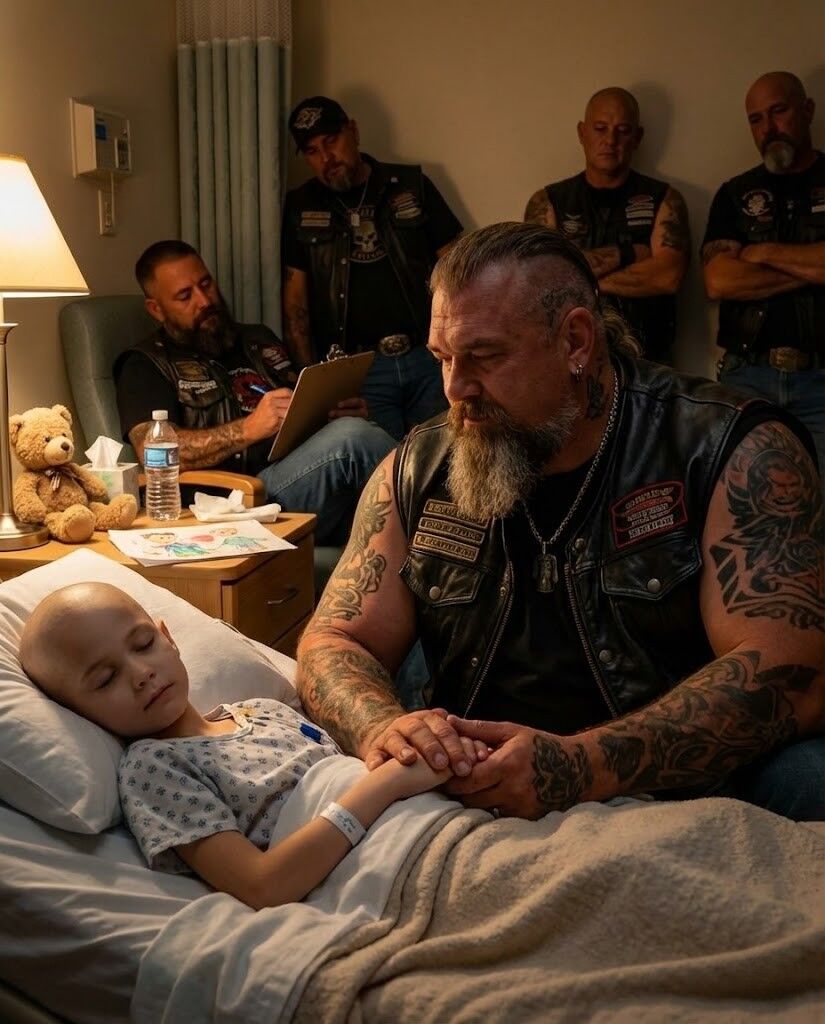
Big John was not looking for a miracle when he took the wrong turn into Room 117 at Saint Mary’s Hospice. He had been following the signs half-blind with grief, his eyes swollen from a night without sleep, his thoughts fixed on his younger brother lying somewhere down the hall with only hours left. The building smelled of antiseptic and wilted flowers, the air heavy with that peculiar stillness that belongs only to places where goodbyes are constantly happening. Big John had spent most of his life outrunning quiet places like this. He was a man built for noise—engines roaring, wind tearing past his ears, laughter echoing across open roads. His leather vest bore patches faded by sun and rain, symbols of a brotherhood forged through miles and scars. Yet there he was, standing frozen in a doorway he had no intention of entering, stopped by a sound that cut deeper than any siren or scream. It was a child’s crying, soft and worn down, as if the tears themselves were tired. Inside the room, machines hummed gently, their steady rhythm contrasting painfully with the fragile life resting on the bed. Katie lay there impossibly small, her head bald and smooth, her eyes too large for her face, her body nearly lost beneath thin blankets. She looked at him with curiosity rather than fear and asked if he was lost. Big John swallowed, his throat tightening, and answered honestly that maybe he was. When she explained, in the simple way only children can, that her parents had gone out and never come back, something inside him cracked open. He had known loss, betrayal, and regret, but this was different. This was innocence abandoned. He felt it settle into his chest, heavy and permanent, like a promise waiting to be spoken.
The nurses later filled in the pieces Katie did not need to say. Her illness had moved beyond treatments and timelines that offered hope; now it was measured in comfort and days rather than cures and years. Her parents, young and unprepared, had been crushed by the weight of watching their child fade. Fear had driven them away, and paperwork had made it official. Katie, however, still believed in their return, still watched the door each evening, still listened for footsteps that never came. That night, Big John made a choice he could not fully explain even to himself. He pulled a chair close to her bed and stayed. He draped his heavy jacket over her legs, the leather absurdly oversized, and hummed old road songs his mother used to sing when storms rattled their childhood windows. He felt the vibration of the machines beneath his palms and the warmth of her small hand in his, and somewhere down the hall his brother took his final breath without him there. When dawn crept in through the blinds, Big John did not regret where he had been. Katie whispered that her biggest fear was not dying, but waking up alone in the dark. He promised her she wouldn’t, the words leaving his mouth before he could consider their weight. Promises, he knew, were dangerous things. Still, as the sun rose, he stepped into the hallway, pulled out his phone, and began calling everyone he trusted to understand what that promise meant.
By nightfall, the promise had taken shape in steel-toed boots and rumbling engines. The first bikers arrived quietly, removing their helmets as if entering a church. Then more came, some he had ridden with for decades, others he barely knew but trusted by reputation alone. They came from different clubs, different pasts, men and women whose lives had not always followed straight lines. Tattoos peeked from sleeves, scars traced old stories across knuckles and faces, and yet each of them softened when they stepped into Room 117. They brought stuffed animals chosen awkwardly from gift shops, coloring books, markers, blankets, and stories from the road. They organized themselves without being asked, setting up schedules so that someone was always there, day and night. Katie began giving them nicknames—Tall Mike, Laughing Joe, Quiet Sam—and called them her Beard Squad, a name that stuck. Laughter returned to the room, gentle and careful but real. Nurses noticed her vitals stabilizing, her appetite flickering back to life, her eyes brighter when she woke to familiar faces. The walls slowly filled with crayon drawings: motorcycles with wings, riders lifting a smiling girl toward the clouds, hearts scribbled in bold colors. Big John became “Maybe Daddy,” a title that both terrified and honored him. He learned how to braid yarn, how to read the same story ten times without losing patience, how to sit with silence when words were too much. In that room, the bikers learned that strength could be quiet, and loyalty could mean simply showing up again and again.
As the weeks passed, word spread beyond the hospice walls. Photos shared quietly among friends made their way online, and one of them reached the man who had once held Katie as a newborn. Her father returned one afternoon, standing uncertainly at the door, shame and longing etched deep into his face. There were no confrontations, no raised voices, only a heavy stillness as past and present collided. Katie saw him and smiled, patting the bed to make space. She introduced him proudly to her many dads, explaining with childlike logic that love was something you could have more of, not less. Big John stepped back, allowing a moment that belonged to them, understanding that love did not have to compete. In her final days, the bikers told her stories of mountains, oceans, deserts, and cities lit by endless stars. She listened as if memorizing maps, as if preparing for a journey she was not afraid to take. When her voice weakened, she whispered to Big John that she wished she had a daddy like him. He told her she did, not just one but an entire crew bound by a promise made in a moment of honesty. She passed quietly one morning, hands held on both sides, her face peaceful. Outside, dozens of bikers stood in silence, engines off, heads bowed, the wind carrying away words no one needed to say.
Grief did not end when Katie’s breathing stopped; it changed shape and direction. Big John returned to the road eventually, but he was no longer riding away from anything. He carried her drawings carefully folded in his vest, her laughter echoing in the spaces between miles. The bikers talked more openly about things they had once buried—fear, regret, hope—and found that doing so did not make them weaker. They organized memorial rides, not loud or showy, but purposeful, raising awareness for children in hospice care who had no one to sit beside them. Nurses and administrators who had once been wary of leather-clad visitors now welcomed them, recognizing the calm and comfort they brought. Big John worked with social workers, lawyers, and volunteers to turn a promise into something lasting. Paperwork replaced patches, meetings replaced some miles, but the heart of it remained the same. He learned how many children faced nights alone, how often fear was mistaken for abandonment, and how much difference a steady presence could make. The nonprofit they built ensured trained volunteers would sit with children whose families could not or would not, offering stories, songs, and simple human connection. It was not about saving lives, but about honoring them.
Years later, Room 117 held other patients, other stories, but the echo of what happened there lingered in quiet ways. Big John still visited Saint Mary’s, sometimes alone, sometimes with new riders who had heard the story and wanted to understand it firsthand. He would sit in the hallway, listening to the sounds of the place, remembering the night a wrong turn became a direction he never knew he needed. He understood now that family was not always defined by blood or history, but by presence and choice. Sometimes it was built in moments of shared silence, sometimes in laughter over coloring books, sometimes in a promise made to a frightened child in the dark. The road had taught him many lessons, but Katie had taught him the most important one: that staying can be the bravest act of all.