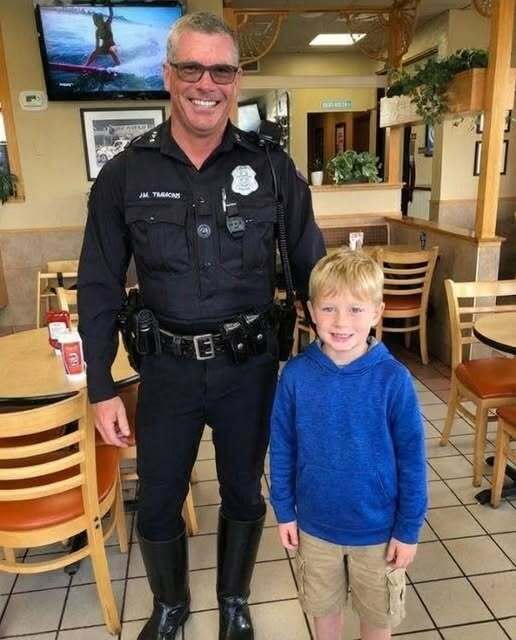
In the dim, early light of a Tuesday morning, a small diner on the edge of town hummed with the rhythmic, weary sounds of survival. Beneath the flicker of aged fluorescent tubes and the low groan of a refrigerator that had seen better decades, a mother and her young son sat tucked into a corner booth. They were engaged in a quiet, practiced dance of restraint—a choreography of “enough” that many families perform when the month is long and the resources are short. Across the table, they shared a plate of eggs and toast, their movements measured and their voices soft, as if speaking too loudly might draw attention to the invisible architecture of scarcity that surrounded them.
It was the boy’s birthday, a day that should have been marked by the exuberant chaos of celebration, the sugary weight of a multi-layered cake, and the breathless anticipation of gifts. Instead, it was marked by a careful pretending. When the waitress, a woman with tired eyes but a quick smile, leaned over the laminate tabletop and mentioned the daily special—a rich, chocolate fudge cake—the boy didn’t look up. He didn’t let his gaze linger on the glass display case where the desserts sat like unattainable jewels. Instead, he shook his head with a quick, instinctive finality.
His refusal was not born of a lack of appetite, but of a precocious, heartbreaking wisdom. At a very young age, he had learned that wanting was a dangerous luxury. He understood that desire, when voiced aloud in the face of an empty wallet, could turn into a heavy weight for his mother to carry. He was shielding her from the embarrassment of saying “no,” protecting her from the quiet devastation of being unable to provide a simple confection on his special day. In that small, silent rejection of the cake, the boy took on a burden of maturity that no child should have to bear, prioritizing his mother’s peace of mind over his own childhood longing.
The love between them was the only thing at the table that felt abundant. It was visible in the way the mother pushed the best parts of the meal toward her son, and in the way he mirrored her restraint, ensuring she ate her share. They were a closed circuit of mutual care, a small fortress built against a world that often measures worth by what one can afford. Yet, despite the strength of their bond, the ache of what was missing hovered in the air like a cold draft, a silent reminder of the birthday that wasn’t quite what it was supposed to be.
Then, without fanfare or an invitation, kindness arrived.
A stranger had been sitting a few booths away—not a man of obvious wealth or grand stature, but someone who possessed the rare gift of truly seeing. He hadn’t watched them with the invasive sting of pity or the idle curiosity of a passerby; he had watched them with the quiet clarity of understanding. He recognized the specific tension in the mother’s shoulders and the unnatural discipline in the boy’s refusal. Without asking for their story, without demanding a justification for their struggle, he chose to act.
The gesture was nearly invisible at first. The stranger settled his own bill and, with a few whispered words to the waitress, slipped out the door. It was only minutes later that the atmosphere in the diner shifted. The waitress returned, not with a check, but with a box from the back and a set of keys. Outside, leaning against a lamp post in the parking lot, was a bicycle. It wasn’t brand new, but it was bright, polished, and adorned with a simple red ribbon that caught the morning sun.
It was more than just a frame of steel and two rubber tires. The bicycle was a profound message delivered without a single word: I see you, you are valued, and your struggle does not make you a burden. It was a disruption of the narrative of lack that had governed the boy’s morning. As the mother and son stepped out into the crisp air, the boy’s practiced hesitation finally began to crumble. He looked at his mother, seeking permission not for the gift, but for the joy. When she nodded, her eyes glistening with a mixture of shock and profound relief, the boy climbed onto the seat.
In the span of a few seconds, the gray asphalt of the diner parking lot transformed into an infinite field of possibility. The heavy, protective mask the boy had worn at the breakfast table fell away, replaced by the jagged, beautiful sound of genuine laughter. As he pedaled in erratic, ecstatic circles, the apologies that usually filled their conversations faded into the background. For those few moments, he was no longer a child who had to be careful; he was simply a child who was free. The limitations of their circumstances hadn’t vanished, but for a few precious minutes, they no longer had a grip on his spirit.
His mother watched from the sidewalk, her hands pressed against her chest as if to hold in the overwhelming surge of emotion. The relief she felt was not because their financial problems were solved or because their future was suddenly certain; it was because someone had reached across the divide of anonymity to soften the world for her son. The gift of the bicycle was immense, but the gift of being noticed—of being treated as someone worthy of a stranger’s generosity—was even greater. It was an affirmation that they were not invisible, and that the harshness of their daily life was not the only reality available to them.
That day became a permanent landmark in their family history, not because of the object itself, but because of the revelation it provided. It served as a reminder that even in a world that can feel indifferent or transactional, there is a persistent, quiet current of gentleness. A stranger had chosen to intervene in their lives without the need for a “thank you” or a public display of charity. He had simply seen a gap where joy should be and decided to fill it.
Long after the boy outgrew that bicycle and the memory of that diner breakfast faded into the haze of the past, the core lesson remained anchored in their hearts. They learned that compassion does not always require a grand stage or a complex plan; often, it is found in the smallest acts of observation and the willingness to act on a whim of kindness. They realized that even in moments shaped by profound lack, they were never as alone as fear had led them to believe. The stranger’s gift didn’t just change a birthday; it changed the way they looked at every stranger they passed, leaving them with the enduring hope that behind any flickering fluorescent light, a miracle might be waiting to happen.