The human memory is a curated gallery, often carefully arranged by those who love us to show only the most beautiful and stable of images. For nearly three decades, my personal gallery was filled with the portraits of a perfect, singular childhood. I was an only child, the sole focus of two parents whose devotion was as constant as the tides. They were the architects of my security, showing up for every soccer game, celebrating every academic achievement, and providing a home that felt like an impenetrable fortress against the chaos of the outside world. I never felt the absence of siblings; I never questioned the foundation of my origin. To me, the story of my life was a finished book, bound in leather and shelved neatly in the center of my heart.
Then, on a restless Tuesday evening, a simple plastic vial and a casual curiosity dismantled everything. I had ordered a DNA ancestry kit on a whim, motivated more by a passing interest in my ethnic percentages than a search for lost connections. When the notification arrived in my inbox, I expected a pie chart of Northern European regions. Instead, at the very top of the “Matches” list, a label stopped my breath: Sibling.
I stared at the screen, the blue light stinging my eyes. I refreshed the page, certain that the algorithm had glitched or that a distant cousin had been miscategorized. But the data was cold and clinical—a 50% shared DNA match. The name attached was “David,” a stranger with a face I couldn’t see and a history I couldn’t imagine. In that instant, the fortress of my childhood didn’t collapse, but it developed a hairline fracture. Once you see a truth of that magnitude, the silence of the past begins to roar.
My parents’ reaction was the first confirmation that I wasn’t chasing a ghost. When I approached my father, showing him the results on my phone, the atmosphere in the room shifted instantly. The supportive, open man I had known my entire life seemed to withdraw into a protective shell of unease. He didn’t deny David’s existence, but he didn’t embrace the revelation either. His voice was a low, strained whisper as he told me it was “complicated,” a relic of a time before my mother and I were his world, and that some stones were better left unturned. His plea for silence was intended as a shield, but to me, it felt like a locked door. I realized then that a well-protected childhood is often built on the selective editing of the parents, and I was no longer willing to read the abridged version of my life.
The decision to reach out to David was born from a mixture of terror and an undeniable gravitational pull. I sent a message through the DNA site, my fingers trembling as I typed. I expected silence, or perhaps hostility, but his response was instantaneous and disarmingly warm. It was as if he had been standing on the other side of that locked door for years, waiting for someone to turn the key.
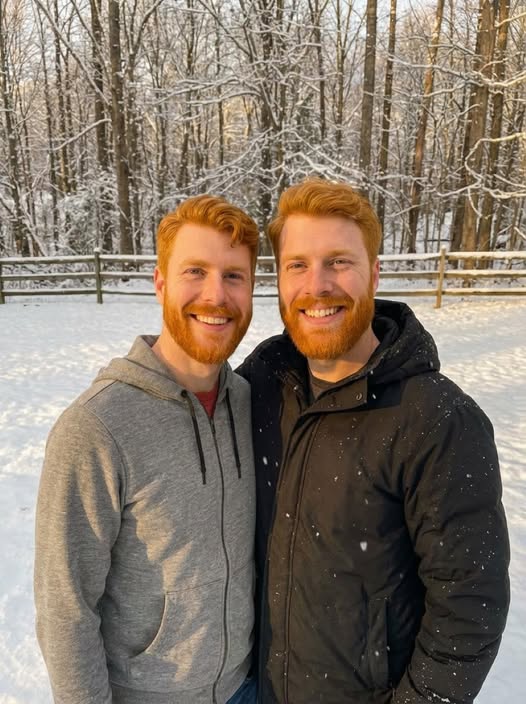
When we met at a quiet coffee shop a week later, the physical reality of our connection was jarring. It was like looking into a distorted mirror; he had my father’s jawline and the specific way my hands moved when I was nervous. But as we began to talk, the commonalities ended at the skin. David’s version of my father was a stranger to me. He spoke of a man who was a fleeting presence, of a struggle for recognition, and of a childhood defined by the very “missing” feeling I had never known. He wasn’t bitter, but he was a witness to a chapter of my father’s life that had been systematically erased to make room for me. Hearing his stories felt like listening to a radio station from a different dimension—the frequency was the same, but the song was entirely different.
The weeks following our meeting were a blur of internal investigation. I began to look through old photo albums and documents with a detective’s eye, noticing the gaps in the timeline and the forced smiles in certain early photographs. I realized that my parents’ “stability” had been a conscious, daily effort to overwrite a messy, painful past. They hadn’t lied to me in the traditional sense; they had simply simplified the narrative until it was a story they could live with. They wanted me to grow up in a world where love was uncomplicated, even if that meant keeping me in the dark about the brother who shared my blood.
This discovery forced a profound internal recalibration. Initially, I felt a sense of betrayal, as if my thirty years of “only child” status were a fraudulent identity. I looked at my parents and saw the shadows of the things they hadn’t said. But as I spent more time with David, the resentment began to dissolve into something more complex and rewarding. I realized that my childhood hadn’t been a lie; the love I received was real, the support was genuine, and the memories were valid. They were simply incomplete.
Discovering David didn’t erase my past; it gave it a much-needed expansion. It turned a short story into an epic. I began to understand my father not as a two-dimensional icon of paternal perfection, but as a flawed, human man who had made difficult choices in the pursuit of a fresh start. More importantly, I gained a brother. We started slow—texts about mundane things, occasional dinners—but quickly found a rhythm that felt ancient. There is a specific comfort in a sibling relationship, a shared biological shorthand that skips over the formalities of friendship.
The truth, while uncomfortable, offered a perspective that a “perfect” life never could. It taught me that family is not just the people who are present at the dinner table, but also the ones who exist in the margins and the silence. It taught me that we are all composed of the things we hide as much as the things we show. Today, my relationship with my parents is different; it is more honest, grounded in the reality of their humanity rather than the myth of their perfection.
If I hadn’t taken that DNA test on a whim, I would still be an only child in a beautifully curated, narrow gallery. But now, my world is larger. I have a brother who understands the nuances of our shared heritage in a way no one else can. I have a more profound sense of self, rooted in the full truth rather than a polished edit. Sometimes, the things we are “missing” aren’t holes in our lives—they are simply gifts we haven’t been brave enough to find yet. I didn’t lose the childhood I loved; I simply found the brother I didn’t know I needed to complete the picture.