I discovered that my existence had been reduced to a clerical error on a humid Tuesday morning in Milbrook, Ohio.
I was sixty-two years old, a woman who had spent twenty-three years measuring her worth by the stability of her marriage and the precision of her PTA minutes. My name was Margaret “Maggie” Thompson, and until 10:14 AM, I believed my biggest challenge was coaxing my husband, Marcus, to remember the grocery list. Then, the phone rang.
The voice from the bank was chirpy, the kind of professional cheer that usually precedes a sales pitch. “Mrs. Thompson, I’m calling regarding your mortgage payment. It seems the transaction was returned for insufficient funds.”
A cold prickle started at the base of my skull. “That’s impossible,” I countered, my voice sounding distant. “My husband deposited his commission check yesterday.”
When I arrived at the First National Bank of Milbrook, the air smelled of stale coffee and the metallic tang of coins—a scent that used to mean security. Jessica, a teller who had processed my deposits since the Reagan administration, wouldn’t meet my eye.
“I’m so sorry, Maggie,” she whispered, her hands fluttering over the keyboard like trapped birds. “But you aren’t listed as an authorized user on these accounts anymore. Not the savings, not the checking, not even the emergency fund.”
“What do you mean ‘anymore’?”
“The restructuring happened six months ago,” she said, her voice dropping to a conspiratorial level. “Only Marcus Thompson has access now. And the balance… Maggie, it’s practically zero.”
Six months ago. The timeline hit me like a physical blow. Six months ago was when my “best friend,” Carol Henderson, had suddenly become too busy for our weekly lunches. Six months ago was when Marcus began his “late-night hospital insurance audits.”
I sat in my car in the parking lot, the vinyl seat burning my legs, and watched the world continue to turn as if I hadn’t just been erased. My hands were shaking, but my brain—the brain of a woman who had been a head bookkeeper before she became a “devoted wife”—was already beginning to crunch the numbers.
I didn’t go to the police. I didn’t call Marcus. Instead, I drove home to perform a surgical strike on his home office, unaware that the first bullet was already in the chamber.
Marcus’s office was a sanctuary of mahogany and ego. I had always respected his privacy there, a courtesy he had apparently weaponized against me. I began to tear through the drawers, my movements frantic yet calculated.
Beneath a stack of mundane insurance claims, I found the evidence of my execution. Bank statements for offshore accounts I never knew existed. A ledger detailing the systematic siphoning of our $127,000 life savings over three years. Every cent I had helped earn, every bonus he had “put away for our retirement,” had been funneled into a private vault.
But the final insult was tucked behind a picture of us at the Grand Canyon. A business card for Harold Webster, Divorce Attorney, with a handwritten note on the back: Consultation: Friday, 2:00 PM. Property transfer complete. She’s out.
The “property transfer” referred to our house. I checked the digital county records on my laptop with a pounding heart. Marcus had quietly transferred the deed of our family home solely into his name a year ago, using a forged signature that looked hauntingly like mine.
The front door opened. I heard him whistling—actually whistling—the tune of some vapid pop song.
“Hey honey, how was your day?” Marcus called out, his voice a masterpiece of domestic normalcy.
I stood in the doorway of his office, the bank statements fanned out in my hand like a losing hand of poker. “The mortgage bounced, Marcus. Jessica at the bank says I don’t exist.”
The color drained from his face so rapidly he looked like a wax figure melting. “Oh, that,” he stammered, his hand going to his tie. “It’s just… financial restructuring, Mags. Tax purposes. To protect our assets.”
“To protect your assets, you mean,” I corrected, my voice dropping to an ice-cold register. “I saw the lawyer’s card, Marcus. I saw the forged deed. I saw the transfers to the accounts Carol helped you set up.”
His posture shifted. The bumbling husband vanished, replaced by a man with eyes as hard as flint. “You were never good with money, Maggie. You’re content with your little garden and your books. I’m the one who built this life. I’m just taking what’s mine.”
“What’s yours?” I laughed, a sharp, jagged sound. “You’ve spent three years planning my destruction while I was planning our thirtieth anniversary. You didn’t just steal my money, Marcus. You stole my history.”
“You have an hour,” I said, stepping aside. “Pack your bags and get out. Or I call the insurance commission and tell them exactly how you’ve been inflating the premiums on the Henderson Account and pocketing the difference.”
He froze. The mention of his professional fraud hit a nerve I hadn’t realized was so raw.
“You wouldn’t,” he hissed.
“Try me. I helped you with those spreadsheets, remember? I kept copies. I may be a fool in love, Marcus, but I was a damn good bookkeeper.”
Marcus left that night with two suitcases and a snarl. I changed the locks before his taillights faded, but as I sat in the silent house, I realized I had won the battle only to realize the treasury was empty.
Three days later, the reality of my situation settled in like a heavy fog. I was “broke” in the way only a suburban woman can be—I had a house I didn’t legally own, a car with a lien on it, and exactly $412 in a secret savings account Marcus hadn’t found.
I did the only thing that felt right. I drove to the one place Marcus had never been allowed to touch: my childhood home.
The Morrison Estate sat on five acres of overgrown Ohio scrubland. It was a Victorian relic that smelled of damp earth and forgotten summers. My grandmother, Rose Morrison, had died three years prior, leaving me the house and a confusing set of instructions to “never sell the bones.”
I let myself in with the spare key hidden under a cracked terracotta pot. The silence was absolute. I climbed the stairs to the master bedroom, where Grandma Rose had spent her final days. Everything was covered in gray dust sheets, looking like a gathering of ghosts.
Sitting on the center of the bed was an object that shouldn’t have been there. A vintage leather suitcase, worn smooth by decades of travel, with a manila tag tied to the handle. In Grandma’s sharp, elegant script, it read: For Margaret, when the mask falls.
My breath hitched. I clicked the latches open.
Inside were neat, vacuum-sealed bundles of hundred-dollar bills. I counted them twice, my fingers trembling. $70,000. Next to the cash lay an old passport in my maiden name and a first-class plane ticket to London, dated for the following Tuesday.
At the very bottom was a vellum envelope.
“My dearest Margaret,” the letter began. “If you are reading this, it means Marcus has finally revealed the predator I saw in him the day you said ‘I do.’ I’ve been preparing for your escape since your wedding. I saw how he looked at my silver—not as a craft, but as a price per ounce. This $70,000 is just travel money, sweetheart. The real inheritance is waiting for you in London. Ask for James Morrison at Barclays Bank, Piccadilly branch. Trust no one until you get there. You are a Morrison, Maggie. It’s time you learned what that actually means.”
I sat on the edge of that dusty bed and cried—not for the man I had lost, but for the grandmother who had loved me enough to plan for my tragedy twenty years before it happened.
I spent the next forty-eight hours in a whirlwind of cold-blooded preparation. I met with Harold Webster—the shark Marcus had intended to hire—and retained him myself. “I want him to bleed,” I told the lawyer. “Financially, legally, and socially.”
The flight to London was my first time leaving the country. As the plane banked over the Thames, the city glittering like a spilled jewelry box under the gray morning light, I felt the last remnants of “PTA Maggie” dissolve.
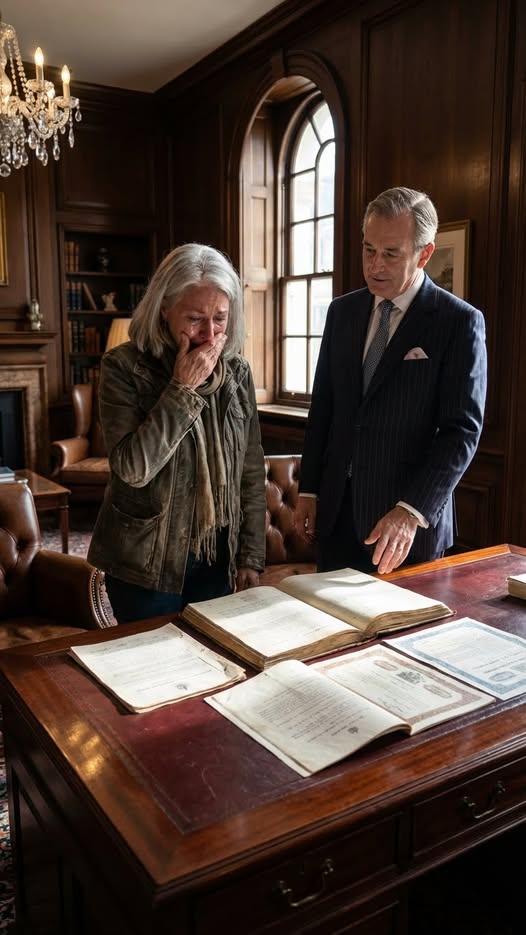
James Morrison was a man who looked like he had been carved out of granite and dressed by Savile Row. He met me in a private suite at Barclays Bank, his silver hair gleaming under the chandeliers.
“Mrs. Thompson,” he intoned, his British accent as crisp as a fresh banknote. “Rose spoke of you with great ferocity. She said you were the only one with enough steel in your spine to handle the weight of the Morrison legacy.”
“I thought she was just a high school librarian,” I whispered, staring at the thick file he placed on the desk.
“Rose Morrison built a textile empire in India during the fifties and sixties,” James explained, a ghost of a smile touching his lips. “She was a woman operating in a man’s world. She learned early that a woman’s greatest weapon isn’t her heart—it’s her autonomy. When she retired, she diversified. Real estate in Kensington, trusts in Switzerland, and a very specific portfolio designed for a rainy day.”
He opened the file. “She’s left you the liquid assets. At current exchange rates, it totals £2.7 million.”
I felt the air leave the room. “I… I don’t understand.”
“She also purchased a flat for you in Kensington,” James continued, unfazed. “It’s been rented for decades, the income feeding into your trust. It’s vacant now. Waiting for you.”
I walked out of that bank a millionaire, but I wasn’t satisfied. Wealth was a shield, but I wanted a sword. I called Harold Webster back in Ohio from my new London burner phone.
“Maggie? Where the hell are you?” Harold barked. “Marcus is losing his mind. He’s claiming you kidnapped yourself to frame him for abandonment.”
“Let him talk, Harold. Have you served the papers?”
“Served and filed. I’ve frozen the joint accounts, but Marcus is claiming they’re empty because of your ‘irresponsible spending.’ He’s even got Carol Henderson to sign an affidavit saying you have a gambling problem.”
“Is that so?” I leaned back in the plush armchair of my new Kensington flat, looking out at the rose garden Grandma had planted fifty years ago. “Harold, I’m sending you a file. It’s a report from a private investigator I hired here in London, Patricia Cole. She’s found the Cayman accounts Marcus thought were invisible. And she’s found the purchase agreement for a villa in Costa Rica under his and Carol’s names.”
There was a long pause on the other end of the line. “Maggie… how are you paying for a London PI?”
“My grandmother left me more than just recipes, Harold. I want you to file for punitive damages. I want the insurance commission notified of the fraud. And I want a full-page apology in the Milbrook Gazette.”
“He’ll never agree to the apology.”
“Then tell him we’ll see him in federal court for wire fraud and identity theft. I have the forged deed, Harold. I have everything.”
I hung up, feeling a grim satisfaction. Marcus Thompson had spent years trying to play me like a flute. He had no idea I was the conductor of the entire orchestra.
The next six weeks were a masterclass in psychological warfare. While I explored the museums of London and learned the quiet dignity of a life lived on my own terms, Marcus was watching his world burn in real-time.
Carol Henderson was the first to break. When the FBI—alerted by the insurance fraud evidence I’d provided—raided Marcus’s office, Carol realized that being a “mistress” carried a much heavier prison sentence than she’d anticipated. She flipped within forty-eight hours, providing a detailed map of how Marcus had fabricated insurance policies for non-existent clients and pocketed the payouts.
The “conspiracy” was no longer a theory. It was a recorded reality.
The call from Harold came on a rainy Thursday morning. “He’s caving, Maggie. The feds have him on wire fraud, money laundering, and tax evasion. He’s looking at twenty years. His lawyer is begging for a settlement in the divorce to show ‘cooperation’ and ‘remorse’ before the sentencing.”
“What’s the offer?”
“He gives you the house, both cars, the liquidated assets from the Cayman accounts, and… he’s signed the apology for the Gazette.”
I sipped my Earl Grey tea, watching the rain streak the windows of my London sanctuary. “Not enough. I want the $400,000 he stole from his clients repaid from his share of the legitimate business assets. I won’t have him going to prison while innocent people lose their premiums.”
“He doesn’t have a choice,” Harold chuckled. “He’s a dead man walking.”
The apology ran the following Sunday. It was a full-page spread in our small-town paper.
“I, Marcus Thompson, publicly apologize to my wife, Margaret Thompson, for my unconscionable betrayal. I systematically stole our life savings, forged her signature to seize our home, and conducted a fraudulent business enterprise. Margaret was an exemplary partner who deserved none of the cruelty I inflicted upon her.”
Jenny, my sister in Portland, called me hysterical with laughter. “Maggie! You evil genius! The whole town is talking. Carol Henderson was seen packing her car in the middle of the night while people threw eggs at her driveway. You’ve turned Milbrook into a fortress of justice!”
“I didn’t do it, Jenny,” I said softly, looking at the gold locket around my neck. “Grandma Rose did. I just followed the map.”
I returned to Ohio six months later, not as a victim, but as a builder.
Marcus had been sentenced to fifteen years in a federal penitentiary. Carol was serving three years of probation after a hefty fine and a permanent ban from the banking industry.
I stood in the living room of my childhood home, watching a crew of contractors install a state-of-the-art security system and a professional-grade kitchen. The Rose Morrison Center for Financial Independence was no longer a dream; it was a construction site.
“Mrs. Thompson?” The foreman called out, holding a hard hat. “We found something behind the brickwork in the pantry. You’re going to want to see this.”
I followed him to the back of the house. Behind a false panel in the original 1920s masonry, the workers had uncovered a small, fireproof safe.
“Any idea what the combination is?” the foreman asked.
I looked at the gold locket around my neck. On the back, Grandma had engraved: 19-55-Forever.
I dialed the numbers. The heavy door groaned open.
Inside wasn’t more money. It was a collection of photographs and letters from 1955. They showed my grandmother and four other women standing outside a small factory. They looked fierce, their arms crossed, their eyes full of a fire that I finally recognized as my own.
The letters told the story of the “Silent Five”—a group of women who had run a secret investment club during an era when they couldn’t even open a bank account without a husband’s signature. They had pooled their “grocery money” to buy stocks in burgeoning tech and textile companies. They had built a secret empire to protect themselves from the men who viewed them as property.
One letter, addressed to me and dated weeks before her death, read:
“Margaret, money is just numbers on a page until it becomes a choice. I spent my life making sure you would always have a choice, even if you didn’t know you needed one. This house isn’t just a building; it’s a fortress. Use it to teach other women how to build their own. Let the Thompson betrayal be the last time a Morrison woman is ever underestimated.”
I touched the faded photograph of the five women. They weren’t just business partners; they were revolutionaries. And I was their newest recruit.
Two years later, I stood on the stage of a grand ballroom in Washington D.C., preparing to accept a national award for my work with the Rose Morrison Foundation.
We had opened thirty-seven centers across the country—places where women escaping financial abuse could find legal aid, forensic accountants, and the seed money to start their own lives. We had helped over five thousand women realize that “I can’t afford to leave” was a lie told to them by men who were afraid of their strength.
James Morrison sat in the front row, beaming. My sister Jenny was beside him, having moved to London to run the international branch of the foundation.
As I looked out at the audience, I saw faces I recognized—women who had arrived at our doors with nothing but a suitcase and a broken spirit, now standing tall as business owners, lawyers, and independent mothers.
My phone buzzed in my pocket. A notification from the victim services portal: Marcus Thompson’s request for early parole has been denied.
I didn’t feel a surge of triumph. I didn’t feel the need for revenge anymore. I felt… nothing. Marcus was a ghost from a life I had outgrown.
“Ladies and gentlemen,” I began, my voice steady and clear, reaching the back of the massive hall. “Two years ago, I was a sixty-two-year-old woman with a coffee stain on her blouse and a husband who thought he had erased me. I thought my life was over because my bank account was empty.”
I held up my grandmother’s gold locket. “But I learned that the most dangerous person in the room is the one who has lost everything and realized they are still standing. Financial independence isn’t about the balance in your ledger—it’s about the autonomy in your soul.”
The applause was thunderous, but in my mind, I was back in that dusty bedroom in Milbrook, clicking open an ancient leather suitcase.
I had learned the difference between forgiving and forgetting. I would never forget the betrayal; it was the fire that had tempered my steel. But I had forgiven myself for being a fool, because that fool had eventually learned how to swing for the fences.
I am Margaret Morrison. I am an architect of futures. And I am finally, truly, home.
I still visit the old Victorian house in Milbrook every autumn. The garden is no longer overgrown; it is a riot of lavender and Morrison roses.
The center is always full. Sometimes, I sit in the library and talk to the women. I tell them about the $70,000 and the London banker. I tell them about the forged deed and the public apology.
But mostly, I tell them about the safe in the wall.
“Don’t wait for the mask to fall,” I tell a young woman with bruised eyes and a trembling hand. “Build your fortress now. Learn your numbers. Know your worth. Because the only person who can truly save you is the one you see in the mirror.”
The sun sets over the Ohio fields, casting long, golden shadows across the porch Grandma Rose used to sit on. The bones of the house are good. The bones of the woman are even better.
The war against financial abuse is far from over, but tonight, as I lock the doors of the center, I know we are winning. One woman, one choice, one suitcase at a time.