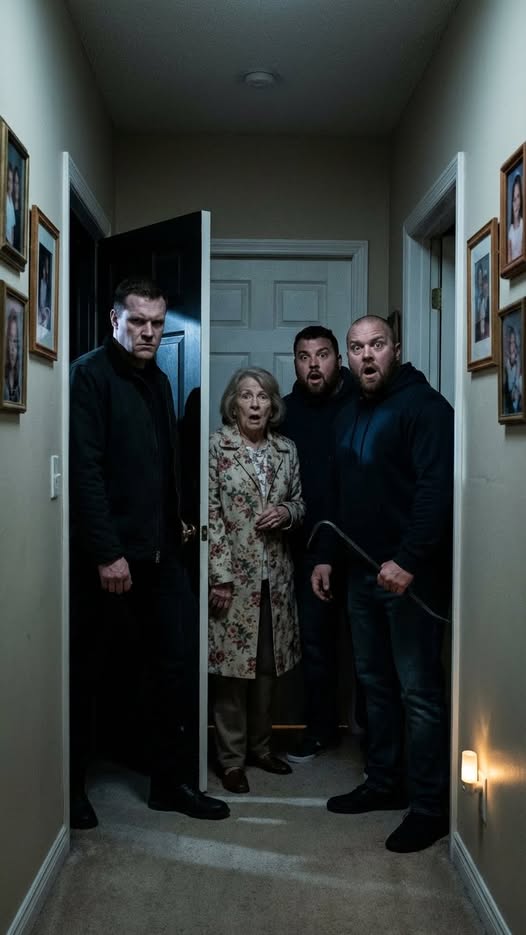
The Sentinel’s Shadow: A Chronicle of My Own Coup d’État
Chapter 1: The Echo of Instincts
In the jagged peaks of Afghanistan, survival wasn’t a matter of luck; it was a matter of listening to the hum of the air. When the silence turned brittle, you ducked. When your skin prickled, you checked for a sniper’s glint. Eight years after I traded my Marine fatigues for the tailored suits of a commercial architect, those instincts had supposedly been buried under layers of domesticity. But as I stood in my Denver foyer, my seven-year-old daughter, Emma, gripped my wrist with a strength that felt like a desperate anchor.
“Daddy, please don’t go,” she whispered. Her eyes, usually as bright as amber, were clouded with a fear so visceral it bypassed my brain and went straight to my gut.
“Emmy, it’s just forty-eight hours,” I said, kneeling on the cold hardwood. “A quick consultation in Grand Junction and I’m back. What’s wrong, sweetheart?”
She twisted the hem of her nightgown, her small fingers knotting the fabric until her knuckles turned white. “I don’t know. I just… I get scared at night when you’re not here. Grandma Constance stays with us, but… she makes me more scared.”
The mention of my mother-in-law sent a chill down my spine that had nothing to do with the air conditioning. Constance was a woman of sharp angles and even sharper judgments. Ever since she’d moved from Phoenix six months ago, the atmosphere in our house had shifted from a struggling marriage to something resembling an occupation.
“Grandma is here to help Mommy,” I said, though the words felt like ash in my mouth. My wife, Deborah, had become a ghost in her own home—distant, frantic, and increasingly reliant on her mother’s “guidance.”
“She looks at me funny, Daddy,” Emma whispered so softly I almost missed it. “Like I’m… a prize. Or a chore.”
I pulled her into my chest. Her heart was a frantic bird hammering against its cage. This wasn’t a child’s fear of the dark. This was the silent scream of a prey animal that knows the predator is already inside the den.
I looked up to see Deborah leaning against the kitchen doorframe, a glass of red wine in her hand. Her eyes were glazed, focusing on something miles away. The $15,000 contract for the Grand Junction project was meant to fix our mounting debts—debts I couldn’t quite account for despite my firm’s success. But looking at Emma, the money felt like blood.
“I’m staying,” I said, the decision settling over me like a shield.
The relief that flooded Emma’s face was so profound it made my throat ache. But across the room, Deborah’s wine glass trembled. For a fleeting second, her face didn’t register disappointment. It registered terror.
What exactly had I just interrupted?
Chapter 2: The Matriarch of Malice
That night, the house felt like a pressurized chamber. I found Deborah in the kitchen, illuminated only by the blue light of her smartphone.
“I canceled the trip,” I told her.
Her head snapped up. In the shadows, her face looked gaunt, aged by a decade in a single year. “Why? We need that money, Lucas. You know what the bank said about the bridge loan.”
“Emma is terrified,” I replied, my voice steady, the voice I used when a site foreman tried to cut corners on load-bearing walls. “She begged me to stay. When did you become so indifferent to our daughter’s well-being?”
“Indifferent?” Deborah scoffed, taking a heavy swallow of wine. “I’m the one who’s here every day while you’re at the firm. My mother was right—you’re still stuck in the desert. You see threats everywhere because you’re broken.”
“Your mother,” I said, stepping into her space, “is a poison. She’s turned this house into a mausoleum.”
“Don’t you dare,” a new voice sliced through the air. Constance appeared in the doorway, her silver hair perfectly coiffed even at midnight, her eyes like chips of flint. “I am here because my daughter married a man who can’t provide stability. If you were half the man you pretend to be, Lucas, we wouldn’t be in this position.”
The sheer arrogance of her tone was a distraction. I’d seen it before—interrogators who used insults to hide the fact that they were lying. I watched her hands. They were steady. Too steady.
“This conversation is over,” Deborah snapped, brushing past me.
I stood in the kitchen long after they had gone upstairs. The silence wasn’t peaceful; it was a tactical pause. I pulled out my phone and dialed my brother, Scott.
“Luke? It’s nearly one in the morning,” he grumbled.
“I need your eyes, Scott. And I need your truck. Tomorrow night, 10:00 PM. Park two blocks over. Don’t turn on your lights.”
“What’s going on, man?”
“I don’t know yet,” I whispered, looking at the ceiling where my family slept. “But the wire is tripped. I’m just waiting for the flare.”
Chapter 3: Eyes in the Dark
The next morning, I played the part of the dutiful, defeated husband. I told Deborah I had to drive to the client’s office in person to hand-deliver the cancellation. She barely looked at me, her fingers flying across her phone screen.
I left, but I didn’t head for the highway. I drove to a climate-controlled storage unit on the outskirts of the city. Inside was a crate labeled Professional Archives.
It didn’t contain blueprints. It contained the high-end Surveillance Equipment I’d kept from my private security days—pinhole cameras, directional mics, and motion-activated sensors that fed directly to an encrypted cloud.
By noon, I was back in the house while they were out at “lunch” with Constance. I moved with the silent efficiency of a man who had cleared rooms in Fallujah. I planted a camera in the kitchen crown molding, one in the hallway facing Emma’s room, and a third disguised as a power strip in the living room.
I spent the afternoon in a booth at a local coffee shop, my laptop open. The feed was crystal clear.
At 4:00 PM, Constance and Deborah returned. They weren’t talking like a mother and daughter. They were arguing like business partners. I watched Constance point a finger at my wife’s chest, her mouth moving in a silent snarl. Deborah looked small, her shoulders slumped in a posture of total defeat.
Then, at 4:30 PM, the screen showed something that made my blood turn to ice.
Constance pulled out a different phone—a burner, by the looks of it. She made a call, her expression shifting into a mask of predatory satisfaction. She looked toward Emma’s room, a slow, terrifying smile spreading across her face.
I didn’t need audio to know what was happening. My mother-in-law wasn’t just staying with us to help. She was the architect of a nightmare, and my wife was the contractor.
But who was the client?
Chapter 4: The Contract of the Damned
Dinner that evening was a charade of normalcy. I cooked spaghetti, watching Deborah out of the corner of my eye. She was trembling.
“Daddy,” Emma whispered as she twirled her pasta. “Are you going away tonight?”
“Never,” I said, catching Constance’s gaze. Her eyes didn’t flinch.
“How noble,” Constance remarked, her voice dripping with sarcasm. “The protector. Tell me, Lucas, do you think your ‘protection’ can pay off a six-figure gambling debt?”
The air left the room. I looked at Deborah. Her face went porcelain white.
“Is that what this is?” I asked, my voice dangerously low. “The spending habits? The ‘missing’ money from the firm?”
“I was desperate, Lucas!” Deborah cried, her voice cracking. “Mom said she could fix it. She said she had friends… people who could help.”
“Friends?” I asked.
Constance stood up, smoothing her skirt. “We’ll finish this tomorrow, Deborah. Lucas is clearly overwrought.”
She left, but the threat remained. That night, I didn’t sleep. I sat in the basement, watching the monitors. At 10:45 PM, Deborah slipped out of our bed. I watched her on the screen as she tiptoed down the stairs and opened the front door.
Two men stepped into my living room.
The first was Jorge Allen, a man I recognized from local high-society gazettes—a “philanthropist” with eyes as cold as a shark’s. The second was Carlton Daniels, a slab of a man who looked like he’d been built in a gym for the sole purpose of breaking bones.
“Where is she?” Jorge asked. The audio from the hidden mic was crisp.
“She’s sleeping,” Deborah whispered, her voice shaking. “My mother said… she said it wouldn’t hurt. That she’d just be gone for a few days.”
“A few days, a few weeks,” Jorge shrugged, his expensive suit catching the light. “The clients are paying for ‘purity’ and ‘exclusivity.’ Your debts are cleared the moment we walk out that door with her.”
My vision tunneled. I wasn’t an architect anymore. I was a Marine with a target in his sights. I reached for the heavy Maglite and the tactical knife I’d kept hidden under the basement stairs.
“Is the father asleep?” Carlton asked, his hand moving toward his waistband.
“He’s dead to the world,” Deborah said, though she sounded like she was mourning herself.
They started for the stairs. My daughter’s room was the first door on the left.
I moved.
Chapter 5: The Helmand Solution
I didn’t come up the stairs. I came through the basement door like a shadow.
“That’s far enough,” I said.
The four of them froze in the hallway. The light from the moon filtered through the window, illuminating the sudden, raw terror on Deborah’s face. Constance, who had been lurking in the shadows of the kitchen, stepped forward, her face contorting into a mask of fury.
“Lucas, go back to bed,” she hissed. “You have no idea what’s at stake here.”
“I know exactly what’s at stake,” I said, my voice vibrating with a frequency that made Jorge take a half-step back. “I know about the ‘specialized childcare.’ I know about the clients. And I know that in three minutes, the police will be swarming this block.”
Carlton didn’t wait. He was a professional, but he was used to intimidating civilians, not veterans. He reached for his weapon.
I didn’t give him the chance. I closed the distance in two heartbeats. I drove the base of my palm into his chin, hearing the sickening crack of his jaw. As he stumbled, I twisted his arm behind his back and slammed him into the drywall. His gun clattered to the floor.
“Don’t,” I warned Jorge, who was reaching into his jacket. “My brother is in the driveway with a tire iron and a very short fuse. And I’ve been recording every word of your ‘business transaction’ for the last ten minutes.”
Deborah collapsed against the wall, sobbing. “I didn’t have a choice, Lucas! They were going to take the house!”
“You sold your daughter to save a pile of bricks?” I looked at her, and the last shred of love I had for the woman I’d married evaporated. “You’re not a mother. You’re a predator’s accomplice.”
“You think you’ve won?” Constance spat, her voice a jagged blade. “We have friends in the DA’s office. We have money you can’t even imagine. This will be your word against ours.”
“Actually,” I said, pulling my phone from my pocket and showing her the live-stream feed. “It’s your faces, your voices, and your ‘contract’ against the world. I sent the link to a contact in the FBI five minutes ago. They don’t take kindly to human trafficking, Constance. Even when it’s dressed in pearls.”
The sirens began to wail in the distance—a low, mournful sound that signaled the end of their world and the beginning of mine.
Chapter 6: Shadow Justice
The weeks following the arrests were a whirlwind of depositions, grand juries, and the slow, painful process of rebuilding a life from the rubble.
Constance Dixon was the mastermind. The feds found a network that spanned four states, a “boutique” agency that catered to the darkest desires of the ultra-wealthy. Jorge and Carlton were the facilitators. And Deborah… she was the broken link in the chain, the desperate mother who had been groomed by her own mother to see her child as an asset.
But for me, legal justice wasn’t enough.
I sat in my new, modest apartment in Boulder, watching Emma sleep through the cracked door. She was safe, but she woke up screaming twice a week. Every time she saw silver hair, she flinched.
I reached out to my old unit. Sarah, who now worked in the Bureau of Prisons, and Marcus, a digital ghost who could vanish an offshore account in an afternoon.
“I don’t want them dead,” I told Marcus over an encrypted line. “I want them to feel the walls closing in. Every single day.”
And so, the “extracurricular” justice began.
In the women’s correctional facility, Constance found that her “reputation” preceded her. I’d ensured that the nature of her crimes—the betrayal of her own blood—was whispered into the ears of the most influential inmates. She spent her days in a state of constant, shivering vigilance, her meals contaminated, her sleep interrupted by the very real threat of those she had once looked down upon.
Jorge Allen’s wealth vanished. Marcus found the backdoors to his “charity” accounts, siphoning the funds into a trust for the victims of the network. By the time he went to trial, he couldn’t even afford a public defender. He was a king without a kingdom, mocked by the guards and broken by the inmates who knew exactly what he was.
Carlton didn’t last long in general population. After the third time he was sent to the infirmary, he begged for protective custody—a cage within a cage where the only thing he had to talk to were the voices in his own head.
And Deborah… I let the law handle her. Her twelve-year sentence was a mercy compared to the look in Emma’s eyes when she asked why Mommy wasn’t coming home. I burned every letter she sent. She had forfeited her right to be remembered the moment she put a price tag on our daughter’s soul.
Chapter 7: A New Horizon
One year later, the sun set over the Flatirons, painting the sky in hues of violet and gold. Scott was at the grill, his kids running through the sprinkler with Emma. Her laughter was the most beautiful sound I’d ever heard—a clear, ringing bell that signaled the darkness had finally receded.
Agent Chun from the FBI sat on my deck, sipping a soda. “You know, Nicholson, we’re still finding ripples from the evidence you provided. You dismantled a decade’s worth of evil in one night.”
“I didn’t do it for the Bureau,” I said, watching Emma.
“I know. But you should know… Constance filed for another appeal. It was denied. She’s… not doing well. She’s lost most of her teeth in ‘accidents,’ and she’s a permanent fixture in the psychiatric ward.”
“Good,” I said. No remorse. No hesitation.
I walked down the steps to the yard. Emma saw me and ran, throwing her arms around my waist. She didn’t look like a trapped bird anymore. She looked like a child who knew she was cherished.
“I love you, Daddy,” she whispered into my shirt.
“I love you more than the stars, Emmy.”
I looked back at the house—a house built on truth, protected by a man who knew exactly what he was capable of. The Marines taught me how to fight wars in distant lands. But being a father? That taught me how to win the wars at home.
The monsters were in cages. The sentinel was on watch. And for the first time in eight years, I finally felt like I could breathe.