I spent two decades teaching men that the human body is a machine that can be disassembled. I promised never to touch the civilian mechanism. But when you broke my daughter, you stopped being a civilian. You became a training dummy.
People in this quiet suburb of Ohio know me as Silas, the history teacher who drives a ten-year-old truck and spends his weekends meticulously pruning rose bushes. They see the cardigan, the reading glasses, and the slight limp in my left leg, and they assume I am exactly what I appear to be: a man winding down the clock, waiting for retirement and a pension.
They don’t know that the limp is from a shrapnel fragment in Kandahar. They don’t know that the pruning shears in my hand feel infinitely lighter than the K-bar knife I carried for twelve years. They don’t know that when I look at a rose bush, I don’t just see a plant; I see structural integrity, fulcrum points, and lines of tension.
Violence is not an emotion for me. It is a language. A language I swore I would never speak again. I built this life—this quiet, boring, beautiful life—as a cage for the wolf. I locked the door and threw away the key.
Then came Emily. My daughter. My reason for breathing. She is the only thing in this world that is soft, the only thing I haven’t tried to analyze for weaknesses.
And then came Brock.
I hated him the moment he walked into my kitchen three months ago. He was twenty-four, a semi-pro MMA fighter with a neck thicker than my thigh and eyes that were too empty. He filled the room with a restless, aggressive energy, the kind of man who mistakes volume for strength.
“Nice place, Pops,” he had said, slapping me on the shoulder. The contact was patronizing, a test of dominance. I didn’t flinch. I just smiled that flat, practiced smile I use for unruly students.
“It serves its purpose,” I replied.
Emily was smitten. She was twenty-two, blinded by his local fame and the bad-boy charm that wears off the moment the lights go out. I tried to tolerate him. For her. I tried to be the civilian father who grills burgers and talks about football.
But tonight, the air felt heavy.
We were sitting on the patio, the summer heat clinging to the evening. I was grilling steaks. Brock was drinking my beer, talking loudly about his upcoming fight, about how he was going to “destroy” some kid from Detroit.
“You ever fight, old man?” Brock asked, leaning back in his chair, putting his boots up on my clean table. “Or were you always a bookworm?”
“I served,” I said quietly, flipping a steak.
“Army? Navy? I bet you were a cook,” he laughed, looking at Emily for validation. She offered a nervous, tight smile.
That was when I saw it.
Emily reached for the salt shaker. She was wearing a long-sleeved cardigan, which was odd for July. As her arm extended, the fabric rode up just an inch.
There, on the tender skin of her forearm, was a contusion. It was yellowing at the edges, purple in the center.
The world slowed down. The sizzle of the grill faded into a low hum. My vision tunneled.
I didn’t see a bruise. I saw data.
Blunt force trauma. Defensive wound. Radius bone. Angle of impact suggests a downward strike from a right-handed assailant.
I froze. My tongs hovered over the fire.
Brock noticed me staring. He reached out and draped his heavy arm around Emily’s neck, squeezing just a fraction too hard. She flinched. It was microscopic, but to me, it was a scream.
“She’s clumsy in the gym, aren’t you, babe?” Brock sneered, his eyes locking with mine, daring me to challenge the lie. “Tripped over a medicine ball.”
I looked at Emily. She was staring at her plate, her shoulders hunched.
“Yeah,” she whispered. “Just clumsy.”
I gripped the metal tongs until they bent imperceptibly in my hand. The wolf inside the cage woke up. It paced. It snarled. But I held the door shut. Intervention requires invitation or imminent threat. That was the code. You don’t deploy into a sovereign nation without cause. You don’t break cover until the shot is clear.
“Careful,” I said softly, placing the steak on his plate. “Bones are harder to fix than pride.”
Brock laughed, digging his knife into the meat. “I got plenty of calcium, Pops. Don’t worry about me.”
They left an hour later. I watched his car pull away, the taillights disappearing into the dark. I stood in the driveway for a long time, listening to the crickets, trying to convince myself that I was just an overprotective father. Trying to convince myself that the monster was gone.
I went to bed, but I didn’t sleep. I lay there, staring at the ceiling fan, counting the rotations.
At 2:00 AM, the phone rang.
It wasn’t Emily.
“Mr. Vance?” The voice was professional, clipped, urgent. “This is Dr. Aris from St. Jude’s Trauma Center. You need to come. We’re stabilizing her, but… there’s a lot of blood.”
The hospital smelled of iodine and floor wax. It is the scent of bad news.
I walked through the automatic doors, my movements mechanical. I wasn’t running. Panic is for civilians. Panic wastes oxygen. I was conserving everything.
A detective met me in the hallway. Detective miller. I knew him from the PTA. He looked tired, his tie loosened, a notebook in his hand.
“Silas,” he said, stepping in front of me. “It’s… it’s bad.”
“Where is she?”
“She’s in the ICU. They just finished surgery.”
“Where is he?”
Miller sighed, rubbing the bridge of his nose. “He’s gone. Neighbors called it in when they heard the screaming, but by the time the patrol car got there, Brock was in the wind. We have an APB out, but…”
“But what?”
“It’s a domestic, Silas. He claims she attacked him. His lawyer called ten minutes ago saying Brock acted in self-defense. Until she wakes up and gives a statement, it’s he-said-she-said.”
I didn’t answer. I walked past him into the ICU.
The room was bathed in the rhythmic blue light of the monitors. Beep… Beep… Beep.
I stood over the bed.
My stomach turned over, a cold, hard knot.
Her face was swollen beyond recognition. Her left eye was swollen shut, the skin stretched tight and purple. Her lip was split, stitched back together with black thread.
But it was the neck brace that stopped my heart.
The doctor, a woman with kind eyes and blood on her scrubs, stepped up beside me. She held a tablet.
“Mr. Vance,” she said softly. “I’m Dr. Aris.”
“Tell me,” I said. My voice sounded like it was coming from underwater.
She swiped the screen, showing an X-ray.
“She has three broken ribs. A collapsed lung, which we’ve re-inflated. An orbital fracture.” She paused, pointing to a small, U-shaped bone in the throat. “But this… this is what worries me. This is the hyoid bone.”
I stared at the image. A fracture line ran right through it.
“This wasn’t a fall, Mr. Vance,” the doctor said, her voice trembling slightly with suppressed anger. “And it wasn’t a punch. To break the hyoid requires significant, sustained pressure. Someone squeezed her throat with the intent to crush the windpipe.”
Attempted execution.
The diagnosis rang in my head. This wasn’t a loss of temper. This wasn’t a “crime of passion.” This was a tactical attempt to extinguish life.
I looked down at Emily’s hand—the only part of her that didn’t look broken. I gently touched her fingers. They were cold.
“I taught you how to ride a bike,” I whispered, the words catching in my throat. “I taught you how to read. I taught you how to grow roses.”
A tear leaked from my eye, hot and stinging.
“I’m so sorry, baby girl,” I murmured. “I never taught you how to spot a predator. I thought I had killed them all.”
The hum of the room faded. The beeping of the monitor became a metronome, counting down to zero.
A cold, metallic clarity washed over me. The grief didn’t leave, but it hardened. It crystallized into something sharp. The cage door in my mind didn’t just open; it was ripped off its hinges.
I turned to Detective Miller, who was standing in the doorway.
“Do not go near him,” I said.
Miller looked up from his notes. “We have to bring him in, Silas. We need to interview him.”
“He is a crime scene,” I said.
Miller frowned. “What? We haven’t found him yet.”
“You won’t,” I said. “Not until I’m done.”
“Silas, don’t do anything stupid,” Miller warned, stepping forward. “I know you’re upset. But let the system work.”
“The system requires evidence,” I said, walking past him. “I require results.”
“Silas!” Miller shouted.
I didn’t look back. I walked out of the sterile cold of the hospital and into the humid night.
I got into my truck. I didn’t drive home. I drove to a storage unit on the outskirts of town. Inside, buried under boxes of old textbooks and gardening supplies, was a locked steel footlocker.
I dialed the combination. Left 32. Right 14. Left 05.
The latch clicked.
I opened it. The smell of gun oil and old leather wafted up. I ignored the firearms. I didn’t need bullets. Bullets were too impersonal.
I reached in and took out a pair of worn, black tactical gloves with reinforced knuckles. I pulled them on, flexing my fingers. The leather creaked—a sound I hadn’t heard in fifteen years. It sounded like an old friend whispering a terrible secret.
I closed the trunk. The engine roared to life.
I knew where he would be.
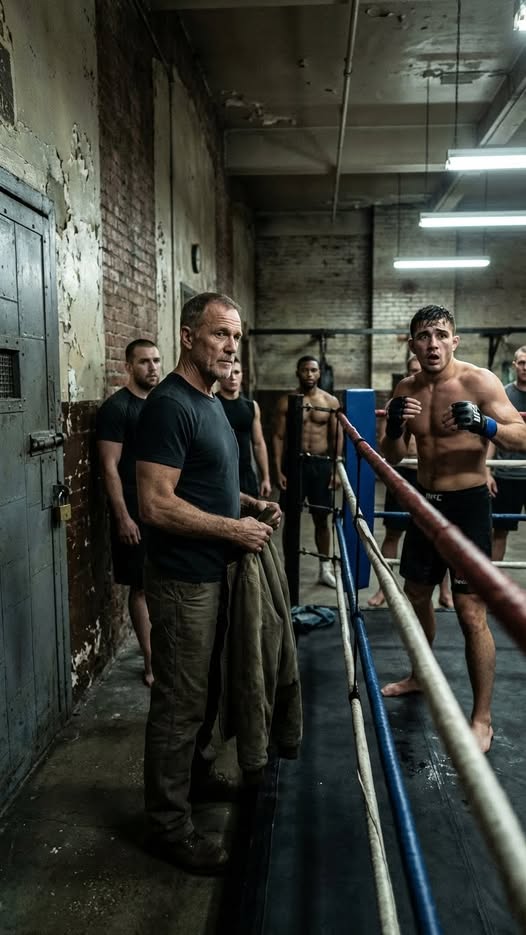
The Iron Den was located in a converted warehouse in the industrial district. It was the kind of place that smelled of stale sweat, Axe body spray, and unwashed gym mats.
It was 11:00 PM. The lights were blazing. Bass-heavy hip-hop shook the corrugated metal walls.
I parked my truck around the block. I walked the rest of the way. I didn’t sneak. I didn’t stick to the shadows. I walked down the center of the street, my boots echoing on the pavement. I was the “gray man”—unremarkable, unnoticed, part of the background until it was too late.
I pushed open the glass double doors.
The gym was packed. Men in compression shorts and tank tops were hitting heavy bags, grappling on the mats, or posturing in the mirrors. The air was thick with testosterone and ego.
In the center ring, Brock was holding court.
He was wearing boxing trunks and gloves, sweating, laughing. He was surrounded by four or five sycophants.
“She came at me, bro!” Brock shouted, throwing a shadow-boxing hook. “I just had to check her, you know? Bitches be crazy. She slipped and hit the counter. Now her dad is probably crying to the cops.”
The other men laughed, high-fiving him.
“You showed her who’s boss,” one of them jeered.
I walked past the front desk. The receptionist, a girl with pink hair and a nose ring, looked up.
“Hey! You can’t just walk in here without a membership!” she called out.
I ignored her. I walked to the main entrance door—the only way in or out of the main gym floor. I turned the heavy deadbolt. Click. Then, I slid the steel security bar into place across the frame.
Thud.
The sound cut through the music. It wasn’t loud, but it was final.
The room went quiet. The heavy bags stopped swinging. Heads turned.
I stood there, an old man in a windbreaker and khaki pants. An anomaly.
Brock looked over the ropes, squinting against the overhead lights. He recognized me. A smirk spread across his face—a predator seeing a wounded gazelle.
“Hey!” Brock shouted, leaning over the ropes. “Look who it is! It’s the grandpa. You come to pay her bill? Or did you come to beg me to take her back?”
His friends chuckled, crossing their arms.
I didn’t speak. I slowly unzipped my windbreaker. I folded it neatly and placed it on a weight bench.
Underneath, I wore a simple black t-shirt. For the first time in years, my arms were exposed. The scars ran down my forearms like a roadmap of violence—jagged lines from knives, burn marks from casings, the mottled skin of healed shrapnel wounds. These weren’t the scars of a sport. They were the receipts of war.
I adjusted my gloves. Scritch. Scritch. The Velcro tightened.
I walked to the edge of the ring.
“Yo, old man, are you deaf?” Brock taunted, bouncing on the balls of his feet. “Get out of here before you break a hip.”
I climbed the steps. I didn’t hop over the ropes like a showman. I stepped through them, methodical and slow.
The music stopped. The receptionist had cut the audio. The silence that filled the room was heavy, suffocating.
I stood in the center of the ring. I didn’t raise my fists in a boxing stance. I stood with my hands loose at my sides, my center of gravity low, my knees slightly bent. I looked Brock in the eyes. I saw the doubt flicker there for a nanosecond, quickly covered by bravado.
“Class is in session,” I whispered.
In the silence, it sounded like the racking of a shotgun slide.
“You want a piece of me?” Brock laughed, looking at his friends for an audience. “Alright. I’ll go easy on you, Pops. Don’t want to kill you.”
He bounced, shaking out his shoulders. He was fast. He was strong. But he was a sportsman. He fought for points. He fought with rules.
He lunged.
It was a telegraphed right cross, a haymaker intended to knock me out and end the show. It was powerful, but it was wide.
I didn’t block it. Blocking absorbs impact.
I stepped inside the punch.
I moved into his personal space, my left hand shooting up to catch his forearm, redirecting the energy. My right elbow drove forward, not striking him, but meeting the inside of his wrist as his momentum carried him forward.
Snap.
The sound was sickening—like a dry branch breaking in a winter storm.
Brock screamed, a high-pitched wail of shock. He stumbled back, clutching his right hand. His wrist hung at an unnatural ninety-degree angle.
The gym erupted in gasps.
I didn’t pursue him. I stood my ground, my breathing even.
“Lesson one,” I said, my voice projecting clearly to the silent room. “The wrist is a complex assembly of eight carpal bones held together by ligaments. It is a hinge. It is not a hammer. When you strike without alignment, the structure fails.”
Brock stared at his hand in horror, then at me. The pain turned to rage.
“I’ll kill you!” he roared.
He swung wildly with his left hand, a desperate hook.
I ducked under the swing. As his arm passed over my head, I grabbed his tricep with one hand and his wrist with the other. I stepped behind him, using my hip as a fulcrum.
I applied torque.
“Lesson two,” I stated, devoid of anger. “Leverage dictates reality.”
I twisted.
There was a wet, heavy pop.
Brock’s shoulder dislocated from the socket. He dropped to his knees, his arms useless, dangling at his sides like broken wings. He was hyperventilating, sweat pouring down his face, snot running from his nose.
“You used these hands to hold her down?” I asked, looking down at him. “Now they can’t hold anything.”
The other fighters by the ring ropes were frozen. They were big men, strong men, but they were watching a shark dismantle a seal. They recognized that this wasn’t fighting. This was surgery without anesthesia. They were too terrified to intervene.
Brock tried to stand up, pushing with his legs, but his balance was gone without his arms. He kicked out at me—a sloppy front kick.
I caught his heel. I twisted the ankle forty-five degrees. He flipped onto his stomach, screaming into the canvas.
I knelt on his lower back, pinning him to the floor.
He was sobbing now. “Stop! Please! My arm! You broke my arm!”
I leaned down, close to his ear. “You broke her hyoid bone, Brock. Do you know where that is?”
I grabbed a handful of his hair and yanked his head back, exposing his throat.
I stood up, keeping my boot hovering over his neck. The exact spot where the bruises were on Emily.
“Lesson three,” I said. The room was deathly silent. “The airway is the most vulnerable point on the human chassis. It takes only thirty-three pounds of pressure to crush the trachea. You tried to crush hers.”
I pressed the sole of my boot against his throat. Just enough to cut off the air. Just enough to let him taste the darkness.
“Shall I show you how easy it is to turn off the lights permanently?”
Brock clawed at my boot with his broken hands, his fingers scrabbling uselessly against the leather. His eyes were bulging, filled with the primal terror of a man facing his own mortality. He made choking, gurgling sounds.
I looked into his eyes. I wanted to push down. I wanted to feel the crunch. The wolf inside me was howling for blood, demanding a life for a life.
It would be so easy. A shift of weight. A sudden stomp. And the monster would be gone.
But then I saw Emily’s face in my mind. Not the broken girl in the hospital bed, but the little girl I taught to ride a bike. I promised never to touch the civilian mechanism.
If I killed him, I wasn’t her father anymore. I was just a murderer.
I held the pressure for ten seconds. Ten seconds of eternity for him.
Then, I stepped back.
Brock gasped, sucking in air with a desperate, ragged wheeze. He curled into a fetal position, weeping, soiling himself. The smell of urine mixed with the blood and sweat.
He wasn’t a warrior. He wasn’t a fighter. He was just a bully who had met a wall he couldn’t knock down.
“Please,” Brock whimpered, mucus dripping from his nose. “Don’t.”
I looked down at him with pure disgust. Killing him was too easy. Leaving him broken, humiliated, and stripped of his physical power—that was the true punishment.
“You aren’t worth the paperwork,” I muttered.
I turned to the paralyzed onlookers. They flinched as I looked at them.
“Assignment complete,” I said calmly. “Dismissed.”
I walked to the bench and picked up my windbreaker. I put it on, zipped it up, and smoothed the collar. I walked to the door, slid the security bar back, and unlocked the deadbolt.
Outside, the night was lit up with red and blue strobes. Sirens wailed, cutting through the heavy air. The receptionist had called them. Good.
I pushed the doors open and stepped out.
“Police! Drop to your knees! Hands in the air!”
Three officers were behind the doors of their cruisers, guns drawn.
I raised my hands slowly. I knelt on the pavement. I didn’t resist. I respected the law, even if I had to bypass it for a moment to get justice.
“I am unarmed,” I announced clearly.
They rushed me. Hands grabbed my arms, pulling them behind my back. The cuffs clicked tight.
The lead officer, Sergeant Miller—the same man who had warned me at the hospital—walked up. He looked at me, then past me into the gym where paramedics were already rushing in with a stretcher. He saw the carnage. He saw Brock being loaded up, screaming in agony.
Miller looked back at me, his face pale.
“Jesus, Silas,” he whispered. “What did you do?”
I looked at the officer with tired, heavy eyes. The wolf was back in the cage. The lock was turned.
“I corrected a mistake,” I said.
Six Months Later
The autumn leaves were turning gold and crimson, falling onto the porch of my house. The air was crisp, smelling of woodsmoke and change.
I sat in my rocking chair, a blanket over my knees. The legal battle had been short and strange.
I spent two nights in a holding cell. My lawyer, a nervous man named Stan, had come in on the third morning looking like he had seen a ghost.
“Silas,” he had said. “The DA is dropping the assault charges.”
“Why?” I had asked.
“Because the victim isn’t cooperating. Brock told the police he fell down a flight of stairs at the gym. He claims it was a training accident.”
“He’s lying,” I said.
“I know,” Stan replied, swallowing hard. “But he’s terrified, Silas. He told his lawyer that if he testifies against you, you might come back for Lesson Four.”
Brock had moved to Nevada a week later. His fighting career was over. You can’t fight in a cage when your wrist is fused and your shoulder has limited mobility. He was working at a car wash in Reno.
The screen door creaked open.
Emily walked out. She was holding two mugs of coffee.
She looked good. The swelling was long gone. The orbital fracture had healed. There was a faint, thin white line on her lip, but you had to be close to see it.
She handed me a mug. “Black. Two sugars.”
“Thanks, kid.”
She sat on the railing, looking out at the rose bushes I had pruned back in the summer. They were dormant now, preparing for winter.
“I heard he’s in physical therapy again,” she said softly, staring at the steam rising from her cup.
“Is he?” I took a sip.
“You promised you’d never use that stuff again, Dad,” she said. It wasn’t an accusation. It was just a statement of fact.
I looked at my hands. They were calloused from gardening, stained with soil. But I knew what lay beneath the skin. I knew the geometry of destruction that lived in my muscle memory.
“I didn’t use it on a civilian, Em,” I said quietly.
She looked at me. Her eyes were clear, strong. She wasn’t the scared girl in the hospital bed anymore. She was a survivor.
“I used it on a bully,” I continued. “Education is important.”
She smiled—a real smile. She reached out and squeezed my hand. I squeezed back, gentle, careful.
“Thanks for the lesson,” she whispered.
We sat in silence, watching the sun dip below the horizon.
A car drove slowly past the house. A black sedan. Tinted windows.
My body didn’t move, but my eyes snapped to it. I noted the license plate. I noted the make and model. I scanned the silhouette of the driver.
The car passed. Just a neighbor.
I relaxed, taking another sip of coffee. The teacher had retired again. The wolf was sleeping. But the watchman?
The watchman never sleeps.