They thought they were safe behind locked doors. They forgot that locks only keep out strangers, not the mother who holds the spare key to their destruction.
The world changes at 4:45 AM. It is the hour of the wolf, that terrifying dead zone between the dregs of the night and the promise of the morning. When the phone rang, cutting through the silence of my bedroom like a shriek, I didn’t wake up with a start. I woke up with a certainty. A mother’s intuition is a heavy, cursed thing; I had been waiting for this ringtone for three years.
I picked up the receiver. My hand was steady, though my heart hammered a frantic rhythm against my ribs.
“Eleanor.”
It was Derek. His voice wasn’t panicked. It wasn’t thick with tears or choked with the hysteria one might expect from a husband calling his mother-in-law in the pre-dawn dark. It was bored. It was the tone of a man inconvenienced by a flat tire.
“What did you do?” I asked. My voice sounded foreign to my own ears—scratchy, old.
“She’s done it again,” Derek sighed, the sound of ice clinking against glass filtering through the line. He was drinking. “She fell. Down the stairs. I told her to stop wearing those ridiculous heels in the house, but you know how she is. Dramatic.”
A cold, expansive numbness began to spread from my chest to my fingertips. “Where is she?”
“Hospital. St. Jude’s. You better come get her. I have a board meeting at nine, and I can’t deal with her hysterics when she wakes up.”
He hung up.
I didn’t scream. I didn’t weep. I put on my shoes.
St. Jude’s Emergency Room was a wash of harsh fluorescent light and the smell of antiseptic masking the underlying scent of human misery—sweat, urine, and metallic blood. I found the doctor before I found Sarah. He was a young man, looking exhausted, holding a clipboard like a shield.
“Mrs. Vance?” he asked.
“Where is my daughter?”
He hesitated, looking down at his shoes. “The trauma… it was severe. Blunt force to the cranium. Massive internal hemorrhaging. We did everything we could, but…”
The world tilted on its axis, then snapped back into a rigid, terrible focus. “Show me.”
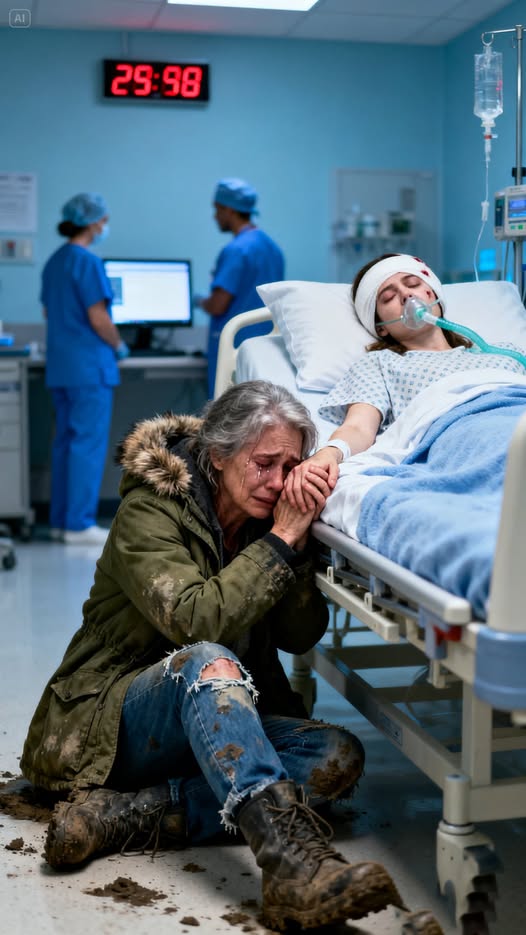
They led me to a curtained alcove. There she was. My Sarah. My bright, laughing girl who used to dance in the rain. She looked small on the gurney, her skin the color of parchment. The bruising was already blooming across her face, a grotesque map of violence.
But it wasn’t her face that broke me. It was her hand.
I reached out and touched her left hand. Her fingers were twisted at unnatural angles. The distinct, sickening crunch of bone beneath the skin told me everything I needed to know. These were not injuries from a fall. You don’t break your fingers falling down stairs. You break your fingers when you hold your hands up to protect your face from a boot or a fist.
“She’s just being dramatic,” Derek’s voice echoed in my head. “Pick her up.”
The grief I expected didn’t come. Instead, something else arrived. It felt like a physical snap in the base of my skull, a circuit breaker flipping to prevent an overload. The weeping mother died in that room, right alongside her daughter. In her place, something cold and mathematical opened its eyes.
A nurse handed me a clear plastic bag. “Her personal effects, ma’am.”
I took the bag. Inside, amidst the bloody jewelry and her shattered phone, was a keychain. Hanging from it was a single, silver key. It was the key to the Victorian, the sprawling, isolated estate Derek had bought six months ago to move Sarah away from her friends, away from me.
I closed my fist around the key. The metal bit into my palm, sharp and grounding.
“You’re right, Derek,” I whispered to the empty room, my eyes dry as desert stones. “She was my problem. Now, you are.”
I walked out of the hospital into the pre-dawn rain. The sky was the color of a bruise. I didn’t turn toward the police station. I knew that game; we had played it before. The warnings, the ‘domestic disputes,’ the handshakes between Derek and the officers who knew his father.
I got into my car. The leather seat was cold against my back. I opened the glove compartment and retrieved a pair of black leather gloves. I pulled them on, finger by finger, the leather stretching tight. A heavy, frantic silence settled over the car as I turned the ignition. The GPS was already set to Derek’s address.
The drive to The Enclave took forty minutes. It was a gated community for the kind of people who believed laws were suggestions for the poor, not constraints for the wealthy. Derek Vance came from old money—dirty money washed clean by generations of philanthropy and political donations.
I drove in silence, the windshield wipers keeping time with the calculating rhythm of my thoughts.
I remembered the first time Sarah called me, crying, hiding in the bathroom. I told her to come home. She said she couldn’t. He would find her. He would ruin me. She stayed to protect me. The irony tasted like ash in my mouth.
Inside the mansion, I knew exactly what was happening. I could visualize it with the precision of the forensic accountant I had been for thirty years.
Derek would be in the study. He wouldn’t be alone. Marcus, his family’s “fixer”—a lawyer with a suit that cost more than my car and a soul that had rotted away decades ago—would be there.
“She was unstable,” Derek was likely saying, pouring a glass of that twenty-year-old scotch he saved for victories. “Everyone knew it. Post-partum depression, maybe? Even though there was no baby. Just… mental fragility. She slipped. Tragedy.”
They would clink glasses. The sound would be sharp in the quiet house.
Derek would check his phone. No missed calls from Eleanor. No police sirens wailing up the long driveway. He would smile that shark-like smile, believing his influence had suffocated the truth once again. He trusted the system because he owned the system.
“The old hag is probably hyperventilating in a waiting room,” he would sneer, loosening his tie. “She doesn’t have the stomach for a fight. She balances books, Marcus. She doesn’t balance scales.”
He was half right. I did balance books. And tonight, I was going to close the account.
I pulled my car onto the shoulder of the road, a half-mile from the gate. I knew the service entrance code; Sarah had given it to me months ago, “just in case.” I walked the rest of the way, the rain soaking through my coat, chilling me to the bone. But the cold was good. It kept the rage condensed, focused.
I reached the driveway. The house loomed ahead, a dark monstrosity of turrets and stone. Light spilled from the study window and the master bedroom.
I watched from the shadows of the hedges. I saw Marcus leave, clapping Derek on the shoulder, laughing. A laugh. My daughter was cooling on a metal slab, and they were laughing.
Derek locked the front door. I heard the heavy thunk of the deadbolt engaging.
“Safe and sound,” I imagined him muttering.
He headed upstairs to sleep, oblivious to the fact that the deadbolt was a Schlage B60—installed by a locksmith I had recommended. A locksmith who owed me a favor for fixing his tax audit. A locksmith who had given me a copy of the master key.
The key slid into the lock with a sensation that was almost erotic in its smoothness. There was no resistance. The tumblers aligned with a soft click, a sound louder than a gunshot in my heightened state of awareness.
I pushed the door open and stepped into the foyer.
The house smelled of him. Expensive cologne, stale scotch, and the faint, coppery tang of bleach. They had cleaned, but not well enough. Not for a mother’s eyes.
I closed the door softly behind me. I was a ghost in a tomb.
I avoided the third step on the staircase. It creaked. I knew this because Sarah had warned me about it, laughing, saying it was how she knew when Derek was sneaking up on her.
I moved to the living room. The rug had been moved slightly. I knelt, peeling back the corner. The hardwood floor beneath was stained dark. They had scrubbed the surface, but blood soaks deep. It seeps into the grain. It becomes part of the foundation.
A cold fury tightened my chest, restricting my breath. This was where she died. I could see the broken vase on the mantle, glued back together poorly. A hole in the drywall near the floor had been hastily spackled, still wet to the touch.
I stood up. My breathing was shallow, controlled. I wasn’t here to scream. I wasn’t here to mourn. I was operating on ice.
I reached into my pocket and pulled out the burner phone I had bought at a gas station on the way. I placed it on the side table, hidden behind a stack of magazines. It was recording.
Then, I moved toward the kitchen. I didn’t go for the knives. That was too personal, too messy. I went to the utility drawer. I took out a roll of duct tape and a heavy, brass meat tenderizer. It felt significant in my hand. Weighted.
I checked my watch. 5:30 AM.
He would be in a deep sleep now, the alcohol pulling him down into the black.
I crept up the stairs. The house seemed to breathe around me, a conspirator in its own liberation. I reached the hallway leading to the master bedroom. The door was ajar.
I pushed it open.
Derek was sprawled across the king-sized bed, mouth open, snoring rhythmically. The sound was obscene. How could he sleep? How could his body find rest when he had just extinguished a light as bright as Sarah?
But he wasn’t alone.
Slumped in the armchair in the corner was Marcus. He hadn’t left; he must have come back or passed out waiting for a cab.
I froze. Two targets.
I had to recalculate. I looked at Marcus. He was out cold, a half-empty bottle on the floor next to him. He was soft, useless. Derek was the threat.
I stepped into the room. My eyes locked on the nightstand next to Derek. There, gleaming in the moonlight, was his pistol. A Sig Sauer. He kept it there for “protection.”
I moved toward it.
And then, I stepped on the loose floorboard I had managed to avoid downstairs, but forgotten up here.
Creeeeak.
The sound ripped through the silence.
Derek’s eyes flew open. He blinked, confused, still half-drunk, seeing a silhouette standing over him in the dark.
“Who…?” Derek mumbled, struggling to sit up.
I didn’t hesitate. I snatched the gun from the nightstand before his brain could send the signal to his hand. The metal was cold and heavy. I slid it into my coat pocket.
“Get out!” Derek shouted, his voice cracking. He scrambled back against the headboard, his hand slapping uselessly at the empty nightstand. “Do you know who I am?”
Marcus snorted in the chair, waking up with a groan. “What’s going on?”
I reached over and turned on the bedside lamp. The sudden light blinded them both.
I sat calmly in the chair opposite the bed, placing the meat tenderizer on my lap, my hand resting casually near the pocketed gun.
“I know exactly who you are, Derek,” I said. My voice was steady, devoid of inflection. “You are a man who likes to break things.”
Derek squinted at me, recognizing the face. “Eleanor? How the hell did you get in here? Marcus, call the police! She broke in!”
Marcus fumbled for his phone.
“I wouldn’t do that, Marcus,” I said softly. “Not unless you want the Bar Association to hear the recording of you two planning to bribe the coroner in the study three hours ago.”
Marcus froze. “What?”
“I’ve been here for a while,” I lied. “Long enough.”
I reached into my bag and pulled out a thick manila folder. I tossed it onto the bed. It landed heavily on Derek’s legs.
“What is this?” Derek sneered, regaining some of his arrogance. “Divorce papers? A little late for that.”
“It’s a ledger,” I said. “And a diary.”
Derek flipped it open. His face went pale.
“Sarah documented everything,” I explained. “Every bruise. Every threat. Every time you forced yourself on her. Dates, times, photos uploaded to a cloud server you didn’t know existed.”
“This is inadmissible,” Marcus barked, his lawyer instincts kicking in. “Hearsay.”
“And the second half of the folder,” I continued, ignoring him, looking straight at Derek, “is the forensic accounting of your father’s firm. You forgot that I did the books for Vance Industries for twenty years, Derek. I know where the bodies are buried. And I know where the money is hidden.”
Derek laughed, a nervous, high-pitched sound. “You can’t touch that money. It’s in the Caymans.”
“Was,” I corrected. “It was in the Caymans. I have power of attorney, Derek. Sarah signed it over to me six months ago when she first tried to leave you. It gave me access to shared assets. And since you were stupid enough to mingle your illegal offshore funds with the joint marital accounts to avoid taxes…”
I leaned forward.
“I emptied them. Ten minutes ago. Every shell company. Every trust. Every hidden account.”
Derek checked his phone, logging into his banking app. His fingers trembled. “No… No!”
“You’re broke, Derek. And not just ‘sell the yacht’ broke. You are ‘federal prison for tax evasion and money laundering’ broke. I sent the files to the IRS and the FBI before I walked through your front door.”
The silence in the room was total. The arrogance drained out of Derek like water from a smashed vase. He looked small. Pathetic.
“You bitch!” Derek screamed. He lunged.
It was an animalistic desperation. He forgot the gun. He forgot Marcus. He just wanted to crush the thing that had taken his power.
I didn’t flinch. I stood up and pulled the Sig Sauer from my pocket.
Derek stopped mid-lunge, his chest heaving, staring down the barrel.
“Sarah begged you to stop,” I said, my finger tightening on the trigger. “She cried. She pleaded. She loved you, God help her.”
I clicked the safety off.
“I’m not Sarah.”
The screen of my mind went white as the gunshot rang out.
The sound was deafening in the confined space.
Derek screamed—a high, guttural sound of pure agony. He collapsed onto the rug, clutching his right kneecap. The bullet had shattered the patella, turning the joint into a soup of bone and cartilage.
Marcus scrambled backward, falling out of his chair, hands up. “I didn’t touch her! It was him! It was all him!”
I didn’t look at Marcus. I watched Derek writhe.
“That hurts, doesn’t it?” I asked, my voice calm over his screaming. “Sarah died in pain, Derek. Alone. Scared. This is just a fraction of what you gave her.”
I walked over to the window and pulled back the curtain. Blue and red lights were flashing at the gate.
“I called them,” I said, turning back to the ruin of a man on the floor. “Not for the murder. They might wiggle out of that. But they don’t ignore gunshots. And they definitely don’t ignore the stack of documents on the bed detailing twenty million dollars in stolen corporate funds.”
I placed the gun on the nightstand. I took off the leather gloves and dropped them on the floor. I sat back down in the chair and waited.
When the SWAT team kicked down the bedroom door, guns drawn, shouting commands, I was sitting with my hands on my knees, the picture of a traumatized mother.
“He attacked me,” I told the lead officer, my voice trembling just enough to be believable. “I came to collect my daughter’s things… he was drunk… he came at me.”
The officer looked at Derek, screaming about his leg, smelling of whiskey. He looked at Marcus, cowering in the corner. He looked at the bruises on my arm—old ones, actually, from gardening, but they told a story in that light.
Then he looked at the diary on the bed. He picked it up. He saw the photos clipped inside.
The officer lowered his weapon. He nodded at me.
“Get the paramedics for the suspect,” the officer barked at his team. “And get cuffs on the lawyer.”
As they dragged Derek past me, he was sobbing. Not from the pain, but from the realization of what was happening. He was being handled like a criminal. Rough hands. Tight cuffs. No deference.
I leaned in close as the gurney passed.
“The accounts are empty, Derek,” I whispered. “You can’t even afford bail. And in prison? A knee injury makes you prey.”
He looked at me with pure terror. He finally understood. I wasn’t a victim. I was the executioner.
As the police lights faded, fading into the gray morning, the lead detective told me to wait while they processed the scene. I asked for one minute to say goodbye to the house Sarah had hated so much.
I walked through the silent halls one last time. I stopped at the nursery—the room Derek had insisted they renovate, the room Sarah was preparing for a baby she hadn’t told him about yet because she was afraid.
I walked to the crib. I reached under the mattress. Sarah had told me she hid it there.
I pulled out the sonogram. A tiny, grainy peanut of a life.
Derek didn’t just kill his wife. He killed his unborn child.
The “ice” that had held me together for the last three hours cracked. Just for a second. A fissure of white-hot, blinding rage threatened to consume me. I wanted to go back out there. I wanted to finish the job. I wanted to aim higher than the knee.
But I took a breath. I put the sonogram in my pocket, next to the spare key. Death was too easy for Derek Vance. A long, painful, impoverished life in a cage… that was justice.
Four Months Later
The earth was hard, frozen by the deep chill of January. I knelt in the dirt, my knees resting on a foam pad. The air was crisp, biting at my nose, but I didn’t mind.
I dug a small hole with my trowel and placed a tulip bulb inside. Dark Queen. Sarah’s favorite. They needed the cold of winter to bloom in the spring. They needed the darkness to understand the light.
The radio on the porch was playing the midday news.
“…former tycoon Derek Vance was sentenced today to life in prison without the possibility of parole. The jury deliberated for less than two hours. In addition to the murder charge, Vance faces consecutive sentences for grand larceny and fraud. His co-defendant, Marcus Thorne, accepted a plea deal…”
I wiped the dirt from my hands. Life in prison.
He would die there. He would grow old within gray walls, surrounded by men who didn’t care about his last name. He would limp every day on that shattered knee, a permanent reminder of the night the accountant balanced the books.
I stood up and walked to the gate of my garden. I got into my car and drove to the cemetery.
It was quiet. The snow muffled the sound of the city. I walked to Sarah’s grave. The stone was simple, elegant. Sarah Vance. I hated the last name, but I couldn’t change history.
I reached into my pocket and pulled out the spare key to the Victorian house. The bank had foreclosed on it last week. It stood empty now, a hollow monument to a failed dynasty.
I placed the key on top of the cold granite headstone.
“I finished it, Sarah,” I spoke to the wind. “You can rest now. The door is locked, and he can never hurt you again.”
I stood there for a long time, letting the silence settle the ghosts in my head.
As I turned to leave, I saw a movement a few rows over.
A young woman was standing at a fresh grave. She was crying, her shoulders shaking violently. She was wearing sunglasses, even though the sky was overcast. As she reached up to wipe a tear, her sleeve slipped.
I saw the bruises. Finger marks. The unmistakable pattern of a grip that was too tight, too possessive.
I stopped. The old Eleanor would have looked away, giving the stranger privacy. The old Eleanor would have thought it wasn’t her business.
But the old Eleanor was dead. She died in an emergency room at 4:45 AM.
I walked over to the young woman. The snow crunched under my boots. She looked up, startled, quickly pulling her sleeve down, adjusting her glasses to hide the black eye I knew was there.
“I’m sorry,” she stammered. “I… I was just leaving.”
I looked at her. I saw the fear. I saw the isolation. I saw the lock on the door she didn’t know how to open.
“My name is Eleanor,” I said, my voice steady, filled with the terrifying resolve of a mother with nothing left to lose.
I took off my glove and extended my hand.
“And I think I can help you.”