They say the nesting instinct is powerful, a primal urge to scrub and polish the world before a new life enters it. But as I stood by the bay window of our colonial in the suburbs of Boston, watching the dying ember of autumn bleed into the gray onset of winter, I felt something else. It wasn’t just the urge to organize; it was a quiet, vibrating dread.
My name is Deborah Wilson. For seven years, my body had been a fortress with the gates locked tight. Seven years of negative tests, of sterile clinics, of hope curdling into despair. And then, a miracle. A heartbeat where there had been only silence.
I rested my hands on the swell of my belly, feeling the rhythmic hiccups of the son I would meet in a week. The front yard was a tapestry of decay—fallen oak leaves rotting into the frost-hardened earth. It should have been a peaceful scene, the picture-perfect suburban tableau. But the silence of the house felt heavy, like the air before a thunderstorm.
“Mom, look! I finished Jupiter!”
The voice of Lily, my eight-year-old daughter, shattered the quiet. I turned, forcing a smile onto my face as I descended the stairs. Lily was holding a solar system model, her face smudged with marker, eyes bright with the fierce intelligence that always startled me.
“It’s beautiful, honey,” I said, tracing the red spot on the cardboard planet. “You captured every detail.”
“Do you think Dad will like it?” she asked, her enthusiasm dimming slightly. “Will he be home tonight?”
My chest tightened. That was the question lately, wasn’t it? Michael was a ghost in his own home. A medical sales manager, he had always been busy, but lately, his absence felt different. It wasn’t just physical; it was an emotional vacancy. When he was home, he looked through me, not at me.
“He has a client dinner, sweetie,” I lied, or perhaps repeated a lie I had been told. “But tomorrow. We’ll show him tomorrow.”
That night, Michael returned late, smelling of cold air and expensive scotch. He loosened his tie, his movements jerky and restless. When he kissed my forehead, his lips felt dry.
“Deborah,” he whispered later, in the dark, his back to me. “I… I just want this baby to be healthy. I want us to be okay.”
“We will be,” I murmured, reaching for his hand. He pulled it away under the pretense of adjusting the blanket.
I didn’t know it then, but he wasn’t praying for our family’s survival. He was praying for forgiveness for a sin he hadn’t yet fully committed to, but had already set in motion.
Two hours later, a pain ripped through my abdomen like a serrated knife. It was too early. A full week too early. I gasped, clutching the sheets, and shook Michael awake. “It’s time,” I groaned. But as I watched him scramble to pack his bag, I saw a flash of something on his face that didn’t look like panic. It looked like guilt. And as we drove into the night, leaving Lily with our neighbor Carol, I had the terrifying sensation that I was not driving toward a hospital, but toward a trap.
The labor was a blur of agony and white light. By the time Thomas Wilson entered the world, crying with a lusty vigor that defied his slightly premature arrival, I was shattered. My body felt like a shipwreck washed ashore.
But he was perfect. Ten fingers, ten toes, and a tuft of dark hair that matched his father’s.
I lay in the recovery room, the adrenaline fading into a bone-deep exhaustion. Michael held Thomas for a moment, his expression unreadable, before handing him back to the bassinet.
“I have to take that call,” he said, checking his watch. “The office… they don’t stop, even for this.”
“Go,” I whispered, too tired to argue.
He left the room. Moments later, the door opened again.
She walked in with a stride that was too confident, too proprietary. Her name tag read Rachel. She was beautiful in a sharp, brittle way—blonde hair pulled back tight, eyes the color of sea glass, and a smile that didn’t quite reach them.
“Mrs. Wilson,” she cooed, checking the IV line with efficient, cold fingers. “You had a rough time of it. I’m Rachel. I’ll be your primary nurse for the next few days.”
“Thank you, Rachel,” I managed. “I’m just… so tired.”
“Of course you are. Dr. Stevens prescribed a sedative to help you rest. You need to sleep to heal.”
She injected something into my IV port. It didn’t feel like the warm flush of typical pain relief. It felt cold, a liquid lead traveling up my vein.
“Just close your eyes,” she whispered.
I fell into a darkness that wasn’t sleep. It was a coma-like void. When I woke, hours had passed. The sun had moved across the sky. My head felt stuffed with cotton, my limbs heavy and unresponsive.
Another nurse was in the room, holding Thomas. “Oh, you’re up,” she said. “We were worried. You slept through two feedings.”
“The medicine…” I slurred. “It was too strong.”
“I see Rachel noted a high dose,” the nurse frowned, checking the chart. “We’ll dial it back.”
That afternoon, the nausea hit. Violent and sudden. My heart raced like a trapped bird. I pressed the call button, and Rachel appeared instantly, as if she had been standing just outside the door.
” palpitations?” she asked, her voice solicitous. “It’s a common reaction to the hormones. Here, this will stabilize you.”
She produced a pill cup. A single blue tablet.
“What is it?”
“Just a beta-blocker. Standard protocol.”
I swallowed it. I trusted the white coat. I trusted the institution. Why wouldn’t I?
Later that evening, Carol brought Lily to visit. My daughter’s eyes went wide when she saw her baby brother, but they narrowed when she looked at me.
“Mom, you look green,” Lily said bluntly.
“Just tired, baby.”
Rachel bustled in then, bringing a pitcher of water. She stopped when she saw Lily. “Well hello there, Lily. You’re even prettier than your daddy said.”
The room went still. I had never mentioned Lily’s name to Rachel.
Lily stiffened. She looked at the nurse, then back at me. She didn’t say a word until Rachel left the room. Then, she leaned in close, her breath smelling of the peppermint candy Carol allowed her.
“Mom,” she whispered, her voice trembling. “I know her.”
“The nurse?”
“I saw her. Two weeks ago. Dad picked me up from school and we stopped for ice cream. That lady was there. They were sitting at a table outside. Dad was holding her hand, Mom. And she… she looked at me like she hated me.”
The blood drained from my face, leaving me colder than the sterile room. Michael and the nurse? My husband and the woman currently administering my medication? I tried to sit up, but the room spun violently. I looked at the IV bag dripping steadily into my arm. It wasn’t medicine. It was a weapon. And I was tethered to it.
Paranoia is a terrifying thing. It makes you question gravity. Is the floor really there? Is the water poisoned? Is my husband trying to kill me?
I spent a sleepless night, watching Rachel enter and exit the room. Every time she touched my IV, I flinched. I feigned sleep, watching her through slitted eyes. She didn’t check my vitals like the other nurses. She stood at the foot of the bed, staring at me with a look of pure, unadulterated loathing.
The next morning, Michael visited. He looked haggard, his eyes darting around the room like a trapped animal.
“How are you feeling?” he asked, not sitting down.
“Like I’m dying,” I said, testing him. “The medicine… it makes me feel worse.”
He flinched. “It’s just the recovery, Deb. You need to listen to the nurses. They know best.”
“Do they?” I asked. “Lily said something interesting yesterday, Michael.”
He froze. “What?”
“She said she saw you. With Rachel.”
Michael’s face crumbled. For a second, I saw the man I married—weak, yes, but not evil. Just pathetic. “Deborah, I can explain. It’s not… it’s over. I ended it.”
“You ended it?” I hissed, glancing at the door. “She is my nurse, Michael! She is drugging me!”
“She’s just doing her job,” he pleaded, though his voice lacked conviction. “I didn’t know she was assigned to you. I swear.”
Before we could continue, the door handle turned. Michael jumped back. Rachel breezed in, holding a syringe.
“Time for your antibiotic,” she announced cheerfully.
“I don’t need antibiotics,” I said, my voice shaking. “I don’t have an infection.”
“Dr. Stevens ordered it pro-phyl-ac-tic-ally,” she sounded out the word condescendingly. “Open wide, or give me your arm.”
I looked at Michael. Help me, my eyes screamed. Do something.
He looked at the floor.
I took the pill she offered, pretending to swallow, and tucked it into my cheek. As soon as she turned to log the dosage, I spit it into my napkin.
That afternoon, Lily came back. She didn’t bring drawings or toys. She looked like a soldier entering a war zone.
“Mom,” she said, climbing onto the bed. “I saw them again. In the hallway.”
“Who?”
“Dad and the bad lady. She was yelling at him. She said, ‘We do it today.’ And Dad… Dad looked scared, Mom. He said ‘Not yet,’ but she said ‘It’s too late.’”
A chill went through me that had nothing to do with the hospital air conditioning. We do it today.
Suddenly, the heavy door clicked. Not the sound of it opening, but the sound of the lock engaging.
Lily jumped off the bed. She ran to the window, peering through the blinds, then whipped around. Her face was pale, her eyes enormous.
“She’s coming,” Lily whispered. “I hear her shoes. The squeaky ones.”
Panic, cold and sharp, flooded my system. I was weak. I could barely walk. But the look on my daughter’s face ignited a primal strength in my marrow.
“Lily,” I whispered. “Help me up.”
“Where can we go?” she cried.
The bathroom door had no lock. The hallway was blocked by her.
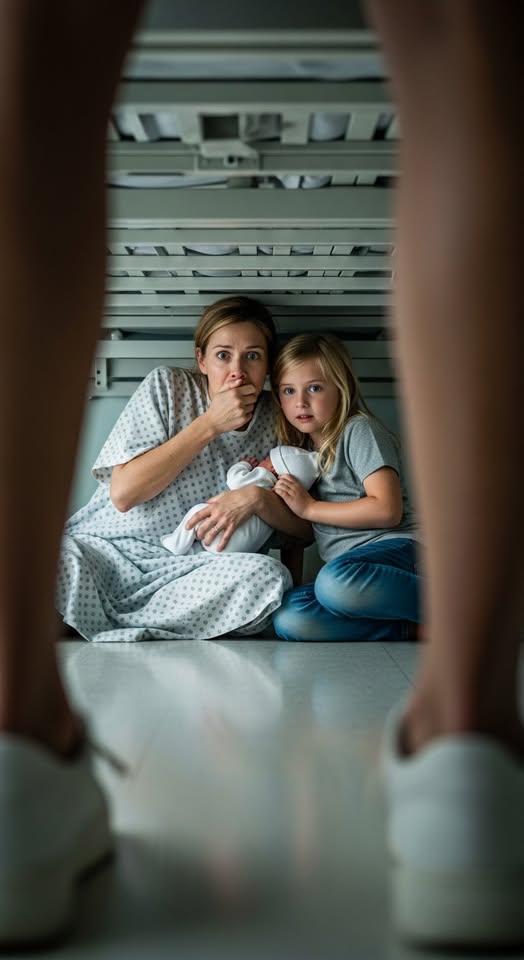
“Under,” I commanded, grabbing Thomas from the bassinet. “Under the bed. Now.”
It was agony. My stitches burned as I slid off the mattress, dragging the IV pole down with me, praying the line wouldn’t rip from my vein. I curled into a ball on the cold linoleum, clutching my newborn son to my chest. Lily scrambled in beside me, her small hand clamping over her own mouth to stifle her breathing.
The door handle turned. Then, the door opened.
From our vantage point, I could only see shoes. White, squeaky nursing shoes. And beside them, polished black leather loafers.
Michael.
“Where is she?” Rachel‘s voice wasn’t professional anymore. It was a jagged edge of madness. “She was just here.”
“Maybe she went for a walk,” Michael stammered.
“She can’t walk,” Rachel spat. “I gave her enough muscle relaxant to drop a horse. She’s here somewhere.”
My heart hammered against my ribs so hard I was terrified it would wake the baby. Thomas stirred, his tiny mouth opening to cry. I did the only thing I could—I offered him my finger to suckle, praying it would soothe him.
“We have to finish this, Michael,” Rachel said, her voice dropping to a terrifying whisper. “The syringe is ready. One injection. An embolism. It happens all the time. Tragic complication.”
I saw Michael’s shoes shuffle backward. “No,” he said, his voice trembling. “I told you, Rachel, I’m done. I want my family. I never agreed to murder.” Rachel laughed, a sound devoid of sanity. “You don’t get to choose anymore. You promised me a life. If you won’t leave her, I’ll remove her.” The white shoes stepped closer to the bed. She knelt down. The bed skirt lifted.
For a second, time didn’t just stop; it disintegrated.
As the hem of the bed sheet lifted, I saw Rachel’s face. It was contorted, her eyes wide and glassy, the pupils blown out with adrenaline and madness. In her right hand, she gripped a syringe filled with a clear liquid.
“Found you,” she whispered.
She lunged.
I screamed, kicking out with my legs, aiming for her face. My foot connected with her nose with a sickening crunch. She howled, falling back, but she didn’t drop the needle.
“Get her!” Rachel shrieked at Michael. “Hold her down!”
I scrambled out from under the bed, dragging Lily and Thomas with me. I was cornered. My back pressed against the window, my children behind me. I ripped the IV out of my arm, blood splattering onto the floor.
“Michael!” I screamed, staring at my husband. “Look at your children! Look at what you’ve brought into this room!”
Michael stood frozen in the center of the room, his face a mask of horror. He looked from me—blood trickling down my arm, clutching our newborn—to Rachel, who was getting to her feet, blood streaming from her nose, the syringe raised like a dagger.
“Rachel, stop,” Michael said, stepping between us.
“Move!” she screamed. “You coward! We can be happy! We just need her gone!”
“She’s my wife!” Michael shouted, finally finding his voice. He grabbed Rachel’s wrist.
She was smaller than him, but she possessed the hysterical strength of the insane. She twisted, driving her knee into his groin. Michael doubled over, gasping.
Rachel turned her eyes back to me. She smiled, raising the needle. “Say goodbye, Deborah.”
She charged.
I braced myself, turning my body to shield Thomas, prepared to take the needle in my own back.
But she never reached me.
A small, blur of motion shot out from the side. Lily.
My eight-year-old daughter grabbed the heavy metal water pitcher from the bedside tray and swung it with both hands. It connected with the back of Rachel’s head with a dull thud.
Rachel stumbled, her eyes losing focus. She swayed, the syringe slipping from her fingers and clattering across the floor.
“Don’t touch my mom,” Lily screamed, her voice breaking.
Rachel fell to her knees, dazed.
Suddenly, the door burst open. Security guards, alerted by the noise, flooded the room. Two nurses followed, gasping at the scene.
” Restrain her!” a guard shouted, tackling Rachel as she tried to crawl toward the syringe.
I slid down the wall, my legs giving out. I pulled Lily into my lap, burying my face in her hair, while Thomas began to wail in my arms.
Michael was on the floor, groaning. He looked up at me, his eyes filled with tears. He reached a hand out.
“Don’t,” I said. The word was quiet, but it had the weight of a tombstone. “Don’t you dare come near us.”
The police arrived ten minutes later. They bagged the syringe. The toxicology report would later confirm it contained a lethal dose of morphine and potassium chloride. Enough to stop a heart instantly.
They dragged Rachel out in handcuffs. She wasn’t screaming anymore. She was laughing, mumbling about wedding dresses and nursery colors.
As they led Michael away for questioning, he looked back at me one last time. “I didn’t know,” he sobbed. “I didn’t know she would go this far.”
I looked at him—the father of my children, the man I had loved for a decade—and I felt nothing. The love had been cauterized by the fear.
“You let the devil in, Michael,” I said. “It doesn’t matter if you didn’t tell it to bite.”
The hospital moved us to a VIP suite on a different floor, under 24-hour police guard. I didn’t sleep. I sat in a chair facing the door, holding Thomas, with Lily asleep in the bed I refused to lie in. When the sun came up, illuminating the bloodstains on my hospital gown, a detective knocked on the door. “Mrs. Wilson,” he said grimly. “We found something in Rachel’s apartment. Journals. This wasn’t just about you. She’s done this before.”
The revelation that Rachel Collins was not just a jealous mistress but a serial predator sent shockwaves through the hospital administration. She had falsified her credentials, moving from state to state, leaving a trail of “medical complications” in her wake. I was just the latest chapter in a book written in blood.
But knowing that didn’t fix the hole in my chest.
Michael was not charged with attempted murder—there was no evidence he knew about the syringe—but he was charged with negligence and obstruction. His career was over. His reputation was ash.
He came to see me three days later, released on bail, standing in the doorway of the new room.
“Deborah,” he started.
“Lily is outside with Carol,” I said, cutting him off. “I don’t want her to see you.”
“I made a mistake. A horrible mistake. I was weak, and I was flattered, and it spiraled out of control. But I saved you. I tried to stop her.”
“Lily saved me,” I corrected him, my voice ice. “Lily saved us. You just watched.”
“Please. We can fix this. I’ll spend the rest of my life making it up to you.”
I looked at the bassinet where Thomas slept. I looked at the bruises on my arm where I had ripped out the IV.
“I filed for divorce this morning,” I said. “I want sole custody. If you fight me, I will put Lily on the stand, and I will let her tell the judge exactly what she saw you doing while that woman tried to kill her mother.”
Michael paled. He opened his mouth, closed it, and slumped his shoulders. He knew he had lost. He turned and walked away, a man who had traded his family for an ego boost and lost everything in the bargain.
The transition home was the hardest part. The house felt too big, too full of memories of a life that was a lie. Every time the floorboards creaked, I jumped. Lily had nightmares. She would wake up screaming about “squeaky shoes.”
We couldn’t stay there. The white two-story house in the suburbs wasn’t a sanctuary anymore; it was a crime scene of the heart.
I sold it.
Three months later, we moved to a small cottage a few towns over. It was modest, with a wraparound porch and a garden that needed work. It was perfect.
Carol came over every weekend. She helped me paint the walls a bright, sunny yellow. She held Thomas while I went to therapy. She sat with Lily and helped her draw, turning her trauma into art.
One afternoon, I sat on the porch swing, nursing Thomas. The spring air was sweet, smelling of blooming lilacs and wet earth. Lily was in the yard, chasing a butterfly.
“Mom!” she called out, her laughter ringing clear and true, a sound I hadn’t heard in months. “Look! It landed on my nose!”
I smiled, feeling a warmth spread through my chest that had nothing to do with the sun.
We were scarred. I would never trust easily again. Lily had grown up too fast, burdened with the knowledge that adults could be monsters. Thomas would grow up without a father in the house.
But we were alive.
I looked down at Thomas, his eyes fluttering open—eyes that were clear and innocent, untainted by the darkness of his birth.
Michael sent checks, but he didn’t visit. The shame was too great, or perhaps he was just cowardly to the end. Rachel was in a secure psychiatric facility, likely for the rest of her life.
They were the past.
I watched Lily run across the grass, her hair flying behind her like a banner of victory. She wasn’t just my daughter anymore; she was my hero.
“Lily!” I called out.
She stopped and looked at me.
“I love you.”
“I love you too, Mom,” she shouted back. “And Thomas.”
I rocked the swing gently. The nightmare was over. The winter was gone. And here, in this small garden, under a vast and open sky, we were finally, truly safe.
Years later, Lily would ask me why I didn’t hate her father. I would tell her that hate is a connection, a tether that binds you to the person who hurt you. Indifference is freedom. And looking at my life now—the peace, the quiet joy—I am finally, wonderfully free.