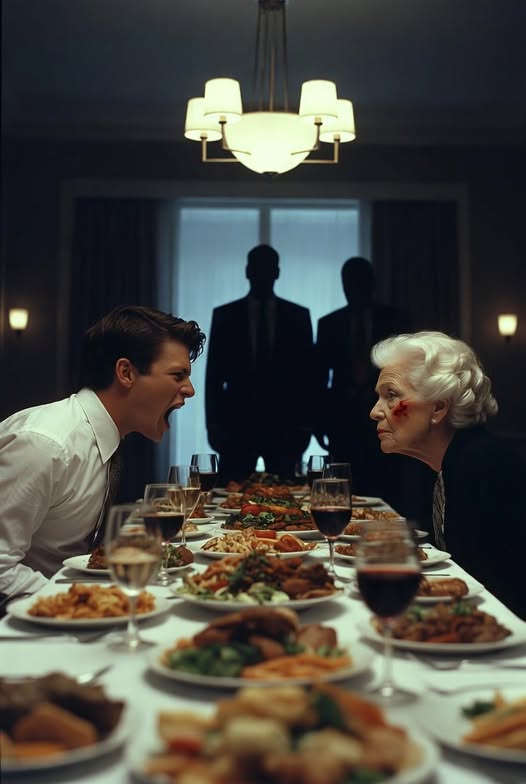
Chapter 1: The Sound of Breaking Glass
The sound of a hand striking flesh is distinct; it is a wet, sharp crack that echoes not just in the room, but deep within the psyche. It was louder than I expected, louder than the thunder rolling over the Blackwood Estate, and certainly louder than the shattering of the crystal vase that followed my stumble.
My cheek burned. A throbbing, hot pulse radiated from my zygomatic arch, spreading toward my eye. But the physical pain was a distant second to the sudden, icy clarity that washed over me. It was as if a chaotic, noisy room had suddenly been silenced.
Lucas, my son, my only child, stood over me. His chest was heaving, his face contorted into a mask of rage that I hardly recognized. He looked like his father in that moment—not the man I loved, but the man I feared in the final years of our marriage.
“Are you listening to me now?” Lucas roared, his voice cracking with the strain of his own entitlement. “I’m done waiting, Mother! I’m done playing the dutiful son while you sit on the inheritance like a dragon on a pile of gold. Sign the papers. Tonight.”
I lay on the cold marble of the foyer, the chill seeping through my silk blouse. I tasted copper; my lip was split. For years, I had made excuses. He’s stressed. The business is tough. He’s grieving. But violence is a boundary that, once crossed, obliterates the map of a relationship.
“Well?” he screamed, kicking the shattered remains of the vase near my hand.
I slowly pushed myself up. My movements were deliberate, fluid, almost mechanical. I didn’t scream. I didn’t cry. I didn’t beg. I simply smoothed my skirt, looked him dead in the eye, and saw nothing but a stranger.
“I hear you, Lucas,” I said. My voice was terrifyingly steady, void of any tremor. It was the voice I used in boardrooms to dismantle hostile takeovers. “You’ve made your point.”
He blinked, taken aback by my lack of hysteria. He expected tears; he expected the guilt-trip I usually dispensed.
“Good,” he huffed, running a hand through his disheveled hair. “Good. Have the notary here tomorrow at noon. And cook something decent. I’m sick of the catering.”
He turned his back on me and marched up the grand staircase, slamming his bedroom door with a force that shook the chandelier.
I stood alone in the foyer. The silence returned, but it wasn’t empty. It was heavy, pregnant with a plan that formed fully realized in my mind. I walked to the mirror. The bruise was already darkening, a purple bloom on my pale skin.
I touched it, wincing. This is the last time, I promised the reflection.
I didn’t go to bed. Instead, I went to my study and locked the door. I pulled out a burner phone I kept for emergencies—a habit from my days in corporate espionage—and dialed a number I hadn’t used in a decade.
“It’s time,” I whispered into the receiver. “Bring the file. And bring the others.”
I spent the rest of the night awake, staring at the rain lashing against the window. I wasn’t grieving the son I lost; I was mourning the mother I had to kill to survive him.
Just as dawn broke, I heard the floorboards creak outside my study door. The handle jiggled. Lucas was checking if I was awake, or perhaps, checking if I had fled. I held my breath, the phone clutched to my chest, knowing that if he entered now and saw the documents on my desk, the violence of last night would look like a mercy.
Chapter 2: The Art of Braising
The handle stopped moving. Footsteps retreated. I exhaled a breath I felt I had been holding for twenty years.
The morning sun filtered through the heavy velvet drapes of the kitchen, casting long, dust-mote filled beams across the butcher block island. I loved this kitchen. It was the heart of the estate, the place where I had taught Lucas to knead dough, where I had bandaged his scraped knees, where I had built the culinary empire that he was so desperate to liquidate for gambling debts.
I began to cook.
This was not just breakfast; this was a performance. I tied my apron tight, the knot sitting snugly against the small of my back. I chose the menu with surgical precision.
Osso Buco. Braised veal shanks. It was his favorite, but it was also a dish that required patience, time, and a slow, searing heat. A metaphor he would never understand.
I chopped the carrots, celery, and onions—the soffritto. The rhythmic thud-thud-thud of the knife against the wood was meditative. With every slice, I severed a cord of attachment. Thud—his first step. Thud—his graduation. Thud—the first time he stole from my purse.
The oil in the heavy cast-iron Dutch oven shimmered. I dredged the meat in flour and laid it into the pan. The hiss was aggressive, a violent searing that filled the air with the scent of browned meat and caramelization.
“Mom?”
I didn’t flinch. I kept my eyes on the veal, turning a shank with my tongs.
Lucas shuffled into the kitchen, wearing a silk robe he hadn’t paid for. He looked at the stove, then at me. He saw the bruise on my cheek—I hadn’t covered it. In fact, I had pulled my hair back to accentuate it.
He winced, a flicker of shame crossing his face, quickly replaced by defensive arrogance. “You’re up early. Is that… Osso Buco?”
“It is,” I said, my voice light, almost cheerful. “We are celebrating, aren’t we? A new chapter.”
He relaxed, his shoulders dropping. He walked over to the coffee machine, pouring himself a dark roast. “Look, about last night… you know how I get. The pressure, Mom. It’s too much. Once I have the control, I can fix everything. You understand, right?”
“I understand perfectly, Lucas,” I replied, deglazing the pan with a dry white wine. The steam rose up, enveloping me. “You did what you felt you had to do to get my attention. And you succeeded.”
He smirked, taking a sip of coffee. “I knew you’d come around. You always do. You’re a smart woman, Elena. You know when you’re beaten.”
Beaten. The word hung in the air, mixing with the smell of garlic and thyme.
“Set the table, would you?” I asked, adding the tomatoes and broth. ” The big table in the dining room. Use the good silver.”
“Who’s coming? Just the notary?”
“Just set the table, Lucas. Make it perfect.”
He grumbled but complied. I listened to the clinking of silverware from the next room. He was humming. He thought he had won. He thought his physical dominance had broken my will, that I was reacting with the submissiveness of a battered animal seeking to please its master.
He didn’t know that the most dangerous animal is not the one that roars, but the one that waits.
I lowered the heat, put the heavy lid on the pot, and let it simmer. Then, I went upstairs to change. I put on my structured black dress, the one I wore to hostile takeovers. I applied lipstick, a deep crimson. I looked at the bruise again. It was the color of a storm cloud.
When I came back down, the house smelled divine. Rich, savory, comforting. It was the smell of home. It was the smell of a trap.
“Everything is ready,” Lucas called out from the dining room. “It looks great, Mom. Really.”
I walked in. He had set two places at the head of the long mahogany table.
“Two places?” I asked, arching an eyebrow.
“Yeah. You and me. And the notary will sit on the side, right?”
I smiled, a cold, tight stretching of my lips. “Oh, Lucas. We need more chairs than that.”
The doorbell rang. It wasn’t a polite chime; it was a long, insistent buzz. Lucas frowned, checking his watch. “That’s early for the notary. And why do we need more chairs?”
I walked past him toward the front door. “Because, my son,” I whispered as I reached for the handle, “a feast is no fun without an audience.” I threw the door open, and the bright midday sun flooded the hallway, revealing silhouettes that made Lucas’s blood run cold.
Chapter 3: The Uninvited Guests
Lucas stood frozen near the sideboard, a crystal decanter of whiskey halfway to a glass. He squinted against the backlight of the open door.
“Who is that?” he demanded, his voice pitching up.
I stepped aside, allowing the entourage to enter.
First came Mr. Sterling, the family attorney, a man whose spine was as rigid as the law he practiced. He carried a thick leather briefcase. Lucas relaxed slightly; he knew Sterling. He assumed Sterling was here to facilitate the transfer.
But Sterling was not alone.
Behind him walked Detective Miller, a tall woman with eyes that missed nothing, her badge glinting on her belt. And behind her, two men in dark suits whom Lucas had never seen before—men who carried themselves with the heavy, bureaucratic air of federal auditors.
“What is this?” Lucas slammed the decanter down. “Mom? I told you, just the notary!”
“Please, sit down,” I said, gesturing to the table. “The food is ready.”
I walked to the kitchen and returned with the heavy Dutch oven, placing it on the trivet in the center of the table. I began to serve the risotto I had prepared on the side, the steam curling into the tense silence.
“I’m not eating until you explain this!” Lucas shouted, pointing a shaking finger at the Detective. “Why are the police here?”
“Sit down, Mr. Vincenzo,” Detective Miller said. Her voice was calm, authoritative. It wasn’t a request.
Lucas sat. He looked at me, his eyes darting from the bruise on my face to the officers. “You called the cops? Because of a little argument? Are you serious? I’m your son!”
“Eat,” I said, placing a ladle of the rich, tender veal onto his plate. “It’s your favorite.”
“You finally learned, didn’t you?” Lucas sneered, trying to regain control of the room, playing to the audience. “She finally learned that she can’t manage this place alone. She needs me. That’s why you’re here, Sterling, right? To witness the handover?”
Mr. Sterling adjusted his glasses. He didn’t look at Lucas. He looked at me. “Shall I begin, Madam?”
“After the first bite,” I said, taking my seat at the head of the table.
Lucas laughed, a brittle, nervous sound. He picked up his fork and shoved a piece of meat into his mouth. He chewed aggressively, staring me down. “Delicious. Now, get on with it.”
“You asked for the deed,” I began, folding my napkin in my lap. “You asked for control of the Vincenzo assets. You hit me to prove you were strong enough to take it.”
“I didn’t hit you,” he lied instantly, glancing at the detective. “She fell. She’s clumsy.”
“We have the footage, Lucas,” I said softly.
He froze. “What?”
“The security system,” I explained. “I had cameras installed in the foyer three months ago. When items started going missing. I saw you strike me. I saw you kick the vase. Detective Miller has seen it too.”
Lucas dropped his fork. It clattered loudly against the china. “You… you recorded me?”
“That is assault, Mr. Vincenzo,” Detective Miller stated. “But that is the least of your worries today.”
Lucas turned pale. “What do you mean?”
I nodded to the two strangers in suits. “These gentlemen are from the forensic accounting firm I hired last week. They have been auditing the company accounts you had access to.”
“Mom…” Lucas’s voice trembled. The arrogance was evaporating, leaving behind the frightened boy he used to be. But I could not afford to see the boy. I had to see the thief.
“You embezzled nearly two million dollars, Lucas. Gambling debts? Or was it the failed venture in Macao?”
“I was going to pay it back!” he screamed, standing up. “Once I had the inheritance, I was going to put it all back! You can’t do this to me!”
“Sit down!” Detective Miller barked, her hand resting near her holster.
Lucas collapsed back into his chair. He looked at the feast spread before him—the food of his childhood, now the meal of his condemnation.
“You said… you said I finally learned,” I said, my voice dropping to a whisper that carried the weight of a judge’s gavel. “You were right. I did learn. I learned that enabling you was destroying you. And I learned that a mother’s job isn’t always to protect her child from the world. Sometimes, it’s to protect the world from her child.”
“I’m your son,” he wept, the tears finally coming. Real tears? Or tears of a cornered rat? It didn’t matter anymore.
“Mr. Sterling,” I said. “The document.”
Mr. Sterling opened his briefcase and slid a single sheet of paper across the polished wood. It stopped right in front of Lucas’s plate. It wasn’t a deed transfer. It wasn’t a will.
Lucas picked it up, his hands shaking so violently the paper rattled. He read the header, and his eyes bulged. “A restraining order? And… what is this? Disinheritance?”
“Read the bottom clause, Lucas,” I commanded.
He read it. His face went slack. He looked up at me, horror dawning in his eyes. “No… you can’t. You can’t give it to them.”
Chapter 4: The Clean Break
“I can, and I have,” I replied, sipping my water.
“The Rossi Foundation?” he spat the words out like poison. “You’re giving my legacy to a charity for… for victims of domestic abuse?”
“It is not your legacy, Lucas. It is mine. It is your father’s. And you have forfeited your right to it.”
The silence that followed was absolute. The room felt vacuum-sealed. Lucas looked around the table, realizing there were no allies here. No sympathetic mother, no bribable lawyer. He was surrounded by the consequences of his own actions.
“I won’t sign it,” he hissed. “I’ll fight you. I’ll drag you through court. I’ll say you’re senile.”
“The disinheritance is already notarized,” Sterling said calmly. “And regarding the court… you will be busy with criminal court, I’m afraid.”
Detective Miller stood up. “Lucas Vincenzo, you are under arrest for aggravated assault and grand larceny.”
The reality hit him. The handcuffs came out. The metal clicked—a sound strangely similar to the crack of his hand against my face the night before.
“Mom!” He lunged across the table, knocking over the wine glass. The red liquid bled across the white tablecloth, staining it like a fresh wound. “Mom, please! Don’t let them take me! I’m sorry! I’m sorry!”
The two agents grabbed him, pulling him back. He struggled, thrashing, knocking his chair over.
I remained seated. I didn’t reach for him. My hands were folded in my lap, gripping my knuckles so hard they turned white. Every instinct in my body screamed to jump up, to hug him, to tell them to stop. That was the mother in me screaming. But the woman—the survivor—stayed seated.
“You cooked for me!” he screamed as they dragged him toward the door. “You made Osso Buco! Why would you do that if you were sending me to jail?”
I stood up then. I walked to him, stopping just out of his reach. I looked at his tear-streaked face, the face I had kissed a thousand times.
“Because I wanted you to remember what it tastes like to be loved,” I said, my voice trembling for the first time. “So you know exactly what you threw away.”
He stared at me, stunned into silence. The malice drained out of him, leaving a hollow, broken shell. He finally saw me. Not as an obstacle, not as a bank, but as a person he had shattered.
They marched him out. The front door opened and closed.
The house was quiet again.
I turned back to the table. The feast lay untouched, save for the one bite Lucas had taken. The wine dripped slowly onto the floor.
Mr. Sterling cleared his throat. “Elena… are you alright?”
I looked at the empty chair. “No, Arthur. I’m not.”
I walked over to the window and watched the police cruiser pull away, gravel crunching under the tires. It disappeared down the winding driveway, taking my heart with it.
“But I will be,” I added.
I turned to face Sterling and the auditors. “Gentlemen, I believe we have business to conclude. But first…” I looked at the dark hallway leading to the basement. “There is one more thing Lucas didn’t know about. One more secret regarding the estate that even he didn’t find in the accounts. If the Foundation is taking over, they need to see what’s in the vault.”
Sterling looked confused. “The vault? The inventory listed it as empty.”
“That’s because what’s inside isn’t on the inventory,” I said, walking toward the basement door. “And it changes everything about the value of this estate.”
Chapter 5: The Vintage of Liberation
The basement of the Vincenzo Estate was older than the house itself. It was a labyrinth of stone arches and temperature-controlled rooms. We descended the stairs, the air growing cooler, smelling of damp earth and aged oak.
I led Sterling to the far wall, behind the racks of dusty Merlot. I pressed a hidden brick—a cliché, perhaps, but effective. The false wall swung open.
Sterling gasped.
It wasn’t gold bars or piles of cash. It was a collection of pre-war vintages, bottles that had been hidden from the fascists in the 40s, hidden from creditors in the 80s, and hidden from Lucas always.
“My grandfather’s private reserve,” I whispered. “Worth more than the house itself.”
“Elena,” Sterling stammered. “This… this is millions. Why didn’t you sell?”
“Because this was the insurance policy,” I said, running a finger over a dusty bottle of 1928 Cabernet. “I always feared a day would come when I would need to start over. I just never thought I’d be starting over alone.”
I picked up a bottle. “We will auction this. Half to the Foundation. The other half… I’m going to use to travel. somewhere Lucas can’t find me when he gets out.”
Epilogue: One Year Later
The sun in Tuscany is different from the sun at the Blackwood Estate. It is warmer, golden, less judgmental.
I sat on the terrace of a small villa I had rented outside of Florence. The air smelled of rosemary and baking bread. My phone buzzed on the table.
It was an email from Mr. Sterling.
Subject: Update.
Lucas’s plea deal has been finalized. Five years. He asks about you in every letter. I have not told him where you are, as per your instructions.
I put the phone down. I didn’t feel the sharp pang of guilt that used to plague me. I felt a dull, distant ache, like an old injury that flares up when it rains.
I touched my cheek. The skin was smooth. The bruise was long gone, but the memory of the crack was still there, a reminder of the line in the sand.
I had cooked a feast that day. A feast of betrayal, a feast of justice. It was the hardest meal I ever had to prepare. But as I looked out over the rolling Italian hills, holding a glass of wine that I had saved from the wreckage of my past, I realized something.
Silence isn’t always empty. Sometimes, it is full of peace.
My son hit me, and I stayed quiet. And in that quiet, I found my voice.
I picked up my fork. The pasta in front of me was simple—just olive oil, garlic, and chilies. I took a bite. It tasted like freedom.
I smiled, alone at my table, and finally, truly, began to eat.