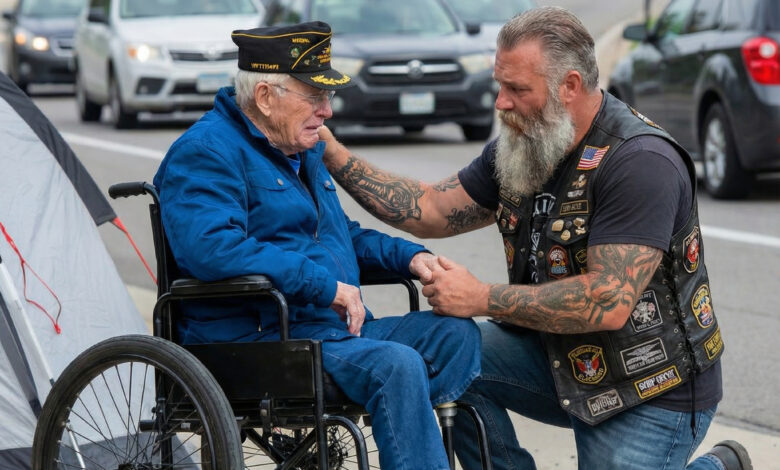
I was riding home from a memorial service when I spotted him—a lone figure in a wheelchair on the shoulder of Route 47, a sagging gray tent pitched behind him. Cars flew past without slowing. He held a cardboard sign on his lap: Homeless Vet. Anything Helps.
I almost rode on. Told myself the usual lie: someone else will stop. Someone with more time, more money, more strength to deal with what I assumed was another sad roadside story. But then I saw the hat. Vietnam Veteran.
My heart cracked. I braked so hard my tires squealed, killed the engine, and sprinted toward him.
The closer I got, the clearer his face became—sunken cheeks, weathered skin, eyes foggy with age and fear. And then recognition slammed into me so hard my knees buckled. I dropped right there on the pavement.
“Sergeant Morrison?” My voice shook. “Walter Morrison?”
He blinked slowly, confused. “Do I know you, son?”
“Sir, you saved my father’s life in ’69. You carried him three miles through the jungle under fire. Took shrapnel in your back for him.”
My throat closed up. The man who’d been my father’s hero was sitting alone on a highway, forgotten.
His eyes welled. “Jimmy Patterson’s boy?”
“Yes, sir. I’m Thomas. You held me when I was a baby. You spoke at my father’s funeral. Fifteen years ago.”
His frail body shook as he cried. “Tommy. I remember your daddy.”
I took his hands, horrified by how cold they were. “Why are you here? What happened?”
He stared down at the gravel. “My daughter… she put me in a nursing home three years ago. Said it was for the best. I didn’t fight her. Thought she knew what she was doing.”
He told me how he got pneumonia, spent two months in the hospital, and returned to find the nursing home had given his bed away. “My daughter said she had no room. Her husband didn’t want me there. Told me to go to a shelter.”
But every shelter was full. They handed him a tent, wished him luck, and pointed him toward a roadside spot where other homeless folks camped.
He’d been there nearly a month.
I stared at the flimsy tent, the endless highway, the dirt caked on his clothes. A 94-year-old veteran living like roadside trash.
“Sir, you’re coming with me.”
He tried to protest. I ignored him. Packed his belongings—barely anything. A small duffel. A box of medals. A photo of his platoon, my father young and grinning beside him.
I called my wife. She cried instantly.
“Bring him home,” she said. “I’ll make up the guest room.”
Next call was my club president.
“Brother, we’re on it,” he said. “Two hours.”
When I pulled into my driveway, twelve bikers stood waiting. Arms crossed. Eyes sharp. They’d brought food, clothes, medical supplies. A nurse in our club gently checked him over. A lawyer took notes, already preparing elder abuse filings.
“Why are you all doing this?” Morrison asked, overwhelmed.
One of the guys just said, “Because you’re a veteran. That’s all we need to know.”
Over the next week, the whole story came out. His wife of sixty-one years died eight years ago, and he never recovered. His daughter moved him in for a while, but her husband didn’t want him around. Too much work. Too much smell. Too old. So they dumped him in a nursing home. And when his hospital stay stretched too long, they stopped paying his bill.
He had nowhere to go. No one checking on him. No one who cared.
Except now he had us.
Two weeks after moving in, he told me something that hit harder than everything else.
“Your daddy saved my life too,” he said.
I thought he meant Vietnam.
“After the war,” he explained. “I came home broken. Couldn’t sleep. Couldn’t work. Couldn’t stop seeing the dead. I was ready to end it.”
He stared at the sunset through the porch railings.
“Your daddy showed up at my apartment. Don’t know how he knew. Sat with me for three days. Wouldn’t let me be alone. He kept saying, ‘Walt, you carried me out of hell. Now let me return the favor.’ He saved me, Tommy. More than once.”
I couldn’t breathe. My father had kept that to himself his whole life.
Sergeant Morrison stayed with us for fourteen months. They were the best months of his final years, he said. He became a grandfather to my kids. My brothers in the club built him a custom sidecar so he could ride with us. He wore our vest with pride.
His daughter never visited. Never called. Didn’t care that he was dying.
But our brothers cared. They showed up every day. Sat with him. Played cards. Told stories. Made sure he never felt alone again.
When the end came, he was surrounded by twenty-three bikers, my wife, my kids, and me. He held my hand and whispered, “Tell your daddy I’m coming. Tell him thank you.”
Then he slipped away.
His funeral was enormous. Veterans from three wars. A dozen clubs. Hundreds of strangers who’d read his story online. His daughter didn’t show.
We gave him the send-off he deserved—full military honors and a three-hundred-bike procession roaring behind his hearse like thunder.
I spoke at his funeral.
“Sergeant Morrison spent his final months with people who loved him,” I said. “Not because we were blood. But because we understood something his own family didn’t: Family is the people who show up. The people who carry you when you can’t walk. The ones who refuse to leave you on the side of the road.”
I still visit his grave every month. Talk to him like he’s still on my porch. Sometimes I talk to my father too. Tell him I finally understand what brotherhood means. What loyalty means. What it means to never leave a man behind.
A forgotten old soldier on the highway taught me all of that.
And I’ll spend the rest of my life trying to live worthy of the men who carried each other through hell—and back.