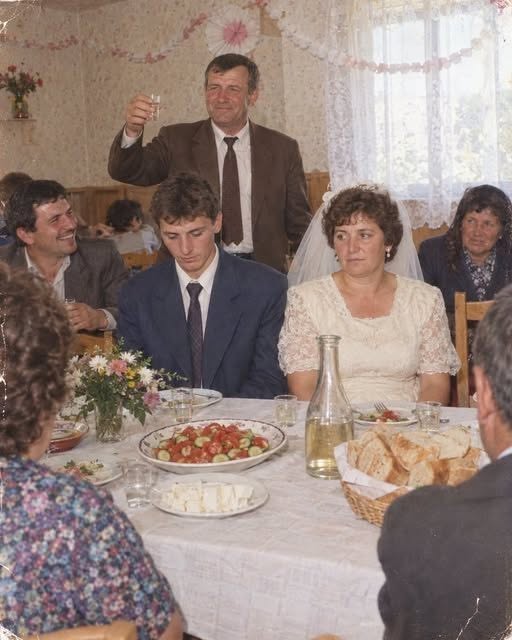
The date on the paper was: a week before my wedding. My father’s signature was clear, and right above it was my first and last name. For a moment, I couldn’t catch my breath. I read the first sentence. Then the second. In the end, I had to lean against the wall because my legs refused to obey me. The document was an agreement concerning the land belonging to Stojanka. In it, my father committed to transferring a specific amount in exchange for the right to use parts of her fields for the coming years. In return, I was to become Stojanka’s husband and work on her farm. However, it wasn’t the money that made my hands start to tremble. At the very bottom was an additional statement. It showed that my father had undertaken to cover his debts from the future income of the farm, even though he had no rights to it whatsoever. And next to it was a note written in a different hand: “The young man does not know the contents of this agreement. He has not been informed of his father’s obligations.” I read these words several times. For twenty-two years, I thought my father had forced me into the marriage because he considered me a failure who couldn’t take care of himself. Now I was beginning to understand that it was about something much worse. It wasn’t just about land. It was about debts. And about the fact that my father had found a way to pay them off with someone else’s life.
The letter hidden under the documents Beneath the agreement lay a small envelope. On its front, Stojanka had written my name. I recognized her handwriting. The letters were slanted, some almost invisible, as if her hand had been trembling while writing. I opened the envelope. “If you are reading this letter, it means I am no longer in this world. I do not know if you will feel relief, anger, or perhaps nothing but exhaustion. I have no right to dictate your feelings. But you have the right to know the truth.” I sat down on the crate. Stojanka continued to write.”Your father came to me even before I met you. He had debts and was afraid of losing the land, which he himself considered the only thing he could pass on to his son.
He presented you to me as a boy with no future, no money, and nowhere to go. He said you needed a home and I needed someone to work.
However, he didn’t tell me everything.
It was only later that I realized he had used our situation to secure his own interests.”
I clenched my fingers around the paper.
I remembered the day my father put Stojanka’s photo on the table. His confident voice. The complete lack of any discussion. The letter from the university that he took from me without a word.
Back then, I thought he was simply choosing the life for me that he wanted.
Now I knew he had his own motives.
But the next paragraph of the letter was even harder to read.
“I am not innocent. I agreed to this arrangement. I needed help on the farm, I was afraid of losing the land, and I didn’t want to admit to myself how much I feared loneliness after my husband’s death.
I could have refused. I could have demanded that you learn the truth first. I didn’t do it.
I was older. I should have known better.”
I stopped reading.
For twenty-two years, I had imagined Stojanka as a woman who accepted my father’s deal without a second thought. Sometimes she was kind to me, sometimes cold, and sometimes she said things that hurt more than the hard work.
Yet I had never tried to imagine what she herself felt.
This didn’t excuse what she had done.
But for the first time, I saw that our marriage wasn’t a story about one bad man and one innocent victim.
It was a story about people who allowed fear and self-interest to decide for someone else.
The real reason the chest was locked
Inside the envelope, there was one more document.
This time it was a notarial deed drawn up a few years after our wedding.
In it, Stojanka changed the entries regarding the farm. The land, the house, and the outbuildings were to remain her property until the end of her life. After her death, they were to be transferred to me, provided they were not used to pay off someone else’s debts.
This was not a promise that my father could change at will.
The document had been drawn up and certified in accordance with applicable formalities.
Beneath it was a short explanation.
“I don’t want you to stay here because you have nowhere to go. I want you to be able to leave if that is what you desire.
If you decide to stay, let it be your choice.
If you leave, I will hold nothing against youI pressed the letter to my chest.
For twenty-two years, I had waited for permission that no one ever had the right to deny me.
I waited for my father to stop being disappointed.
I waited for the debts to be paid off.
I waited for the farm to start turning a sufficient profit.
I waited until Stojanka wouldn’t need me anymore.
And now I was learning that, for at least the past few years, I could have left without losing everything I had worked for.
Why didn’t she tell me?
Why did she keep the documents locked in the chest for all those years?
I found the answer at the very end of the letter.
“I was afraid that if you knew the truth, you would hate me even more. And I, though I never knew how to tell you, had grown attached to you.
Not in the way a woman should grow attached to a man she married under such circumstances.
I grew attached to the boy who got up every dawn before sunrise, never complained about the cold, and never left the animals unattended, even when he was sick.
In time, I stopped seeing you as just a helper.
I began to see a man who had been robbed of his choice.
I didn’t know how to fix what had happened.”
I put the letter down.
I couldn’t cry.
Maybe because I was too tired. Or maybe because, over the years, I had learned to hide all my feelings so deeply that even I couldn’t find them anymore.