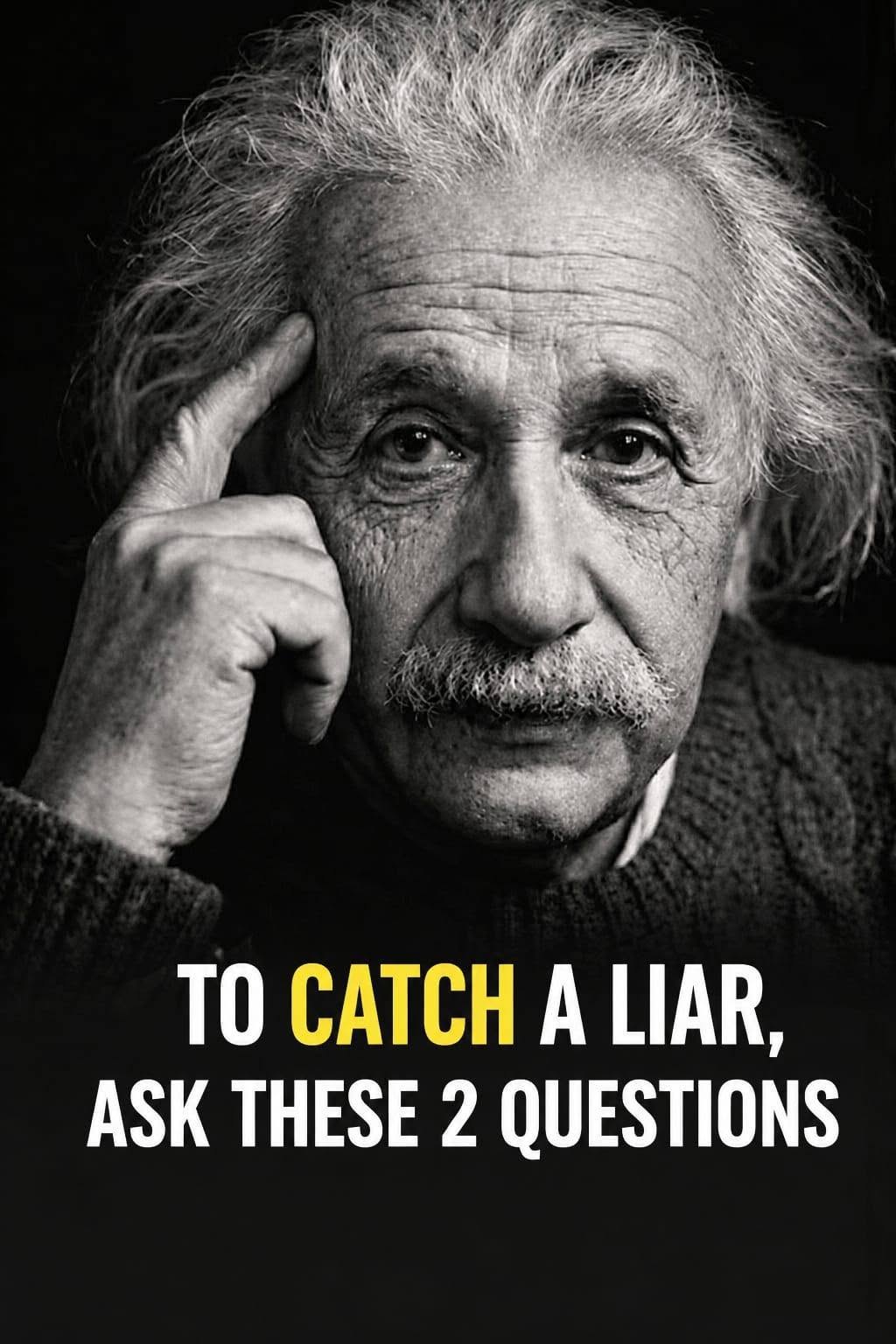
“To catch a liar red-handed, you only need to ask him two questions…”
This type of statement circulates widely on social media, but there is no proven historical evidence that Einstein ever said these exact words. His name is often invoked to legitimize modern psychological advice.
However, beyond this attribution, the idea is based on genuine principles of behavioral psychology.
To unmask a liar, ask them these two questions.
By the special editorial team | Psychology and communication
Detecting a lie does not depend on magical intuition, but on observing consistency.
Studies on deception show that lying requires more cognitive effort than telling the truth. A liar must:
Details of the invention:
Maintain temporal consistency.
Remember what he has already said.
Control your body language.
“Tell me exactly how it happened, step by step.”
When someone tells the truth, they generally remember events with a certain fluency, even if they forget minor details.A liar tends to:
Being too lazy
or excessively detailed in irrelevant parts.
Avoid a clear chronology.
Asking for a step-by-step reconstruction increases cognitive pressure.
Inconsistencies usually appear when the narrative needs to be structured.
2️⃣“What happened just before and just after?”
This is the key question.
Most lies concern the main event. What happens before and after is usually less prepared.
By extending the period:
Contradictions are detected.
Changes in the story.
Unusual hesitations.
Authentic memories generally include context. Lies focus on the essentials.
What NOT to do:
Don’t make direct accusations without evidence.
Don’t constantly interrupt.
Don’t look for “universal signs” like avoiding eye contact (this doesn’t always indicate a lie).
Effective detection relies on narrative inconsistencies, not isolated gestures.
An important warning:
No technique is infallible.
Some nervous people may give the impression of lying.
Some trained people can lie with great consistency.
The best tool is not aggressive confrontation, but patient observation.
Final thought:
This viral expression simplifies a complex process.
It’s not about capturing, but about understanding.
The truth tends to remain stable over time.
Lies require constant maintenance.
And when a story changes under the pressure of simple questions… it’s usually not by chance.