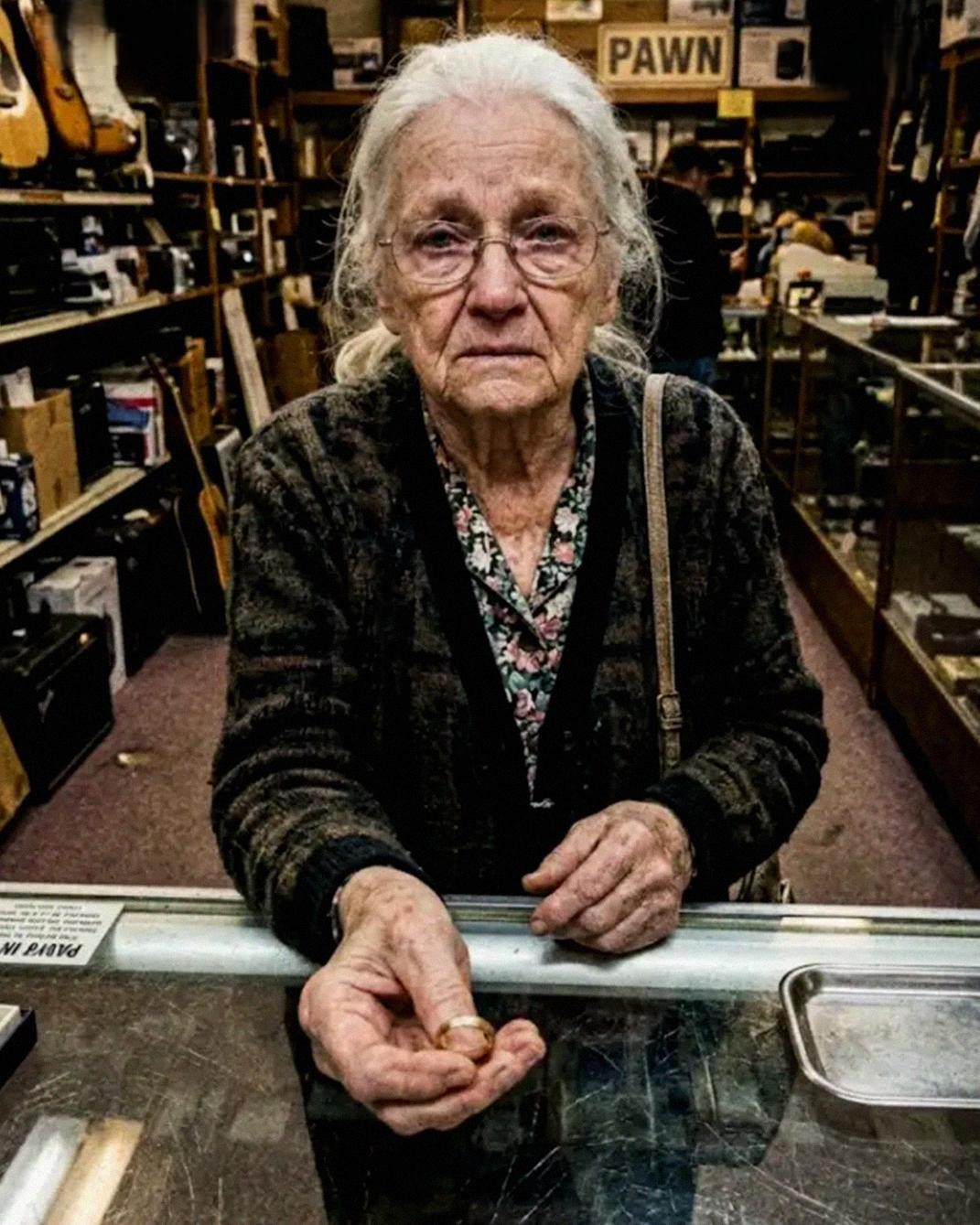
I work at a pawn shop on the outskirts of town, a place where the air is thick with the scent of old oil and the quiet desperation of people parting with their history. Most days follow a predictable, somber rhythm. Customers slide items across the scratched glass counter—items they once swore would stay in their families forever—and try to talk about them in a way that suggests they mean nothing at all. They look at their feet while I weigh their gold or test their diamonds, and I try to maintain a professional distance. But a few days ago, that distance collapsed the moment a bell chimed and an elderly woman stepped through the front door.
She was frail but carried herself with a quiet, regal dignity that didn’t ask for a single ounce of sympathy. That was precisely why she got mine. She walked up to the counter and offered a small, weary smile, placing a plain gold band on the glass. It was worn smooth, polished by decades of nervous rubbing, the kind of shine that only comes from a piece of jewelry that has lived through a lifetime of prayers and memories. When I asked if she was sure she wanted to part with it, her eyes dropped to her bare hand. She told me her electric bill was three hundred dollars overdue, and if she didn’t pay it by morning, her house would go dark.
I picked up the ring to begin a standard appraisal, tilting it beneath the harsh fluorescent lights. My breath hitched. Inside the band, a delicate, faded engraving stared back at me: O and E — Always. 1968.
For a moment, the shop disappeared. I was suddenly ten years old again, sitting on the floor of my grandfather Oscar’s den. I could see him clearly, turning the pages of his old notebooks filled with grocery lists and weather patterns. But scattered throughout those pages was a single letter—a recurring, lonely “E.” He never spoke her name, never told her story, and never married. He had raised me after my parents died, and in all those years, “E” remained the only ghost he allowed in the house.
I looked up at the woman, my heart hammering against my ribs. I asked her name and if she had ever known a man named Oscar. Her fingers gripped the edge of the counter as the color drained from her face. She whispered that her name was Eden and asked how I could possibly know that name. When I told her Oscar was my grandfather, she nearly collapsed. She hadn’t seen him since 1968. To her, he was the man who had supposedly abandoned her. To me, he was the man who had spent a lifetime mourning a missing piece of himself.
My boss, Neal, grumbled from the back about the shop not being a counseling office, but I didn’t care. I pulled up a photo of my grandfather on my phone—the one where he was half-smiling in his garden. Eden’s hand trembled as she covered her mouth, confirming that it was indeed him. She told me their story through tears. They had been young and in love; he worked at a feed store, and she worked at her aunt’s diner. They had planned everything, but her family intervened, deeming Oscar too poor for her. They had whisked her away to the city, telling her that if Oscar truly loved her, he would find her. When he never showed up, she assumed he had moved on. She spent the next five decades believing she wasn’t worth the effort of a search.
I knew that couldn’t be the truth. My grandfather was a man of silent, dogged devotion. I told Eden to wait right there and promised I would prove he never left her. I drove home like a madman, sprinting to the cedar cabinet in his old room. I grabbed a wooden box he kept wrapped in a flannel shirt on the highest shelf. Inside were dozens of letters, all addressed to “My beloved E.”
I raced back to the shop and laid the letters out on the counter. They were a chronicle of a man’s desperate, failed attempt to find his heart. One letter described how he had returned to the diner every day for weeks. Another detailed how he had ridden out to the city only to be lied to by her relatives. The final, unsealed letter was the most heartbreaking: “If you ever hear that I failed to come, I need you to know I tried until trying was all I had left.”
Eden read them with shaking hands, the weight of fifty years of misunderstanding finally lifting, replaced by a bittersweet grief. She realized that the version of her life she had lived—the one where she was the “discarded” girl—was a lie. They had both lived in parallel shadows, fueled by the same lost love.
But the reality of the present still lingered. Eden still had no power, and she still had no money. I looked at the eighty-seven dollars she had managed to scrape together and told her we were going to build a bridge. I called the utility company and fought for an extension, explaining the situation with a fierce persistence that wouldn’t take no for an answer. My boss, Neal, usually a man of stone, watched us from the register. Without a word, he pulled twenty dollars from his own wallet and tossed it onto the counter “for the bridge.” I covered the rest.
“Keep the ring, Eden,” I said softly, sliding the gold band back to her. She couldn’t even find the words; she just nodded, her silence speaking louder than any thank you.
As the sun began to set, casting long, copper shadows across the town, I drove Eden to the cemetery. We walked the gravel path to the old maple tree where my grandfather rests. When she saw the headstone—Oscar: Beloved Father, Grandfather, and Friend—she reached out as if to touch the granite, then pulled back, her shoulders finally breaking under the weight of the moment. She stood there for a long time, talking to the air, finally closing the loop that had been open since 1968.
On the drive back to her small white house, the atmosphere was different. The bitterness that had brought her into the pawn shop had been replaced by a fragile peace. She asked me if he had ever spoken of her. I told her that while he never used her name, he never forgot her; he grew the best roses on the street because they reminded him of the diner where they met.
Before she stepped inside her home, her ring back on her finger and the letters clutched to her chest, she invited me for tea that Sunday. She said my grandfather would be offended if we left things at a pawn shop interaction. She told me that for years, she thought her story was about being left behind, but it turned out her story was about finally being found. I watched her walk inside, knowing that while a lifetime had been lost to the wrong story, the truth had finally been returned to the people who deserved it most.