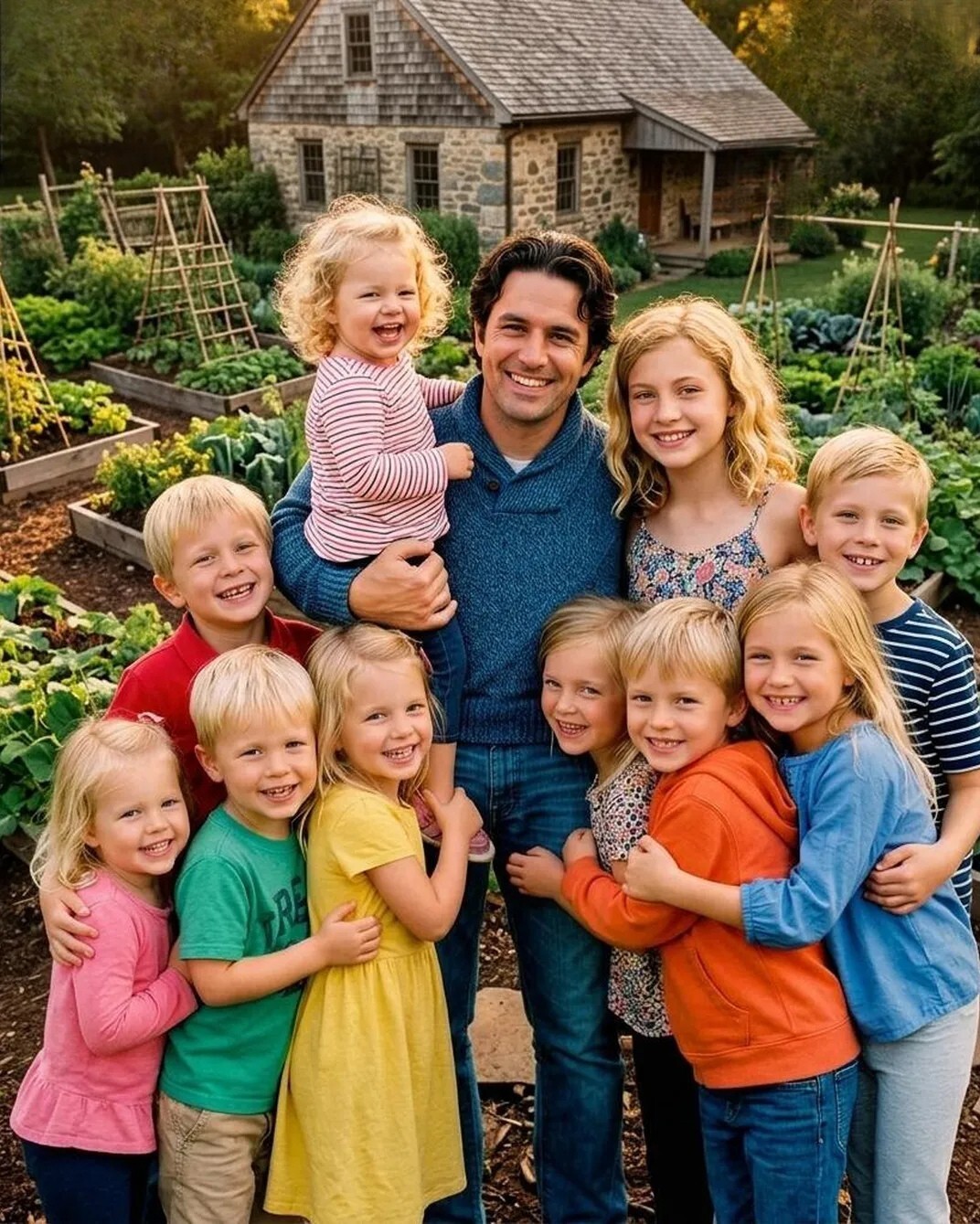
The morning ritual in our household was a symphony of survival. By seven o’clock, the air was thick with the scent of burnt toast and the frantic energy of ten different lives colliding in a single hallway. There were shoes that refused to be found, lunchboxes waiting to be filled, and the rising tide of sibling bickering that serves as the soundtrack to a family of twelve. At forty-four years old, I had become a master of this specific brand of chaos. For seven years, I had been the sole anchor for the ten children my late fiancée, Calla, left behind. Though we shared no biological bond, they were mine in every sense that the heart acknowledges. I had learned to braid hair with precision, to navigate the complexities of middle-school social wars, and to soothe the night terrors that occasionally gripped the younger ones. I believed that we had survived the ultimate tragedy. I believed that love had successfully filled the crater left by Calla’s death. But one evening in the quiet sanctuary of the laundry room, my eldest daughter Mara looked at me with eyes that were far too old for her nineteen years, and the foundation of our history began to crumble.
The narrative of Calla’s passing had always been a tragic, open-ended mystery. Seven years ago, her car had been discovered abandoned near the riverbank. Her purse sat on the passenger seat, untouched. Her coat was draped over a nearby railing, positioned as if to signal a desperate, final choice. At the time, Mara was only eleven. She had been found hours later wandering near the scene in a state of profound shock, her small face a mask of trauma. For years, she maintained a haunting consistency: she claimed she couldn’t remember a single detail of that night. With no body ever recovered, we eventually held a memorial service, buried an empty casket, and began the agonizing process of moving forward. I built our home around the saintly memory of a woman taken too soon, never imagining that the silence I was protecting was actually a lie designed to shield a coward.
As the dryer hummed in the background that night, Mara finally shattered the glass. She didn’t tell me how her mother died; she told me how her mother lived. Calla hadn’t drowned in that river. She had staged the entire scene with a cold, calculated precision. That night, she had spoken to an eleven-year-old child about crushing debts, the suffocating weight of ten children, and a desperate need to reinvent herself. She had looked her eldest daughter in the eye and commanded her to stay silent, telling her that if the truth came out, the family would be torn apart by the authorities. Mara hadn’t been suffering from amnesia; she had been suffering from a burden of shame that no child should ever be asked to carry. She had protected her younger siblings from the truth that their mother had simply decided they weren’t worth the struggle.
The heartbreak I felt in that moment was a new, jagged species of pain. It wasn’t the soft grief of a widower; it was the hot, white-hot fury of a father whose child had been emotionally hijacked. I held Mara while she sobbed, a decade of suppressed secrets finally pouring out of her. Then, she showed me the evidence that proved the nightmare was far from over. Calla was alive, and she had resurfaced. She had sent Mara a hidden envelope containing a letter and a series of digital messages. After seven years of silence, Calla was attempting to negotiate her way back into a life she had discarded. She spoke of regret, of mistakes made in a moment of “weakness,” and of a desire to see the children who were now strangers to her.
My first instinct was protective. Before responding to the ghost of my past, I sought ironclad legal counsel. Whatever Calla’s biological claim might have been, she had forfeited her moral right to these children the moment she used a child to cover her tracks. I needed to ensure that our home remained a fortress that she could not breach with mere apologies. When the day finally came for me to meet her in a quiet, neutral location, I didn’t see the vibrant woman I had once loved. I saw a woman who looked worn and hollowed out by her own choices. She tried to weave a narrative of desperation and second chances, begging for a way to “make things right.” But as she spoke, I could only see the face of eleven-year-old Mara, standing in the cold by a river, watching her mother walk away into a new life. Regret is a powerful emotion, but it is not a time machine. It cannot rewrite seven years of abandonment.
The most difficult task lay ahead: telling the other nine children. With the help of family counselors, I sat them down and delivered an age-appropriate version of the truth. I explained that their mother had made a choice that was deeply wrong, and that the “death” we had mourned was a fabrication. Most importantly, I gathered them around Mara. I made it clear that she was a hero, not a liar. I explained that she had been forced into a secret by an adult who should have been protecting her, and that she had carried that weight to keep them all together. The reaction was not what I expected. There was no anger directed at Mara. Instead, the younger siblings moved toward her, forming a physical circle of support. They realized that while their mother had left, their sister had stayed and suffered in silence to ensure they felt safe.
In the weeks that followed, the atmosphere in our house changed. The “quiet grief” that had always lingered in the corners was replaced by a raw, honest dialogue. We were no longer mourning a tragedy; we were navigating a betrayal. It was painful, but it was also strangely liberating. The truth had finally given us room to breathe without the weight of an artificial legacy. One night, as I was tucking in the youngest, Mara pulled me aside and asked what she should say if her mother ever reached out again, demanding to be recognized as their parent.
I looked at her and gave the only answer that held any weight in our world. I told her that giving birth is a biological event, but being a parent is an active, grueling, and beautiful choice that is made every single day. It is found in the three-o’clock-in-the-morning fevers, the science projects built at midnight, and the unwavering presence that survives even the hardest days. Calla had the title, but I had the life. We decided together that while the truth was a heavy thing to carry, it was the only thing that could set us free. We are a family built on the rubble of a lie, but we are stronger now than we ever were when we believed in a saint. We don’t need a ghost to return; we have each other, and that is the only championship that matters.