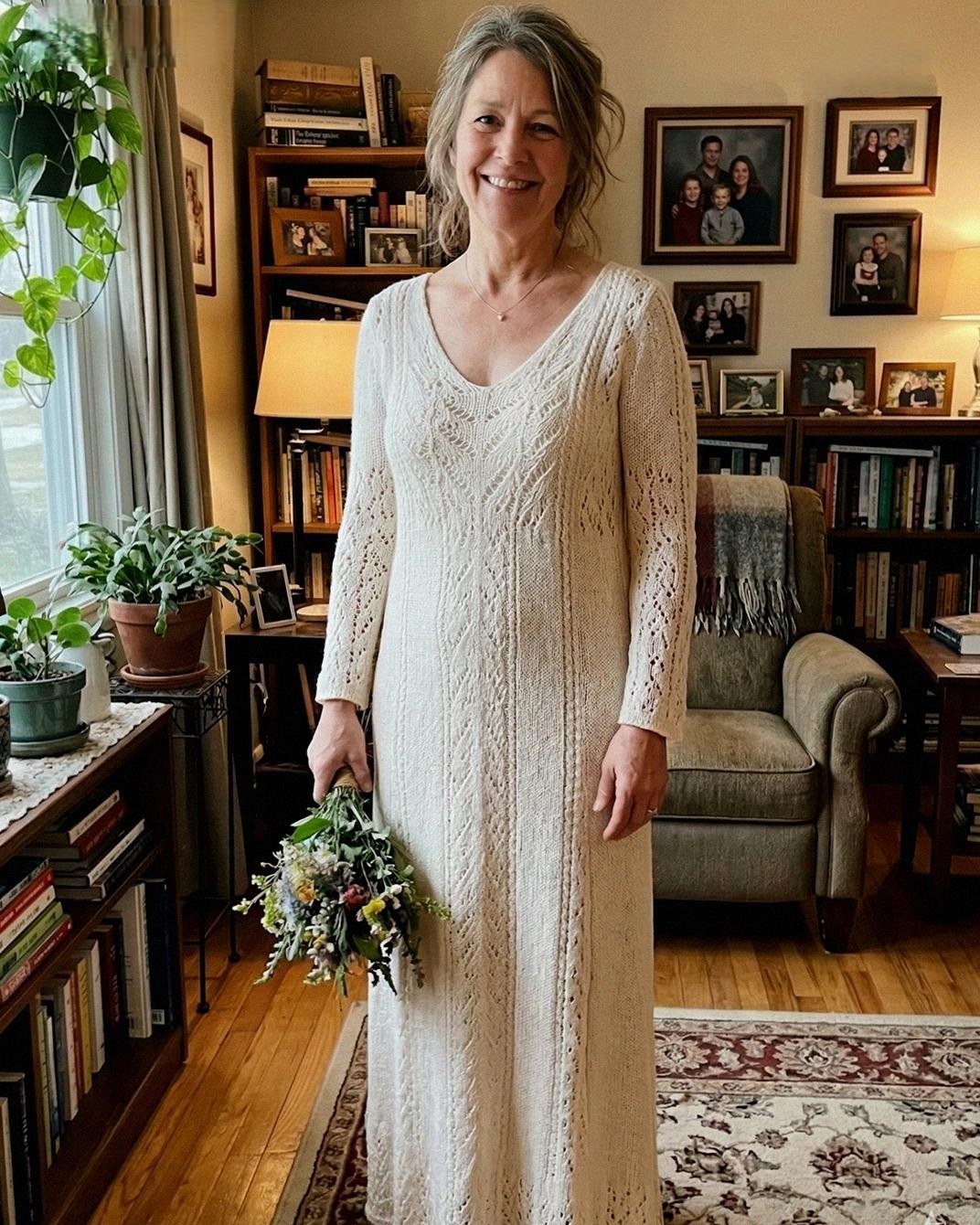
They say that after thirty years, a marriage is supposed to be a well-oiled machine, but for Janet and me, that thirtieth year felt more like a fraying tapestry. While I have always been the quiet type—the man neighbors call to fix a leaky pipe or jump-start a dead battery—I found myself facing a problem no toolbox could solve. Janet was fighting an exhausting illness, her strength waning as she spent her evenings curled on the couch. I needed a way to anchor my hope, to weave my devotion into something she could touch. So, in the quiet sanctuary of my garage, I picked up a set of knitting needles and began the most ambitious project of my life: her wedding dress.
For a year, I snuck away to the rhythmic clack of needles. I wasn’t just working with ivory yarn; I was knitting a record of our lives. I hid our children’s initials—Marianne, Sue, and Anthony—into the hem. I painstakingly recreated the lace pattern from the first curtains we bought for our studio apartment and mirrored the delicate scallop of her original wedding veil. Every stitch was a prayer for her recovery. When I finally laid the finished gown across our bed and asked her to marry me again, her tears told me she saw exactly what I had intended: a lifeline.
The ceremony was a sun-drenched dream, but the reception took a sharp, jagged turn. In a room filled with people we had known for decades, the dress became an easy target for those who mistake kindness for weakness. My cousin Linda’s voice cut through the soft clink of champagne glasses. “A toast to Janet for being brave enough to wear something her husband knitted!” she laughed, her eyes gleaming with a cruel sort of playfulness. “It must be true love, because that thing is as unflattering as it gets!”
The room erupted. My brother-in-law, Ron, chimed in, asking if I’d run out of money for a “real” dress. I tried to force a grin, playing the role of the good-natured handyman who could take a joke, but I felt my face flush. For thirty years, I had been the one who showed up at 2:00 AM to fix their plumbing or skip my own daughter’s birth to help with their emergencies. Now, those same people were using my labor of love as a punchline.
Janet didn’t let the laughter finish. She stood up, her hand smoothing the ivory yarn at her waist, and took the microphone. The room fell into a sudden, uneasy hush. “You’re all laughing because it’s easier than facing what this dress actually means,” she said, her voice steady and clear. “Tom made this while I was sick. Every row was hope. Every stitch is a memory.”
She scanned the room, her gaze resting on Linda and Ron. “You call him when your pipes freeze. He always shows up and never asks for a dime. Some of you think kindness is a weakness you can mock, but let me tell you what I see. I see the curtains from our first home. I see my first wedding veil. I see our children’s names.” She paused, her eyes welling with tears. “What’s embarrassing isn’t this dress, Linda. What’s embarrassing is being surrounded by people who know how to receive love but don’t know how to respect it.”
The silence that followed was heavy and deserved. The shame shifted away from the man with the knitting needles and settled squarely on the guests who had forgotten the value of a selfless heart. Janet set the microphone down, walked to the center of the floor, and whispered, “Dance with me, Tom.”
As we drifted together, the dress didn’t look like a “project” anymore; it looked like a masterpiece. Our children watched from the sidelines, their eyes filled with a new kind of pride. That night, we didn’t just renew our vows; we redefined what it means to be truly seen. I realized then that while some people spend their lives chasing grand, expensive gestures, I had spent mine building a fortress out of yarn, lace, and thirty years of never walking away.