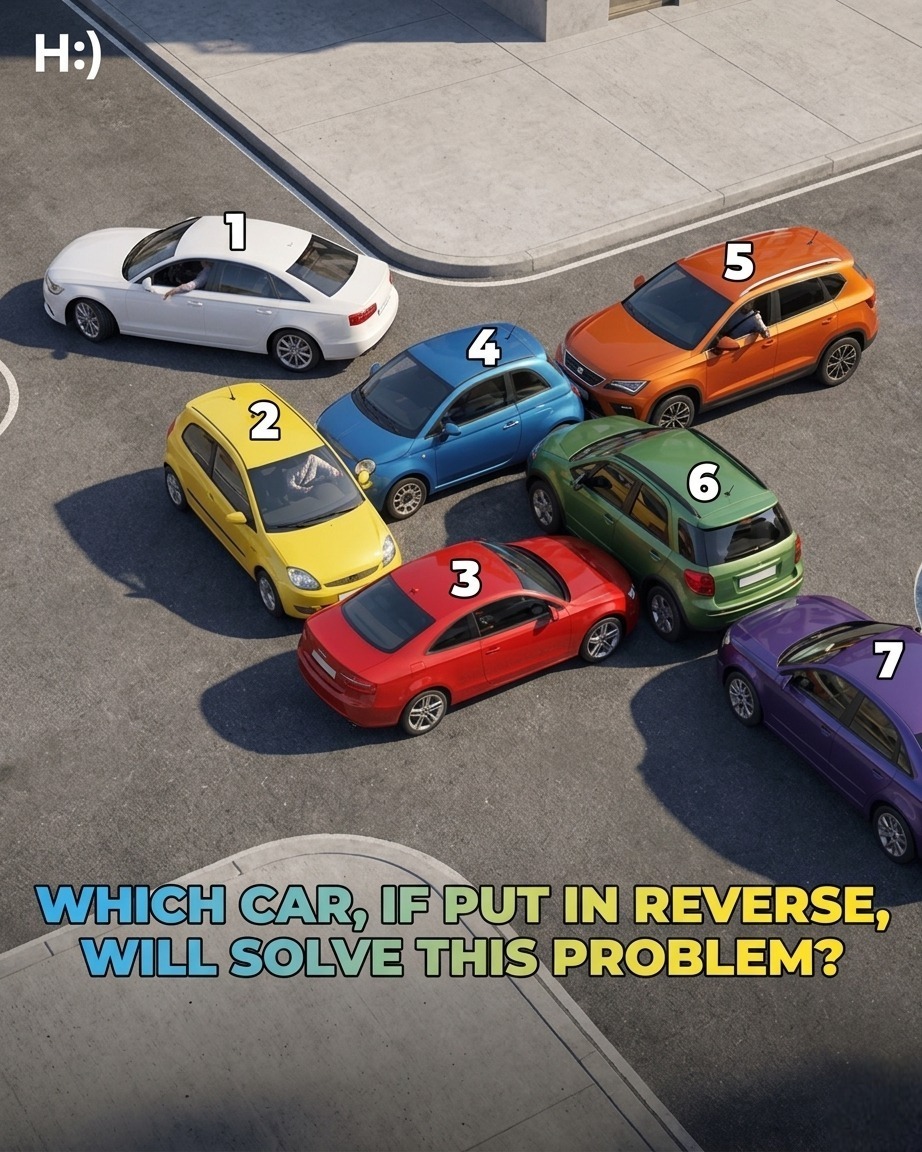
Traffic puzzles have long fascinated people, blending spatial reasoning, logic, and a touch of patience into a deceptively simple scenario. Among these, the classic “blocked car” or “gridlock” puzzle stands out as both a brain teaser and a lesson in strategic thinking. At first glance, these puzzles seem straightforward—after all, if a car is stuck in the middle of a tight arrangement, it must be the one you need to move, right? However, as many enthusiasts quickly discover, intuition often misleads in such situations. The challenge lies not merely in seeing which car is physically stuck but in recognizing which vehicle’s movement will initiate a chain reaction, gradually untangling the entire jam. In this context, the solution isn’t always the most visually obvious; instead, it requires analyzing the relative freedoms each vehicle possesses. For the puzzle under discussion, careful examination reveals that Car 4, the blue car, is the linchpin, the subtle but crucial piece that, when moved, creates the pathway for multiple others to follow.
To understand why Car 4 holds this key role, it is necessary to examine the positions and constraints of the surrounding vehicles. Imagine a parking lot or a tightly packed traffic grid: some cars appear blocked from almost all sides, while others seem to have a small pocket of space that allows minimal movement. Car 4 stands out because, although it is near the center of the congestion, it has enough room behind it to reverse slightly without colliding with other cars. This minor movement is deceptively powerful. While cars like 3, 5, or 6 may look tempting because they are more obviously “stuck,” attempting to move them first does not solve the gridlock; these cars are constrained on multiple sides, and shifting them alone does not generate usable space elsewhere. The brilliance of this puzzle lies in this exact misdirection: by focusing on the vehicles that seem blocked the most, a solver is tricked into thinking they hold the key, when in reality, it is the seemingly less obvious choice—the one with enough freedom—that sets the solution in motion.
Once Car 4 moves backward, the dynamics of the entire grid change dramatically. This initial step is analogous to pulling the first domino in a carefully arranged pattern. By moving Car 4, it creates immediate room for Car 2 and Car 6, which are currently occupying the central “lock” that prevents other vehicles from moving. Car 2, previously hemmed in by Car 4, can now shift forward or sideways depending on the puzzle’s layout, while Car 6 gains the opportunity to reposition, freeing adjacent lanes and creating a cascading effect. The genius of the puzzle’s design is in this chain reaction: a single, precise move unlocks a series of possibilities, demonstrating a principle that extends far beyond traffic puzzles. In real-world problem-solving, this mirrors the idea of focusing on leverage points—strategic actions that have outsized effects compared to their apparent simplicity.
A deeper analysis of why other cars cannot serve as the starting point further underscores the puzzle’s subtlety. Car 3, for example, is boxed in on multiple sides; attempting to move it first is ineffective because it cannot generate additional space for surrounding cars. Similarly, Cars 5 and 6, while visually tempting due to their central locations, are physically constrained by adjacent vehicles and walls or boundaries. Moving them first either results in no net gain or exacerbates the congestion. The puzzle challenges the solver to shift from a surface-level assessment—“Which car is blocked?”—to a higher-level understanding of freedom within constraints. It is this recognition that separates casual guessers from analytical thinkers, illustrating the cognitive skill of identifying the path of least resistance that unlocks complex systems.
Another fascinating aspect of this puzzle is the psychological dimension it exploits. Many solvers instinctively gravitate toward the cars that appear to be the most trapped. Human perception tends to overemphasize visual cues of blockage and underestimate subtle opportunities for movement. By contrast, Car 4 is not visually the most blocked; it has a sliver of open space behind it. This minimal freedom, however, is exactly what matters. It embodies a broader lesson in problem-solving: sometimes, the solution is hidden not in the most obvious difficulties but in the element that offers just enough leverage to set the larger system in motion. Cognitive biases, such as focusing on the most immediately constrained objects, are highlighted here, making the puzzle as much an exercise in psychology as in spatial reasoning.
Finally, the puzzle illustrates the importance of planning and foresight in sequential problem-solving. After moving Car 4, the solver must anticipate the subsequent moves—Car 2 and Car 6 follow, each creating additional space for Cars 1, 3, and 5 to gradually exit the grid. The correct solution is not a series of random attempts but a carefully orchestrated sequence where each move depends on the previous one, highlighting the interplay between immediate action and long-term strategy. This sequential planning mirrors real-world applications: whether in logistics, urban traffic management, or project planning, understanding which small, strategic actions will produce cascading benefits is a universally valuable skill. The puzzle, therefore, is more than a recreational brain teaser; it is a metaphor for systems thinking, demonstrating how a single well-considered choice can unlock complex chains of events, in conclusion the puzzle of moving the cars to resolve a gridlock teaches multiple layers of insight. It begins with recognizing that the most visually blocked cars are often not the solution. It then requires identifying Car 4—the vehicle with just enough freedom to initiate a chain reaction that unlocks the entire system. Through its cleverly designed constraints, the puzzle challenges solvers to think several steps ahead, consider leverage points, and overcome natural cognitive biases. More than just a game, it illustrates fundamental problem-solving principles: the power of small, strategic actions, the importance of sequence and foresight, and the value of looking beyond the obvious. By moving Car 4 first, solvers witness the elegant flow of logic and space, revealing that sometimes, the key to solving a complex puzzle lies not in brute force or intuition but in the subtle recognition of opportunity, strategy, and timing.