The sterile, fluorescent-lit corridors of the hospital usually provide a sense of predictable routine, but on a Tuesday morning at 11:42 a.m., that predictability vanished. As a nurse, I am accustomed to life-and-death stakes, yet the vibration of my phone in my scrub pocket felt like a physical blow. I was mid-shift, attending to a patient in room seven, when I saw the unknown number. Normally, I would have ignored it until my two o’clock break, but a cold prickle of intuition crawled up my spine. Excusing myself to the hallway, I answered, only to hear the steady, professional voice of Officer Benny from the local police dispatch. He didn’t offer details; he only offered a command: “Come home immediately. We have an important matter to discuss.”
The twenty-minute drive home was a blur of adrenaline and agonizing speculation. I am a single mother working double shifts to keep my two boys, seventeen-year-old Logan and two-year-old Andrew, fed and housed since their father passed away two years ago. In the absence of a partner, Logan had become my reluctant lieutenant, the one who picked up Andrew from daycare and managed the household while I traded my sleep for overtime. But Logan was a teenage boy in a world that rarely gave boys like him the benefit of the doubt. He had experienced two minor brushes with the law—a bicycle race gone wrong at fourteen and a skipped school day at sixteen—but those small shadows had cast long reflections in the eyes of the local precinct. I had spent years watching officers “recalibrate” their perception of him, waiting for him to slip so they could slot him into a pre-written narrative of delinquency.
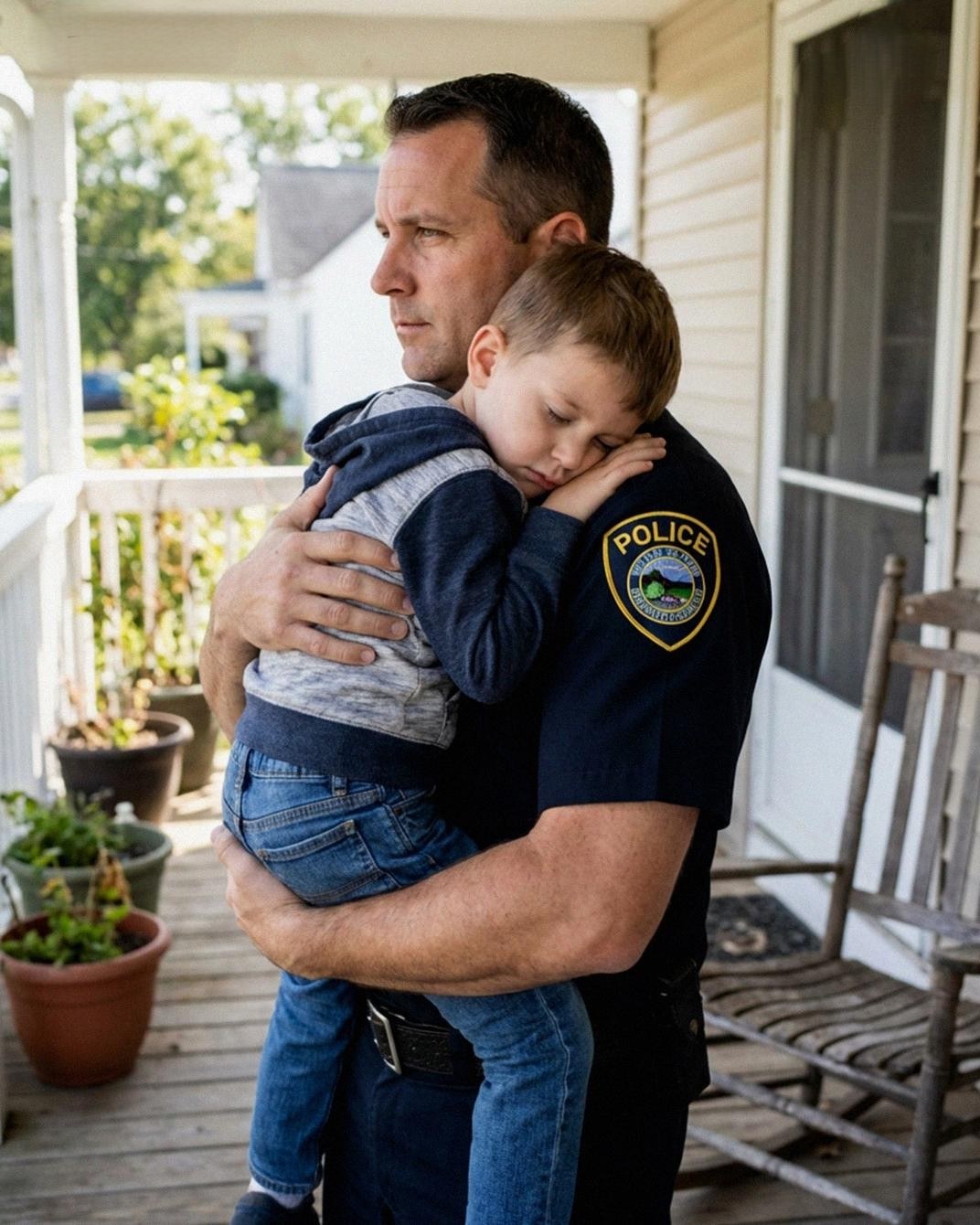
By the time I pulled into my driveway, I had convinced myself that the worst had happened. I expected to see Logan in handcuffs or the house cordoned off with yellow tape. Instead, the sight that greeted me was hauntingly domestic. Officer Benny was standing in the gravel, gently cradling my toddler. Andrew was fast asleep on the officer’s shoulder, his small fingers still clutching a half-eaten cracker. The relief of seeing my youngest safe was instantly replaced by a sharp, jagged fear for my eldest.
Inside the house, the atmosphere was thick with unspoken tension. Logan was standing by the kitchen counter, his knuckles white as he gripped a glass of water. He looked younger than seventeen in that moment—vulnerable and defensive, like a child who had broken a window and was waiting for the glass to stop falling. I demanded to know what he had done, my voice sharp with the exhaustion of a thousand worried nights. I was so prepared for a confession of guilt that I almost didn’t hear Officer Benny when he told me to calm down. “It’s not what you’re expecting,” the officer said, his voice softening.
As Logan stared at the floor, his fingers trembling, the true story began to emerge. It hadn’t been a fight, a theft, or a reckless joyride. Earlier that afternoon, Logan had taken Andrew for a walk around the block to see a neighbor’s dog. As they passed the home of Mr. Henson, an elderly man known for his kindness and his frail heart, Logan heard a heavy thud. Looking through the fence, he saw Mr. Henson collapsed on his porch, motionless.
In that split second, the teenager I feared was drifting away became the man our family needed him to be. Logan didn’t freeze. He gave his two-year-old brother a firm command to stay by the fence and not move an inch—a command Andrew followed with uncharacteristic solemnity. Logan then vaulted the fence and ran to the porch. He called 911, staying on the line with dispatchers while he checked Mr. Henson’s breathing and kept the man conscious through sheer force of will until help arrived.
Officer Benny, who had been on a routine patrol nearby, had seen Logan’s frantic sprint and stopped to assist. While one officer stayed with a bewildered Andrew by the fence, Benny and the paramedics tended to Mr. Henson. “If Logan hadn’t acted when he did,” Officer Benny said, looking me directly in the eye, “Mr. Henson would not have made it. Your son didn’t just help; he saved a life.”
The weight of those words caused me to grip the back of a kitchen chair to keep from collapsing. I thought about the countless nights I had lain awake wondering if I was failing as a mother, fearing that Logan was becoming someone I couldn’t reach. I had been so focused on the shadows—on what might go wrong and who he might become if I stumbled—that I had missed the light that was already there. My son wasn’t a problem to be solved; he was a partner in our survival.
Officer Benny reached into his pocket and pulled out his cap, preparing to leave. He reminded me of a conversation we’d had a month prior in the cereal aisle of the grocery store, where I had poured out my anxieties about Logan’s future. “You told me you didn’t know if you were handling it right,” he said. “I wanted you to hear this part of the story so you’d know you don’t need to worry as much as you do. He’s figuring it out. He’s becoming a man you can rely on.”
After the officer left, a profound silence settled over the kitchen. Andrew, now awake and sensing the shift in energy, padded over to Logan and wrapped his arms around his brother’s leg. It was a simple, wordless gesture of belonging. I stepped forward and pulled Logan into a hug, feeling the initial stiffness of a teenager surprised by affection, followed by the steady, grounding weight of him hugging me back. I told him I had thought I was the only one holding the family upright, but he looked at me with an honesty that was both heartbreaking and beautiful and said, “No, Mom. We both are.”
Later that evening, the chaos of the day subsided into a rare, peaceful quiet. Logan was at the sink, methodically rinsing the dinner dishes. As I sat at the table, I heard a sound I hadn’t realized was missing from our home for over a year: Logan was humming. It was a low, easy melody, a song of contentment that seemed to fill the cracks in our weary lives.
The exhaustion of working double shifts hadn’t disappeared, and the financial pressures of being a single parent remained, but the fundamental architecture of my world had shifted. For so long, I had been looking for signs of failure, watching my son for the first hint of a downward spiral. But that night, as I watched him work, I saw only strength. I saw a young man who had looked death in the face and chosen to act, a boy who protected his brother even in the midst of a crisis. I realized then that my boys were going to be more than just fine. They were going to be exceptional. The fear that had lived in my chest for years finally began to dissipate, replaced by a fierce, quiet pride. We weren’t just surviving; we were a team, and for the first time in a very long time, I knew we were going to make it.