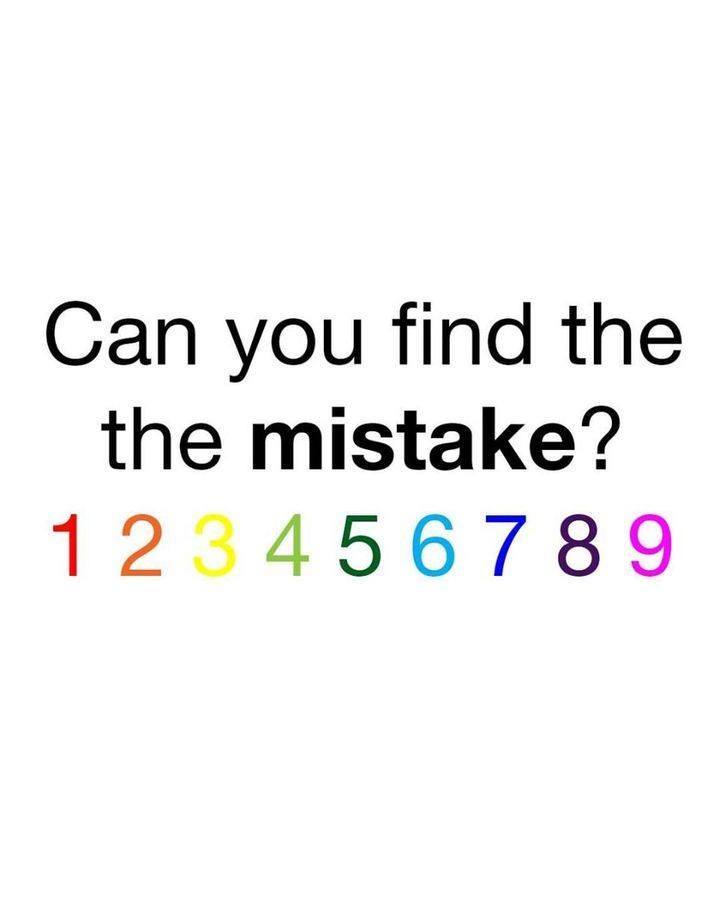
At first glance, the challenge looks incredibly simple. You see a short sentence asking a straightforward question: “Can you find the the mistake?” Beneath it appears a colorful sequence of numbers neatly arranged from 1 to 9. Everything looks clean, organized, and perfectly normal.
But the moment you begin examining it more closely, something strange happens.
Your brain pauses.
You stare at the numbers again. One… two… three… four… five… six… seven… eight… nine.
They appear correct. Nothing is out of order. Nothing seems missing. Nothing seems duplicated.
And that’s when many people do something they never expected to do while looking at such a simple puzzle.
They start counting on their fingers—just to be absolutely certain they didn’t miss anything.
It’s a small moment, almost humorous. But it reveals something fascinating about the way the human brain processes information, solves puzzles, and occasionally falls for clever tricks.
This tiny challenge may look simple, but it’s a brilliant example of how our minds can overlook obvious details while searching for something more complicated.
Why Simple Puzzles Can Feel Surprisingly Difficult
When people encounter puzzles like this, they often assume the answer must involve something complicated. After all, if someone asks you to “find the mistake,” your brain immediately starts searching for something hidden or unusual.
Maybe one of the numbers is out of order.
Maybe one number is repeated.
Maybe a color doesn’t match the pattern.
Your brain begins scanning the numbers carefully, comparing each one to the next.
But the truth is that many puzzles rely on something much simpler: our tendency to overlook the obvious.
Instead of hiding something complex, the puzzle designer often places the mistake in plain sight.
And that’s exactly what happens here.
The Numbers Look Perfect
Let’s examine the sequence beneath the question.
1 2 3 4 5 6 7 8 9
At first glance, everything appears exactly as it should be. The numbers are arranged in perfect numerical order. Each digit appears only once. There are no gaps or duplicates.
This is why many people immediately begin counting again, sometimes even whispering the numbers under their breath.
Some people even double-check by counting on their fingers:
One… two… three… four… five… six… seven… eight… nine.
Still correct.
So where is the mistake?
The Brain’s Natural Assumptions
When people read text quickly, their brains don’t process every word individually. Instead, the brain recognizes patterns and fills in gaps automatically.
This ability allows us to read quickly and efficiently. Without it, reading would take far longer because we would need to analyze every single letter and word.
However, this shortcut sometimes causes us to miss small details.
Our brains assume certain things are correct, so we skip over them without noticing.
In puzzles like this one, that assumption becomes the trap.
The Real Mistake
The error isn’t hidden in the numbers at all.
It’s in the sentence above them.
Look carefully at the question again:
“Can you find the the mistake?”
Did you notice it immediately?
Most people don’t.
The word “the” appears twice in a row.
It says “the the mistake.”
This tiny duplication is the actual mistake the puzzle is asking about.
But because the numbers draw your attention first, many people completely overlook the repeated word.
Why Your Brain Missed It
This happens because your brain expects the sentence to be correct.
When we read quickly, we often process phrases as a whole rather than examining each individual word.
Your brain likely interpreted the sentence as:
“Can you find the mistake?”
Even though the extra “the” was right there.
This phenomenon is known as automatic reading processing. Our minds prioritize meaning over exact wording, which makes reading efficient but occasionally leads to small oversights.
Why the Numbers Are a Distraction
The colorful numbers in the puzzle are not actually the source of the mistake. Instead, they serve as a clever distraction.
By presenting something that looks like it might contain an error, the puzzle directs your attention away from the sentence.
Your brain becomes focused on checking the numbers rather than examining the text.
This technique is commonly used in riddles and brain teasers.
The puzzle encourages you to search in the wrong place.
The Psychology Behind the Trick
Puzzles like this exploit several well-known cognitive tendencies.
Pattern Recognition
Humans are excellent at recognizing patterns. When we see a sequence of numbers, our brains immediately look for irregularities.
This makes us focus intensely on the numbers rather than the surrounding text.
Expectation Bias
When someone asks you to find a mistake, you assume it will be hidden somewhere unusual or complicated.
As a result, you overlook simple possibilities.
Selective Attention
Your brain can only focus on a limited amount of information at once.
Because the colorful numbers draw attention, the repeated word becomes less noticeable.
Why People Start Counting
The moment people realize they might have missed something, they often begin verifying the numbers.
Some people count silently.
Others count out loud.
And many people—often with a smile—admit they started counting on their fingers just to be sure.
This reaction is completely natural.
When our brains detect uncertainty, we instinctively switch to more deliberate reasoning methods.
Counting on fingers may seem childish, but it’s actually a very effective way to confirm a result.
Finger Counting Is More Common Than You Think
Even adults rely on finger counting more often than they realize.
Researchers studying how people perform basic arithmetic have discovered that the brain maintains a strong connection between numerical thinking and physical finger awareness.
In fact, the parts of the brain responsible for finger movement are closely linked to those used for numerical processing.
This means finger counting isn’t just a childhood habit—it’s a natural cognitive tool.
Many adults simply perform it mentally rather than physically.
Why These Puzzles Are So Popular
Short puzzles like this spread quickly online because they trigger curiosity.
People see the challenge and immediately want to test themselves.
If they solve it quickly, they feel clever.
If they miss the answer at first, they laugh at how simple it was.
Either way, the puzzle creates an engaging experience.
These small moments of surprise and realization are exactly what make brain teasers enjoyable.
The Satisfaction of Solving It
The moment you finally notice the repeated word, everything clicks.
You realize the puzzle was never about the numbers at all.
The answer was right in front of you from the beginning.
This moment of realization often produces a mix of amusement and mild embarrassment.
You might think:
“How did I miss that?”
But that reaction is part of what makes puzzles fun.
They remind us that even the smartest people can overlook small details.
A Lesson in Paying Attention
Beyond entertainment, puzzles like this also highlight an important lesson.
They remind us to slow down and observe carefully.
In everyday life, we often rush through tasks, conversations, and written information.
Because our brains rely on shortcuts, we sometimes miss small but important details.
Taking a moment to double-check—whether by rereading a sentence or counting on your fingers—can prevent simple mistakes.
The Value of Curiosity
Another reason these puzzles are valuable is that they encourage curiosity.
Instead of passively consuming information, you actively engage with it.
You analyze, question, and verify.
This process strengthens critical thinking skills and keeps the mind sharp.
Even simple puzzles can provide a small workout for the brain.
Why Everyone Falls for It
If you didn’t spot the repeated word immediately, you’re far from alone.
In fact, most people miss it the first time they see the puzzle.
That’s because the trick relies on universal features of human cognition.
Our brains evolved to process information quickly, not perfectly.
The ability to skim and interpret text efficiently is incredibly useful—but occasionally it allows small errors to slip by unnoticed.
The Humor in Human Thinking
Perhaps the best part of puzzles like this is the gentle reminder that our minds are wonderfully imperfect.
We pride ourselves on intelligence and quick thinking, yet a tiny repeated word can fool us completely.
And sometimes, the only way to confirm our answer is to quietly count on our fingers.
That moment of humility is part of what makes learning and problem-solving enjoyable.
Final Thoughts
At first glance, the challenge seemed to be about numbers.
But the real trick was hidden in the wording all along.
The repeated word “the” in the sentence “Can you find the the mistake?” is the true error.
The colorful numbers simply served as a distraction to draw your attention away from the obvious.
If you found yourself checking the numbers repeatedly—or even counting on your fingers—you’re not alone.
That reaction shows your brain was doing exactly what it was designed to do: analyze, verify, and search for patterns.
And sometimes, the path to the answer involves a few extra finger counts along the way.