Riddles and logic puzzles continue to captivate people worldwide, offering both entertainment and cognitive challenges. They’re not just fun but also stimulate the brain, encouraging reasoning, observation, and even intuition. Below are five intriguing puzzles that show how seemingly complicated situations often have straightforward solutions. Ready to think outside the box?
The Man Surrounded by Danger
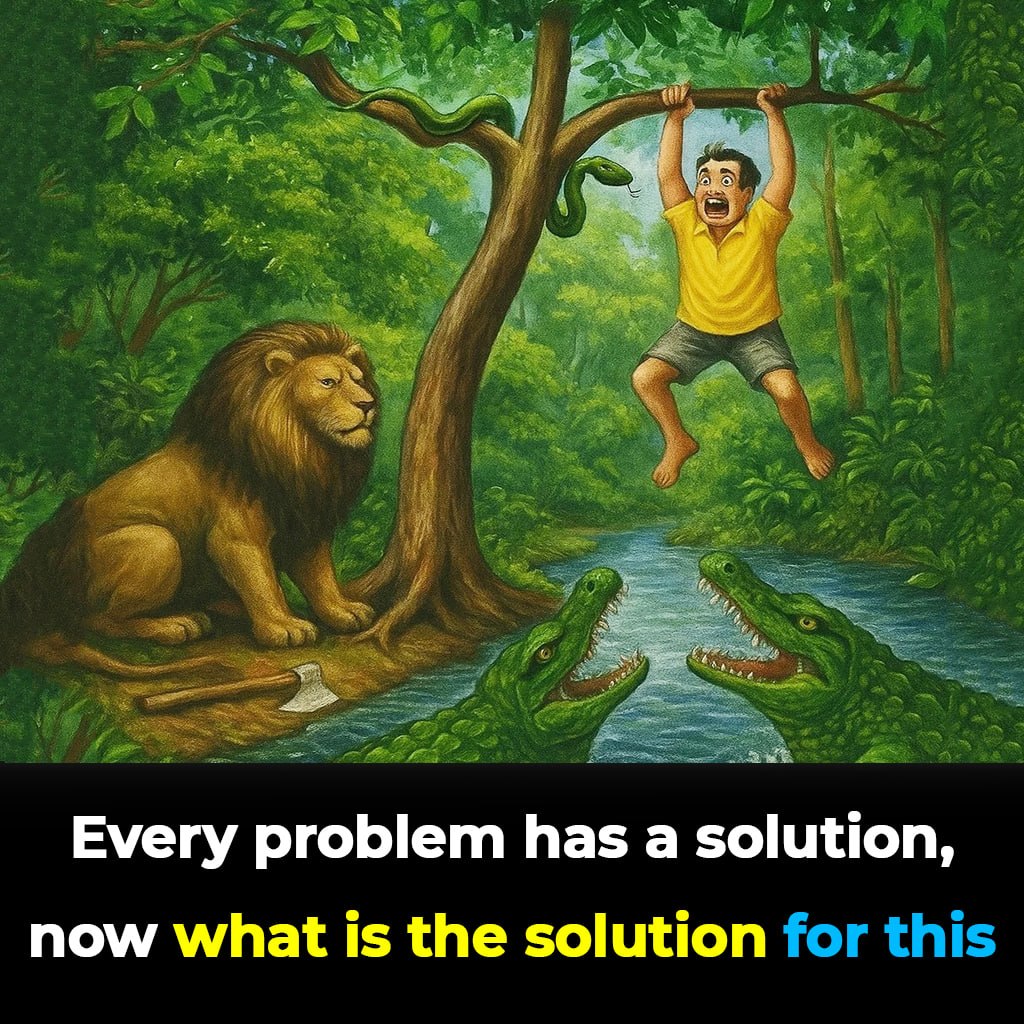
In this riddle, a man finds himself surrounded by imminent dangers. A snake is poised to strike to his right, a tree on his left threatens to fall into a lake filled with crocodiles, and a lion lurks nearby. Initially, there seems to be no escape, but the key is patience. Over time, the lion moves toward the lake to drink, distracting the crocodiles. This moment of distraction allows the man to slip away unnoticed. The lesson here is that sometimes, survival is more about timing and calm than reacting quickly or forcefully.
A Clock You Cannot Touch
A man stands under a clock that is stuck at 12:30. It’s out of his reach, and he has no tools to fix it. All he has is a mirror in his pocket. Despite the challenge, the man manages to reset the clock without touching it. The trick is in using the mirror to reflect the face of the clock. By mentally flipping the numbers, he calculates how far off the clock is and waits for the correct time to align with what the broken clock shows. This puzzle is a great example of how thinking creatively and working smarter can solve problems without needing direct action.
Truth or Lie at the Crossroads
A girl arrives at a fork in the road where one path leads to safety and the other to danger. There are two stones—one labeled “Truth” and the other “Lie.” She is told that only one stone tells the truth but not which one. With no ability to ask questions, she must decide which path to take. This riddle presents a paradox. If the “Lie” stone were truthful, it would be lying. If the “Truth” stone were lying, it wouldn’t be true. Realizing this, the girl ignores the stones and chooses the more worn path, relying on observation rather than logic. Sometimes, simple observation offers a clearer solution than complicated reasoning.
The Case of the Missing Umbrella
A man leaves his umbrella by a bench in a park. Despite facing the bench and seeing no one approach, the umbrella mysteriously disappears. The riddle seems puzzling until we consider the possibility of environmental factors. The answer? A gust of wind likely carried the umbrella away while the man was distracted. This puzzle reminds us that not all riddles involve trickery—sometimes, the answer lies in natural forces, which we might overlook in the moment.
A Locked Room with No Lock
In this puzzle, a room has no windows, a bolted door, and a key lying on the floor. The man seems trapped with no clear way out. However, a closer inspection reveals a simple escape: the bolt is merely decorative, and the key serves no purpose. There’s no lock to open—the door can simply be pushed and walked through. This riddle highlights how overthinking can be more of a barrier than any physical lock.
Misleading Labels and Mental Loops
The crossroads riddle illustrates how our brains interpret contradictory information. When labels and rules don’t align, our minds struggle to trust basic facts. The girl in the puzzle overcomes this mental loop by disregarding the misleading words and instead relying on observable facts. The message here is clear: when logic collapses, trusting your senses and what you can see can lead to a better solution.
When Nature Becomes the Answer
The missing umbrella puzzle emphasizes that not all problems are human-made. In a world full of distractions and misdirection, it’s easy to assume something is deliberately hidden or taken. This riddle redirects our focus to environmental factors, which can be just as influential as human actions. It teaches us to be mindful of nature’s role and not to underestimate the forces beyond our control.
Escaping the Obvious Trap
The locked room puzzle plays on false assumptions. At first glance, it seems like the key and bolt are necessary to escape. However, the real trick is realizing that everything in the room is an illusion. The door isn’t locked, and simply pushing it open reveals the simplicity of the solution. This riddle serves as a metaphor for many challenges in life, where we often perceive barriers that don’t actually exist. All we need is the confidence to try the obvious solution.
Lessons Hidden in Every Puzzle
Each of these riddles offers valuable lessons, whether about patience, logical thinking, environmental awareness, or trusting our instincts. They show how easy it is to overlook simple solutions when we’re caught up in complex scenarios. Perhaps the most important takeaway is that creativity, calm thinking, and a willingness to challenge what seems obvious can often lead to the best outcomes.