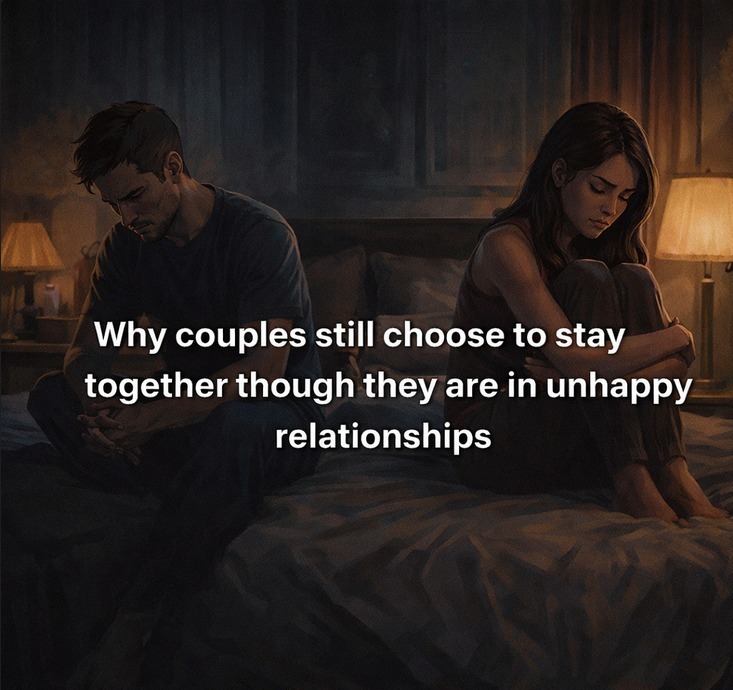
What makes you stay in a relationship that’s lost its spark? Is it a fear of being single, or a reluctance to plunge back into Bumble? Could you be unwilling to share custody of your Maltipoo puppy, Steven? According to a study published in the Journal of Personality and Social Psychology, the motivation is often a bit more selfless than that. Research led by psychologist Samantha Joel found that people frequently consider how dependent their partners are on the relationship before deciding to break up with them. Why don’t people leave unhappy relationships? Often, it’s because they don’t want to break their partner’s heart.
Researchers from universities in the U.S. and Canada (the University of Utah, Wayne State University, the University of Toronto, and the University of Toronto, Mississauga) conducted two studies to understand the motivations behind staying in an unsatisfying relationship. The first tracked 1,348 participants in relationships over 10 weeks. After completing a survey on how invested they believed their partner was in their relationship, the participants answered weekly questions about whether they were still together. In the second study, 500 subjects who were considering breaking up with their partner answered questions on why they were reluctant to end the relationship; two months later, they were asked whether they were still with their partner.
The study’s conclusion? “The more dependent people believed their partner was on the relationship, the less likely they were to initiate a breakup,” Joel said. While previous studies have demonstrated the role of self-interest in remaining in an unfulfilling relationship, Joel’s study indicated an “altruistic component.”

“When people perceived that the partner was highly committed to the relationship they were less likely to initiate a break up,” Joel added. “This is true even for people who weren’t really committed to the relationship themselves or who were personally unsatisfied with the relationship. Generally, we don’t want to hurt our partners and we care about what they want.”
Previous studies have flagged up a different force that compels people to stay in unhappy relationships: the sunk cost effect, or sunk cost fallacy. As Stylist reports, a 2016 study by researchers from the University of Minho, Portugal, concluded that people are more likely to stay in a relationship in which they’ve invested time, effort, or money. This exemplifies the sunk cost effect, which “occurs when a prior investment in one option leads to a continuous investment in that option, despite not being the best decision.” Essentially, you might stay in a relationship you’re dissatisfied with because you don’t want to feel the effort you put into it has gone to waste.

The first experiment of the study, published in Current Psychology, found “the likelihood of participants staying in the relationship was higher when money and effort, but not time, had been previously invested in that relationship.” A subsequent experiment found that “participants were willing to invest more time in a relationship in which more time had already been invested.”
Reluctance to squander a perceived investment or fear of being single might seem like less compassionate reasons to remain in a relationship than concern for your partner’s welfare — but as Samantha Joel points out, it might not be kind to defer a breakup to avoid hurting your significant other. “Who wants a partner who doesn’t really want to be in the relationship?” she said. What’s more, it’s vital not to valorise self-abnegation over your own wellbeing — after all, your happiness is just as valid as your partner’s.
The “48-Hour Rule” Is A Game-Changer For Relationships
It’s been a week and you’re still stunned that your partner had the audacity to watch the latest episode of Traitors without you. They know you love the show. You usually watch it together. Why would they betray you like this?
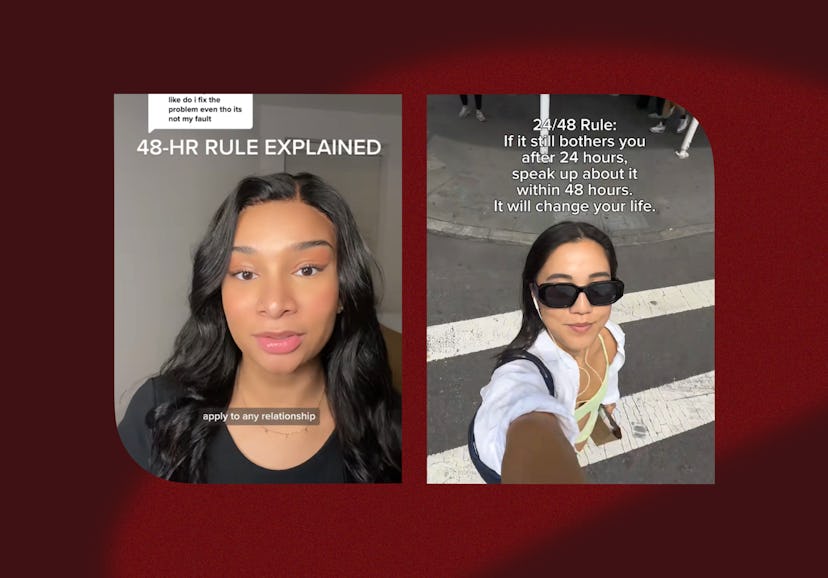
Though it seem like a reasonable reaction, some people on TikTok have advice for you: You have two days to get over it.
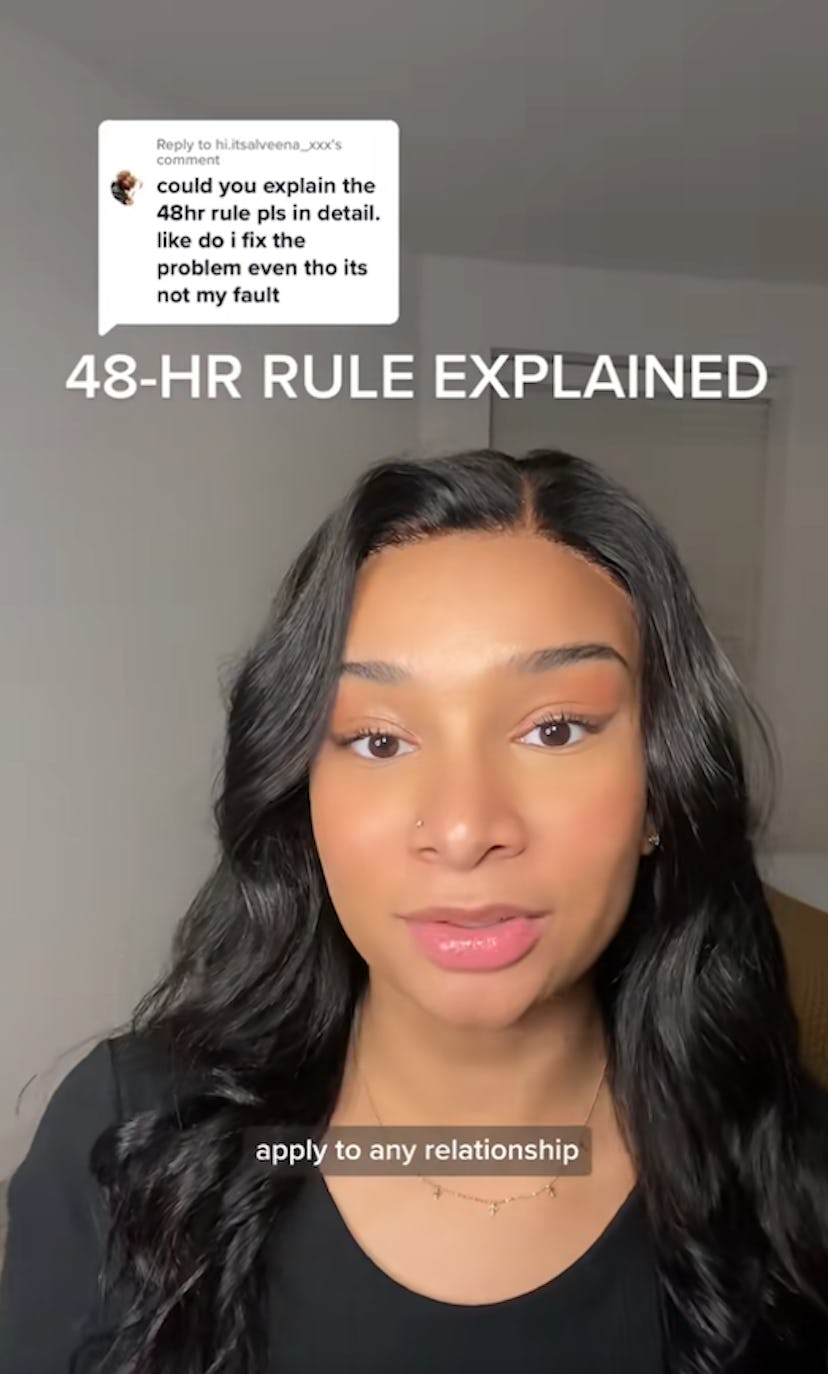
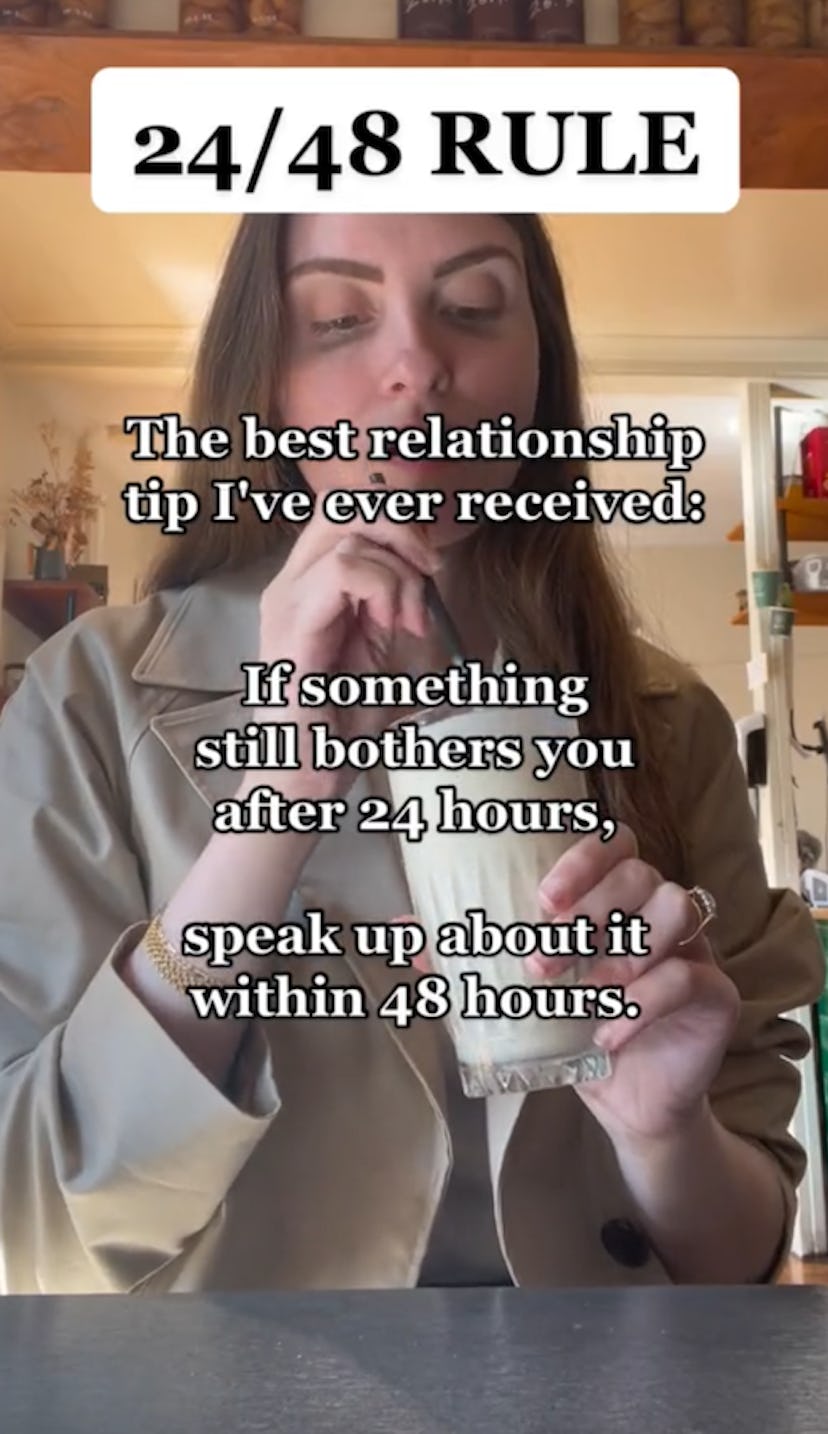
The viral “48-hour rule” suggests a time limit for bringing up these types of issues within your relationship. “You have 48 hours to reflect on it and address it, or you let it go,” said creator @taneamariee. If you don’t bring it up within that time period, you move on.
This rule is designed to keep your personal life running smoothly. Under the video, one commenter wrote, “That’s a good way to make you more assertive and vocal about your needs. I think this will really help passive aggression.” In the Traitors situation, you would tell your partner that you were upset, and then ask to watch all future episodes together. Speaking up and asking for a game plan can help you stop stewing.
While this rule doesn’t apply as seamlessly to larger issues, it’s a nice reminder to address everyday problems before they get blown out of proportion. Here’s why relationship experts love this hack.
Why The 48-Hour Rule Works
According to Jerilyn Adams, LPC, a therapist and owner of Totality Counseling, it’s not uncommon to keep things to yourself when you’re upset, especially in relationships.
Whether you’re still processing, trying to play it cool, or hate conflict, you might let annoyances slide for days or weeks at a time. “It’s not fun to have tough conversations, and it can sometimes feel like it’s easier not to say anything in the moment,” she tells Bustle.
The thing is, when you don’t address problems as they happen, resentment can start to build. “A lot of time the same or similar issues can continue because the other person doesn’t know it’s a problem,” she says. “And even if the issue doesn’t repeat, things can get stuck with us if we don’t address them.”
Resentment can eventually show up as passive-aggressive comments, anger, or feeling like your needs aren’t being met, and it doesn’t bode well for your connection.
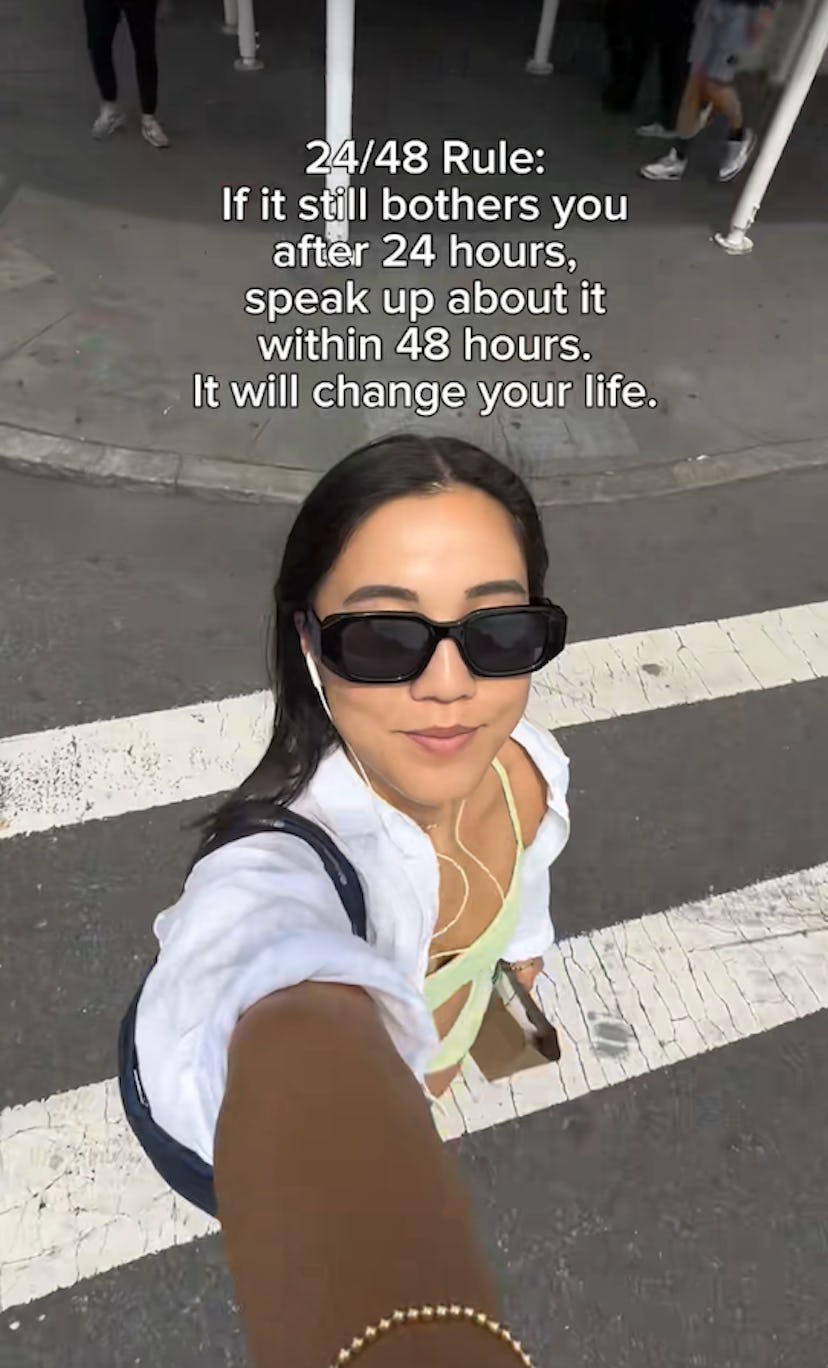
“The 48-hour rule can help because it pushes you to take time to get clear on how you feel in a timely manner so that you can share it,” she says. If you don’t address the issue in the exact moment, that’s fine. This is about giving yourself a beat to process why you’re upset. You might relax and realize it’s no big deal. Or you might hone in on exactly what you need to explain. A quick, “Hey, about the other night…” is often all it takes to clear things up.
Waiting longer than 48 hours can mean forgetting important details or misremembering exactly what happened. By keeping your complaints within this window, you can have a concise chat, nip it in the bud, and move on before things get worse than they need to be.
According to @jfabfindingauthenticity, this hack also prevents you both from bringing up things that happened six months ago at seemingly random moments. Pretending everything is fine is tends to mean it’ll come pouring out during an unrelated argument six months down the line. The 48-hour rule helps prevent that.
When To Give It A Try
To address what’s nagging you, Adams recommends bringing it up during a casual chat. “This doesn’t have to be a ‘we need to talk’ situation,” she says. “Weaving it into a more normal conversation is more disarming and collaborative.” Share what felt off and what you’d like to change. Your partner will likely be glad you said something.
Not sure how to put your thoughts into words? “Journaling is a great way to reflect and process things when you are unsure of exactly how you feel about something,” Adams says. “If you happen to have a therapy session falling during this time, that’s a great way, too.”
If the 48-hour window passes, that’s your cue to take a deep breath and truly let it go. If you don’t want to talk about it, release it from your mind. It likely wasn’t that big of a deal, and you deserve to move on. Spare yourself the mental replays.
The only time the 48-hour rule doesn’t apply is for bigger issues that often take longer to process. “This rule is a good thing to aspire to, but definitely wouldn’t work in every single situation,” Adams says. Some problems require more thought, longer chats, and serious reflection, and in those cases, it’s OK if you can’t forget about or resolve it all in 48 hours.
Otherwise, though, quick, concise communication is key.
Being Busy Is Hot, Actually

If you’ve ever tried to “make time” for dating, don’t bother. And while you’re at it, you can forget about checking your texts and DMs regularly, too. According to a recent viral TikTok, it’s way more attractive to be booked and busy.
In a Jan. 15 post, @stevecole__ said, “I want to date someone who’s too busy to date me.” He went on to say, “If you have all day, every week, to date someone, you probably don’t have enough going on in your life.” It felt like he was looking for the protagonist from Sabrina Carpenter’s song “Busy Woman” in real life.
Instead of only focusing on dating, @stevecole__ said he likes it when someone’s focused on becoming the best version of themselves, whether that means growing a business, training, etc. “People are looking for their own happiness in someone else,” he added. “I want someone who has their own happiness, and then I’m just an addition to that.”
In his comments, people chimed in to say they felt the same way. One woman wrote, “Exactlyyyy, I will never text someone 24/7.” Others felt a sense of relief: “My calendar is STACKED until April already and I was like, ‘yeah so no one is going to take me seriously so I just won’t date yet,’ but now I have faith lol.” Here’s why it’s so hot.
Being Busy Is Hot

According to Julie Nguyen, a certified dating coach at Hily Dating app, this viral TikTok points to a shift in dating culture. Instead of swiping all day and night, or centering your love life as the most important thing, there’s something so appealing about focusing on other goals — and letting your dates fill in the gaps.
“When someone says they’re attracted to someone who is busy, that usually means they’re attracted to someone who has a full, engaged life,” she tells Bustle. “Someone with work they care about, friendships they invest in, routines, interests, and real responsibilities. ‘Busy’ doesn’t mean unavailable or avoidant. It means their life has pre-existing structure and momentum with meaning, and dating is an addition to that life, not the thing holding it together.”
It’s refreshing to see being busy as a pro, especially if you’re someone who isn’t glued to your phone and the dating apps. When you prioritize doing things you enjoy, you can remain open to a relationship that fits into your existing life.
It also weeds out those who wouldn’t ever be able to appreciate you. In @stevecole__’s comments, someone recalled a past relationship ending because of their hectic life. “I got ghosted because throughout my work day I wouldn’t text him until I got home.” Now imagine having a partner who appreciates that you put your work goals first, rather than being intimidated by it. You’d know from the jump that your values were aligned.
Another commenter wrote, “Why don’t more people understand this? I am busy!! I will make time for you, but my time is precious,” they said. It’s why someone penciling you into their schedule is a major compliment. “Time has value, so when they choose to spend it with you, it means something,” Nguyen says. “That can make a date feel more intentional and rewarding.”
This belief isn’t just about embracing your busy lifestyle. It’s also about looking for more compatible matches. “Having a fulfilling life makes dating healthier, not harder,” Nguyen says. “When your sense of worth comes from multiple places, you’re less likely to fixate on the person you’re dating and see them with more clarity.”
Where To Meet Busy People

This trend begs the question: How do you meet busy people? As @stevecole__ said, “Lord knows they aren’t at the bars 24/7.” And they probably aren’t swiping all that often, either. To track them down, Nguyen recommends meeting busy people where they are.
“If you’re invested in your career, that might mean networking events or professional meetups,” she says. “If you enjoy fitness or hiking, it could be classes, group workouts, or exploring local trails, and being open to conversation. Dating apps can always be part of the mix, but try to combine it with meeting people in person where they’re already spending their time doing something they care about.”
You can also show that you’re busy in your dating profile with photos that reflect how you spend your time. “That might be a pottery class, training for a marathon, or traveling with friends,” Nguyen says. “It shows you’re engaged in your life and that dating is a complement, not a means to complete something.
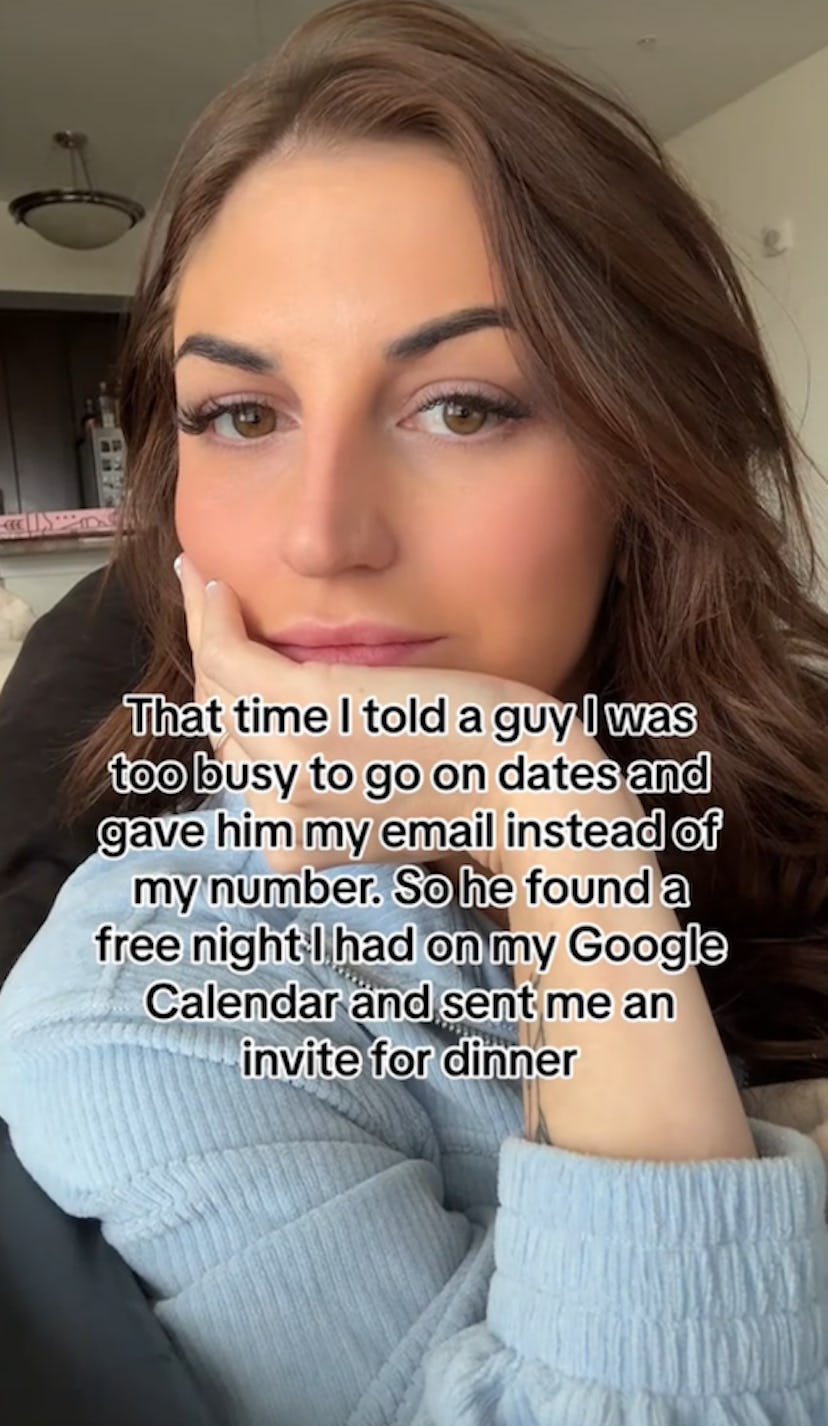
Creativity is also key. Creator @sarapoptarts said a guy she was talking to found a free night in her schedule and sent a Calendar invite for dinner. “IDK why this was hot,” she said. Maybe, instead of feeling bad for being too busy for a first date, this is your reminder to focus on yourself. Eventually, the right person will make it work.