The text message arrived three days before Christmas, invading a moment of such profound peace that the violence of the words felt like a physical violation.
I was sitting in the overstuffed armchair by the bay window, the winter sun painting long, golden rectangles across the floorboards. Wendy, only eight weeks old, was nursing, her rhythmic breathing the only sound in the room. The air smelled of milk and the pine needles from our tree in the corner. She was heavy and warm against my chest, her tiny hand gripping the collar of my sweater with a strength that always surprised me.
My phone buzzed against the wooden armrest. A short, sharp vibration.
I glanced down, expecting the mundane logistics of the holidays—a reminder from my mother about the glaze for the ham, or a question about arrival times.
Instead, I saw my mother’s name, Eleanor, hovering above a sentence that made the world stop spinning.
I forbid you from bringing Wendy. Your daughter is disgusting and will ruin everything.
My mind stalled. I blinked, certain that sleep deprivation was causing me to hallucinate. I read it again. The words remained, cruel and absolute. Disgusting. Ruin everything.
A cold, metallic dread coiled in my gut. My grip tightened instinctively around Wendy, my body recognizing the threat before my brain could fully process the betrayal. She stirred, letting out a soft, milky sigh, oblivious to the fact that her own grandmother had just declared her existence an abomination.
Wendy had been born with a port-wine stain—a vascular birthmark. It was a deep, rich crimson map that covered the left side of her face, stretching from her temple down to the curve of her tiny jaw. To Grant, my husband, and me, it was just a part of her, like her dark eyes or her father’s nose. The doctors had been clear: it was cosmetic. She was healthy. She was perfect.
But to the House of Sterling—my parents’ self-aggrandizing title for our family—image was not just important; it was the currency by which they purchased their self-worth.
I dialed my mother. My fingers trembled so violently I nearly dropped the phone. She answered on the fourth ring, her tone clipped, as if I were a telemarketer interrupting her dinner.
“Did you get the message?” she asked. No hello. No warmth.
“Mom, what are you talking about?” My voice was a whisper, strangled by shock. “You can’t be serious.”
“I am deadly serious,” she snapped. “We have guests coming. Important guests. The Hendersons from the club, the new pastor. I will not have people staring at that… mark all afternoon. It’s unappetizing.”
“Unappetizing?” I choked out. “She is a baby. She is your granddaughter.”
“She is a distraction,” my mother corrected, her voice ice-cold. “It creates an awkward atmosphere. People don’t know where to look. It ruins the aesthetic of the party. Just leave her with a sitter, or stay home. But do not bring her to my house.”
She hung up.
Grant found me ten minutes later, frozen in the chair, tears silently tracking through the dust motes dancing in the light. When I told him, his face darkened, a storm front moving in.
“We aren’t going,” he said, his voice low and dangerous. “They don’t deserve to breathe the same air as her.”
I wanted to agree. Every instinct in me screamed to board up the windows and cut them out of our lives. But then I thought of Grandma Ruth. My eighty-four-year-old grandmother, who had knitted Wendy a blanket before she was even born. She was waiting for us. She was the only one in that house who had looked at my daughter and seen a miracle instead of a mistake.
“We’re going,” I said, wiping my face. The sadness was evaporating, replaced by a hard, crystallized anger.
“Why?” Grant asked, incredulous.
“Because they don’t get to win,” I replied, standing up. “They don’t get to erase her.”
I looked down at my sleeping daughter. I didn’t know it then, but by crossing the threshold of my parents’ home on Christmas morning, I was about to ignite a fuse that would blow the entire family apart.
Christmas morning was brittle and cold. The sky was a hard, pale blue, devoid of clouds. I dressed Wendy in a dress of crushed red velvet with white lace trim. I placed a headband with a small silk bow on her head. She looked like a festive cherub. She looked like a child who should be cherished.
The drive to the suburbs felt like a funeral procession. My hands were slick on the steering wheel. Grant sat beside me, his hand resting on my knee, squeezing it intermittently—a silent Morse code of support. In the backseat, Wendy slept, safe in her carrier, blissfully unaware that she was the catalyst for a war.
We pulled into the driveway of the colonial house where I had grown up. It looked like a postcard. Wreaths in every window, white lights traced along the eaves, a snowman flag fluttering by the mailbox. It was the perfect picture of American suburban bliss. A lie constructed of brick and mortar.
Cars lined the street. My aunt’s Lexus. The pastor’s sedan. My mother had curated her audience.
“Ready?” Grant asked. He grabbed the casserole dish we had promised to bring—sweet potatoes with pecans—while I unbuckled the carrier.
“No,” I said honestly. “But let’s do it.”
We walked up the path. I could hear laughter drifting from inside, the clinking of glass, the murmur of polite conversation. It sounded like a different world.
I didn’t knock. I just reached for the handle.
The door swung open before I touched it. My father, Robert, filled the frame. He was a large man, broad-shouldered, wearing a cashmere sweater that cost more than my first car. His face, usually flushed with holiday spirits, was set in a grim line of stone.
He didn’t look at me. He looked at the carrier in my hands.
“No,” he rumbled.
“Merry Christmas to you too, Dad,” I said, my voice shaking slightly. I tried to step around him.
He moved to block me, his body a physical barricade. “You got the message. You were told.”
My mother appeared behind him. She was wearing a silver silk suit, holding a crystal champagne flute. Her hair was sprayed into an immobile helmet of perfection. Her eyes darted to the guests visible in the living room, then back to me, narrowing into slits of pure venom.
“I told you,” she hissed, her voice low so the guests wouldn’t hear. “I told you not to bring it.”
It.
Something inside me snapped. A tether that had held me to my childhood, to my desperate need for their approval, finally severed.
“Her name is Wendy,” I said, loud enough for the conversation in the living room to falter. “And we are coming in to see Grandma Ruth.”
“You are making a scene,” my sister Taylor appeared, flanked by my brother Derek. Taylor looked at the carrier and actually wrinkled her nose. “God, just leave. Why do you have to be so selfish? Nobody wants to look at that while they’re eating.”
“Selfish?” I laughed, a sharp, hysterical sound. “You people are monsters.”
I stepped forward again.
That was when the violence started.
My mother’s hand moved faster than I expected. Crack.
The slap echoed across the porch like a gunshot. My head snapped to the side. The sting was immediate, hot and throbbing, but the shock was colder. My mother had never hit me. Not once.
“You never listen!” she shrieked, abandoning her whisper.
Grant dropped the casserole dish. It shattered, orange mash and ceramic shards exploding across the pristine porch steps. “Don’t you touch her!” he roared, stepping between us.
My father grabbed the handle of the car seat.
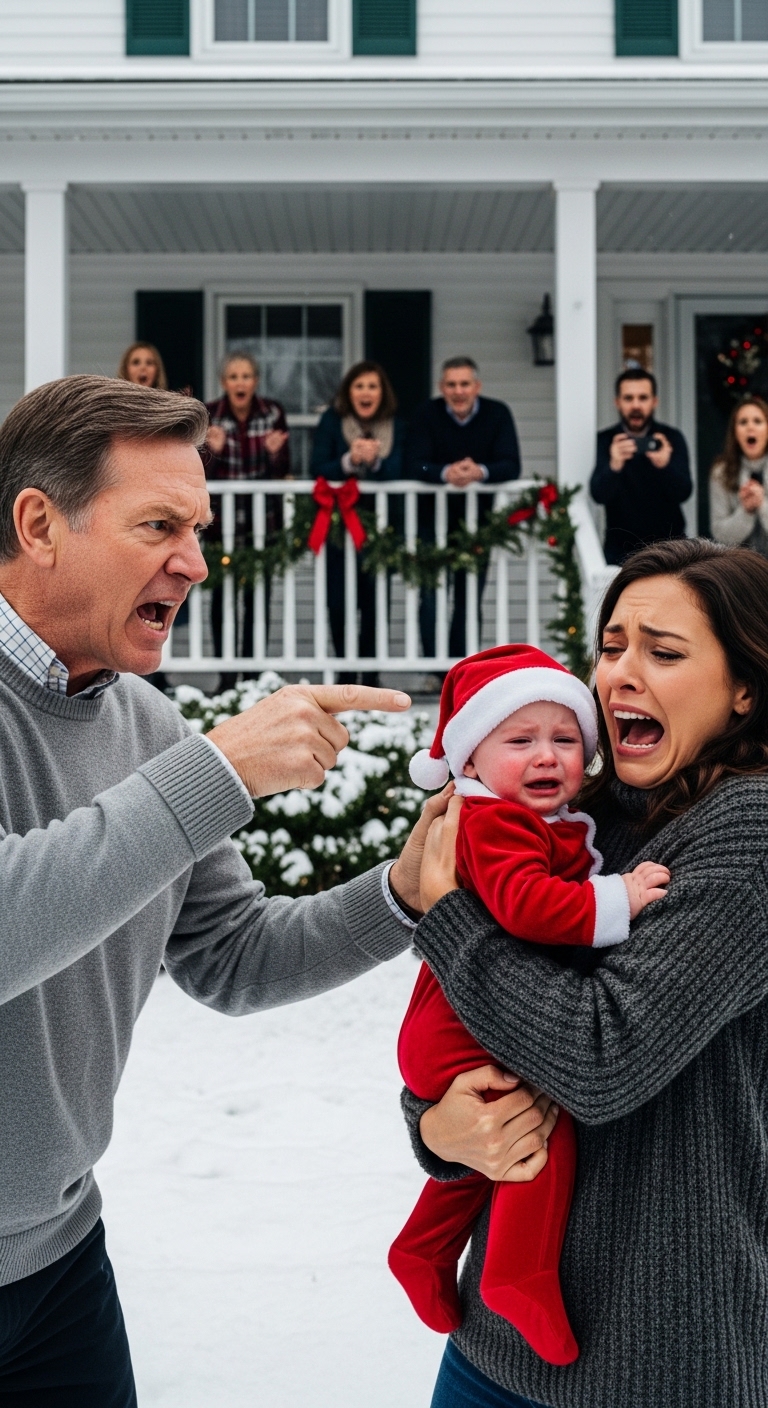
“Get this thing out of here!” my father yelled. He yanked the carrier. I held on. For a terrifying second, we were locked in a tug-of-war over my infant daughter. Then, Derek shoved me. hard. I lost my footing on the slick concrete. My hands slipped.
Gravity is a cruel mistress. As Derek’s shove sent me reeling backward, time seemed to liquefy, slowing down into a horrific frame-by-frame nightmare.
I saw my fingers slip from the plastic handle.
I saw Grant lunging, but being blocked by my father’s bulk.
I saw the look of utter disgust on my father’s face as he held the carrier—not like it held his bloodline, but like it held toxic waste.
“Get out!” Derek screamed.
And then, my father did the unthinkable. He didn’t hand the carrier back. He didn’t set it down.
He swung his arm and heaved the carrier off the porch.
“Go run after her!” he bellowed.
The scream that tore from my throat didn’t sound human. It was animalistic, a raw tear in the fabric of the morning. I watched the carrier arc through the freezing air. It hit the dormant, frozen grass of the front lawn. It tumbled once. Twice. And came to rest on its side.
Wendy began to scream.
I scrambled down the stairs, ignoring the pain in my hip where I had slammed into the railing. I hit the grass on my knees, crawling the last few feet, my breath coming in ragged, panicked gasps.
“Wendy! Wendy!”
I fumbled with the straps, my hands shaking so bad they felt useless. I got her out. She was red-faced, wailing, her tiny body rigid with terror. I pulled her against my chest, shielding her from the cold, from them, from the world. I checked her limbs, her head. She seemed unhurt, protected by the heavy padding of the seat, but the psychological horror of the moment washed over me.
My own father had thrown her.
On the porch, the tableau of my family stood in judgment. My mother was adjusting her silk cuff. Taylor was looking at her phone, probably checking if anyone had seen. Derek was smirking.
Grant was on his phone, shouting at the 911 operator. “Assault! Yes, right now!”
“Hang up that phone!” my mother screeched. “Don’t you dare bring the police into this! We have guests!”
“You threw my daughter!” I screamed back from the lawn, tears freezing on my cheeks.
I reached into my pocket. My hands were numb, but I found my phone. I unlocked it. I opened the camera. I hit record.
“Say it again,” I yelled, holding the lens up. “Tell the world why you just threw an eight-week-old baby into the dirt.”
My mother froze. The red light of the recording was an unblinking eye she couldn’t intimidate. “Stop that. You’re embarrassing yourself.”
“Tell them!” I advanced a step. “Tell them she’s disgusting. Tell them she ruins your aesthetic.”
The front door, which had been half-closed, suddenly flew open.
Guests were spilling out now. Aunt Regina. The Hendersons. They looked horrified, confused. They saw the broken casserole, the screaming baby, the matriarch in the silver suit looking like a cornered animal.
But then, a small, stooped figure pushed through the crowd of onlookers.
Grandma Ruth.
She was trembling, but not with age. She was vibrating with a rage so pure it felt like it could scorch the earth. She held her cane like a weapon.
Ruth didn’t look at me. She looked at her son—my father. She walked up to him, raised her cane, and smashed a porcelain vase that sat on the porch table, sending shards flying everywhere. The silence that followed was absolute.
“You are garbage,” Ruth’s voice wasn’t loud, but it carried across the yard with the clarity of a church bell. “You are absolute, rotting garbage.”
My father, a man who commanded construction crews and intimidated business rivals, shrank back. “Ma, you don’t understand. She brought the baby when we said—”
“I saw!” Ruth cut him off. “I was watching from the window. I saw you throw your own flesh and blood like a sack of trash.”
She turned to my mother. “And you. You vain, shallow, empty shell of a woman. You slapped her. I saw that too.”
“Ruth, please,” my mother tried to regain her composure, smoothing her hair. “The neighbors are watching. We can discuss this inside.”
“Discuss?” Ruth laughed, a dry, harsh sound. “There is nothing to discuss. You wanted to protect your image? You wanted a perfect Christmas?”
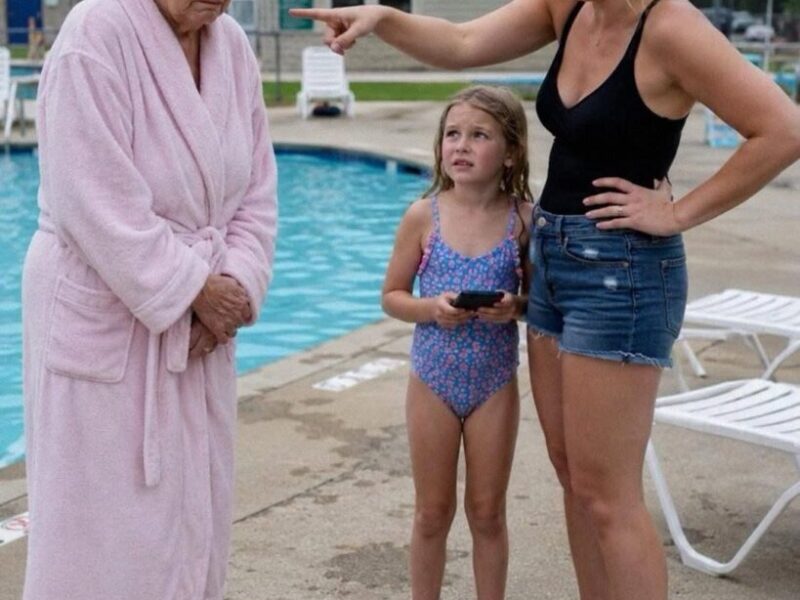
Ruth turned to the crowd of guests gathered on the porch. The elite of the neighborhood. The people my parents had spent thirty years trying to impress.
“Look at them!” Ruth pointed a gnarled finger at my parents. “Look at these people! They banned a newborn baby because she has a birthmark. They called her disgusting. And when my granddaughter came anyway to let me see her, they assaulted her.”
A gasp rippled through the Hendersons. Aunt Regina covered her mouth.
“Is that true, Eleanor?” Regina asked, her voice trembling.
My mother flinched. “It’s… complex. The baby is… it’s difficult to look at. We were thinking of the comfort of our guests.”
“I have never been so uncomfortable in my life,” Mrs. Henderson said, stepping back. “Come, Arthur. We’re leaving.”
“No, wait!” my father pleaded.
“I’m leaving too,” Ruth announced. She turned to me, her eyes softening as they landed on Wendy, who was finally quieting down against my shoulder. “Elena, darling, is the car warm?”
“Yes, Grandma,” I sobbed.
“Good.” Ruth turned back to her son. “I am going to pack my bag. I am going to live with Elena. Do not speak to me. Do not look at me. As far as I am concerned, I have no son.”
“Ma, you can’t be serious,” my father stammered. “You live here. This is your house.”
“It’s your house, Robert,” Ruth spat. “It ceased to be a home the moment you threw that child off this porch.”
Ruth disappeared inside. The exodus began immediately. The guests, realizing they were standing in the middle of a crime scene and a moral vacuum, began to flee. They stepped over the sweet potato mess. They skirted around Derek, who looked suddenly like a lost child rather than a tough guy.
I kept recording. I recorded the guests leaving. I recorded my mother sobbing, not for her family, but for her ruined party. I recorded my father standing amidst the wreckage of his reputation.
Sirens wailed in the distance.
As the first police cruiser turned the corner, lights flashing, I saw my mother’s phone buzz. She looked at it and went pale. I realized then that I wasn’t the only one who had been recording. One of the bridge club ladies had been livestreaming the entire speech from the porch. The internet already knew.
The fallout wasn’t a ripple; it was a tsunami.
The police took statements on the lawn. They photographed the red handprint blooming on my cheek. They photographed the overturned carrier in the grass. They took witness statements from Aunt Regina and the Hendersons, who were all too eager to distance themselves from the accused.
My parents, Taylor, and Derek were cited for assault and child endangerment. They weren’t arrested in handcuffs right there—suburban privilege has its perks—but the court summons were issued.
We drove Grandma Ruth home with us. She sat in the back seat next to Wendy, humming a lullaby, her hand resting protectively on the baby’s knee.
By the time we got home, the video—not mine, but the one filmed by the guest—had thirty thousand views. By dinner, it had a million.
The title: “Grandmother destroys shallow family for banning baby with birthmark.”
The internet is a cruel place, but it has a distinct sense of vigilante justice. My parents were doxxed within hours. My father’s construction business page was flooded with one-star reviews. “Throws babies off porches” became the top comment on every post.
My mother, a woman who lived for the approval of her peers, became a pariah.
I sat on my couch that night, Wendy asleep in her crib, Ruth sipping tea in the armchair. My phone wouldn’t stop buzzing. Calls from cousins I hadn’t spoken to in years.
“I saw the video,” my cousin Angela texted. “I never told you this, but your mom told me to put braces on my son before we came to the reunion last year. She said his teeth were ‘distracting.’ I’m so sorry I didn’t warn you.”
Another message from an uncle: “Your dad mocked my daughter’s dyslexia for years. We stopped coming around because of it. We stand with you.”
The floodgates had opened. It turned out Wendy’s rejection wasn’t an isolated incident; it was the climax of a decades-long reign of superficial terror.
My mother called me at midnight. I let it go to voicemail. I listened to it later.
“Elena, you have to take it down,” she pleaded, her voice cracking. “They’re canceling your father’s contracts. The church asked me to step down from the committee. You are ruining our lives!”
Not a word about Wendy. Not a word of apology. Just fear for her own standing.
I blocked her number.
The legal battle was swift and brutal. We had video evidence and a dozen witnesses. Their high-priced lawyers tried to argue provocation, tried to argue that they were “protecting the child from staring eyes.”
Our lawyer, a sharp-witted woman named Caroline, decimated them. She played the audio of my mother calling Wendy “disgusting.” She put Grandma Ruth on the stand.
Ruth’s testimony was the final nail. She sat in the witness box, frail but fierce, and looked her son in the eye.
“I failed them,” she told the judge. “I raised them to value gold over grace. But I will not let them destroy my great-granddaughter.”
The judge was unamused by my family’s antics. Probation. Anger management. Restraining orders. And the most humiliating punishment of all: mandatory community service working with families of children with disabilities.
Leaving the courthouse, my father tried to approach me. He looked older, smaller. His cashmere sweater looked threadbare. He opened his mouth to speak, perhaps to finally apologize, but Grant stepped in front of me. “You lost the right to speak to her,” Grant said. “You lost the right to even look at her.” We walked away, leaving them on the courthouse steps, a family of ghosts in expensive suits.
Five Years Later.
The sun is different here. We moved three states away, to a house with a big wrap-around porch and a garden where Grandma Ruth could plant hydrangeas.
Ruth passed away last winter. She died in her sleep, in a room filled with photos of Wendy. She left us everything—her savings, her jewelry, but mostly, she left us the certainty that we were right.
Wendy is five now. The birthmark is still there, though we’ve done a few laser treatments to lighten it, strictly for her comfort. She calls it her “superhero mask.” She is fierce, funny, and kind. She knows she is loved.
We don’t talk about the Sterlings. To Wendy, they are just strangers in a story she’s too young to understand fully.
I heard through the grapevine that my parents sold the big colonial house. They downsized to a condo in a different town, trying to outrun their reputation. But the internet never forgets. The video is still there. A digital scar they can never remove.
It’s Christmas Eve. I’m sitting in the rocking chair—a new one, in a new house—watching Wendy hang an ornament on the tree. It’s a porcelain angel that used to belong to Ruth.
“Mama, look!” she beams, turning to me. The firelight catches the crimson stain on her cheek, making it glow like a ruby.
“It’s beautiful, baby,” I say. And I mean it.
My phone buzzes. It’s a text from Grant, who is out picking up the turkey. “Can’t wait to get home to my girls.”
I smile and set the phone down.
There is a concept in Japanese art called kintsugi—repairing broken pottery with gold lacquer, making the cracks a part of the history, a part of the beauty. My family was broken that Christmas day. Shattered into a thousand pieces on a frozen lawn.
But we didn’t try to glue the old pieces back together. We built something new. We filled the cracks with love, with Grant’s loyalty, with Ruth’s courage.
My mother was right about one thing that day. Wendy did ruin everything. She ruined their facade. She ruined their legacy of cruelty. She burned down a house of cards just by existing.
And from the ashes, she allowed us to build a home.
I watch her dance around the living room, spinning in circles, dizzy with holiday joy.
Some lines, once crossed, can never be uncrossed. I lost my parents that day. But looking at my daughter, whole and happy and free, I know one thing with absolute certainty.
It was a fair trade.
The End.