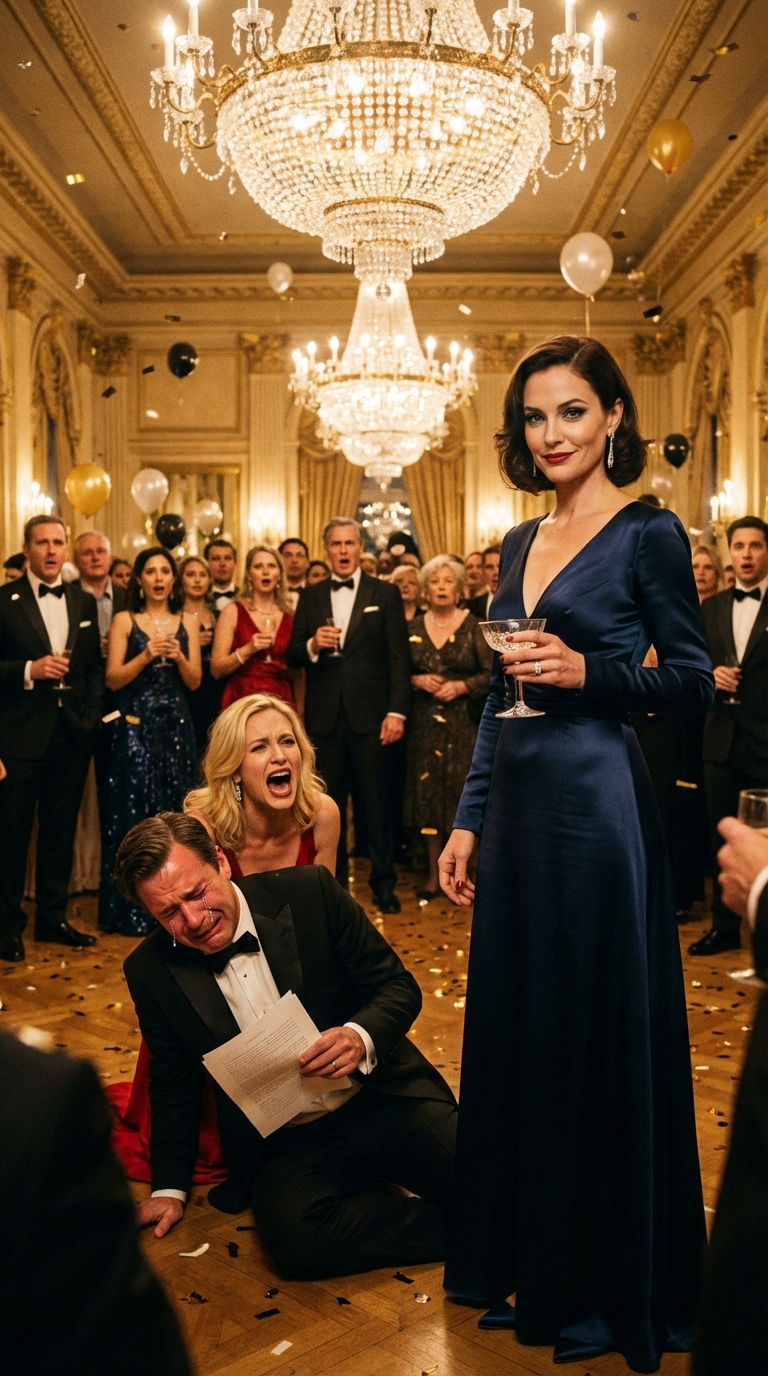
They wanted me to watch. They wanted me to break down in front of the Boston elite while champagne bubbles popped and strangers pretended not to stare at the weeping wife. They wanted the spectacle of my ruin to be the opening act for their “happily ever after.”
But I didn’t give them that satisfaction.
Instead, I smiled, raised my own crystal flute, and set in motion a sequence of events that would turn their perfect midnight into a nightmare they would replay for the rest of their lives.
But to understand the end, you have to understand the silence that preceded it.
Five days before New Year’s Eve, the illusion of my life shattered on a granite countertop.
It was a Tuesday morning, dark and biting cold, the kind of New England winter dawn that turns the windows into sheets of ice. My husband, Marcus Hartley, had rushed out for his morning run along the Charles River, leaving the scent of his expensive sandalwood cologne and his leather briefcase in the kitchen.
I was moving the briefcase to make room for the coffee maker. It was a mundane action, a muscle memory born of six years of marriage. But the clasp wasn’t secured. As I lifted it, the leather flap fell open, and a single manila folder slid out, spilling its contents across the island.
I reached to gather them, annoyed at the mess. Then, I stopped.
Topmost on the pile was a property transfer document. It was standard legal boilerplate, the kind of thing Marcus, a partner at Thornbridge Capital, dealt with daily. But the address caught my eye.
142 West Newton Street.
My hands went cold. That was our address. That was the brownstone in the South End that we had bought three years ago, the one we had gutted and renovated room by room. The house where we were supposed to raise the children we hadn’t had yet.
According to the document, the title was being transferred from “Marcus and Elena Hartley” to an entity called VIM Holdings, LLC.
I stared at the paper, my coffee forgotten. Marcus moved assets into shell companies for clients all the time. It was part of the private equity game. But never our personal assets. Never without a discussion. And certainly not for the sum listed: $10.00.
I pulled out my phone. My fingers were trembling so badly I had to unlock it twice. I took high-resolution photos of every page. The transfer deed. The LLC registration. The notarized signature page.
I stuffed the papers back into the folder, slid it into the briefcase, and snapped the clasp shut. I stood there for a moment, breathing in the smell of old coffee and betrayal, trying to steady my heart rate.
I needed a shark.
I called Maya Chen.
Maya and I had been roommates at Boston University fifteen years ago. She had gone to law school; I had pursued art history. Now, I curated exhibitions at the Newbury Street Gallery, and she was a partner at one of the city’s most ruthless family law firms. We had stayed close through everything—bad breakups, career pivots, and my marriage to Marcus.
She answered on the second ring.
“Elena, it is 7:15 in the morning. Unless you are calling to tell me you found a Caravaggio in your attic, this better be good.”
“He’s hiding assets,” I said. My voice sounded foreign, hollow. “I found transfer documents. Marcus is moving our house into an LLC I’ve never heard of.”
The line went dead quiet. All traces of sleep vanished from Maya’s voice.
“Send me the photos,” she commanded. “Right now. Do not confront him. Do not let him know you know. Act like everything is normal. Can you come to my office at noon?”
“I’ll be there.”
I spent the next three hours performing the role of the oblivious wife. When Marcus returned from his run, flushed and handsome, I poured him coffee. I asked about his route. I kissed his cheek, tasting the salt of his sweat, and forced a smile when he said he had a “late client dinner” that night.
At noon, I walked into Maya’s corner office overlooking the harbor. The gray December waves were chopping angrily against the piers, matching the turmoil in my gut.
Maya had the photos I’d sent spread across her mahogany desk, along with several other documents she had pulled from databases I didn’t even know existed. She didn’t offer me tea. She didn’t offer me a hug. She looked at me with the grim focus of a general surveying a battlefield.
“Elena,” she said softly. “When was the last time you checked your credit report?”
“I don’t know. A year ago? Why?”
She turned her laptop screen toward me.
“Because according to the records in Clark County, Nevada, your husband filed for divorce two months ago.”
The room tilted. I gripped the edge of the desk.
“That’s impossible,” I whispered. “I’m right here. We live together. I never signed anything. I never even knew.”
“He forged your signature.”
Maya’s voice was gentle, but the words hit like stones.
“I pulled the filing,” she continued. “The signature on the waiver of service doesn’t match your handwriting. It’s too loopsy, too hesitant. I already sent the digital file to a forensic document examiner I work with. She can have a preliminary analysis by tomorrow morning.”
I stared at the screen. There was my name. Elena Marie Hartley. Agreeing to dissolve a marriage I thought was just going through a rough patch. We had grown distant, yes. Marcus worked long hours; I traveled for gallery shows. But divorce? Behind my back?
“There’s more,” Maya said. “The LLC that he’s transferring the house to? VIM Holdings. I ran a search on the registered agent.”
She slid a piece of paper across the desk.
“It’s owned by a woman named Vivian Monroe. Does that name mean anything to you?”
It felt like a physical blow to the chest.
“Yes,” I managed to say. “She’s an associate at Marcus’s firm. Twenty-six. Wharton grad. I’ve met her at the Christmas parties. She’s… she’s his protégée.”
“She’s his exit strategy,” Maya corrected.
Vivian Monroe. I pictured her immediately. Sharp, ambitious, perfectly put together. The kind of woman who wore five-inch heels as a power move. Marcus had mentioned her brilliance on the Cascade Merger. He had praised her work ethic.
VIM Holdings. Vivian Monroe. He hadn’t even been creative.
“Oh God,” I whispered, pressing my hands to my eyes. “He’s stealing the house to give to her.”
“He’s stealing everything,” Maya said. “But he made a mistake. He got arrogant.”
Maya stood up and walked to the window, her silhouette framed by the stormy sky.
“Here is what we are going to do. You are going to go home. You are going to act completely normal. You said Marcus is throwing that New Year’s Eve dinner at Odyssey?”
“Yes,” I said. “He invited eight other couples. Clients. Friends. It’s a huge production.”
Odyssey was a rooftop restaurant in the Seaport District. Floor-to-ceiling glass, views of the skyline, four hundred dollars a plate. It was Marcus’s favorite stage.
“Perfect,” Maya said, turning back to me with a smile that was terrifyingly sharp. “You are going to go. You are going to wear your best dress. You are going to smile and play the perfect, supportive wife.”
“I can’t,” I said. “I can’t look at him and not scream.”
“You have to,” Maya insisted. “Because I am going to be there too. At a different table. You won’t acknowledge me. When midnight comes, whatever he is planning—and he is planning something—you are going to record it. Everything.”
“Why?”
“Because if he is bold enough to forge federal court documents,” Maya said, “he is bold enough to do something stupid in public. And when he does, we aren’t just going to divorce him. We are going to bury him.”
The next three days were a fugue state of surreal horror.
I moved through my home like a ghost haunting her own life. I watched Marcus meticulously pick out his ties. I listened to him hum in the shower. I watched him text on his phone, angling the screen away from me, smiling at messages I now knew were from Vivian.
He was so convincing. He asked about the gallery. He touched my shoulder when he passed me in the hall. How long had he been practicing this performance? Was our entire marriage just a long con?
On December 29th, Maya’s document examiner confirmed the forgery. “I would stake my license on it in a court of law,” the email read. “This is a crude simulation.”
On December 30th, the violation turned personal.
I was looking for a pair of earrings in my jewelry box when I noticed the velvet slot in the back was empty.
My breath hitched.
My mother had died when I was sixteen. I had sold most of her things to pay for college, but I had kept one piece: a delicate platinum bracelet set with Burmese sapphires. It wasn’t flashy, but the stones caught the light like frozen teardrops. My mother had made me promise to give it to my daughter someday.
I didn’t have a daughter. And now, I didn’t have the bracelet.
I tore the bedroom apart. I checked the safe. I checked the drawers. It was gone.
I called Maya, my hands shaking with a rage that felt different from the cold shock of the property theft. This was hot. This was blood.
“He took my mother’s bracelet,” I choked out.
“Are you sure?”
“I keep it in a specific box. It’s gone. Maya… he gave it to her, didn’t he?”
“Probably,” Maya said, her voice hard. “Add it to the list. That is theft of marital property at a minimum. Grand larceny if we push it.”
“He gave my mother’s legacy to his mistress.”
“Elena,” Maya said. “Use it. Let that anger keep your spine straight tomorrow night.”
New Year’s Eve arrived cold and crystal clear. The city looked like it had been carved out of ice.
I spent the afternoon at the gallery, staring at a new Rothko acquisition. The painting was deep, bruised purple and black. It felt like looking into a mirror.
My assistant, Sarah, asked if I was okay. “You look… intense,” she said.
“I’m just focused,” I told her.
At 6:00 PM, I went home to prepare for war.
I didn’t choose the demure beige gown Marcus had suggested. I chose a midnight blue silk dress that clung to my frame like a second skin. It was backless, severe, and elegant. My father, a carpenter who raised me alone after Mom died, used to tell me that true strength wasn’t about shouting.
“Be steel wrapped in silk, Elena,” he’d say. “Let them cut themselves on you before they realize you’re sharp.”
He had passed away three months ago from a sudden heart attack. Marcus had been supportive during the funeral—holding my hand, handling the logistics. Now, looking at myself in the mirror, I wondered: Had he been planning this then? Had he been counting down the days until I was truly alone, an orphan with no one to protect her?
He forgot one thing. I was my father’s daughter. I could build, but I could also dismantle.
Marcus came home at 7:00 PM, already in his tuxedo. He looked at me, and for a second, his eyes widened.
“You look… beautiful,” he said, kissing my temple. “Ready for tonight?”
“Ready,” I said. And I smiled.
We arrived at Odyssey at 8:00 PM. The elevator ride to the rooftop was smooth and silent. When the doors opened, the noise of the party washed over us—clinking glass, jazz, the hum of wealth.
The other couples were already clustered near the floor-to-ceiling windows. I recognized them all. Tom and Jennifer, Marcus’s college friends. David and Rachel, biotech clients worth millions.
I played my part. I complimented dresses. I laughed at jokes I didn’t hear. I accepted a glass of champagne and let the bubbles burn my throat. My phone was in my clutch, the voice memo app already running.
At 8:30 PM, we sat down for dinner.
That was when she walked in.
Vivian Monroe.
She was wearing a red dress that was designed to stop traffic. It was aggressive, bold, and undeniably stunning. Her hair was swept up in an intricate chignon. She walked with the confidence of someone who knows she holds all the cards.
And there, on her left wrist, catching the chandelier light with every movement, was my mother’s sapphire bracelet.
The world stopped. The sound of the restaurant faded into a dull roar.
Marcus stood up, beaming. He pulled out the chair next to him. Not the one across from him. The one next to him.
“Everyone,” Marcus announced, his hand resting possessively on the bare skin of Vivian’s shoulder. “I don’t think you’ve all met Vivian Monroe. She’s been absolutely instrumental in the firm’s success this year. Brilliant analyst.”
There was polite applause. Confused glances darted toward me. Why is the colleague sitting next to the husband?
I kept my smile fixed. It felt like the skin of my face might crack.
Vivian sat down. She looked at me, a flicker of triumph in her eyes, then turned her back to engage Marcus in a whisper.
Dinner was seven courses. I tasted none of them. I watched Vivian laugh at Marcus’s stories—stories I had heard a thousand times. I watched his hand brush her arm. I watched my mother’s sapphires sparkle on the wrist of the woman who was stealing my life.
At 11:50 PM, the house lights dimmed. The screens above the bar switched to the Times Square broadcast. Waiters circulated with fresh bottles of Dom Pérignon.
Marcus stood up. He tapped his spoon against his glass. The sharp ding-ding-ding cut through the chatter.
“I want to say something,” he announced. His voice was rich, projecting easily to the surrounding tables. The restaurant quieted.
“This year has been transformative for me,” he began. “I’ve learned a lot about myself. About what I really want. About the importance of being honest, instead of hiding behind comfort and routine.”
My heart pounded against my ribs like a trapped bird. I pulled my phone from my clutch, pretending to check the time, and propped it against the centerpiece. The camera lens was trained directly on him.
“So,” Marcus continued, “as we go into this new year, I am making a change. I am starting fresh.”
He reached down and took Vivian’s hand. He pulled her to her feet.
“Vivian and I are engaged.”
The gasps were audible. A fork clattered onto a plate. Everyone looked at Vivian, who was beaming, holding up her left hand to display a diamond the size of a skating rink.
Then, everyone looked at me.
Marcus turned to me then. His expression was a masterpiece of pity and condescension.
“Elena,” he said, his voice dropping to a theatrical hush. “I know this is awkward. But you knew this was coming. You signed the papers back in November. Remember? We’ve been divorced for six weeks. It’s time to move on. Let’s all be adults about this.”
The silence was suffocating. It was a vacuum. Sixteen people were staring at me, waiting for the breakdown. Waiting for the hysterical ex-wife to throw a drink or scream.
I stood up slowly. I picked up my napkin and set it gently on the table.
“Did I?” I asked. My voice was calm, clear, steel wrapped in silk.
Marcus blinked. “What?”
“Did I sign papers? Are you sure about that, Marcus?”
His confidence flickered. A crack in the façade. “Elena, don’t be dramatic. You know you did. My lawyer sent them to you. You signed and returned them.”
“Your lawyer sent papers,” I corrected. “Someone signed them. Someone returned them. But Marcus… are you absolutely certain that someone was me?”
“What are you talking about?” There was fear in his voice now.
I picked up my phone. “I think we should listen to the experts.”
I tapped the screen. The recording I had made in Maya’s office played through the phone’s speakers, amplified by the silence of the room.
The forensic examiner’s voice was professional, dry, and devastating.
“Based on my analysis of the signature on the divorce documents filed in Clark County, Nevada, versus the authenticated exemplars of Elena Hartley’s handwriting… it is my professional opinion that the signature was NOT made by Elena Hartley. The pressure points are wrong. The letter formation is inconsistent. There are multiple indicators of simulation. This is a forgery.”
I stopped the recording.
“So, no, Marcus,” I said. “I didn’t sign your papers. Which means we aren’t divorced. Which means you just announced your engagement to your mistress while you are still legally married to me.”
I looked around the table.
“In front of sixteen witnesses.”
The color drained from Marcus’s face, leaving him ashen. Vivian’s smile had frozen into a rictus of horror.
“That’s impossible,” Marcus stammered. “You’re lying. This is… this is a misunderstanding.”
“It’s fraud,” I said. “Forging a spouse’s signature on legal documents is a felony. Actually, it’s several felonies.”
Movement caught my eye.
Maya Chen rose from a table three rows away. She walked toward us, a predator closing in on wounded prey. She was holding a thick manila envelope.
“Marcus Hartley,” she said, her voice carrying across the silent restaurant. “I am Maya Chen, Attorney at Law. I represent your wife.”
She slapped the envelope onto the table in front of him.
“I am here to serve you with several documents. First, a temporary restraining order preventing you from accessing, selling, or transferring any marital assets. Second, a notice of a fraud investigation being opened by the Massachusetts Attorney General’s Office. Third, notification that your employer, Thornbridge Capital, has been made aware of the criminal investigation and will be conducting their own internal audit effective immediately.”
Marcus looked at the papers. His hands began to shake uncontrollably.
Then Maya turned to Vivian.
“Miss Monroe,” she said pleasantly. “I need to inform you that you are currently wearing stolen property.”
Vivian flinched. She covered her wrist with her other hand.
“That bracelet belongs to my client,” Maya continued. “It was taken from the marital home without her knowledge or consent.”
“Marcus gave it to me!” Vivian cried, her voice shrill. “It was a gift! I didn’t steal anything!”
“Marcus didn’t have the right to give it away,” I said, stepping closer. “That bracelet was my mother’s. It is the only thing I have left of her. And you are wearing it like a party favor.”
“I’m not taking it off,” Vivian hissed, though her lip was trembling.
Maya pulled out her phone. “Then I will need to call the Boston Police Department right now and report a theft of property valued over ten thousand dollars. They can come up here and arrest you in front of the entire restaurant.”
“Ten thousand?” Vivian’s eyes went wide. “Marcus said it was costume jewelry.”
“The sapphires are Burmese,” I said. “The platinum is antique. Current appraisal is twelve thousand dollars. So, yes, it’s a felony theft charge if you don’t hand it over. Now.”
Vivian looked at Marcus. He was staring at the tablecloth, unable to meet her eyes.
She let out a sob. Her fingers scrambled frantically at the clasp. The bracelet fell onto the white tablecloth with a heavy clink.
Maya picked it up. She checked the clasp, then handed it to me.
The weight of the cool metal in my palm grounded me. I fastened it around my wrist. It felt like my mother holding my hand.
The countdown to midnight started on the TV screens.
Ten… Nine… Eight…
The room around us was frozen. No one was watching the ball drop. They were watching the ruins of Marcus Hartley’s life.
Three… Two… One…
“Happy New Year,” I said to Marcus.
His face was gray. “Elena, please. We can talk about this. I made a mistake. I was… confused. We can fix this.”
“You’re right,” I said. “We can fix this. With lawyers. And judges. And a very public divorce where everyone learns exactly what kind of man you are.”
I turned to leave. Maya fell into step beside me.
Behind us, I heard Vivian sobbing. I heard a client ask Marcus, “What the hell were you thinking?”
I walked out of the restaurant and into the cold night air, breathing freely for the first time in months.
Maya drove me home. Not to the brownstone—that was a crime scene now—but to my father’s old house in Dorchester. I had inherited it when he died and hadn’t been able to bring myself to sell it. Now, it was a sanctuary.
We sat in the kitchen where my father used to make blueberry pancakes on Sundays. Maya made tea.
“The firm will fire him,” Maya said, watching me. “Fraud investigation plus this public disaster? He’s radioactive. He’s done.”
“Good.”
“Vivian might face charges too. She was receiving stolen property, and her name is on the LLC hiding the assets. At minimum, her career at Thornbridge is over.”
“Also good.”
Maya reached across the table and squeezed my hand. “Are you okay?”
I looked down at the sapphire bracelet. “No. But I will be.”
The next six months were a brutal war of attrition.
Marcus tried everything. He begged. He threatened. He offered settlements that were insulting. His lawyer was expensive, a bulldog from a big firm.
Mine was better.
Maya connected me with a forensic divorce specialist. We tore his financials apart. The handwriting expert testified. The forged Nevada papers were thrown out with prejudice. We started fresh in Massachusetts court, where I had the moral and legal high ground.
Marcus was fired from Thornbridge within the week. The fraud investigation found enough irregularities to recommend charges. He eventually pleaded down to probation and massive restitution, but his reputation in Boston’s financial sector was incinerated.
Vivian lost her job. She moved back to New York, vanishing into the anonymity of a mid-tier firm.
The divorce was finalized in June. I got the brownstone. I got half of Marcus’s retirement accounts. I got a settlement that reflected six years of marriage plus punitive damages for fraud.
But winning didn’t feel like a parade. It felt like quiet survival.
In August, I went back to the gallery full-time. I threw myself into curating. I created an exhibition titled “After Midnight,” featuring artists who created their best work in the wake of trauma. It opened in September to rave reviews.
I started therapy. I finally allowed myself to grieve my father, a process Marcus’s betrayal had stolen from me. I adopted a cat named Rothko, a chaotic orange tabby who knocked over my coffee and slept on my feet.
On New Year’s Eve, exactly one year later, Maya invited me to her house.
It was quiet. Just Maya, her husband, and a few close friends. We played board games. We ate too much artisan cheese. We drank cider instead of champagne.
At 11:50 PM, Maya pulled me aside into the kitchen.
“How are you doing?” she asked. “Really?”
I thought about it. I thought about the brownstone that was truly mine now, cleansed of Marcus’s ghost. I thought about the career I had reclaimed. I thought about the strength I had found in the wreckage.
“I’m okay,” I said. “Not healed. Not ‘over it.’ But okay.”
“That’s enough,” Maya said. “That’s more than enough.”
At midnight, we hugged. I looked down at my wrist. The sapphires caught the warm light of the kitchen.
I thought about Marcus, alone in whatever small apartment he could afford. I wondered if he ever understood what he had really lost. Not the money. Not the house. But me. The person who had loved him when he was nobody.
I thought about the version of me who sat at that table at Odyssey, terrified and heartbroken, and smiled through the pain.
I had won the lawsuit. I had won the house. But the real victory wasn’t the assets.
The victory was standing here, one year later, surrounded by people who didn’t require a performance.
I was steel. I was silk. And for the first time in a long time, I was whole.