The irony was not lost on me as I stood in the palatial lobby of Hotel Miramar, the salt-heavy breeze off the Pacific tugging at the hem of my coat. To the world, I was Carmen, the black sheep, the “starving artist” whose career in graphic design was whispered about with a mixture of pity and derision at every Thanksgiving table. But as my fingers brushed the sleek, cool surface of the mahogany check-in desk, I felt a secret thrill run through my veins.
Six months ago, this hotel—this shimmering white fortress of luxury with its cascading bougainvillea and emerald gardens—had become mine. My grandfather, Don Ernesto, had bypassed his own children to leave me his crown jewel in a will so secret it had required three different law firms to iron out the ironclad trust.
“I thought you wouldn’t show, Carmen,” a cold, familiar voice drifted over my shoulder.
I turned to see my mother, Isabel. She didn’t offer a hug. She didn’t even offer a smile. She simply adjusted her pearls and looked at me as if I were a smudge on a pristine window. Behind her, the family favorite, my sister Lucia, was being swarmed by cousins, her laughter ringing out like expensive crystal.
“I wouldn’t miss the annual reunion for anything, Mother,” I replied, my voice steady despite the old, familiar knot tightening in my stomach.
Roberto, Lucia’s husband—a man whose personality was largely comprised of the brand of watch he was wearing—stepped forward. He scanned my simple linen outfit with a mocking squint. “Seems the ‘logo business’ isn’t exactly buying you any Gucci this season, eh, Carmen? If you’re short on the bill, don’t worry. Lucia and I have it covered. This place isn’t exactly budget-friendly.”
If only he knew. If only he knew that my “small company” was now a premier agency with clients in London, Tokyo, and New York. If only he knew that every cent he was about to spend this weekend would eventually flow into my accounts.
Miguel, the hotel manager, approached our group. He caught my eye for a fleeting second, his gaze flickering with a deep, professional respect that he quickly masked. We had rehearsed this. For this weekend, I was just a guest. I needed to see my family without the filter of my wealth. I needed to see them for who they truly were when they thought I had nothing.
“The room assignments are ready,” Isabel announced, taking the keys from Miguel with the air of a queen. “Lucia and Roberto, you have the Presidential Suite with the panoramic ocean view. Your father and I will take the Executive Wing. The cousins have the Deluxe Oceanfronts.”
She paused, holding a single, plastic key card as if it were contaminated. “And Carmen… you’ll be in Room 108. It’s on the first floor, tucked away near the laundry. It’s… modest. But then again, you’ve always preferred the simple life, haven’t you?”
A ripple of stifled laughter moved through my cousins. Room 108. I knew that room. It was the smallest cell in the building, a place usually reserved for last-minute budget travelers or staff overflow. It smelled of industrial bleach and vibrated with the heavy thrum of the washing machines.
Miguel stepped forward, his face tight. “Ma’am, I believe we might find a more suitable—”
“It’s fine, Miguel,” I cut him off, my voice a calm blade. “Room 108 will be perfect. I find the sound of machinery… grounding.”
As I took the key and headed toward the service elevator, I heard my cousin Daniela whisper to the others, “As always, Carmen settles for the leftovers. Some things never change.”
I walked into the cramped, noisy room and sat on the thin mattress. The vibration of the laundry machines below felt like a countdown. I wasn’t here to humiliate them—not yet. I was here to find the answer to a question that had haunted my thirty years: why was I the only one they refused to love?
Chapter 2: The Table of Scraps
The welcome dinner was held at L’Océan, the hotel’s flagship restaurant. It was a masterpiece of candlelight and silver service, but for me, it was a gauntlet of subtle cruelties.
The family occupied the largest table in the center of the room, a place of honor. My chair, however, had been placed at the very end, partially obscured by a massive marble column. From my vantage point, I could see the back of my father’s head and the sparkling profile of Lucia, but I was effectively a ghost at my own feast.
“Can you even afford the appetizers here, Carmen?” my father asked, not looking up from the wine list. “The prices have gone up since the new ownership took over. We can put your dinner on our tab if you’re struggling.”
“The salad is fine, thank you,” I replied, maintaining a posture of quiet dignity.
The conversation flowed around me like a river I wasn’t allowed to swim in. It was a litany of Lucia’s triumphs—her promotion at the private bank, the new equestrian estate she was eyeing, the social circles she was conquering.
“Our Lucia always knew her worth,” Isabel said, her voice dripping with pride. “She didn’t waste her time with ‘creative pursuits’ like some. She understood that in this family, we build empires.”
The head chef, Antonio, a man I had personally poached from a Michelin-starred kitchen in Paris three months ago, approached the table. He was a formidable man, but when he saw me, he paused. He performed a slight, elegant bow—the kind reserved only for royalty or the person who signs the paychecks.
“Was the salad to your liking, Miss Carmen?” he asked, his voice thick with genuine concern. “I could prepare the sea bass specifically for you, if you wish.”
The table went silent.
“You know the chef?” Lucia asked, her eyes narrowing as she poked at her lobster thermidor.
“We’ve crossed paths,” I said vaguely. “The hotel industry is smaller than it looks.”
“Antonio, please,” Roberto barked, snapping his fingers. “More wine for the table. The expensive stuff. Don’t worry about the girl; she’s on a diet of humility tonight.”
Antonio looked at me, his jaw tightening. I gave him a nearly imperceptible shake of the head. Not yet.
As the night progressed, the wine loosened their tongues and sharpened their knives. Every comment directed my way was a calculated strike. They mocked my “little drawings,” my lack of a “real” partner, and my “stubbornness” in refusing to work for the family’s failing textile business.
Discreetly, Miguel approached my chair. He leaned in, whispering so only I could hear. “Miss Carmen, there is an urgent matter in the private office. Something regarding the Mendes documents you requested.”
I stood up, adjusting my dress. “Excuse me,” I said to the table. “I have to take care of something.”
“What could be so urgent for you, Carmen?” Roberto snickered, his face flushed with wine. “Did the hotel run out of crayons? Or are you late for your shift in the laundry room?”
I ignored him and walked toward the back corridors, my heart hammering against my ribs. In the sanctum of the owner’s office, Miguel looked troubled.
“I cannot watch this anymore, Miss,” he said, gesturing toward the CCTV monitors that showed the dining room. “You are the owner of the Miramar. You are the legacy of Don Ernesto. Why do you let them treat you like a beggar in your own house?”
“Because, Miguel,” I said, looking out at the dark, crashing surf of the Pacific, “I found a box of letters in my grandfather’s safe. There is a wound in this family that has been festering for thirty years. I’m not just the owner of a hotel; I’m the curator of a tragedy. And I think I’m finally close to the truth.”
As I turned to leave the office, I found my cousin Daniela standing in the doorway, her face pale. She had followed me.
“Carmen?” Daniela’s voice was small, stripped of its usual mockery. “What are you doing in the owner’s office? The staff… they let you in here? Why?”
I stood my ground, my silhouette framed by the expansive window that overlooked the Miramar’s private beach. “Maybe I’m not as insignificant as everyone prefers to believe, Daniela.”
She looked at the desk, cluttered with legal folders and grandfather’s old journals. For a moment, a glimmer of something—doubt, perhaps—flickered in her eyes. “You were always his favorite,” she whispered. “We all knew it. That’s why your mother… that’s why we were told to keep you at a distance.”
“Told?” I asked, stepping closer. “By whom?”
But Daniela turned and fled before I could get an answer.
I spent the next three hours submerged in the past. Miguel had brought me the box I had asked for—the personal correspondence of Don Ernesto. Among the business ledgers and blueprints, I found it: a yellowed envelope, dated fifteen years ago, addressed from my mother to my grandfather.
I read the words, and the world seemed to tilt on its axis.
“Dad, you have to understand that Carmen isn’t like us,” my mother had written in her sharp, elegant script. “She has a wildness, a lack of discipline that will only bring shame to the Miramar. If you continue to favor her, you will destroy the family hierarchy. Lucia is the one with the vision. Carmen is a distraction. I have made sure she understands her place, but your indulgence is making my job difficult.”
And then, I found the response—a draft of a letter my grandfather never sent.
“Isabel, it saddens me to see how you fear your own daughter’s light. Carmen has a spirit you cannot stifle. You call it lack of discipline; I call it vision. You are trying to bury her so that you can feel taller. One day, you will realize that by trying to break her, you have broken yourself.”
The letters continued, detailing years of systemic marginalization. My mother had lied to him about my grades, my business’s success, even my character. She had systematically painted me as a failure to ensure that the inheritance would go to Lucia—the daughter she could control.
But there was more. I found a series of emails from my father and Roberto to an offshore holding company. They had been plotting to force my grandfather to sell the hotel to them at a fraction of its value while he was ill. They hadn’t just been mean; they had been predatory.
The next morning, the “activities” continued. My family spent the morning at the spa. My mother informed me with a thin smile that there was “no more room” for me in the premium massage wing.
“You’ll have to settle for the basic sauna, Carmen,” she said. “The premium treatments are quite taxing on the skin anyway.”
I later found out she had personally cancelled my reservation, telling the spa manager that it would be a “waste of resources” on me.
At lunch, the topic turned to the inheritance.
“I’ll never understand why Dad sold this place before he died,” my father mused, looking around the terrace with greedy eyes. “He was so proud of it. He must have received an offer he couldn’t refuse.”
“Too bad we never found out who bought it,” Roberto added, swirling his gin. “If we owned this place, we could give Carmen a decent room. Maybe even let her design the napkins.”
I suppressed a smile. The gala dinner was that night. The stage was set.
As I walked through the gardens, I ran into Miguel. He looked at me with a question in his eyes. I gave him a single, sharp nod. “Call the lawyer, Miguel. Tell Arturo Mendes to be here at 8:00 PM. It’s time for the reading of the true will.”
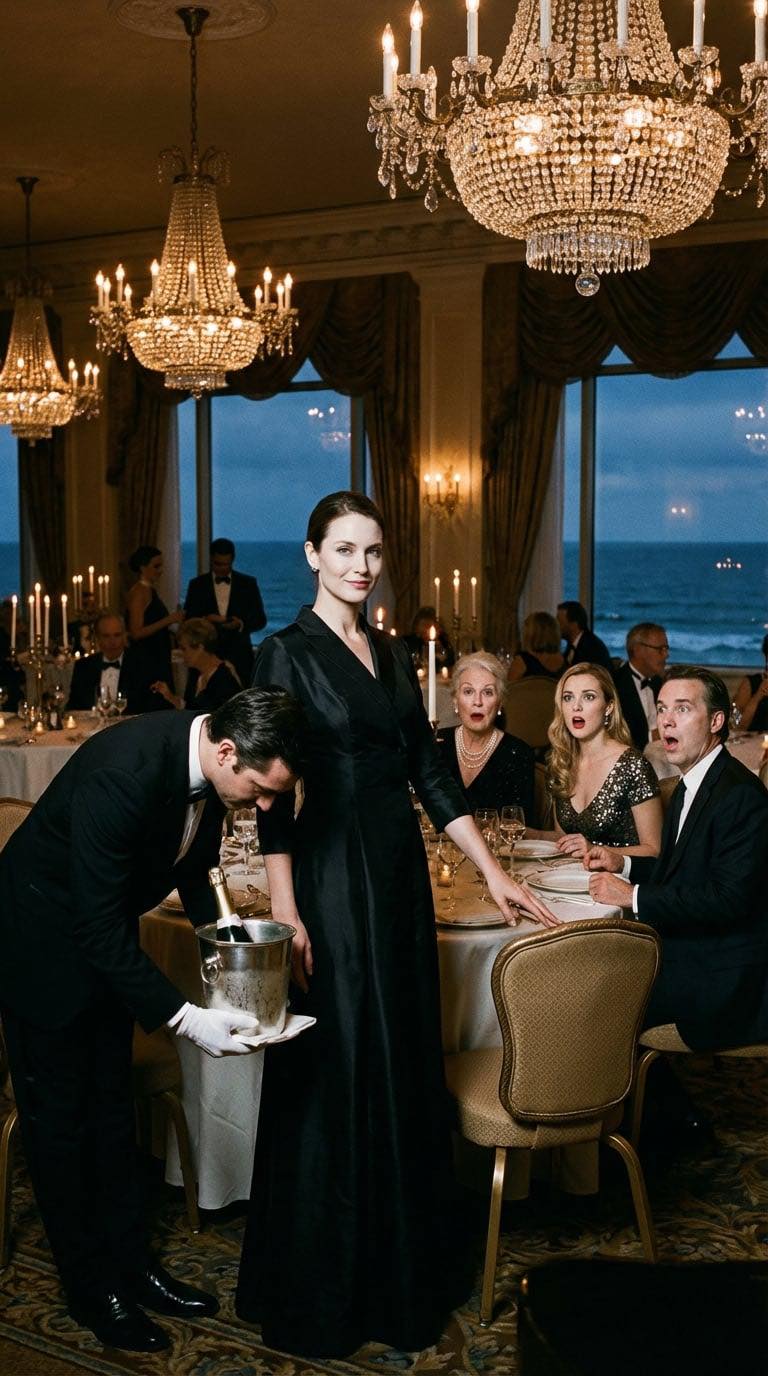
The Grand Ballroom of Hotel Miramar was a cathedral of light. Ten thousand crystals hung from the ceiling, reflecting the flickering glow of a thousand candles. It was the centerpiece of the reunion, the night the family dressed in their finest silks and highest heels to celebrate their own reflection.
I arrived late. Deliberately late.
I wasn’t wearing the “modest” rags they expected. I wore a tailored black gown I had designed myself—a garment of such architectural precision that it commanded the room the moment I stepped over the threshold.
“Finally, you show up,” Isabel snapped as I approached the table. She was wearing a gown that cost a year of most people’s salary, yet she looked small. “We were about to start the first course without you.”
I took my seat at the end of the table, but I didn’t hide behind the column this time. I sat tall.
Roberto was already on his third glass of vintage champagne. “I bought three properties on the coast last month,” he bragged to the cousins. “If I play my cards right, I might even make a move on a property like the Miramar. It needs a firm, masculine hand at the helm. Not like whatever phantom is running it now.”
“My husband has such business vision,” Lucia cooed. “Unlike those who are content drawing ‘corporate identities’ for local bakeries.”
My father raised his glass. “To the true successes of the family. To those who know how to build, not just dream.”
Everyone toasted. I kept my glass on the table.
“Carmen,” Daniela said, her voice trembling. “I saw you in the office again today. Why were you there?”
The table went quiet. Isabel’s eyes flicked to mine, sharp and suspicious. “What were you doing in the restricted wing, Carmen?”
“Investigating the history of the hotel,” I said casually, taking a sip of water. “Grandfather told me so many stories about his legacy. I wanted to see if they were true.”
“What would you know about legacy?” my father scoffed. “You can’t even afford a room with a view.”
At that moment, Miguel approached the table with three waiters in tow. They carried a silver tray with a bottle of Louis Roederer Cristal—a three-thousand-dollar bottle of champagne.
“Compliments of the owner,” Miguel said, bowing low.
“The owner?” Lucia gasped, her eyes widening. “Is he here? Did he send this to us because of my husband’s reputation?”
“He didn’t send it,” I said, my voice cutting through the air like a chilling wind. “I did.”
Roberto burst into a thunderous, braying laugh. “You? Carmen, you can’t even afford the cork! Stop making a fool of yourself. This is embarrassing.”
“What’s embarrassing, Roberto,” I said, leaning forward, “is your attempt to defraud my grandfather of this very hotel three weeks before he passed away. I’ve seen the emails to the holding company in Panama. I’ve seen the fake appraisals.”
The color drained from Roberto’s face so fast it was as if a plug had been pulled. My father dropped his fork; it clattered against the fine china like a gunshot.
“What are you talking about?” Isabel demanded, her voice rising to a shrill pitch. “Carmen, leave this table immediately! You are having a delusional episode!”
“I’m not leaving, Mother,” I said. “In fact, we’re all moving. Miguel, please show the family to the Grand Conference Room. Arturo Mendes is waiting.”
“The family lawyer?” my father whispered. “Why would Arturo be here?”
“Because,” I said, standing up and looking down at the people who had spent my life trying to make me feel small, “it’s time you found out who actually signed the check for your ‘free’ weekend.”
As we walked toward the conference room, my mother tried to grab my arm, her fingers digging in like talons. I shook her off with a look of such absolute authority that she recoiled. The power had shifted, and they could feel the floor falling away beneath them.
The conference room was cold, the air-conditioning humming with a clinical precision. Arturo Mendes, a man who had been my grandfather’s closest confidant for forty years, stood at the head of the table. He looked at my family with a professional coldness that made Isabel visibly shiver.
“Please, take your seats,” I said, gesturing to the front row.
“This is a joke,” Lucia hissed, though she sat down nonetheless. “Carmen is playing some twisted game because she’s jealous of our success.”
“Silence, Lucia,” Arturo barked. He opened a thick leather binder. “As many of you know, Don Ernesto supposedly sold Hotel Miramar to an anonymous trust six months prior to his passing. You were told this was a move to protect his assets during his illness.”
“Exactly,” my father said, regaining some of his bluster. “We were never told who the beneficiary of that trust was. We assumed it was a corporate entity.”
“It was not,” Arturo said. “The trust had a single beneficiary. Don Ernesto chose this person because they were the only one who didn’t view him as a bank account. They were the only one who shared his vision for what a ‘legacy’ truly means.”
He turned the folder around. On the first page, in bold, legal type, was my name. Carmen Elena Winthrop.
The silence that followed was absolute. It was the kind of silence that occurs after a massive explosion, before the screams begin.
“It can’t be,” my mother whispered. “He wouldn’t. I told him… I made sure he knew…”
“I know what you told him, Mother,” I said, pulling the yellowed letters from my bag and sliding them across the table. “I found your letters. I found the way you systematically lied to him to sabotage my future. I found the way you turned the family against me because you were afraid of how much I reminded him of himself.”
Isabel looked at the letters as if they were vipers.
“And you,” I said, turning to my father and Roberto. “I have the forensic trail of your attempt to steal the hotel. Grandfather knew. That’s why he changed the will. He knew that if he left it to you, you would sell the soul of this place for a quick profit.”
Roberto stood up, his face a mask of purple rage. “This is a conspiracy! You manipulated the old man while he was senile! You and this lawyer—”
“Roberto,” Arturo interrupted calmly, “Don Ernesto’s mental competency was verified by three independent neurologists the day he signed this. And if you’d like to discuss ‘conspiracies,’ we can discuss the fraudulent appraisal you filed with the IRS. I’m sure they’d be very interested.”
Roberto sat down. He looked like a punctured balloon.
Then, I opened the final envelope. The one Miguel had given me earlier.
“Grandfather left a final letter,” I said. “He asked that I read it to the family tonight. Six months after I had taken control. Six months after I had seen who you were without his shadow over you.”
I began to read. My grandfather’s voice echoed through the room.
“To my family: If you are hearing this, it means Carmen has endured your contempt for six months while holding the keys to my kingdom. I left her the Miramar because a legacy is not made of stone; it is made of character. Isabel, you spent your life trying to dim Carmen’s light because you were ashamed of your own lack of it. You were never a disappointment to me, but you became one when you chose to hurt your own child to feed your ego. Roberto, Lucia—you chase shadows and call it success. Carmen is the only one among you who builds. My final wish is that you look at her now. Not as the girl in the room by the laundry, but as the woman who has the power to either cast you out or bring you home. The choice to heal this family is now hers. May you deserve her mercy.”
My mother broke. A muffled sob escaped her, and she buried her face in her hands. My father looked at the floor, aged ten years in ten minutes.
I stood there, the owner of the Miramar, the woman they had mocked. I had the power to kick them out into the rain. I had the power to sue them for their fraud. I had the power to walk away and never look back. But as I looked at my mother’s shaking shoulders, I realized that revenge is a small, cold room. And I had spent enough of my life in Room 108.
The aftermath was not a swift resolution, but a slow, painful awakening.
In the weeks that followed, the family hierarchy shattered. Roberto was forced to resign from his firm after my legal team “clarified” some of his business practices. Lucia, stripped of her status as the family’s golden child, fell into a deep period of reflection that eventually led her back to school—this time for something she actually cared about, not just something that looked good on a resume.
My mother… that was the hardest part.
We sat together on the terrace of the Presidential Suite a month later. The same suite she had given to Lucia while stuffing me next to the laundry.
“Why didn’t you just throw us out, Carmen?” she asked, her voice hollow. “After what I did… after the letters…”
“Because, Mom,” I said, watching the sunset paint the ocean in hues of gold and violet, “Grandfather didn’t leave me the hotel to punish you. He left it to me to save us. He knew I was the only one strong enough to hold the mirror up to your faces.”
I didn’t give them shares of the hotel—not yet. I set up a family council. They have a voice, but I have the vote. Every share they earn is tied to their contribution to the hotel’s new philanthropic arm. My father coordinates our community outreach. Even Roberto has a job—he’s in charge of the expansion project, under Miguel’s very strict supervision. His ambition, once predatory, is now being channeled into something constructive.
As for Room 108, I didn’t get rid of it.
I turned it into a small, private gallery. It houses the original blueprints of the hotel, my grandfather’s journals, and the letters. It serves as a reminder that the most valuable things in life are often found in the places people overlook. It reminds me that I was once the girl who “settled for leftovers,” and that those leftovers were the seeds of an empire.
I am still a graphic designer. My agency, Winthrop Identities, operates out of the top floor of the hotel. I still “draw logos,” as Roberto used to say. But now, I design more than just brands. I design the way we live.
A year after the reunion, I stood in the lobby as a new group of guests arrived. I saw a young girl, standing off to the side, looking at her more confident sister with a familiar shadow of doubt in her eyes.
I walked over to her and handed her a small, hand-carved wooden bird—something my grandfather used to make.
“Don’t let them tell you where you belong,” I whispered to her. “The world is much bigger than the room they give you.”
She smiled, and for a moment, I saw the ghost of Don Ernesto in her eyes.
The Hotel Miramar is thriving. Not because of the luxury, but because of the truth that lives within its walls. We don’t just offer rooms; we offer a place to be seen.
My mother and I have lunch every Tuesday. It’s still awkward. There are still silences that taste of thirty years of resentment. But she looks at me now. She really looks at me. And for the first time in my life, I don’t see a smudge in her eyes. I see a daughter.
Grandfather was right. A legacy isn’t something you leave behind. It’s something you build, one brick of truth at a time. And as I look out over the Pacific, I know that the black sheep didn’t just find her way back to the fold.
She bought the field.