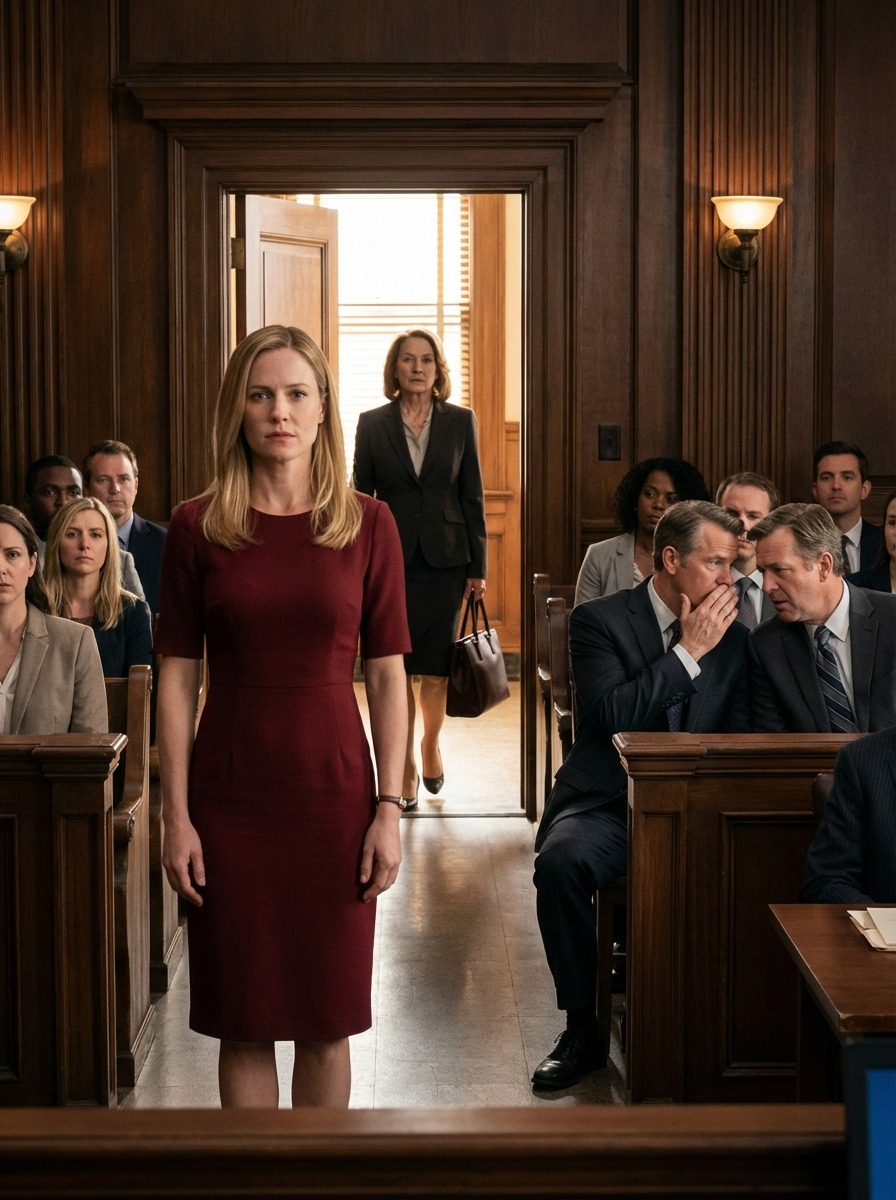
My name is Brianna Fox, and the moment I truly understood how fragile power could be happened inside a courthouse in northern Colorado, on a day when the sky outside was bright and clean while my life felt like it was being dissected under harsh fluorescent lights. The courtroom smelled of old varnished wood, paper dust, and bitter coffee that had been reheated too many times. Every sound echoed. Every footstep carried weight. I sat alone at the defense table, my hands folded carefully so no one would see them trembling, wearing a navy dress I had bought years earlier for a company dinner back when my marriage still looked successful from the outside.
Across the aisle sat my husband, Aaron Tate. He wore a crisp charcoal suit that cost more than my entire monthly grocery budget. His hair was neatly styled. His smile was relaxed. He looked like a man arriving for a meeting he already knew he would win. Beside him sat his attorney, a sharp featured woman with a leather briefcase and a pen that clicked with impatient confidence. They whispered together as if the room belonged to them.
When the clerk called the case, my heart thudded so loudly I wondered if anyone else could hear it. The judge asked for appearances. Aaron attorney stood smoothly and announced representation. Then the judge looked at me.
“And you, Ms. Fox. Do you have legal counsel today.”
I stood slowly, smoothing the fabric of my dress.
“No legal representation, Your Honor,” I said in a steady voice that did not reflect the storm in my chest.
A murmur rolled through the benches. Aaron did not even try to hide his amusement. He leaned back in his chair, crossing one ankle over the other, and looked directly at me with the expression he used whenever he believed he had complete control.
“With no money, no power, and no one on your side,” he said loudly, letting the words float through the room. “Who exactly is going to rescue you, Brianna.”
I met his gaze and said nothing. During our twelve year marriage, I had learned that silence could be a shield. He had stripped away my independence one careful decision at a time. He had convinced me to leave my job to raise our daughter. He had handled all the finances. He had discouraged friendships. He had told me that he alone knew how to protect our family. When I discovered his long running affair and asked for a divorce, he froze every joint account within hours. He wanted me frightened and dependent again. He wanted me to beg.
Instead, I sat quietly and listened.
His attorney began presenting documents, listing Aaron demands with clinical efficiency. Full ownership of the house. Primary custody of our daughter Chloe. A financial settlement so small it felt like a cruel joke. Each item was delivered like a verdict. Aaron watched me closely, waiting for me to break. He expected tears. He expected panic. He expected me to fold.
I gave him none of it.
The judge glanced at me several times, clearly anticipating that I would ask for a delay to secure counsel. I let the silence stretch just long enough to feel Aaron confidence swell.
Before I spoke, the courtroom doors opened.
The sound was soft. The effect was immediate.
A woman stepped inside with calm precision. She was tall, silver haired, wearing a tailored slate blue suit. Her posture was straight. Her eyes were sharp. Every conversation in the room stopped. Even the judge leaned forward slightly.
Aaron turned toward the door.
Color drained from his face. His relaxed smile vanished. His jaw slackened as recognition struck him.
Because he finally realized who had entered the room.
My mother.
Her name was Deborah Knight, a well known constitutional litigator whose name appeared in legal journals and televised panels. She had argued cases that changed state policy. She had spent decades dismantling men who believed authority made them untouchable. She had also respected my request for space when I married Aaron, even though she never liked him. She had waited quietly until I asked for help.
She walked forward without hesitation, heels striking the floor in a steady rhythm. She did not look at Aaron at first. She addressed the bench.
“Your Honor, I apologize for the brief interruption. Traffic was heavier than expected,” she said with composed politeness.
The judge straightened.
“Ms. Knight,” he said, his tone shifting immediately. “Please proceed.”
Aaron attorney stiffened. She knew exactly who my mother was.
Aaron leaned toward me, his voice barely above a whisper.
“Your mother,” he said, disbelief cracking through his words.
“Yes,” I replied calmly.

My mother finally turned her attention to him.
“Mr. Tate,” she said, as if greeting someone she had never bothered to remember. “I have reviewed the financial actions you initiated after filing for divorce. Freezing shared accounts. Transferring marital assets. Attempting to cut my daughter off from resources. These actions are not only unethical. They are actionable.”
Aaron attorney rose quickly.
“Your Honor, Ms. Knight is not listed as counsel of record.”
My mother handed documents to the court clerk with smooth confidence.
“I am now,” she replied. “Filed this morning.”
The judge reviewed the papers, nodded once, and said, “Representation acknowledged.”
The shift in power was immediate and undeniable. Aaron shoulders dropped. His confident posture collapsed inward. He suddenly looked like a man who had miscalculated a dangerous game.
The hearing resumed. Only now, my mother controlled the rhythm.
She dismantled Aaron requests with methodical precision. She presented evidence of hidden investment accounts he believed were secret. She revealed property transfers designed to mask marital funds. She introduced communication records showing that his affair overlapped with key custody decisions. She laid out patterns of financial coercion that painted a clear picture of manipulation rather than protection.
The judge expression hardened with each revelation.
Aaron tried to speak once.
“Brianna never contributed financially,” he said, his voice cracking slightly. “I built everything.”
My mother did not raise her voice. She did not need to.
“She contributed by raising your child, maintaining your household, and enabling your career advancement. The law recognizes that contribution as equal value,” she said.
Aaron opened his mouth again. Nothing came out.
By the end of the session, the judge ordered a full forensic financial review. Temporary spousal support was reinstated immediately. Joint custody was established pending further investigation. Aaron was warned clearly that any further financial interference would result in sanctions.
When the gavel struck, the sound felt like a door closing on a chapter that had dominated my life for over a decade.
As we gathered our papers, Aaron did not look triumphant anymore. He did not look superior. He looked cornered.
Outside the courthouse, the afternoon sun felt strangely gentle. I stood on the steps and drew in a deep breath, as if breathing freely for the first time in years. My mother stood beside me, her expression softer now that the courtroom battle was over.
“You never had to do this alone,” she said quietly.
“I needed him to believe I was powerless,” I replied. “I needed him to reveal exactly who he was.”
She nodded, understanding more than I could express.
Aaron exited the building moments later. His tie was loosened. His suit jacket was wrinkled. His eyes were hollow. He passed us without a word. He could not speak. The version of himself he had built on control and certainty had crumbled in public view.
The weeks that followed were exhausting. Financial auditors uncovered more hidden assets. Emails confirmed patterns of manipulation. Testimonies from former employees described how he bragged about keeping me dependent. Each discovery tightened the consequences around him. The final settlement reflected fairness rather than domination. I kept my share of the assets. I retained stable custody of Chloe. I secured independence.
But the story did not end with victory in court.
It continued in quieter places. In a small apartment I chose myself. In mornings when I made breakfast without fearing criticism. In evenings when Chloe and I read stories together without tension in the walls. In therapy sessions where I learned that control disguised as love is still control. In phone calls with my mother where we rebuilt closeness that had faded over the years.
One night, months after the ruling, Chloe asked me something unexpected as I tucked her into bed.
“Mom,” she said, “were you scared in the courthouse.”
I smiled softly.
“Yes,” I admitted. “Very scared.”
“Then why did you look so calm,” she asked.

I thought for a moment.
“Because sometimes bravery is doing something while you are scared,” I told her. “Not because you are fearless. But because you refuse to let fear decide your future.”
She nodded sleepily and closed her eyes. I sat beside her for a while, listening to the quiet hum of safety that now filled our home.
My story is not about revenge. It is not about humiliation. It is about understanding that power is not always loud. It is not always visible. It can wait quietly until the right moment. It can appear when someone finally asks for help. It can walk through a courtroom door in a calm blue suit and change the entire direction of a life.
Aaron believed silence meant weakness. He believed dependence meant victory. He believed isolation meant ownership. He was wrong.
I was never powerless. I was simply preparing.
If someone reading this has ever been underestimated, dismissed, or laughed at for standing alone, remember this. Alone does not mean unprotected. Silence does not mean surrender. And strength does not always announce itself before it arrives.
Sometimes, the truth simply walks through the door.