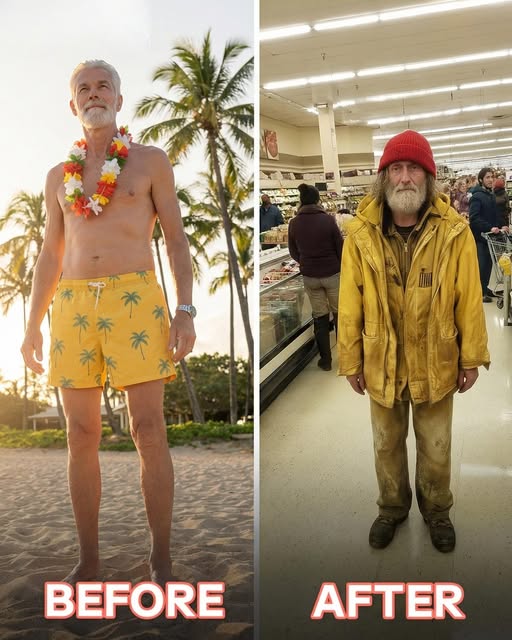
My name is Hutchins. I am ninety years old.
For seventy of those years, I built a business most people recognize before they recognize me. What began as a single, dim corner grocery after the war—one aisle, one register, and my own hands stocking every shelf—grew into the largest grocery chain in Texas. Hundreds of stores. Thousands of employees. More money than a boy like me ever imagined while sweeping floors at dawn and counting coins at night.
People assume success fills the empty places in a life.
It doesn’t.
My wife died in 1992. We never had children. No birthdays cluttered with wrapping paper. No grandchildren racing through hallways. Just a house so large it echoed when I walked through it alone. Fifteen thousand square feet of silence. Marble floors that felt colder each year.
One night, sitting in that house, I asked myself a question that refused to let me sleep.
Who deserves all of this when I’m gone?
I’d seen inheritances tear families apart. Smiles at funerals, lawsuits a week later. People who hugged you while calculating what your death might buy them. I wanted no part of that. If everything I built was going to outlive me, it needed to land in the hands of someone who valued people more than power.
So I decided to disappear.
Not quietly. Not comfortably.
I shaved my head badly. Glued on a filthy, uneven beard. Pulled on ripped clothes that smelled like dust and neglect. I rubbed dirt into my hands and face, grabbed an old cane, and finished the job by spraying myself with spoiled milk. When I looked in the mirror, I didn’t see a billionaire.
I saw a man the world pretends doesn’t exist.
That was the point.
I walked into my flagship supermarket, the one with my name engraved on a bronze plaque near the entrance. The store gleamed. Polished floors. Bright lights. Order and efficiency. Everything I’d worked for.
No one recognized me.
The looks came immediately. Sharp. Appraising. Disgusted.
A cashier leaned toward another employee and whispered, “He smells like something died.”
A man pulled his child closer and murmured, “Don’t stare.”
Then a floor manager approached. Someone I had personally promoted years earlier.
He didn’t ask if I needed help. He didn’t lower his voice.
“Sir,” he snapped, “you need to leave. Customers are uncomfortable. We don’t want your kind here.”
Your kind.
I built the walls around him. Signed his promotion papers. Paid for the lights over his head.
But the insult wasn’t what stung.
The clarity did.
This was how my empire treated people when it believed no one important was watching.
I turned toward the exit, my experiment already confirming the worst parts of my suspicion.
Then someone grabbed my hand.
Not timidly. Firmly. Like it mattered.
I turned around.
She was young, mid-twenties at most. Wearing a faded apron, tired sneakers, hair pulled back without vanity. Her name tag read Maria. She’d been stocking shelves nearby and must have seen everything.
She looked straight at me and asked quietly, “Sir, are you okay?”
No pity. No judgment. Just concern.
Before I could answer, she slipped something into my palm.
A granola bar.
“I don’t have much,” she whispered, “but you shouldn’t be hungry.”
The floor manager barked her name. “Maria, get back to work!”
She nodded once. No argument. No drama. Before stepping away, she leaned closer and said, “Please take care of yourself.”
Then she walked off.
I stood there holding that granola bar like it was something precious.
No cameras. No applause. No one watching.
Just a choice.
I left the store without a word.
That night, I couldn’t stop thinking about her. Not because she broke policy, but because she followed something deeper than policy. Something most people bury early because it’s inconvenient.
Over the next few weeks, I visited other stores. Different disguises. Same test.
I saw indifference dressed up as procedure. Cruelty disguised as professionalism. People enforcing rules without humanity.
And every time, Maria’s face came back to me. Quiet courage. Uncalculated kindness.
I asked my legal team to look into her, quietly.
Single mother. Two children. Double shifts. No complaints. No write-ups. Volunteers at a food pantry on weekends. Never once asked for recognition.
She didn’t know my name.
But I knew hers.
A month later, I invited her to corporate headquarters.
She nearly didn’t come. Thought she was in trouble.
When I walked into the room clean-shaven and wearing a tailored suit, confusion crossed her face. Then recognition. Then shock drained the color from her skin.
“It was you,” she whispered.
I nodded.
She immediately began apologizing, words tumbling out. She said she hadn’t meant to break rules, that she could explain, that she’d never do it again.
I stopped her.
“You passed,” I said.
She blinked. “Passed what?”
“My final test,” I replied.
I told her everything. About the disguise. The visits. The question that kept me awake at night. About how kindness without witnesses mattered more to me than profits ever had.
Then I told her she would inherit the majority of my estate, with clear conditions: investment in employees, humane training, community food programs, dignity written into every policy.
She cried harder than I’ve ever seen anyone cry.
She didn’t ask how much.
She asked, “Are you sure?”
That was the moment I knew.
Money doesn’t warm a bed. It doesn’t answer silence.
But knowing everything I built will live on through someone who squeezed a stranger’s hand when it mattered—that finally gave me peace.
For the first time in years, I slept without the echo of my own footsteps keeping me awake.