Prom night is traditionally marketed as a glittering rite of passage, a cinematic evening of satin gowns, expensive tuxedos, and the fragile, youthful illusion that the world is an organized and predictable place. For most of my classmates, the goal was to find the “perfect” date to complete a social tableau. But for me, the choice was simple, though it defied every convention of high school tradition. My world has always been anchored by a single, formidable woman: my grandmother, Evelyn. She was not just my guardian; she was the architect of my survival and the curator of my joy. When my mother passed away giving birth to me and my father remained a ghost in my history, Evelyn stepped into the void without a moment’s hesitation.
By day, she was a fixture of my high school in a way most students overlooked—she worked as a janitor, her hands calloused from decades of pushing heavy brooms and scrubbing the very desks where I sat to learn. By night, she was the woman who read me stories until I fell asleep, the chef who turned every Saturday morning into a celebration with a stack of pancakes, and the silent, steady presence at the back of every school play and award ceremony. Her love was a quiet, unwavering force, a steady drumbeat that filled the cavernous spaces where a traditional family should have been.
When the time came to select a date for the senior prom, I realized that taking anyone else would be a disservice to the person who had actually walked every mile of my education with me. When I asked her, Evelyn laughed—a soft, musical sound that carried a hint of sadness. “Oh, sweetheart,” she said, smoothing the apron she wore. “That night is for the young and the beautiful. I’ll just stay home with my programs and wait for you to come back and tell me all about it.” But I wouldn’t take no for an answer. I told her that no one had shaped my character more than she had, and that the milestone of graduation wouldn’t feel like a victory if she wasn’t there to share the spotlight. Eventually, with a mixture of terror and pride, she agreed.
The evening of the prom was a study in contrasts. While my peers arrived in rented limousines and designer labels, Evelyn and I arrived in her modest, aging sedan. She had unearthed a floral dress she had kept carefully preserved for years—a garment from another era that she apologized for incessantly, fearing it wasn’t “nice enough” for the glittering ballroom. To my eyes, however, she was radiant. Her beauty wasn’t the fleeting, polished kind found in magazines; it was the kind forged in the fires of resilience and dignity. Yet, as we stepped into the hall, the atmosphere shifted. The room was a sea of shimmering sequins and expensive cologne, and as we moved through the crowd, the air began to hiss with the sound of whispers.
The cruelty of teenagers is often born of a lack of perspective, a failure to see the person beneath the label. To many in that room, Evelyn wasn’t a hero; she was “the janitor,” a woman out of place in their curated fantasy. I could see the mockery in their eyes and hear the stifled laughter as we walked toward our table. I felt Evelyn’s hand tremble in mine, her shoulders beginning to hunch as she tried to make herself smaller, as if she could disappear into the floral patterns of her dress. I felt a surge of protectiveness that was sharper than any embarrassment. I knew that if I didn’t act, this night—a night I had intended as a tribute—would become a wound she would carry forever.
I gently squeezed her hand, led her toward the center of the room, and then made a beeline for the DJ booth. With a polite but firm gesture, I signaled for the music to stop. The silence that followed was heavy and uncomfortable, a vacuum that demanded an explanation. I took the microphone, my heart hammering against my ribs like a trapped bird, and looked out at the sea of faces—classmates I had known for years, teachers who had seen me grow, and parents who lived in a world of privilege Evelyn helped maintain.
“I know many of you are wondering why I brought my grandmother to prom tonight,” I began, my voice trembling but gaining strength with every word. “And I know some of you find it funny. But before you laugh, I want you to know who you’re looking at.”
I told them her story. I told them about the woman who scrubbed these very floors so I could have a clean place to study. I spoke about the midnight reading sessions, the Saturday morning pancakes, and the way she had worked double shifts to ensure I never felt the sting of what we lacked. I spoke about the dignity she brought to a job that many of them considered beneath notice. “She taught me that responsibility isn’t a burden; it’s a privilege,” I said, looking directly at the group that had been whispering. “She taught me that love isn’t about what you can buy, but what you are willing to give up. She is my hero, my mother, and my best friend, and I am the luckiest person in this room because I get to stand beside her.”
The silence that followed was no longer uncomfortable; it was reflective. I saw a teacher in the front row wipe away a tear. I saw parents stand up, their faces softening with a sudden, sharp realization of their own blessings. And most importantly, I saw the students who had mocked her lower their heads, the weight of their own shallow behavior finally settling on them. A slow, steady wave of applause began at the back of the room and surged forward until the entire hall was on its feet.
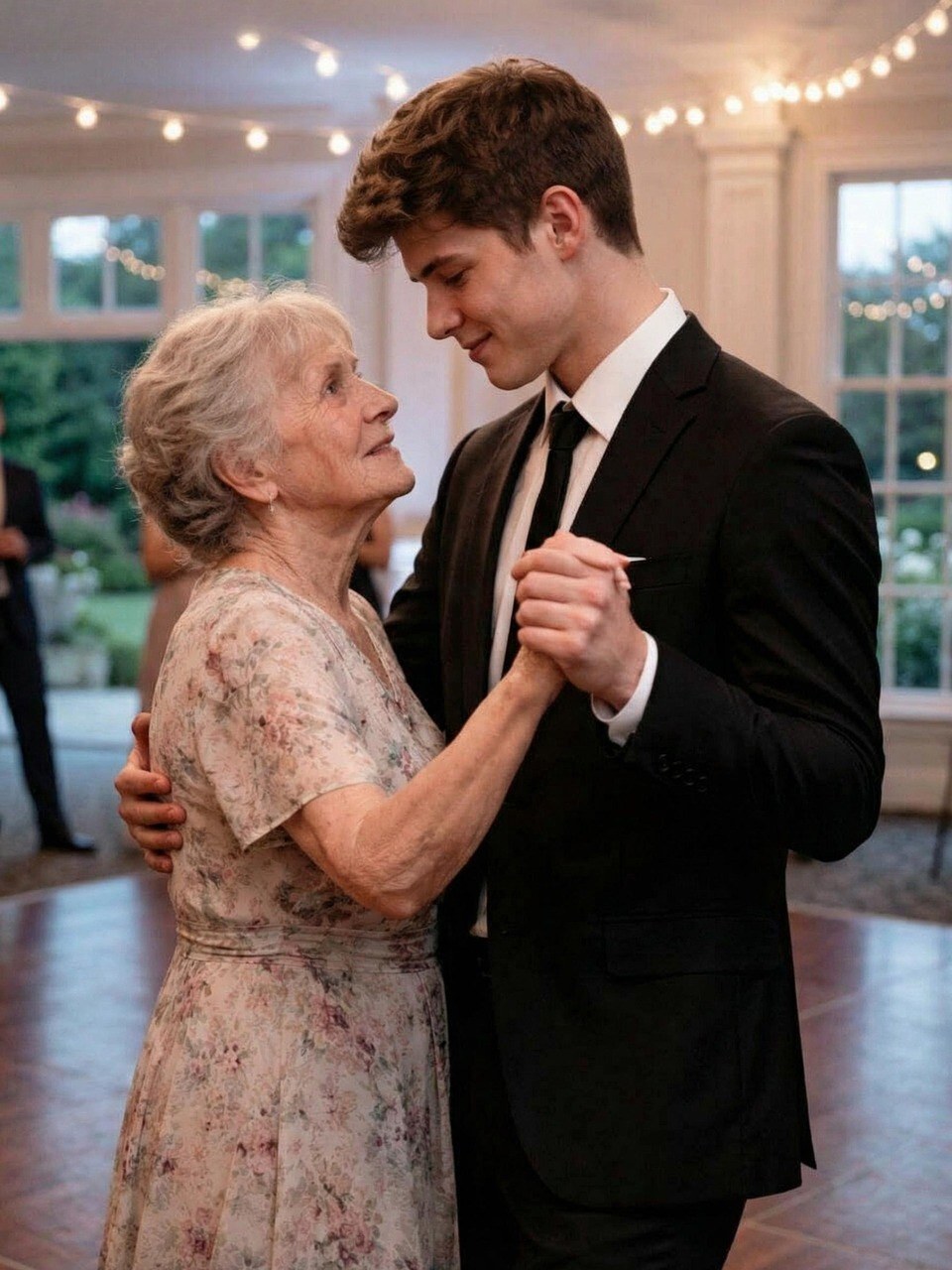
I set the microphone down and walked back to Evelyn. She was crying, but for the first time in years, she wasn’t trying to hide her face. She looked tall. I offered my hand and bowed slightly. “May I have this dance, Evelyn?” I asked. She nodded, her smile breaking through the tears like sun through a storm.
As the music began—a slow, soulful melody—we danced. We weren’t just a boy and his grandmother moving in circles; we were a testament to the power of seen and unseen labor. Classmates began to join us on the floor, some coming up to Evelyn to shake her hand or offer a kind word. That night, the prom didn’t belong to the popular or the wealthy; it belonged to the woman who had spent her life making sure others had a clean path to walk on.
I learned something vital on that dance floor: life is not about the approval of the crowd or the perfection of the image. It is about honoring the people who poured themselves into the empty spaces of your life until you were whole. As the final song played and the lights dimmed, Evelyn didn’t look like a janitor in an old dress. She looked like exactly what she was—the queen of the ball, standing exactly where she belonged.