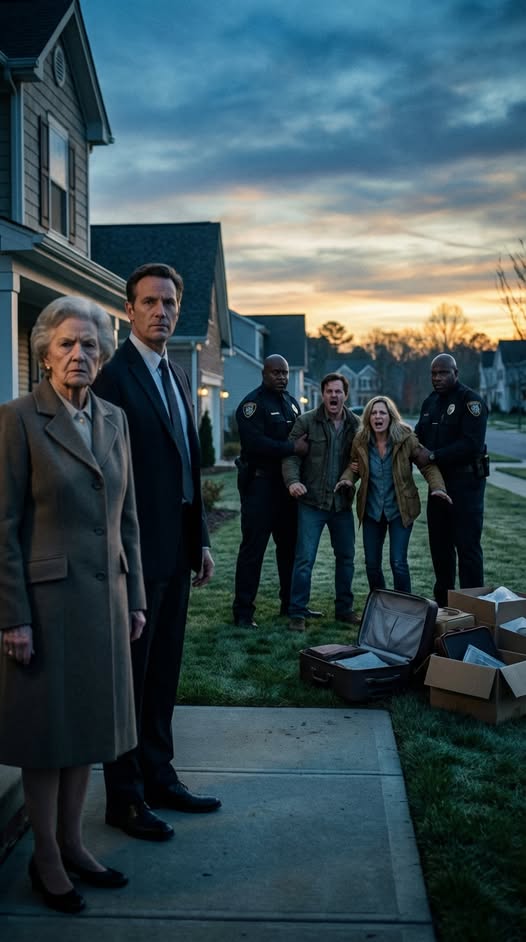
My leg was throbbing, a deep, rhythmic pulsation that felt as though a rusted nail were being slowly twisted into the marrow of my knee. The air in the living room was stagnant, heavy with the oppressive heat of a coastal summer that had forgotten how to breathe. My mouth felt as dry as cracked earth under a scorching sun, a desert thirst that made my tongue stick to the roof of my mouth.
I looked at the coffee table, just out of reach. A pitcher of water sat there, sweating condensation, the droplets sliding down the glass like tears.
“Linda, honey,” I called out, my voice slightly hoarse, carefully modulating my tone to ensure it carried no hint of a command. I have always believed that the right words, spoken softly, can prevent fires. “Could you pass me a glass of water, please?”
It was not an order. It was not a complaint. It was a small favor, the kind you might ask a stranger on a bus without a second thought.
The silence that followed lasted only two seconds, but it stretched in the room like a taut, vibrating thread. Linda, my daughter-in-law, was resting her feet on that very table, her phone in hand, laughing at some triviality on the screen. Michael, my son—the boy I had led by the hand to school under sun and rain, the man I had raised alone after his father died—was sunk into the sofa next to her, watching television without really seeing it.
Linda sighed. It was a long, theatrical exhalation, loaded with annoyance, as if I were a persistent fly buzzing near her ear. She lowered the phone with agonizing slowness and turned her head to look at me.
In her eyes, there was no affection. There was no respect. There was only a cold, hard contempt.
“Get up and get it yourself, you useless old woman,” she screamed.
The sound of the scream bounced around the living room, sharp and jagged. “This is not a hotel!”
I felt the blow as physically as if I had been slapped across the face. The air left my lungs for a second. My heart hammered against my ribs, not from fear, but from a sudden, shocking clarity. I looked for my son. I looked for Michael.
He did not look at me. He lowered his head, fixing his gaze on the carpet, shrinking into the cushions. He remained silent.
That silence was worse than the scream.
I clenched my teeth so hard my jaw ached. I leaned my trembling hands on the arms of the beige reading chair—the one I had bought before Michael got married, back when this house was a sanctuary, not a battleground—and pushed my body up. My knee crunched, a sickening sound of bone on bone. The pain rose in waves, blinding and white-hot, but it did not stop me.
I walked.
I moved slowly to the table, dragging the heavy leg. Linda had already returned to her cell phone, a little smile of victory curling at the corner of her lips. She thought she had taught me a lesson. She thought she had put the “useless old woman” in her place.
I took the pitcher with a trembling hand. I poured the water without spilling a single drop. I drank standing up, feeling the cold liquid rush down my throat, quenching the thirst but lighting something else in my stomach—a different kind of flame. It was a cold blue flame, the kind that burns without smoke.
“Good night,” I said. My voice was unrecognizable to my own ears—firm, metallic, stripped of all warmth.
I turned my back and walked down the hall. I did not look at anyone. I went into my room and closed the door. Then, for the first time in eighteen years, I turned the key in the lock.
I had never locked my door. I had always thought Michael might need me. That night, sitting on the edge of the bed in the semi-darkness, illuminated only by the yellow wash of the streetlight outside, I understood the truth. The person who had needed me was no longer there.
I looked at the solid wood closet. Up on the top shelf, behind some heavy wool blankets we almost never used in this heat, was an old shoebox. I got up, ignoring the protesting scream of my knee. I dragged the little stepping stool over and climbed up carefully. I took the box and brought it down as if I were carrying a religious artifact.
It was my life on paper.
My name is Emily Henderson. I am seventy-two years old. I was a labor and delivery nurse for four decades. I helped bring children into the world and held cold hands during their last breath. I worked double shifts, entire nights, weekends and holidays. I missed family parties, birthdays, my own fading youth. All to get my son ahead. All to buy, brick by brick, this house near the ocean where they now called me “useless.”
I opened the box. The smell of stored paper rose like a memory—dry, dusty, and official.
There were the deeds in my name, clear and firm. And there was the hardcover notebook. The Red Notebook.
I had started using it almost without realizing it, noting down every expense I made since Linda and Michael had come to stay “for a few months” after the wedding. The months had turned into years. The guest had started believing she was the owner. I became a shadow in my own home. I avoided the living room when Linda watched TV. I avoided cooking when she said garlic gave her nausea. I shrank to fit into the cracks of their lives, thinking I was helping my son.
I saw Michael become small, walking on eggshells so as not to bother her, and I accepted it out of fear of loneliness.
But tonight, the fear had changed shape.
I looked at the clock. The hands marked 2:00 AM. Outside, the house slept. Inside me, something woke up with a clarity I had not felt since my days in the ER, when a patient crashed and you had to act without shaking.
I took my cell phone, the one with the big buttons that Linda mocked for being outdated. I searched for a name saved years ago.
Mr. Davis, Attorney.
I dialed. It rang once, twice, three times.
“Hello?” answered a sleepy, gravelly voice.
“Mr. Davis,” I said. “Sorry for the time. This is Emily Henderson.”
There was a brief silence, the rustle of sheets, and then a change of tone. “Miss Emily? Are you okay? Is it your health?”
“Within reason, yes,” I answered. “The problem is something else. I need you to help me get my house back.”
On the other side of the line, I heard the distinct click of a lamp turning on. “Miss Emily,” he said, fully awake now. “Tomorrow morning we can—”
“No,” I cut him off. “Now. I want to start now.”
I pressed the deeds against my chest. Useless old woman, she had said.
I smiled, a small and cold gesture in the dark. They did not know who they were dealing with. They did not know that when one has worked all their life in delivery rooms and emergency wards, one learns to distinguish what can be cured and what must be cut to save the body.
“Tell me what to do,” I whispered. “I am ready to operate.”
————-
The dawn arrived without asking permission. At 5:30 AM, my body did what it had learned during decades of shifts: it woke up alone. The pain was still there, installed in my knee like an old, rusty nail, but there was something different in the air. It was not relief. It was determination.
I walked barefoot to the kitchen, trying not to make noise. The house was wrapped in that deceptive silence that only exists when someone sleeps, convinced that everything will stay the same forever. The living room seemed frozen in the scene from the night before. The empty glass on the table, the dirty mark of Linda’s feet on the furniture I had paid for in monthly installments, the throw pillows tossed around like debris.
It was not just disorder. It was conquered territory.
I opened the window to let in the salty air. The sea breeze entered timidly, as if asking permission. I thought about how ironic it was: outside, there was freedom; inside, a weight that suffocated.
I made black coffee, strong, exactly how I liked it. While the coffee pot bubbled, spitting its dark venom, I opened the refrigerator.
Expensive cheeses. Craft beers. Takeout containers from high-end Thai restaurants. I do not eat these things. I looked for my medicines and found them shoved in a corner, behind a stack of gourmet yogurts.
I closed the door carefully. On the counter next to the microwave were the unopened bills: electricity, internet, water. I took them and put them in a row. The red banner on the electric bill announced a “High Usage Rate.” Of course—the air conditioning ran day and night, even when no one was home.
I sat down and started adding up. Not with rage. With method. The nurse I once was made herself present; when there is a hemorrhage, you quantify the blood loss. Each number I wrote was one less drop of naivety. I had been supporting two healthy adults who treated me like a nuisance.
That was not family. That was a drain.
I took my cell phone and walked to the modem. I looked at the flickering blue lights as if they were an artificial life support system. I called the cable company.
“Yes,” I told the operator. “I want to downgrade the package to basic. No, remove the sports channels. Remove the movie pack. And change the Wi-Fi password.”
I gave them a new password, one I repeated under my breath like a mantra: Dignity1954.
I felt a strange peace settle over me. Next, I opened the banking app. I looked for the additional credit card under Michael’s name.
Cancel. Confirm. Done.
There was no drama. There was no noise. Just a click.
At 8:00 AM, Linda came out of the room dressed to go to the gym. She looked at me with suspicion, seeing me sitting at the table with papers spread out.
“What are you doing?” she asked, her voice thick with sleep.
“Accounts,” I answered without looking up. “Mine.”
“Ugh,” she grunted, a sound of dismissal. “Don’t stress yourself out.”
I did not answer. Michael appeared behind her, yawning, scratching his stomach. “Mom, is everything okay?” he asked.
I looked him in the eyes. I saw tiredness, yes, but also comfort. The comfort of someone who lets others carry the difficult decisions.
“Everything is in order,” I said. “For now.”
They left. When they returned at noon, the atmosphere changed instantly. Linda slammed her car keys on the table.
“There is no internet,” she announced, her voice rising. “I can’t load anything. Is there maintenance?”
“I answered calmly, continuing to sip my tea. “That is what they said.”
“And the card,” Michael insisted, looking panic-stricken. “It didn’t go through at the gas station. It was embarrassing, Mom.”
“I canceled it,” I said, looking him dead in the eye. “It is no longer necessary.”
Linda let out an incredulous laugh, a sharp bark of sound. “Are you joking?”
I did not blink. “I am not joking.”
The silence stretched, elastic and dangerous. Michael opened his mouth, then closed it. Linda took a step forward, invading my personal space.
“And what are we supposed to do?” she demanded. “Starve?”
I looked at her with absolute serenity. “This is not a hotel,” I said, echoing her words from the night before. “Everyone takes care of their own.”
It was like striking a match in a room full of gasoline. Linda turned red.
“That is cruelty!” she shouted. “You cannot do this!”
“I can,” I answered. “And I will.”
She stormed off, slamming the bedroom door so hard the pictures on the wall rattled. Michael stood there for a few seconds, doubting, caught between the wife he feared and the mother he had betrayed.
“Mom,” he started.
“Not today, son,” I interrupted him, raising a hand. “Not today.”
I closed my bedroom door and leaned my back against it. I felt the trembling in my hands, but I did not back down. I knew the next move would not come from me, but from them. When the supply is cut, the true face appears.
The afternoon fell thick, with a leaden sky that announced rain without fulfilling the promise. The air was still, as if the house itself was holding its breath, waiting for the next blow.
In the kitchen, I prepared only what I needed for myself. White rice, a boiled egg, fresh water. I put my plate on the small folding table in the corner, the one that had always been relegated because Linda preferred to eat on the sofa. I ate in silence, savoring every bite. It was not a gourmet meal, but it tasted of independence.
Linda came out of the room with her cell phone in her hand, visibly irritated.
“The Wi-Fi still isn’t working,” she snapped. “What did you do?”
“I called the company,” I answered. “They said the bill is in my name, so the service is my choice.”
“That is a lie!” she exploded. “Do you think I am stupid?”
I looked up slowly. I looked at her without challenge, without fear.
“No,” I said. “I think you are upset.”
“Of course I am upset!” she shouted. “This is abuse! Michael!”
Michael appeared behind her, frowning, looking haggard. “Mom, she already asked. Don’t make this bigger.”
“I am not making anything bigger,” I replied. “I am doing what is necessary.”
Linda let out a sarcastic laugh. “Necessary for what? To punish us?”
“To set boundaries,” I said. “So that everyone takes charge of their life.”
“And what about us?” asked Michael. “Are you going to leave us like this?”
I took a deep breath. The air filled my chest slowly. “I am not leaving you,” I said. “I am giving you back what is yours: responsibility.”
Linda took a step back as if my words had physically pushed her. Her eyes narrowed. “This doesn’t stay like this,” she threatened. “I am going to talk to my mom. With my uncles. With whoever.”
“Do it,” I answered, returning to my egg. “Talking costs nothing.”
———–
The next morning, the strategy shifted. The anger was replaced by something more insidious: concern.
At noon, the phone rang. It was Michael.
“Mom,” he said, his voice laced with caution. “Linda is saying that you are… that you are not well. That maybe you need help.”
I felt a prick in my chest, not of surprise, but of confirmation. I had seen this card played so many times in the hospital. When the matriarch becomes inconvenient, she becomes “confused.”
“She thinks that, does she?” I asked.
“She says that… that you get confused. That you forget things. That you are acting erratically.”
“Do you believe that?” I asked directly.
There was a long silence on the line.
“No,” he finally admitted, his voice small. “But I am afraid that this is getting out of control.”
“It got out of control a long time ago,” I answered. “But don’t worry. I am putting it back in order.”
I hung up without waiting for an answer. I sat on the bed and let the silence do its work. I knew what was coming. They were going to try to declare me incompetent. It was the nuclear option.
I took out the Red Notebook and checked the pages. Everything was there. Dates, amounts, signatures, stapled receipts. I took out the deeds and put them next to the notebook. Two pieces of a single truth.
In the afternoon, Mrs. Cooper, my neighbor of twenty years, knocked on the door. I let her in.
“Emily,” she said in a low voice, looking over her shoulder. “Your daughter-in-law is outside on the phone. She is saying ugly things. She’s telling people you’re losing your mind.”
“I know,” I answered, pouring her a cup of tea. “And it does not worry me.”
Mrs. Cooper looked at me carefully. She saw the set of my jaw, the clarity in my eyes. “If you need someone to say what they see,” she added, squeezing my hand, “I am here.”
“Thank you, Margaret.”
At 9:00 AM the next day, Linda came out of her room with a face I did not know. It was a mask of tense, rehearsed calm. Michael came behind her, serious, frowning.
“Mom,” he started. “We have to talk.”
“Sure,” I answered, gesturing to the table where my documents lay. “Sit down.”
Linda took the floor without looking at me. “I talked to my family,” she said. “They are worried about you.”
“About me?” I asked gently.
“Yes,” she continued, gaining confidence. “They say that lately you act strangely. That you cut services, that you cancel cards, that you lock yourself in your room. That maybe you are not in a condition to make decisions alone.”
There it was. The doubt sown, the suspicion wrapped in fake worry.
“Is that what they say?” I asked.
“They say we should seek help,” added Michael, uncomfortable, shifting in his seat. “Someone to evaluate you.”
I stayed silent for a few seconds, not to think of what to say, but to decide how to say it. I opened the notebook and spun it around so it faced them. Then I placed the deed next to it. Two simple, heavy objects.
“Linda,” I said. “Do you remember when I bought this house?”
She did not answer.
“Eighteen years ago,” I continued. “With my money. Here is the deed. My name. Do you see it?”
She looked sideways. “That is irrelevant,” she said.
“It is relevant,” I answered. “And now the notebook.” I opened to a marked page. “Here is the sofa you chose.
2,400∗∗.Hereisthepremiuminternetpackagewiththesportsbundle.∗∗2,400∗∗.Hereisthepremiuminternetpackagewiththesportsbundle.∗∗180 a month. Here is the repair of Michael’s car after he hit the post.
1,200∗∗.HereisthegourmetsupermarketrunfromlastweekwithproductsIdidnottouch.∗∗1,200∗∗.HereisthegourmetsupermarketrunfromlastweekwithproductsIdidnottouch.∗∗450.”
Linda frowned. “You are watching me,” she accused. “That is sick.”
“No,” I said. “It is accounting.”
Michael leaned forward, looking at the pages, his eyes widening as he saw the totals. “Mom,” he murmured. “All this…”
“All of it,” I answered. “For three years.”
The silence fell like a heavy blanket. Linda stood up suddenly, her chair screeching against the floor.
“This is manipulation!” she shouted. “She is trying to scare us!”
“No,” I said. “I am showing facts.”
Linda took a deep breath. She changed her tone again. Her voice became sweet, cloying, almost pleading.
“Miss Emily,” she said. “Look, I understand that you are sensitive. Age… hormones… but you cannot kick us out into the street like this.”
I looked at her fixedly. “Do not call me that,” I answered. “Call me by my name.”
“Emily,” she corrected, forced. “Michael is your son. Are you going to destroy your family?”
I felt the blow. It was the exact point where she knew it was going to hurt. Even so, I did not back down.
“I am not destroying anything,” I said. “I am correcting something that got twisted.”
Linda took a step forward, lowered her voice to a poisonous whisper. “If you insist,” she hissed, “we are going to ask that you be evaluated. That they determine if you are capable. I know a lawyer.”
Something inside me hardened into diamond. It was not rage. It was absolute clarity.
“I also know one,” I answered.
I took my cell phone and dialed. I put the call on speaker.
“Mr. Davis,” I said. “Can you come this afternoon?”
The voice on the other side was immediate and sharp. “In two hours,” he answered. “I will bring everything.”
Linda turned pale. “What are you doing?” she demanded.
“Protecting myself,” I answered.
The two hours passed slowly. Linda walked from one side to the other, muttering. Michael sat down, got up, sat down again. I stayed in my chair, reading, waiting.
When the doorbell rang, no one moved. It was me who opened it.
Mr. Davis entered with a leather folder under his arm. He greeted me with respect, then looked at Linda and Michael with distant professionalism.
“Good afternoon,” he said. “Miss Emily, can we proceed?”
“Sure,” I answered.
We sat down. The lawyer opened the folder and began to speak with clear words, without detours.
“The house belongs exclusively to Miss Emily Henderson,” he explained. “There is no lease agreement or written lending contract. The eviction notice is ready.”
Linda stood up. “This is abuse!” she shouted. “She is not well!”
The lawyer looked at her calmly over his spectacles. “If you question her capacity,” he said, “you will have to prove it in court. And I tell you something in advance: The lady has her documents in order, her accounts clear, and witnesses.”
“Witnesses?” asked Linda.
“Neighbors,” I answered. “Mrs. Cooper. And receipts. Thousands of dollars of receipts.”
Linda looked at me as if she did not recognize me. She looked at the woman who had made herself small for years and saw, finally, the giant who had raised a child alone.
Michael lowered his head. “Mom,” he whispered. “I did not know.”
“Now you know,” I answered.
The lawyer closed the folder. “Tomorrow,” he announced, “the formal notice will be delivered by a process server. I suggest you prepare.”
—————-
The doorbell rang at 6:20 PM the next evening with that uncomfortable punctuality that leaves no room for doubt. It was not a nervous or rushed ring. It was firm, professional—the sound of the law arriving.
I was sitting in my armchair with the notebook closed on my lap. Linda was in the kitchen talking on the phone in a low voice. Michael walked back and forth like a caged animal.
I got up slowly. My leg hurt, but I did not waver. I opened the door.
A middle-aged man, light shirt, black briefcase, ID badge hanging around his neck. He looked at me with rehearsed neutrality.
“Mrs. Emily Henderson?” he asked.
“That is me,” I answered.
“I bring a formal notice of eviction and revocation of verbal lending,” he said. “I need the occupants to sign for receipt.”
Linda appeared behind me, pale. “What is that?” she demanded. “Who sent it?”
The man did not look at her. “Do Mr. Michael Henderson and Mrs. Linda Henderson live here?” he asked.
Michael took a step forward, swallowing hard. “Yes, that is us.”
“I need your signatures,” repeated the process server, extending the envelopes.
Linda let out a nervous laugh. “This is ridiculous,” she said. “I live here. This is my home.”
The man looked up for the first time. “You occupy the property,” he corrected. “It is not the same.”
I took the pen he offered and put it on the hall table.
“Sign,” I said. “It is just the formality of what you already know.”
Linda looked at me with pure hatred. “Are you really going to do this?” she whispered. “Throw out your own son?”
I looked at her with serenity. “I am throwing out the lack of respect,” I answered. “If my son wants to stay, he can talk to me. But you do not decide here.”
Michael took the pen. His hand was trembling. “Mom,” he murmured. “Thirty days? Only thirty?”
I nodded. “It is enough time.”
He signed.
Linda took a few seconds more. She gritted her teeth, tears of rage welling in her eyes, and stamped her signature with force, tearing the paper slightly.
The server detached the copies, handed over the envelopes, and left without looking back.
Linda ripped her envelope open. Her eyes ran over the legal lines, stopping at words she did not expect to read. Non-extendable deadline. Owner occupation. Voluntary vacancy.
The color drained from her face. “Where are we supposed to go?” she shouted. “We have nowhere to go! We have no savings!”
“That is not my business,” I answered. “It never was.”
Linda turned to Michael. “Say something!” she demanded. “Do not stay silent!”
Michael looked at me. For the first time in days, he held my gaze. “Mom,” he said. “I… I should have spoken sooner.”
I nodded slowly. “Yes,” I answered. “You should have.”
The following days had no screams or theatrical scenes. They had something worse for someone who lives by imposing themselves: Silence. A thick, uncomfortable silence that forces one to look inside.
The house became a narrow hallway where every step seemed measured. Linda walked with the phone glued to her hand, speaking in whispers with family and friends who promised help and then disappeared when asked for money. Michael left early and returned late, carrying a guilt he no longer knew where to put.
I continued with my routine. I got up early, made myself coffee, did my gentle exercises for my leg. I did not intervene. I did not offer opinions. I had learned that when dependence is cut, everyone shows what they are made of, and I needed to see them clearly.
A week later, the cardboard boxes arrived. Linda stacked them in the living room like a barricade. She put things in and took them out clumsily, slamming cupboard doors.
Michael helped her in silence. Sometimes he looked at me as if looking for permission or absolution. I returned his gaze with a calm that hid nothing.
“Mom,” he told me one night when Linda was not there. “Sorry.”
It was not a long speech. It was not needed.
I nodded. “Learn,” I answered. “That is all I ask of you.”
On Day 20, Linda tried one last maneuver. She sat in front of me with red eyes, her voice trembling.
“Emily,” she said. “We can fix this. I… I was wrong.”
I listened to her without interrupting.
“We can stay a little longer,” she added. “I promise to change.”
I looked at her with honesty. “Change is not promised when privilege is lost,” I answered. “It is demonstrated when there is no safety net.”
There were no more attempts.
Day 30 dawned clear. The moving truck arrived early. The metallic noise of the ramp going down was, for me, strange and liberating music. I stayed in the kitchen making chamomile tea, listening to how the house emptied of an energy that had weighed on me for years.
When Linda came out with the last box, she did not look at me. Michael stayed a moment longer standing in the threshold.
“I am going with her,” he said. “She is my wife.”
“I know,” I answered. “Do it right this time.”
He hugged me. It was not long. It was sincere.
When the door closed, I stood still for a few seconds. The silence that followed was not empty. It was spacious.
I walked through the living room. The light marks on the floor where the new sofa had been looked like scars starting to heal. I opened all the windows. I let the sea air enter without asking permission.
————–
The following days were for cleaning. I called a company to wash curtains, carpets, and forgotten corners. It was not just dust I wanted to remove. It was the trace of a stage that had ended.
I transformed the room that was theirs into a small study. I put a table, a comfortable chair, and my books. I went back to sewing in the afternoons, a hobby I had put aside so as not to bother anyone with the noise of the machine.
I also started going down to the building lounge. I checked the blood pressure of the older neighbors, chatted, listened. I felt useful again without being exploited. I returned to being me.
One Sunday afternoon, the phone rang.
It was Michael.
“Mom,” he said. “I got a job. A second one. Nights.”
I smiled. “I’m glad,” I answered. “Work brings dignity.”
There was a brief silence. “Thanks for… for not giving up on me,” he added. “I’m seeing things clearer now.”
“Keep looking, son,” I said. “The view gets better.”
I hung up and went to the kitchen. I took my glass water pitcher—the one I bought for myself, heavy crystal that catches the light. I poured a glass.
I sat by the window, watching the ocean churn against the rocks. I drank slowly. The water was cool, clean. It had never had such a clear taste.
It was the taste of autonomy. Of respect regained. Of the peace earned when one stands up in time.
My name is Emily Henderson. I am not useless. I am a woman, a mother, a homeowner, and the owner of my decisions. The thirst I had that night was quenched. The life I recovered… that is just beginning.