I have spent thirty-eight years of my life cataloging the stories of others, placing them neatly on shelves, and ensuring that every narrative, no matter how frayed the spine, had a place where it belonged. But as I stepped out of the restroom of The Veridian Grove, the narrative of my own life took a turn I hadn’t prepared for.
“Perfect timing,” the hostess said, her voice carrying a brittle, practiced cheer. She gestured toward the table I had occupied just three minutes prior, or rather, the empty space where a family dinner was supposed to be unfolding.
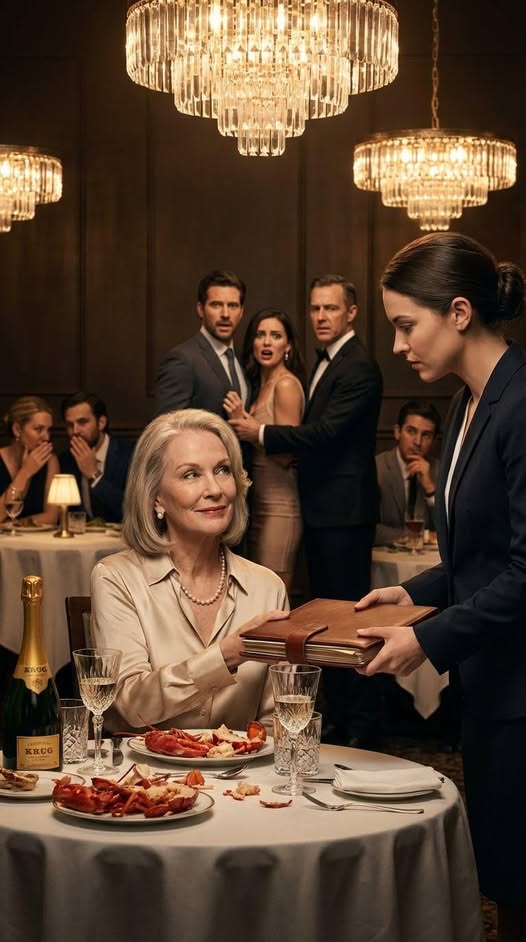
The scene was a study in sudden abandonment. The velvet-cushioned chairs were pushed back haphazardly, angled away from each other like people fleeing a crime scene. The wine glasses, expensive and delicate, stood half-drunk, catching the amber glow of the candlelight. My own bowl of wild mushroom bisque sat exactly where the waiter had placed it—steaming, fragrant, and entirely untouched.
But my son, James Dre, and his wife, Carly, were gone.
On the pristine white linen tablecloth, folded with a precision that felt surgical, was a single cloth napkin. It wasn’t tossed aside; it was positioned where my plate should have been. I walked toward it, my footsteps muffled by the thick, ornate carpet. The restaurant was a cathedral of high-end consumption, filled with the low hum of Manhattan’s elite, yet in that moment, I felt as though I were standing in a vacuum.
I reached out, my hand hovering over the fabric for a second longer than was strictly necessary. I didn’t touch it. Not yet. I looked around the room, feeling the sudden weight of eyes upon me. The couple at the neighboring table stopped mid-bite, their forks suspended in the air. A waiter lingered near the mahogany bar, his face a mask of professional uncertainty.
Then, the whisper drifted over from a booth nearby. “She’s still here.”
It hit me like a cold draft against bare skin—light, but cutting. It was the sound of pity, and in my sixty-seven years, I had learned that pity is often just a polite form of contempt.
I finally picked up the napkin. Scribbled in Carly’s slanted, aggressive handwriting were four words that felt like a slap delivered in silk: Enjoy dinner, love birds.
I stared at the ink until the letters began to blur. I didn’t cry. I didn’t reach for my phone to demand an explanation. I simply tucked the napkin into my leather clutch and waited.
The waiter finally stepped forward, clutching a slim leather folder against his chest like a shield, and I knew before he spoke that the “gift” of this dinner was a trap I had already walked into.
My name is Evelyn Dre. I am a woman defined by the quiet labor of thirty-eight years in the public school system. Thirty of those years were spent behind the scarred oak checkout desk of the Franklin Ridge High School library. I am a creature of order, of late fees, of whispered “shhh’s,” and of the firm belief that every debt must eventually be settled.
I raised James alone. His father vanished when the boy was seven. There was no dramatic confrontation, no cinematic goodbye note left on the fridge. There was only the sudden, echoing silence where a father’s promise used to be. I filled the gaps of his absence with double shifts at the library, with meticulously packed lunches, and with long nights spent folding laundry beside his intricate science projects.
We didn’t have much, but James never went without. I never missed a parent-teacher conference. I never showed up to a birthday party empty-handed. I am not the kind of woman who drapes herself in designer scarves or carries the sort of handbags that require a five-year waitlist. I wear what is clean, what fits, and what is appropriate for a woman who has spent her life among the dust of old books.
When James brought Carly home for the first time, I tried. I really did. She is a woman made of glass and sharp edges—polished, efficient, and constantly scanning a room for something shinier than what she currently holds. I would offer to help with family dinners, and she would inform me, with a smile that never reached her eyes, that everything was “handled.” I would bring flowers from my garden, and she would leave them in their brown paper sleeve on the counter until they wilted.
It wasn’t that she was unkind; it was that she was transactional. She didn’t want a mother-in-law; she wanted a spectator for the life she was building.
Slowly, the exclusions began. I would hear about birthdays after the cake had been eaten. I would see photos on Instagram of holiday gatherings I hadn’t been invited to. Once, when Carly mentioned how exhausted she was with the new baby, I offered to babysit for the weekend. She smiled that practiced, hollow smile and said, “We’ve got a professional service already, Evelyn, but thank you.”
The “thank you” was delivered the way one thanks a mailman for a bill. It was a dismissal. They weren’t just pretending I didn’t belong anymore; they were daring me to notice.
And tonight, this invitation to The Veridian Grove—the city’s most exclusive reservation—was supposed to be an olive branch. James had called three days ago, his voice rehearsed. “Carly wants to treat you, Mom. It’s overdue. She got a bonus at work and wants to celebrate.”
I had looked at the calendar on my kitchen wall, at the empty squares of my retired life, and said yes. I always say yes.
But as the waiter opened the leather folio and revealed a bill for seven hundred and ninety dollars, I realized that the only thing being celebrated tonight was my son’s final move to write me out of his life.
“$790,” the folio read.
I didn’t blink at the number. I have lived on a librarian’s pension; I know the value of a dollar. What rattled me were the line items. The Osetra Caviar appetizer. Six small plates of artisanal tapas I hadn’t even tasted. The Dry-Aged Ribeye. The Grand Seafood Tower. Two signature cocktails. And the crowning insult: a bottle of 1998 Krug Champagne, priced at $148 on its own.
Carly had been smiling far too much when she ordered that bottle. She had poured me half a glass, toasted to “family,” and then waited for me to excuse myself so she could make her exit.
“Would you like me to process this now, ma’am?” the waiter asked, his voice low, his eyes avoiding mine.
“No,” I said. My voice was as steady as the silence in a library at midnight. “Not yet.”
I looked up at him. “Could you do me a favor? Could you ask the manager to come by for a moment?”
He hesitated, perhaps expecting a scene, a plea for a discount, or a tearful admission that I couldn’t afford the steak I hadn’t eaten. “Is there a problem with the service, ma’am?”
“No,” I replied, adjusting the sleeve of my neatly pressed blouse. “Just tell him that Evelyn Dre is here. And please, tell him I’d like to speak with him about a particular… standard of guest conduct.”
He nodded, a half-bow of confusion, and disappeared into the labyrinth of the kitchen.
I stayed seated. I didn’t reach for my phone to see if James had texted. I didn’t check the parking lot to see if their car was still there. I simply watched the candle flicker in the center of the table—steady, low, and persistent.
The dining room continued to hum around me, but the air felt different now. The pity was being replaced by curiosity. I wasn’t the woman who had been left behind; I was a woman who was waiting for something they didn’t see coming.
The kitchen doors swung open, and the manager didn’t come alone. He was followed by a woman whose silhouette I recognized instantly, even in the dim, atmospheric lighting.
The woman who stepped out from the kitchen didn’t walk with the frantic energy of a floor manager. She moved with a relaxed, quiet authority that commanded the room. Her eyes scanned the tables until they landed on mine, and her expression immediately softened into something far more genuine than a professional greeting.
“Evelyn,” she said, her voice warm and rich. “I wasn’t told you were dining with us tonight.”
“Hello, Juliet,” I replied, standing to greet her. “It’s been a while.”
Juliet Reyes was the Vice President of Operations for the entire Vanguard Restaurant Group, which owned eleven of the most prestigious venues in the city. We had known each other for five years, ever since I had helped her daughter navigate a difficult research project for her senior thesis at Franklin Ridge. I had spent months in the library with that girl, teaching her how to vet sources and structure an argument. Juliet had never forgotten it.
The manager hovered nearby, his eyes darting between the $790 bill and the woman who effectively signed his paychecks. Juliet nodded him away with a sharp flick of her wrist.
She sat across from me, her attention entirely focused. “They said you were dining with family.”
“I was,” I said, sliding the leather folio toward her. “For most of the evening.”
I reached into my purse and placed the folded napkin—Carly’s note—beside the bill. Juliet read the itemized charges first, her jaw tightening as she saw the champagne and the seafood tower. Then, she unfolded the napkin.
Her expression shifted from surprise to a cold, simmering anger. “Enjoy dinner, love birds,” she whispered.
“I’m so sorry, Evelyn,” she said, her voice trembling slightly. “I can have this entire bill removed immediately. This is a disgrace.”
I shook my head. “No. I’m going to pay it. Every cent.”
Juliet looked at me, startled. “Evelyn, they ordered this with the express intent of leaving you with the debt. You shouldn’t have to—”
“I’ll pay for it,” I said evenly. “Because that’s what makes it count. I was raised to believe that you pay your own way, and tonight, I am paying for the privilege of knowing exactly where I stand with my son.”
I took out my credit card and placed it on top of the bill. Juliet studied my face for a long moment, then nodded slowly. She understood the ledger of the heart as well as I did.
“All right,” she said. “If that’s how you want to handle it.”
She signaled the manager to process the payment. As the card was swiped, Juliet leaned in, her voice dropping to a conspiratorial whisper. “You know, Evelyn, our group has a certain… protocol. We share a network with the other privately owned houses in the city. We have standards for our guests, just as we do for our staff.”
She pulled a small, sleek tablet from the pocket of her blazer.
“When a guest displays repeated cruelty, or a pattern of behavior that crosses a line of basic human decency, we add their names to a shared list. A restricted registry. It’s not public, but once you’re on it, you’re not welcomed at any of the eleven venues we control. No reservations. No corporate events. Not even a walk-in at the bar.”
I looked at the tablet, then at the empty chairs where James and Carly had sat.
“They live for these places, Juliet,” I said quietly. “Carly’s entire social standing is built on where she is seen eating.”
“I know,” Juliet replied. “And I don’t want to assume anything, but if you want… I can add James and Carly Dre to that list right now. For ‘Guest Conduct Violation: Intentional Fraud and Harassment of an Elderly Patron.’”
I sat there, the silence of the library returning to my soul, letting the decision rise through me not from a place of rage, but from a place of final, chilling clarity.
“Yes,” I said. “But don’t tell them I asked.”
Juliet didn’t smile. She just gave my shoulder a gentle, supportive squeeze and tapped a series of commands into her tablet. “It’s done. They are effectively invisible in this city’s dining scene as of five minutes ago.”
I signed the receipt, added a generous tip for the waiter who had been caught in the crossfire, and picked up my coat. I walked out of The Veridian Grove without looking back.
Two days passed in a heavy, expectant silence. I went about my week as I always did—groceries on Wednesday morning, garden club on Thursday afternoon. My life moved in small, steady circles.
Then, on Friday morning, the first crack appeared.
A text message came through from Carly. No apology, no explanation. Just a jagged, defensive barb: Hope the soup was worth it, Evelyn.
I stared at the screen for a moment, then locked my phone and set it face-down on the kitchen table. I didn’t respond.
That evening, James sent his own version. Next time, don’t order the steak if you can’t handle the mood, Mom. We were just trying to have some fun.
Still, I said nothing.
What they didn’t know was that Carly had a standing brunch reservation for that Saturday at The Gilded Lily, another restaurant in Juliet’s group. She had been talking about it for weeks—it was a “high-society” event she was using to network for her promotion.
I heard about what happened from Lisa, my neighbor’s daughter, who worked the front of the house there. Carly had arrived in a new dress, entourage in tow, only to be told that her reservation had been “canceled due to an administrative flag.” When she tried to argue, the manager—having already received the alert from the network—had politely, but firmly, asked her to leave the premises.
By Saturday night, James tried to book a table for their anniversary at Marche, the list-topper Carly had been circling in magazines for months. Declined.
On Sunday, Juliet texted me directly: They’ve tried four different venues. They’re starting to panic. Apparently, Carly thinks there’s a glitch in the software.
I looked out my window at the shadows lengthening across the lawn. The windchime on my porch stirred in a soft breeze. The world was still.
I picked up my phone, typed two words—Thank you—and hit send.
I didn’t need a front-row seat to their frustration. I just needed to know that for once, the debt was being paid by the people who had actually incurred it.
Carly called on Wednesday afternoon. Her voice was no longer polished; it was clipped, vibrating with a desperate, suppressed fury.
“Let’s have dinner,” she said. “Just the three of us. Let’s clear the air, Evelyn. Obviously, there’s been a massive misunderstanding about the other night.”
“I’d like that,” I said, my voice as calm as a summer pond.
“We’ll go to Bistro Noir,” she said. “Friday at seven. We’ll handle the reservation.”
“I’ll be there,” I replied.
Friday came. I arrived at Bistro Noir five minutes early. I wore the same slacks, the same polished shoes, the same neat blouse. I was greeted by the host, who checked his list and led me to a small, elegant table by the window. I ordered a glass of water and waited.
At 7:05, James and Carly stepped through the front doors. He wore a sharp charcoal blazer; she was in a pale silk dress, her eyes darting around the room to see who was watching. They looked exactly as they wanted to be seen: successful, important, and in control.
The host smiled at them, took their name, and scanned his tablet. Then, his expression changed. He checked the screen again, straightened his tie, and looked up with a mask of cool, professional regret.
“I’m sorry,” he said, his voice carrying just enough to reach the neighboring tables. “But you are not permitted to dine here.”
Carly blinked, her mouth dropping open. “Excuse me? I made this reservation three days ago. Check again. Under Dre.”
“I have the name,” the host said. “But your account has been flagged across our entire network for ‘Conduct Violations.’ I’m afraid I’ll have to ask you to leave the premises immediately.”
James stepped forward, his face flushing deep red. “There must be a mistake. We were invited here. My mother is already sitting at that table.”
He pointed toward me. I didn’t wave. I didn’t smile. I simply sipped my water and watched.
The manager appeared beside the host, his arms crossed. “No mistake, sir. We maintain a high standard for guest conduct. Unfortunately, you no longer meet those requirements. Please move along, or I will be forced to call security.”
Carly turned toward me, her voice rising to a shrill pitch. “Did you do this?! Evelyn, did you do this to us?”
I set my glass down. The room was silent now. Every diner in the bistro was watching.
“You made the reservation, Carly,” I said. “I just showed up. Isn’t that what we agreed on?”
James’s jaw tightened. He looked at the manager, then back at me, the realization finally beginning to dawn in his eyes.
“Come on,” James whispered to Carly, grabbing her arm. “Let’s go.”
They turned and walked out, their exit accompanied by the soft, rhythmic clink of silverware as the rest of the room went back to their meals.
I watched the doors close behind them, feeling the weight of thirty years of folding laundry and packing lunches finally lift from my shoulders. But the conversation wasn’t over yet.
They were waiting for me just outside the entrance, standing under the glow of the streetlamp. Carly moved first, her heels clicking sharply against the pavement.
“You’ve ruined everything!” she hissed, her face contorted with a brittle, ugly rage. “Do you have any idea what this does to my reputation? I can’t take clients anywhere! My corporate account is dead! Why would you be so petty?”
I stopped and looked at her. I didn’t see a daughter-in-law; I saw a woman who didn’t understand that actions have consequences that cannot be smoothed over with a smile.
“I’m not being petty, Carly,” I said evenly. “I’m being thorough. I spent thirty years ensuring people returned what they borrowed. You borrowed my time, my love, and my dignity, and you thought you didn’t have to pay it back.”
James stepped between us, his hands lifted as if to slow traffic. “Mom, this is too far. Whatever you’re trying to prove, it’s gone far enough. We’re family.”
“Family,” I repeated. The word felt hollow. “Is that what we were at The Veridian Grove? When you watched me walk to the restroom and then ran for the door? Was I family when you left that note on the table?”
James looked away, his gaze falling to his shoes. “It was just a joke, Mom. We thought you’d just… call us and we’d laugh about it.”
“No,” I said. “You thought I would be invisible. You thought I would be the same quiet woman who always says yes, who always pays the bill, who always fades into the background so you can feel important. But I’m a librarian, James. I know how to read between the lines.”
“So, what now?” Carly demanded, her arms crossed tightly. “You’re just going to keep us locked out of every restaurant in the city?”
“I’m going to do nothing,” I said. “The list is permanent. The distance between us is yours to manage now. I’ve already settled my account.”
I stepped around them and started toward my car.
“Mom!” James called out.
I didn’t look back. I didn’t need to see his face to know what he was feeling. He was feeling the shock of being denied something he had always assumed was his by right: my silence.
I drove home in the quiet of the evening, the city lights reflecting in my rearview mirror like a story that had finally reached its last page.
A week passed before I saw him again. James knocked on my door just after lunch on a Thursday. There was no call ahead, no warning.
I opened the door and let him in without a word. He looked different—his blazer was gone, his hair was messy, and he had the tired, slumped posture of the little boy who used to come home after losing a soccer match.
He sat at the kitchen table where he had done his homework for a decade. I poured two cups of tea, the way I always had.
“Carly’s still upset,” he said, staring at the steam rising from his mug.
“Are you?” I asked, sitting across from him.
He hesitated, then let out a long, ragged sigh. “I just don’t get why you’d go this far, Mom. It feels like you’re trying to punish us for moving on with our lives.”
“I’m not punishing you for moving on,” I said quietly. “I’m holding you accountable for how you treated the person who helped you get there.”
I reached into the drawer of the hutch and pulled out the $790 receipt from The Veridian Grove. I laid it on the table between us.
“You chose to leave me at that table, James,” I said. “I simply chose not to follow you.”
He looked at the receipt, then at his hands. “It wasn’t supposed to be serious.”
“Betrayal is always serious,” I said. “Even when it’s wrapped in a joke.”
He didn’t argue. He didn’t apologize. And for the first time, I didn’t ask him to. I didn’t tell him about Juliet or the shared network. I didn’t explain how many favors I had done for people who thought I owed them my silence.
I let the quiet do the work.
He stayed for twenty minutes, mostly talking about the baby and his work. When he stood to leave, I walked him to the door. There was no hug, no bitterness, just a space between us that was finally honest and intact.
After he left, I walked back to the kitchen, opened the drawer where I keep my tax returns, and slid the $790 receipt in between the manila folders.
I never wanted payback. I just wanted something simple: proof that I still had worth.
I sat down, picked up my tea, and looked out at my garden. The lilies were starting to bloom, white and resilient against the spring wind. I had been a librarian for thirty-eight years, and I knew one thing for certain: a story is only as good as its ending.
And mine? Mine was finally written in my own hand.